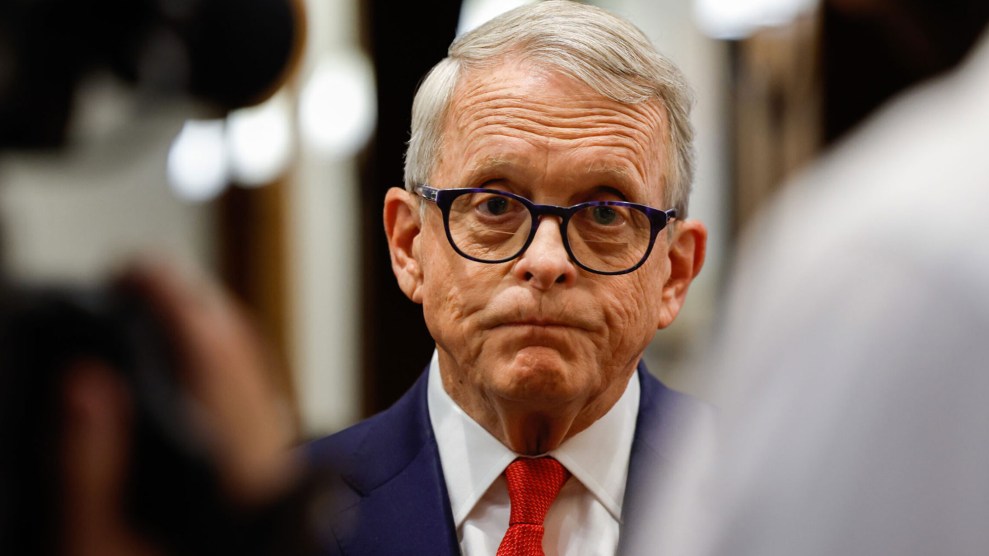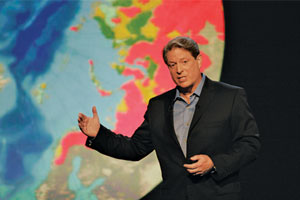
Photo: G.S. Callendar: University of East Anglia/G.S. Callendar Archive: Al Gore: Participant Media: Carter: Bettmann/Corbis
1800: At the dawn of the industrial revolution, planet’s CO2 concentration is around 280 ppm—38% lower than today.
1896: Swedish chemist Svante Arrhenius publishes first study tying CO2 emissions to fossil fuels.
1937: University of Wisconsin geographer Glenn Trewartha helps coin the term “greenhouse effect.”
1938: English engineer G.S. Callendar asserts that CO2 increases are warming the planet, suggests this will make cold areas more habitable.
1958: Scientists begin to track CO2 levels and soon observe increases. First official studies show level at 315 ppm.
May 30, 2004: Climate change dystopia The Day After Tomorrow released; will bring in more than $544 million.

December 7, 2004: Michael Crichton’s State of Fear, which features climate change as environmentalist hoax, published; Bush reported to have “avidly read” book.
February 16, 2005: Kyoto Protocol goes into effect for 130 countries.
May 2005: Mother Jones reveals ExxonMobil spent more than $8 million from ’00 to ’03 funding climate change deniers.
December 8, 2006: Inhofe’s Senate committee releases 68-page “A Skeptic’s Guide to Debunking Global Warming Alarmism.”
1960: Soviet Union publishes essay titled “Man Versus Climate” that advocates deliberate planet heating to unthaw Arctic and boost farm output.
April 22, 1970: First Earth Day. US National Oceanographic and Atmospheric Association (NOAA) created 5 months later.
1975: National Academy of Sciences report warns of “serious worldwide cooling” in the next 100 years, sparking fears of new ice age.
July 1981: A young US represent-ative from Tennessee, Albert Gore Jr., organizes climate change hearing on Capitol Hill. Media attendance sparse.
January 2007: New House Speaker Nancy Pelosi creates climate change committee.
2007: IPCC releases fourth report, concluding again that global warming is caused by humans.
May 7, 2007: Three decades ahead of projections, scientists report record lows in Arctic summer ice.
October 12, 2007: IPCC and Al Gore awarded Nobel Peace Prize.
December 15, 2007: Papua New Guinea’s delegate tells US reps at Bali climate negotiations to step up or “get out of the way.”
1985: Scientists at Villach conference in Austria reach consensus that global warming is happening and international treaties needed to curb emissions.
1988: UN-led Intergovernmental Panel on Climate Change (IPCC) is established to assess state of knowledge on climate change.
February 1, 2008: ExxonMobil reports $40.6 billion profit—the largest for any US company ever.
February 2008: An iceberg bigger than Manhattan breaks off the Wilkins Ice Shelf in Antarctica.
1989: National Association of Manufacturers along with oil and auto companies form Global Climate Coalition to fight carbon restrictions.
1992: At Rio Earth Summit, US blocks calls for serious action; President George H.W. Bush declares, “The American way of life is not negotiable.”
1995: UN-led international climate negotiations begin.
December 11, 1997: First global climate treaty, Kyoto Protocol, adopted.
November 12, 1998: President Bill Clinton signs the Kyoto Protocol, a symbolic gesture; Senate has already rejected it 95-to-0.
March 2001: President George W. Bush withdraws US from Kyoto treaty.
2001: Hottest year on record.
July 28, 2003: US Sen. James Inhofe (R-Okla.) says on Senate floor that global warming is “the greatest hoax ever perpetrated on the American people.”
Summer 2003: Heat wave hits Europe; 35,000 die.
April 2008: Hansen warns that a CO2 concentration over 350 ppm isn’t compatible with “a planet similar to that on which civilization developed and to which life on Earth is adapted.”
2008: Ties 2001 as hottest year on record.
February 1, 2009: NOAA finds that effects of climate change will be “largely irreversible” for more than 1,000 years after emissions stop.
June 26, 2009: American Clean Energy and Security Act, a.k.a. Waxman-Markey bill, passes House.
2009: Conservative Washington Post columnist George Will pens several syndicated pieces saying planet is actually cooling; readers, scientists go ballistic; Post reporters so embarrassed, they debunk claims in paper’s news pages.
April 2009: Global CO2 concentration reaches 387 ppm, projected to reach 866 ppm by century’s end if unchecked.
December 7-18, 2009: Nations to meet in Copenhagen to negotiate successor treaty to Kyoto Protocol.