MOTHER JONES BY E-MAIL

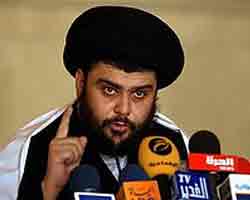
Who Is Iraq's "Firebrand Cleric"?

Interview: From Baghdad, veteran Middle East correspondent Patrick Cockburn explains why Muqtada al-Sadr is no maverick.

March 31, 2008


TOOLS

EmailE-mail article
PrintPrint article


BACKTALK

E-mail the editor


Google


"Interview in Baghdad," "Interview in Najaf," "Interview in Basra," "Interview in Amara": The endnotes at the back of Middle East correspondent Patrick Cockburn's new book read like an atlas of Iraq. Such is the depth of reporting in Cockburn's Muqtada: Muqtada al-Sadr, the Shia Revival, and the Struggle for Iraq, a political biography-cum-war chronicle due out April 8.

As the U.K. Independent's correspondent, Cockburn has spent about half of the last five years reporting, unembedded, around Iraq, a country he's been visiting since 1977. His subject is the real Iraq, and Iraqi voices predominate in his work. British and American officials rarely appear in the book. (He assiduously avoids the U.S. military's Green Zone press briefings.) When Cockburn does give airtime to the official line, he's usually debunking it. It was this irreverent attitude that got him barred from entering Iraq in the late 1990s when the regime was displeased with Out of the Ashes: The Resurrection of Saddam Hussein, a collection of Iraq reportage focusing on the aftermath of the Gulf War, which Cockburn wrote with his brother. In Muqtada Cockburn both explores the rise of al-Sadr, undoubtedly one of the most important men in Iraq today, and traces the disintegration of Iraq through five years of American occupation.

After several failed attempts, I reached Cockburn by phone at the Al-Hamra Hotel in Baghdad March 17, just before the start of the recent fighting in Basra. In between broken connections and over the loud whir of a military helicopter above the hotel, I asked him what al-Sadr's role will be in the future Iraq and if, on the fifth anniversary of the invasion, he sees any reason for hope.

Mother Jones: In the beginning of your book, you write that Muqtada al-Sadr leads "the only mass movement in Iraqi politics." Can you elaborate on that, especially given that in the American media we still hear more about the official Iraqi government than some of these other factions?

Patrick Cockburn: It's always sort of amazing, sitting here in Baghdad, to watch visiting dignitaries—today we had Dick Cheney and John McCain—being received in the Green Zone by politicians who have usually very little support and seldom go outside the Green Zone. Muqtada leads the only real mass movement in Iraq. It's a mass movement of the Shia, who are 60 percent of the population, and of poor Shia—and most Shia are poor. Otherwise the place is full of sort of self-declared leaders, many of whom spend most of their time outside Iraq. You know, if you want to meet a lot of Iraqi leaders, the best places are the hotels in Amman or in London. In general the government here is amazingly unpopular.

MJ: What are the roots of his credibility among the people?

PC: Muqtada belongs to the most famous religious family in Iraq, which is the al-Sadr family. He's really the third in line. [Muqtada's father] drew his power from the first really important al-Sadr, Muhammad Baqir, who was executed by Saddam in 1980, together with his sister. So it's really a family of martyrs, and that's why Muqtada suddenly emerged from nowhere with the fall of Saddam. If you had passed around a picture of him in Washington at the time of the overthrow of Saddam, I doubt if any of them would have heard of Muqtada.

MJ: Did anyone outside or inside the country predict Muqtada's rise?

PC: No, absolutely not. His father was dead along with two of his brothers, assassinated by Saddam in 1999. His father-in-law had been executed. He was under sort of house arrest in Najaf and was just within inches of getting executed himself. So everybody—those who knew the family history—thought that the whole organization had been destroyed. What Muqtada had going for him was that he had been a senior lieutenant of his father, so he had street experience of politics from the 1990s. Also he had a sort of core of people who revered him who were politically experienced, and he brought this together very fast just in the days after the fall of Saddam.

His father was a very interesting character because he's almost the only person who persuaded Saddam to trust him. Saddam thought it would be a really smart political move after the great Shia uprising of 1991 if he could have his own Shia religious leader who'd be in his pocket. So he chose this guy, Muqtada's father, who came from the right family. Muqtada's father used this to promote a mass movement. And then at the last movement Saddam discovered he had been fostering this extremely dangerous enemy, who was refusing to use Saddam's name when he called for prayers, so Saddam had him murdered in Najaf.

MJ: Is the Western media epithet for Muqtada as the "firebrand cleric" accurate?

PC: The idea that he's a maverick is 100 percent contrary to his track record over the last five years. In fact he's very cautious, never pushing things too far, trying not to be pushed into a corner. [L. Paul] Jerry Bremer tried to arrest Muqtada and ignited a tremendous uprising over most of southern Iraq in 2004. You could see all these Americans in the Green Zone had completely failed to realize the kind of support he could get. They announced they were going to arrest him and suddenly the whole of southern Iraq erupted and Bremer [couldn't] control it anymore—but Muqtada did. Then there was a big siege of Najaf. But Muqtada always sort of looked for a way out. So the idea of him as a maverick cleric, a firebrand, is one of these absurd journalistic clichés that takes on a life of its own, despite the fact that its contradicted by everything that happens.

MJ: Another thing you see is journalists frequently describing him as a "radical cleric." Is there anything radical about al-Sadr?

PC: Well, it's slightly more accurate. He's radical in the sense that he wants the U.S. occupation to end and has always said so from the beginning. Secondly, his support among the Shia really runs along class lines; it's mainly the poor who support him. His organization runs an enormous social network. Despite the fact that there's billions of dollars sitting in the Iraqi government reserves, somehow they are incapable of getting it out to the people. There are a very large number of people here who are on the edge of starvation. For those sort of people—a sizable chunk of people—that service makes them regard Muqtada as a sort of god.

Another thing is that he's always been able to call on a core of young men. Young Shia who have been brought up with nothing, who are pretty anarchic, pretty dangerous. My book begins with a run-in I had with them in 2004 when they came close to killing me, and of course they have killed very large numbers of other Iraqis. That's a major source of strength for Muqtada.

MJ: You write that from the U.S. perspective, Muqtada looks too much like a younger version of Ayatollah Khomeini. Is there anything to that?

PC: There's an element of truth to it. But from the moment George Bush decided to overthrow Saddam, the people who were going to benefit here were the Shia, who are 60 percent of the population. So if you were ever going to have an election, then the Shia would take over. An awful lot of the American problems in Iraq over the last five years come from the U.S. thinking that in some way it can devise a formula here that Saddam would be gone and the Shia religious parties—guys who look a bit like Khomeini, not just Muqtada, but all the other clergy—wouldn't take over. The U.S. never found it. I don't think it's there.

MJ: So if the Democrats win the election in the United States, and they make good on their promise to pull out or mostly pull out from Iraq, what role would al-Sadr play in that scenario?

PC: A very critical role. Here is sort of the biggest Shia leader with the most popular support. If there were elections tomorrow he would probably sweep Shia Baghdad and most of the south. He's not going to take over the whole of Iraq because Iraq is such a divided place these days. The Kurds are never going to let the Arabs take over their chunk, and the Sunni are going to fight like tigers to keep the Shia from taking over their areas.

MJ: What would an Iraq under al-Sadr look like?

PC: I don't think the whole of Iraq would be under al-Sadr, but I think he would be the predominant force on the Shia side. Quite contrary to his sort of maverick, firebrand image, he's shown a propensity to deal with the other side, to look for compromises, to negotiate. You might have a loose federation [in Iraq]. There are some things that could hold it together, notably oil revenues. But at the moment, the much vaunted surge has had a measure of success primarily, to my mind, because Sunni and Shia Iraqis hate and fear each other more these days than they hate and fear the Americans.

MJ: You write in the book that the U.S. as well as Iraqi politicians habitually fail to recognize the extent to which hostility to the occupation drives Iraqi politics. How much of al-Sadr's popularity do you ascribe to him speaking against the occupation?

PC: I was doing a lot of interviews today with ordinary Iraqis, and they all bring it up, the question of the American occupation. The latest opinion polls show that seven out of ten Iraqis want foreign forces to leave Iraq, and most want them to leave now. One of the problems of the Iraqi government sitting in the Green Zone [is that] being associated with the occupation taints them and reduces their authority. Lots of people you talk to here, particularly Sunni, don't just say "the government," they say "the traitor government." In some ways this is extremely simple and obvious. There are very few countries in the world that welcome being occupied. And it's sort of strange that this very obvious fact—which has probably been a critical fact for why the U.S. is in such trouble here—has never really penetrated Washington.

MJ: In your piece marking the fifth anniversary of the invasion, you describe Iraq as "a collection of hostile Sunni and Shia ghettoes divided by high concrete walls." That's a pretty grim picture. Do you see any reason for optimism on the horizon?

PC: Well, not greatly. Because it seems to me that all the things that have led to the violence are still there. The current situation reminds me of the war in Lebanon, which went on really from the mid-70s to 1990. You had periods where there was kind of an unstable balance of power. Baghdad has the same feeling at the moment. Sunni and Shia aren't coming together; they don't go into each other's areas. The Sunni-Shia dispute, the Arab-Kurd dispute, the Iraqi-American dispute—none of these things are resolved and any of them could ignite at any moment, and almost certainly will.

One of the problems with the media covering this place is that there are stereotypes of news, one of which is "war rages" and the other is "peace dawns." And there isn't much in between. When I talk to foreign journalists, often they are gritting their teeth because they've been asked for a piece about how shops are reopening and restaurants are reopening and so forth—happy pieces. And it just ain't so.

Justin Elliott is an editorial fellow at Mother Jones.


Post a Comment

Your Name: 

Your Comment: 
 
Please press "Submit" only once to avoid double-posting.
All HTML formatting is removed from comments.
Read the Mother Jones community rules here.

Comments:

I have trouble believing I'm the first comment. PBS documentary "Bush's War” has Bush and Rumfield at least toying with the idea of winning and getting out. Some people hollered at other emails I wrote asserting this. But at any rate Bush refusing to betray his friend Maliki and negociate with al Sadr must be a factor in the war continuing.

Iran would probably be happy to offer Maliki and his supporters safe-haven in Iran plus a stipend in return for the US leaving.

Bush, after Sunniis turned in al Qadea kingpin Zarqawi to the CIA, offered them peace talks but so many Sunniis died after the last cease fire in Fuluja, summer 2006, that al Jeelani was afraid to agree and demanded the release of 5000 detainees as a good will gesture to prove the US was serious before agreeing to talks. In 2006 John Kerry, campaigning for President, complained of terrorists hiding in Fuluja. Bush them demanded al Sadr's arrest who was in Fuluja in solidarity with the Sunniis. Ocober 2006, Fuluja was turned into total rubble while the rest of Iraq was all but ignored.

If we could have protests demanding that the US negociate with al Sadr, and such hawks as Senator Specter address the crowd in agreement, the war would be over.

Come on fellow Americans; none of us are paying any attention to what's going on over there thus all of us, Doves and Hawks alike, can only mess things up as long as don't pay attention to what's going on.
Posted by:RichardKanePA@aol.comApril 1, 2008 2:41:53 PMRespond ^
There's no way the U.S. will ever openly negotiate with al Sadr. It might be wise and even in our best interests to, but domestically it's not politically possible. The only way it could happen IMO is that a deal could be made through some intermediary who has the political gravitas to appear to be able to stand on his own but who has made a deal with Muqtada. I don't pretend to have any idea to know who would potentially be in this position, however.

A cynic might think that the Bush administration's current policy is to arm the Sunnis so that things really go to hell once the newly elected Democratic president starts to pull our troops out. That way, much like after Vietnam, the right can blame the left for the unfolding disaster they have in reality themselves wrought. All for domestic politics, of course. Such is the sickening blight of Empire.

However, it might also be the case that a kind of balance of power is (inadvertently) being created, and if some basic security can be had on all sides, maybe some sort of stable government can emerge without widespread bloodshed. From the current situation, this would require a timetable to U.S. withdrawal. This would force all sides to come to the table to make a deal.

The real shame of the current situation is that Muqtada IS an Iraq nationalist and, if Cockburn's estimation of him is right, he would be the kind of figure who could be motivated to make a deal with the Sunnis. His reputation as a murderer of the Sunnis, however well-earned, would seem to argue against this possibility however.

It will be interesting to see how the Iraqi elections affect our elections this fall. I think there might be an explosive interaction between the two, with most of the fall-out being felt domestically. That could be one explanation of what just happened in Iraq - maybe the right realizes the an al Sadr victory would propel the democrats to the White House. If the Iraqis elect a party whose main platform is an end to occupation, McCain would be toast.
Posted by:Bill StearnsApril 1, 2008 10:36:59 PMRespond ^
Hey People,

What needs to be done is to surround they whole area with the army 3rd division with tanks... Send in the marines and clear house to house. WHen you get to the middle and have the little roaches trapped, let the tanks do there work..!!! KILL the leader and anyone left..

Bill..
Posted by:Bill NighApril 2, 2008 9:58:01 AMRespond ^
Richard, I'm surprised you weren't believed when you asserted Rumsfeld wanted to get out of Iraq quickly. It makes sense. The neocons thought they could go in, collect the flowers and candy, and leave as the happy Iraqis waved bye-bye as they looked forward to their radically privatized economy. The mere fact they got stuck was a sign of failure, and they knew it, but they weren't willing to leave until they had Iraq running they way they wanted it. I recall vividly how Iraq had barely fallen, and they were rattling their imaginary swords (real swords are for the poor schlubs stuck doing actual fighting) at Syria, thinking they could just keep going from Baghdad on to Damascus, Tehran, and who knows where else. So yes, Rumsfeld did want to get out of Iraq, because he and Wolfowitz and AEI hadn't thought a minute past pulling down Saddam's statues.
Posted by:Eric FergusonApril 2, 2008 10:21:32 AMRespond ^
If ever there was a cogent argument for getting out - and getting out now - this was it. How long will U.S. forces keep their fingers in the dike? Once we leave, all hell will probably break loose, and that will be true today as much as ten years from now (and anyone who thinks we can afford to stay 10 years at this level, militarilly, economically etc. let alone McCain's 100 years, needs to have their head examined). We need to get out and stop acting as the American octopus holding back half a dozen sides from killing each other. If the Iranians think they will annex an American-free southern Iraq, they don't understand the nationalistic/tribal identity of southern Iraq nearly as well as they think they do. The Saudis will not allow the mid-Iraq Sunnis to be pushed aside; they're too worried about Iran knocking on their door for that. The kurds will have enough to do defending their own northern territory to bother Turkey (who is our NATO ally, in case anyone has forgotten). As for the predictable bloodbath that will ensue until a new strongman, Al-Sadr or someone else, takes the helm from Saddam's ghost, in the Immortal Word of Dick Cheney, "So?" Our enemy is Al-Qaeda, not Iraq or any of the factions in it except Al-Qaeda - and they are NOT going to get control of Iraq. Even if they did, they would be easy to topple, just as it was easy to topple the Taliban. It was the rebuilding part that got screwed up.
Posted by:Scott BakerApril 2, 2008 1:42:21 PMRespond ^
I think it is possible for the government to negotiate with al-Sadr, but to do it, the American people needs another government because the present one lacks what it takes: intelligence, flexibility and humanity (Nixon's trip to China showed it is possible to do this even when all of the above elements are not present). Hm, Bill Nigh, no wonder why the world is so frightened of the US: it is full of whackos like you. Yours is a case of flagrant and shameless misuse of public funds. You see, your government has spent several thousand dollars in your education, and look at the results! It is like one of those toilets the Pentagon has contracted to be built at a shocking price, but the moment somebody sits to do what he/she has to do, something terrible like pipes bursting happens. Surround the roaches and kill them all? Interesting perception the ordinary American has about those who are not like them? Including women and children, Mr. Nigh?
Posted by:JimApril 2, 2008 5:04:38 PMRespond ^
Very refreshing to read an interview that is not the product of corporate media. How much we do not know due to the lack of genuine investigative reporting shows when these kind of interviews come out. I have read on other sites that the Maliki government is very weak because it does not reflect the wishes of the majority while Al Sadr does. I would like to ask, what has become of Al Sistani, once the powerful Shia cleric. No report on him for years now.
Posted by:RaymondApril 3, 2008 10:50:12 AMRespond ^
Very interesting indeed.
Posted by:Irene FaulkesApril 5, 2008 11:21:52 PMRespond ^
Bill, is that how it worked with your toy soldiers on the living room carpet? Yeah you can always go to the store and get more if you're short a few 100,000 men, right?
Posted by:PeterApril 7, 2008 9:19:49 PMRespond ^

Bill, is that how it worked with your toy soldiers on the living room carpet? Yeah you can always go to the store and get more if you're short a few 100,000 men, right?

======================================
Hey Peter,

I have thought since the evening of 9/11 that the first thing the president should have done was reinstate the "Draft". There would be NO shortage of soldiers if that had been done. We could have 1 million soldiers on the field if we had done this. Even many democrat senators and congressmen have stated that that is one thing that the president should have done.

Bill
Posted by:Bill NighApril 8, 2008 7:52:18 AMRespond ^
Bill Nigh,
Why are you not over there with your guns? Reinsert the draft? What part of individual liberty does that represent?
Ron Paul is correct, get the hell out of there as soon as possible. We simply can't control them and have no right to try. Shore up our defenses, guard our borders, apply our money to our needs and leave the world alone, politically.
Trade and dialogue with those who want it and intangling aliances with none. Freedom is not free, but forcing our version of life on others causes a resentment beyond reason. We would not,(I pray) tolerate such actions against our homeland, to violate other societies is counterproductive. If we have a fight against a group or government, then deal directly with them, not the populations they dictate too.
Posted by:MartinApril 8, 2008 1:51:21 PMRespond ^
I like to hear the truth about thingsjnone of the sugar coated news I watch
Posted by:Susan McBrideApril 8, 2008 4:32:28 PMRespond ^
WE ARE IN OUR LAST DAYS GIVE ME MONEY AND I WILL PRAY FOR YOU
Posted by:MichaelApril 9, 2008 9:06:46 AMRespond ^
Martin,

I don't think you understand the situation. The people in these countries deserve freedom and democracy, the same as you. It will take time for them to realize what they can have and that it is better than living under there twisted sharia, 12th century law. LIke i have said many times before, we should reinstate the draft, place 1 million soldiers in one end of the sand, and march to the other end. Then after we have killed as many of the terrorists as possible, make the area our 51st state, we get ALL the oil and everything is better.

But we NEVER do that, we will give it back to those little ingrates and let them screw us for generations to come.

It makes me sick..

Bill
Posted by:Bill NighApril 9, 2008 9:41:55 PMRespond ^
Wow, is this Bill guy for real?

Either his comments are purely here for show to rile up the supposed "lefties" or he's actually completely ignorant and thinks the best way to spread democracy is with the barrel of a gun. Make Iraq the 51st state? Lol, I haven't heard a statement so ignorant in years, thanks for giving me a good laugh Bill.

Anyways, guess I should stop feeding the trolls...
Posted by:DustinApril 12, 2008 4:40:02 AMRespond ^
I think he's Lumpy from Leave it to Beaver?
Posted by:joeyDApril 12, 2008 6:59:58 PMRespond ^
Bill, you make me sick
Posted by:joeyDApril 12, 2008 7:01:24 PMRespond ^

Jail.org - Inmate Search
Criminal records, instant public records & people search & current court records. www.jail.org

U.S. Public Records Search
Search County & State Court Records, Criminal records, Vital and Adoption Records www.PublicRecordsInfo.com

Records.com - People Search
Public Records and Background Checks. Instantly Search Criminal Records, Addresses and Court Records www.Records.com

Court Records & County Records
Find Instant Public Records, Criminal Records as Well as County Property Records Search. www.PublicRecordsIndex.com


bookIN PRINT

CLICK HERE
for more great reading

headphones IN TUNE
New music every issue

CLICK TO LISTEN


This article has been made possible by the Foundation for National Progress, the Investigative Fund of Mother Jones, and gifts from generous readers like you.

© 2008 The Foundation for National Progress

About Us   Support Us   Advertise   Ad Policy   Privacy Policy   Contact Us   Subscribe   RSS