- ‹ previous
- 265 of 2798
- next ›
Chart of the Day
Good news for haters of the nanny state: New York City's new law requiring calorie counts on chain restaurant menu boards doesn't appear to be making any difference. In fact, it might be causing people to eat more.
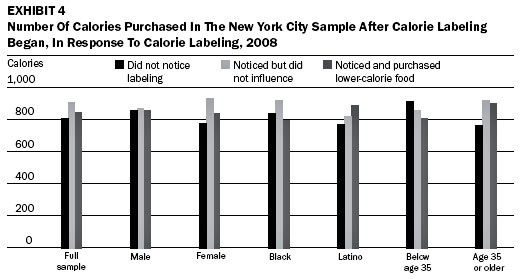
The full study is here. Results are below. The researchers chose 14 fast-food outlets in low-income NYC neighborhoods (Newark was a control group) and interviewed a few hundred people both before and after the calorie labeling law went into effect, asking them if they'd noticed the calorie counts
and if they'd changed their selection because of it. Then they got receipts from each respondent so they could find out what they'd actually purchased.
The results were pretty dismal: only about half the respondents even noticed the calorie counts and only 15% said they influenced their choice. But the receipts told an even more dismal story: overall, people actually purchased more calories after the law went into effect. The results aren't statistically significant, though, so basically all the researchers can really say is that the law (so far) hasn't had any effect. The only glimmer of good news is that among people under 35, respondents who noticed the labeling did seem to cut back a bit. No other subgroup showed any effect. So who knows? Young people probably respond to this kind of thing more quickly than older people, so maybe it's just going to take some more time before all this stuff sinks in.


It HAS influenced my
It HAS influenced my decisions. When I realized the tuna sub I often eat his 900 calories while the turkey is just 600, I started going with turkey.
The other night in Yankee stadium, I noticed that the beer I was drinking was almost 400 calories per glass. I had one less.
As someone who has calorie
As someone who has calorie counted for a long time, here's how it works. People know the daily limit is 2000 so if you have an 850 meal you can still have smaller meals later as long as you're underneath.
Today for instance i had an 864 meal, a 380 meal, and 700 meal. So that puts me at roughly 2000 though I did walk about a mile. So overall, a push for the day.
The skinny folks don't
The skinny folks don't notice. The less skinny folks do notice, but they don't all care.
Sometimes I try to find the most calories for the money. If I want fewer calories I might not go to the restaurant, share, or plan on having left overs. Anyway, the methodology is debatable.
This study focused on
This study focused on low-income areas because, it says, of "the increased risk of obesity and related health problems associated with low-income and racially/ethnically diverse populations".
So its results, as stated by Kevin, are misleading. What it found is that low-income people do not pay attention to what they eat.
Unfortunately, this is not news to anyone. Low-income people do a lot of things against their self-interest. They don't stay in school. They don't eat right for long-term health. And they don't vote. (Which is just fine with the Republicans, and is the reason they go after groups that try to change some of these behaviors).
So that's where the beef is in this study: low-income people do not act as rational consumers with a long-term horizon. Nothing wrong with the NYC food labeling law -- it is going to help a lot of people make better decisions, you can be sure of that.
Actually, the study as
Actually, the study as summarized didn't show anything close to the class war divisions you just projected onto it.
It could be, as B states above, that low income families are buying more calories for their buck. I've been known to do that to, to get me through a long day.
Rational consumers? Perhaps they're being perfectly rational but you're just being a dumbshit who doesn't understand their motivations? And you're a perfectly rational "consumer" yourself? Rational actor theory is so pre-bubble.
I appreciate your contempt.
The main point was that the
The main point was that the results of a study that focuses on one income group should not be presented as somehow applying to the whole population.
There may be different interpretations for the behaviors of different income groups, of course. You say that eating high-calorie foods makes sense for the poor because it is more economical -- more calories for your buck. Perhaps -- but note that the whole premise of the study is that the poor have increased incidence of obesity. (So they seem to consume more calories than they need, and more than other income groups).
As for the rest -- no contempt for low-income people was intended. Quite the contrary. Many sociologists who have studied the vicious cycle of poverty (especially among American blacks) have found that the main problem is the "culture of poverty" -- a sense of helplessness which leads poor people to live only for the moment, unable or unwilling to plan for the future. That's why they don't stay in school, eat healthy food or vote. (Or do you dispute these statistics?) Saying so is not a criticism of them -- it is a recognition of a social disease that society should confront. It is the conservatives who oppose this approach, in the name of "individual responsibility".
Obviously not all low-income people fit this mold, but if you do a study in low-income inner-city areas, chances are that is what you are dealing with. Trying to draw general conclusions of the general effectiveness of food labeling from such a study is obviously not meaningful -- regardless of your own interpretation of the reasons different income groups make different choices.
The reason I see it as being
The reason I see it as being valid to use this sub-group is that when these laws were sold, it was primarily to "benefit" poor people. That is, the legislators vouching for these laws said they would help poor people make "better" choices.
This did not happen. Thus the law, based on the criteria its proponents set forth, failed.
I would be interested in
I would be interested in seeing information about this law being promoted mainly to benefit the poor. Although the poor (especially blacks) are disproportionally obese compared to the rest of the population, the overall number of obese people primarily is not in this group -- because of different group sizes.
In any case there are many problems with this study and the authors themselves listed several limitations and the need for more research. It didn't study whether the labeling caused any people to visit these restaurants less often; the restaurants it selected do not offer a wide variety of choices (people go to McDonald's to have burgers, fries and soda -- they cannot easily reduce their calories by 15%, say); there has not been enough time for public education to work with the labeling; the study did not isolate the effect of labeling on people who actually have diabetes or a weight problem; it didn't study whether participants modified their diets for the rest of the day as a result of seeing the calorie counts; etc.
In any case to argue (as conservatives already are doing) that studies like these show that government should not require mandatory food information disclosure is an unsupportable position in my opinion.
labeling is a succes
Lower sugar consumption in Newark would indicate labeling is a success, much to the chagrin of the sugar and insulin industries.
having hundreds of millions
having hundreds of millions of people addicted to food is gonna be pretty bad for our wallet down the road. bring on more debt for our health bill!
Other possible
Other possible explanations:
1. People aren't as stupid as you think they are and recognize that a Triple Royale w/Cheese has 2000 calories in it and either budget their diet accordingly or simply don't care.
2. Economic woes have lured more people into places that serve such cheap, high calorie foods, so the labeling did have an effect, but it happened to be offset by other circumstances.
This does bring up an interesting dillema: if you really want to change people's behavior, you should tax all such cheap, calorie dense food, either directly or via a "fee" on something like health insurance premiums. If you choose the latter, this is effectively charging for a pre-existing condition, which nearly everyone here condemns. So then, if you would approve of a premium on health insurance costs for being fat, why not allow a premium to be charged for other pre-existing conditions? Is it merely because we view being fat as a choice, and the premium as the consequence? What about those who engage in risky behavior? Should someone who got liver disease via alcoholism be charged a premium for their health insurance, since we know it's going to require dialisis or a transplant?
Hey dude, was that window
Hey dude, was that window pane or blotter?
Dialysis?
Isn't that for KIDNEY disease?
Indeed it is. The point
Indeed it is. The point remains the same though (swap liver for kidney, obviously).
...
When I was poor, I did count calories and nutrients like this. The more the better, without blowing out one of the daily values like fats or salts. Even so, when you're walking home and only have a couple bucks for something warm, you want what gives you the most bang for the buck.
I guess those are the sorts of people who count calories. It's the ones who ignore the calories we need to worry about.
Young people probably
Huh? It's not like the calorie count is being twittered. Older people (and what does that mean - 40, 50, 60, 70?) are probably more likely to act on this information than those younger people (tweens, teenagers, 20, 30?)
Speaking for myself, the calorie count signs have been extraordinarily effective. I have frequently wanted something (say a sandwich or scone) and have passed because of the calories. Or I consider buying something and cutting it in half.
Yet another example of a
Yet another example of a progessive nanny state program that - shocker! - doesn't work.
And don't think that the only cheap food poor people can afford is high-calorie junk food. Far from it. Bananas are dirt cheap year-round. In-season, locally-grown fruits and vegetables are also good values. People eat fast food because it's easy and fast. No need to cook or shop. Drive your fat butt to the drive-through and you're gone in a couple of minutes.
If people made their lunch instead of eating out, they'd save a ton of money in the long run and probably eat more healthy (it's easier to make a turkey sandwich than a homemade Big Mac). Eating sensible nutritious meals is cheaper in the long run than eating out all the time.
Sorry nanny-staters, you can't fix lazy and stupid with some calorie-count charts.
If people made their lunch
Right. And guess what. This study did not try to find out how many people may have started doing just that. Or how many people may have started avoiding these restaurants altogether. So it cannot be used to prove what you think it has proved.
Nanny state?
I really don't understand how this is a "nanny state" program. (yes, I'm looking at you, Drum.) It doesn't prevent the sale of high-calorie foods. It doesn't tax them more highly. Places are free to sell as much crap as they want, and you are free to gorge your fat ass on it all day long. It just requires accurate disclosure of an extremely limited nature. I guess, then, that requirements that ingredients be listed on food packaging are nanny state too, right? Or requirements that the octane of gasoline be accurately disclosed? Hey, how about our entire securities law regime, which is fundamentally one of requiring accurate disclosure? Nanny state regs, all of them! Hey, Kevin, what laws don't qualify in your view, huh?
...
I guess you didn't know, but of fruits at the market, bananas are the calorie king with 200+ each, more than 1/3rd more than in the average 12oz soda.
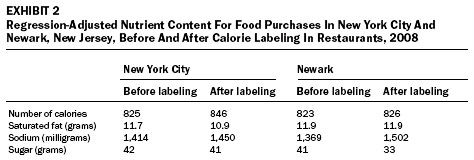
Less saturated fat more than makes up for increase in calories
Each person ate 3/4 gram less saturated fat while eating 21 more calories. That's like swapping a piece of cheese for half a dozen small carrots. It's not so much the calories but what kind of calories. Sodium went up, bad, but sugar went down, good. I'd say so far it's a mild success due mostly to the lowering of the saturated fat intake.
sugar consumption was reduced
The insulin manufacturing industry cannot be pleased that sugar consumption was reduced with the posting of sugar content. They may have to lobby for more sugar industry subsidies.
...
You probably should seek treatment for your paranoid delusions. "Insulin industry"?
Are you a sugar beet farmer?
Newark was the control
Lower sugar consumption in Newark would indicate labeling is a success, much to the chagrin of the sugar and insulin industries.
Newark was the control group. There was no labeling there
The study does not
The study does not explicitly say labeling was not placed in the Newark restaurants studied, but even if labeling was not done there, the proximity to NYC and its labeling laws may have influenced the good people of Newark to reduce their sugar consumption. The change in sugar consumption is not mentioned in the researcher's article.
Calorie counts certainly help me
It sure helps me.
It has absolutely influenced the food I've purchased at both Yankee Stadium and Citi Field. And what a treat it has been for me to finally have that information.
Not you, Kevin! But I get so annoyed with the whining about the "nanny state" -- and the morons who can't distinguish the provision of a little information from the fascist jackboot.