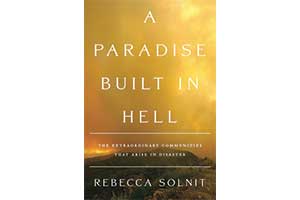
Books: A Paradise Built in Hell

Four years after Katrina, Rebecca Solnit looks at the extraordinary communities that arise in disaster.

Get your news from a source that’s not owned and controlled by oligarchs. Sign up for the free Mother Jones Daily.


Disasters,” writes Rebecca Solnit, “are, most basically, terrible, tragic, grievous…not to be desired.” Obviously, but don’t stop reading: Nearly every other sentence in A Paradise Built in Hell will challenge what you think you know about catastrophes, starting with the idea that they bring out the worst in people.

Take panic, for instance: Most of us expect incivility after crises, and worry about rioting, rape, murder, and mayhem. This belief, fueled by sensational media coverage, shapes our reactions. Hunker down or help thy neighbor? Send in food or federal troops? From the 1906 San Francisco earthquake to Hurricane Katrina, officials have often presumed that the survivors were dangerous, not endangered, doubling the damage by emphasizing a paramilitary response over a humanitarian one. In New Orleans, police infamously stopped residents trying to evacuate, and charged the poor with looting when they scavenged to survive their confinement in the drowning city.

Through this people’s history of five natural and man-made disasters—Katrina, earthquakes in San Francisco and Mexico City, a giant ship explosion in Halifax, Canada, and 9/11—Solnit shows that emergencies can bring out the best in us. Catastrophe survivors are often joyous, even ebullient, because they’ve been liberated from the constraints of everyday life. She argues that the extraordinary civility that follows disasters such as September 11 suggests that utopia is possible, if only we recognize how good life can be when the state breaks down.

However, A Paradise Built in Hell exaggerates the joyousness of conditions in places like Mexico City, where at least 10,000 people died and 250,000 lost their homes. Yes, disasters break down social structures, but Solnit’s own stories show that these structures also determine who lives and dies in the first place. Emergency planning, such as securing levees, can help protect the vulnerable. Yet state-sponsored projects don’t fit into Solnit’s picture of spontaneous, anarchic recovery, so they get little attention here. Nonetheless, this is a bracing, timely book.
If you buy a book using our Bookshop link, a small share of the proceeds supports our journalism.

BEFORE YOU CLICK AWAY!

December is make or break for us. A full one-third of our annual fundraising comes in this month alone. A strong December means our newsroom is on the beat and reporting at full strength. A weak one means budget cuts and hard choices ahead.

The December 31 deadline is closing in fast. To reach our $400,000 goal, we need readers who’ve never given before to join the ranks of MoJo donors. And we need our steadfast supporters to give again today—any amount.

Managing an independent, nonprofit newsroom is staggeringly hard. There’s no cushion in our budget—no backup revenue, no corporate safety net. We can’t afford to fall short, and we can’t rely on corporations or deep-pocketed interests to fund the fierce, investigative journalism Mother Jones exists to do.

That’s why we need you right now. Please chip in to help close the gap.

BEFORE YOU CLICK AWAY!

December is make or break for us. A full one-third of our annual fundraising comes in this month alone. A strong December means our newsroom is on the beat and reporting at full strength. A weak one means budget cuts and hard choices ahead.

The December 31 deadline is closing in fast. To reach our $400,000 goal, we need readers who’ve never given before to join the ranks of MoJo donors. And we need our steadfast supporters to give again today—any amount.

Managing an independent, nonprofit newsroom is staggeringly hard. There’s no cushion in our budget—no backup revenue, no corporate safety net. We can’t afford to fall short, and we can’t rely on corporations or deep-pocketed interests to fund the fierce, investigative journalism Mother Jones exists to do.

That’s why we need you right now. Please chip in to help close the gap.

We Recommend

Latest

Sign up for our free newsletter

Subscribe to the Mother Jones Daily to have our top stories delivered directly to your inbox.

Get our award-winning magazine

Save big on a full year of investigations, ideas, and insights.

Subscribe

Support our journalism

Help Mother Jones' reporters dig deep with a tax-deductible donation.

Donate