«--Previous Post | Blog Index | Next Post--»
On 5th Anniversary of Iraq Museum's Looting, New Attention to Antiquities Trafficking
Iraq's National Museum, home to artifacts of the world's oldest civilization, was looted five years ago tomorrow. A collection of academics, lawyers, law enforcement officials, and former military personnel commemorated the anniversary with the release of a new book, Antiquities under Siege: Cultural Heritage Protection after the Iraq War, and an event for interested parties at the National Press Club. That included me.
The invasion of Iraq actually did surprisingly little damage to Iraq's historic sites, in part because McGuire Gibson, an expert on ancient Mesopotamia based at the University of Chicago, gave the military coordinates of thousands of sites it should avoid on its way to Baghdad. "Iraq is Mesopotamia," said Gibson, who spoke at the Press Club. "It is the root civilization for all civilizations." The military did make mistakes, however. On April 10, looting of the Iraq Museum began and, due to a lack of postwar planning (and due to the Bush Administration's unwillingness to treat culture like a legitimate facet of post-war reconstruction), it took six days for American soldiers to show up to help museum staff defend the premises. In all, 15,000 items from the Museum's collection disappeared or were damaged. Theft and vandalism occurred at archaeological sites across the country.
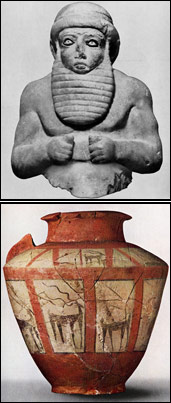
Matthew Bogdanos, a Marine colonel, led the effort to investigate the looting of Iraq's artifacts and to secure their return. Speaking at the Press Club today, Bogdanos showed slides of stolen or damaged artifacts from the Iraq Museum — the first naturalistic depiction of a human face in stone, for example — that could be found nowhere else in the world. Speaking of the unique nature of Iraq's treasures, Bogdanos said, "Everything in Iraq can be prefaced with the word 'first.'"
The reason why people like Bogdanos are needed to investigate the looting is because theft by neighborhood thugs is only the first step is a sophisticated chain that eventually puts fine artifacts in the hands of wealthy buyers in New York, London, Paris, and Tokyo. Smugglers who traffic guns and drugs across the Middle East also carry high-value historical treasures: Bogdanos identified one artifact that had traveled from Baghdad to Damascus to Beirut and then to Geneva. Tracing that network and working to end it is a full-time job for units within the American military.
Many of the artifacts from the Iraq Museum have been recovered and restored. The point, the speakers at the Press Club agreed, is not Iraq. The point is calling attention to antiquities trafficking and its ability to destroy a nation, likely already ravaged by war, by stealing its history and culture. The book provides procedures and strategies that can protect historic sites and artifacts in future war zones. The world's preservers of culture — monuments, museums, libraries, and archives — are an underlooked casualty of war. The group behind Antiquities under Siege aim to change that.

Comments
Last evening, the Oriental Institute in Chicago opened its exhibit on looting, with a lecture by Prof. Gibson, and then held a candlelight vigil, in conjunction with the non-profit SAFE, Saving Antiquites for Everyone (www.savingantiquities.org), to commemorate the 5th anniversary of the looting.
Donny George, former Dir of the Iraq Museum attended, and other vigils are being held un universities across the country and worldwide.
Perhaps 6,000 of the artifacts looted from the museum have been returned. Major sites of Sumerian culture continue to be looted on a massive, industrial scale--Umma, Isin, Zabalam--their surfaces so pitted with craters they resemble lunar landscapes. This illicit digging destroys context, the relationship of artifacts to the site & each other, and thus valuable information about their production, use, depostion, social & culture values, in short, their voice. Even if they ar recovered, this information is lost forever.
Truly this is an issue of winning hearts & minds, of educating the public of the irretriveable loss of context through illicit excavations, of our shared and collective past. Saddest of all for Iraq, the shared heritage of Mesopotamin civilization represents an important integrating factor for all groups--Shiite, Sunni, Kurd--while preservation of the sites and archaeological heritage, if successful, could represent the potential for tourist revenue when the oil runs out.
I speak as both a student of Mesopotamian archaeology at the OI and a member of SAFE.
Posted by: Cynthia Bates on 04/11/08 at 9:48 AM Respond
Don't forget that the coalition forces also converted the ancient city of Babylon into a military base, shortly after the invasion. The U.S. and Polish military dug trenches through soil filled with archeological deposits and built a helicopter landing pad. Heavy vehicles left cracks and scars in the ground of Babylon's Processional Way.
I would avoid characterizing the oversight of the museum's looting, as well as the occupation of Babylon, as a mistake. As a matter of fact, these are mindful acts of neglect and occupation. And they are war crimes - to neglect looting, as well as to turn an archeological site into a military base, directly violates the Hague Convention for the Protection of Cultural Property in the Event of Armed Conflict, which the United States signed in 1954.
Experts have told me, again and again, that these war crimes could easily have been avoided. Instead, even in the face of international outrage, they weren't. The Bush Administration and the Pentagon instead chose to take a great loss in the war for "hearts-and-minds" and, meanwhile, divert its resources to fix huge problems it started.
The base on Babylon has been closed since 2004. Thankfully, the State Department is now embarking on project to renovate the ancient city. That is good to know. But numerous experts on this issue have said that there is currently no fully-developed program led by the United States to coordinate with bodies like the Oriental Institute, the Iraqi government and security forces in the country. I wonder - why didn't the United States military set up such a program to protect Iraq's archeological sites before it invaded the country? Obviously, that would not only have been smart, but legally sound.
It is good that there is now an effort to fix Babylon. Yet that is not enough of an effort, I think. The United States should set up a governmental body to preserve and protect Iraq's cultural institutions and archeological sites. Some might say that this responsibility belongs entirely to Iraq's Ministry of Culture. But as long as the United States occupies Iraq, the United States is responsible for protecting Iraq's cultural property and heritage. It makes sense, then, that there should be a coordinated and focused effort to do so.
Posted by: Peter Holslin on 04/11/08 at 1:53 PM Respond
The question of why the US military did not set up a program before the invasion to protect Iraq's cultural sites is a very complicated one, which Antiquities Under Siege delves into in detail. (It is worth noting, by the way, that the Future of Iraq Project run by Ryan Crocker out of the State Dept forgot to set up a working group on culture until just before the invasion).
Posted by: Larry Rothfield on 04/13/08 at 5:57 AM Respond
ARCHIVE
April 6, 2008 - April 12, 2008
March 30, 2008 - April 5, 2008
March 23, 2008 - March 29, 2008
March 16, 2008 - March 22, 2008
March 9, 2008 - March 15, 2008
February 24, 2008 - March 1, 2008
February 17, 2008 - February 23, 2008
February 10, 2008 - February 16, 2008
February 3, 2008 - February 9, 2008
January 27, 2008 - February 2, 2008
January 20, 2008 - January 26, 2008
January 13, 2008 - January 19, 2008
January 6, 2008 - January 12, 2008
December 30, 2007 - January 5, 2008
December 23, 2007 - December 29, 2007
December 16, 2007 - December 22, 2007
December 9, 2007 - December 15, 2007
December 2, 2007 - December 8, 2007
November 25, 2007 - December 1, 2007
November 18, 2007 - November 24, 2007
November 11, 2007 - November 17, 2007
November 4, 2007 - November 10, 2007
October 28, 2007 - November 3, 2007
October 21, 2007 - October 27, 2007
October 14, 2007 - October 20, 2007
October 7, 2007 - October 13, 2007
September 30, 2007 - October 6, 2007
September 23, 2007 - September 29, 2007
September 16, 2007 - September 22, 2007
September 9, 2007 - September 15, 2007
September 2, 2007 - September 8, 2007
August 26, 2007 - September 1, 2007
August 19, 2007 - August 25, 2007
August 12, 2007 - August 18, 2007
RECENT COMMENTS
On 5th Anniversary of Iraq Museum's Looting, New Attention to Antiquities Trafficking (3)
Larry Rothfield wrote:
The question of why the US military did not set up a prog...
[more]
A Feminist Hears a Who (111)
Tango wrote:
So let's apply some other viewpoint: The 96 daughters had ...
[more]
Updated: Obama's Hebrew Blog (10)
Vitor Vieira wrote:
I don't believe that Obama may have some kind of simpathy ...
[more]
Ex-Bushie Still Pounding the Pavement (1)
capt - Hussein wrote:
Gonzo is a petty criminal. He will be brought up on charge...
[more]
The Rise and Fall of Lyndon LaRouche (10)
Opteron wrote:
The Larouche mouvement is the most dangerous cult I've kno...
[more]
Where Is the Black Outcry Against China? (45)
Jodie wrote:
I can forgive you not to understand China, but you should ...
[more]
John McCain's Age: An Issue? (10)
capt - Hussein wrote:
There are a few people that are nimble-minded into their e...
[more]
Asbestos Company Settles, Leaves Montana Residents in the Dust (12)
Michael L. Wagner wrote:
Irving Stone wrote how, even in Jack London's day, your li...
[more]
Protest the Olympics? The Conundrum for San Francisco Liberals (15)
Splendid One wrote:
"[M]ost Chinese seem to think that . . . the Tibetans are ...
[more]
Clinton and Obama: We (Heart) Gays, Especially in Pennsylvania (65)
capt - Hussein wrote:
I think some of the posts here prove some people have a ve...
[more]
Movable Type 3.33


RECENT ENTRIES
McCain & Co. Find New Ways to Circumvent Campaign Finance Laws McCain Wrote
Will Trouble in Afghanistan Become a Tough Campaign Issue for McCain?
MoJo Convo: Iran Panic? A Follow Up Question for the Experts
Blogger Brian Beutler Shot, Expected to Make Full Recovery
Video: DNC Hammers McCain on Economic Double Talk
McCain Denies Ever Saying He Lacks Expertise on Economy
Report: Interrogation Instructors at Gitmo Taught Communist Tactics from 1950s
One More Clinton Campaign Post-Mortem: No Hierarchy, No Trust, No Comity
How to Think about Immunity