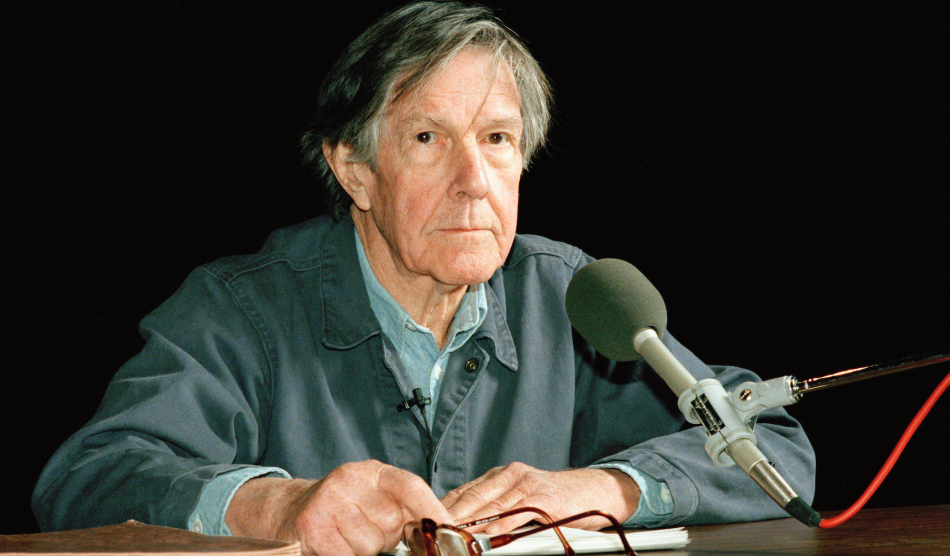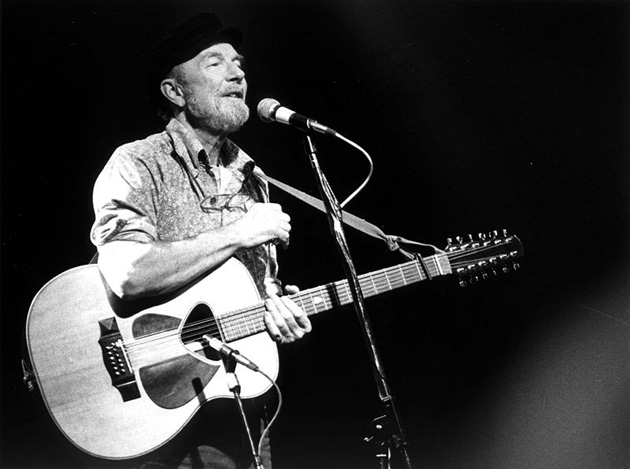
Pete Seeger, 1919-2014<a href="http://commons.wikimedia.org/wiki/File:Pete_Seeger_1986.jpg">Josef Schwarz</a>/Wikimedia
Update (1/27/14): Pete Seeger has passed away at the ripe old age of 94. Read the New York Times obituary here. The following is a profile of the folk music icon from the September/October 2004 issue of the magazine.
On the day Ronald Reagan died, an atypically modest tribute to the patriarch of the right appeared at the foot of a veteran’s monument in Wappingers Falls, a quiet town in upstate New York. A rough-cut chunk of granite dedicated the site to a local Marine lost in action during the Vietnam War; a wreath of fading red, white, and blue carnations was left over from Memorial Day. The pole of a dollar-store American flag was stuck into the earth, and a portrait of Reagan, cut from a magazine and taped onto a piece of cardboard, lay on the ground.
If you had pulled out of the parking area that the monument shares with Shorty’s Pizza and driven south on Route 9 for two miles, you would have found a contrapuntal scene that afternoon: about a dozen people gathered at an intersection to protest the Bush administration’s military policies. A steel post was decorated with a peace symbol, made from a coat hanger, and an American flag like the one at the veteran’s memorial. A young woman sat in a folding lawn chair, holding a sign asking, “Vietnam all over?” A teenage boy held up a bill imploring, “Stop the War!”
An old man with a white straw broom of a beard stood in the midst of them. He was wearing stained, torn blue jeans and a polo shirt that had probably been a color like burgundy, perhaps 10 or 15 years and a few hundred washings ago. He stood straight-backed, his arms at his sides, turning his head left to right, left to right, in rhythm as he watched the cars pass. His mouth moved silently, as if he were singing to himself or trying to send messages through the windshields. He wasn’t holding a placard and needed none, because his very image is a symbol of political dissent.
Pete Seeger, who lives near Wappingers Falls, has been protesting the Bush administration’s actions in Iraq at these Saturday peace vigils, organized a few months before the invasion—and at dozens of other anti-war events of all sizes around the country—with the passion, if not the vigor, of a person one-fourth his age. Indeed, after an extended period of low-key concentration on local issues, during which Seeger was most visibly absorbed with cleaning up the Hudson River, the grand old lion of the American left has, in his 85th year, again taken to challenging the state of world affairs. This is the latest—and perhaps the last—of his great missions, a crusade with resonant echoes of his work in the eras of the civil rights movement and the Vietnam War.
Last year, Seeger led thousands in song at the New York City arm of the Global March for Peace. The veteran protest songwriter has since rewritten and rerecorded his Vietnam-era broadside, “Bring Them Home,” with three of his musical acolytes, Billy Bragg, Ani DiFranco, and Steve Earle. (“Now we don’t want to fight for oil/Bring ’em home, bring ’em home/Underneath some foreign soil/Bring ’em home, bring ’em home.”) And in late June, as violence in Iraq erupted in anticipation of the formal transfer of authority to an interim Iraqi government, Seeger prepared to lead a performance of antiwar songs at the Clearwater Festival, the annual Hudson River event to raise social, p olitical, and environmental consciousness (and funds) that he and his wife, Toshi, launched 35 years ago.
The effort strikes some of his critics as quixotic, the tragicomic vagary of a clinging, misguided anachronism. A lifelong Marxist blacklisted during the McCarthy era, Seeger has long been an easy target for conservatives. (Seeger’s early group, the Almanac Singers, released an album of songs against American involvement in World War II, but recalled it and replaced it with anti-Axis songs when Hitler attacked the Soviet Union.) Since the fall of the Iron Curtain, Seeger’s little-changed politics have proved vexing even to former fellow travelers, such as Ronald Radosh, a fellow at the Hudson Institute and author of Commies: A Journey Through the Old Left, the New Left and the Leftover Left. A red-diaper baby who took banjo lessons from Seeger and organized his first concert at the University of Wisconsin, Radosh says, “I have known Pete for most of my life, and I think he is a national treasure for his contribution to American music culture, for acquainting America with its own indigenous music. But Pete doesn’t understand that this is not the ’60s, and Iraq and the war against terrorism are not the war in Vietnam. He looks at things through his old lens, and that’s more than unfortunate. It’s sort of sad and silly.”
To those he still rallies to dissent and activism, however, Seeger remains an inspiration, the unwavering embodiment of progressive idealism. After all, he has been using music to stand up for the disenfranchised and to mobilize their sympathizers since the days of the original American folk-music revival in the 1930s. Once Woody Guthrie’s partner and traveling companion, later the composer of “Where Have All the Flowers Gone” and “Turn, Turn, Turn,” now a friend and mentor to young artists such as DiFranco (who was born after “Turn, Turn, Turn” was written), Seeger has lived the whole history of activist culture as we know it.
“Pete has always been unafraid to stick his neck out and say what he believes in,” says Ramblin’ Jack Elliott, the folksinger and fellow Guthrie protégé. “Pete has been the single most important force of inspiration and courage to several generations of people—musicians and their audiences—because he gave them the spirit and the courage to go out and protest against the war.”
Pete Seeger is, in many ways, the Reagan of the left: a sunny idealist, amiable and grandfatherly, unyieldingly devoted to a few simple ideas, a nostalgist whose worldview often seems frozen in the era of his own coming-of-age. He’s a polarizing figure who incites deep loyalties among his fans and equally deep antagonism among his detractors. Unlike Reagan, though, Seeger is still among us—indeed, fighting with renewed zeal. At the same time, he is up against more than Bush, the military, and the conservative establishment; he is confronting his own legacy and his mortality.
It is a coincidence that the river town from which Pete Seeger has long served as a guiding light to progressive activists is called Beacon. He and Toshi, his wife of 61 years, have lived on a few acres of wooded hillside overlooking the Hudson since 1949, when Seeger began clearing trees with an ax he’d been given by a leftist youth organization. With instructions he found in the New York Public Library and some help from hardy young admirers, he built a log cabin now occupied by one of his six grandchildren, the musician Tao Rodriguez Seeger. He later added a hodgepodge of connected ante-buildings—a kitchen that’s more like a small house, a barn/studio, and a two-story loft— where the elder Seegers live and work today. Peering between garments drying on a set of clotheslines drawn between elm trees, Seeger gazed out at his view and shook his head. “There used to be a beautiful 19th-century village down there,” he said. “It has been ruined by the scam of urban development. After a while, an oil company constructed a big tank along the banks of the river to provide fuel for the developers, and today there are dozens of the things. They seem to be propagating.”
Seeger tends to function, now as ever, from a well of deep, politicized convictions about how things ought to be. In his campaign against the ongoing American military presence in Iraq, he works daily in his office on the second floor of the loft. There, on an afternoon in June, he made and fielded calls to and from DiFranco, Dar Williams, Holly Near, and Guy Davis, all of whom had agreed to perform at this year’s Clearwater Festival. While the complex business of planning the two-day event transpires at Clearwater’s home office in nearby Poughkeepsie, Seeger has always been the festival’s de facto leader and the steward of its creative quotient.
“I’m up to my ears with Clearwater, and I’m also involved in various other festivals,” said Seeger, sitting at a gray steel desk built decades ago for use in the corporate world. The mere sight of Pete Seeger at an office desk is unnerving; it seems like digital trickery, like an image of Dick Cheney at a hootenanny. “I’ve found that festivals are a relatively painless way to meet people and make a few points that need making, without having to hit them over the head with too many speeches.”
Seeger picked up the receiver of a red,’60s-vintage desk phone nearly buried in his papers. A lesser-known folksinger from Southern California was calling to offer his services at Clearwater. Seeger was grateful, he said, but the schedule was full. So many people are so fired up these days that there’s not enough room to present them all, Seeger explained. In fact, he joked, he wasn’t sure if there would be room to go onstage himself.
After the call, Seeger leaned back in his chair and returned seriously to the issue of his own performance. “I probably shouldn’t sing at all,” he said. “My voice is gone, I can’t play like I used to or like I want to, and I get awfully tired awfully quick.” All afternoon, he had been carrying a small plastic bottle partially filled with water from his well. Now he slowly unscrewed the lid and lifted the container to his mouth with two hands, the left to steady the right, which was trembling.
“But I believe that there are things worth saying, especially now—more now than ever,” Seeger said. His speaking voice was dry, and it quavered when he spoke up. Still, his eyes were piercing behind his oversized glasses. “We’re in a very dangerous situation. The problems in the Middle East are not going away—they’re getting worse. Churchill said, anybody who thinks, when they get into a war, that they know what’s going to happen, is fooling themselves. With all the power that the American military establishment has, they still cannot predict all the things that are going to happen.
“The shortsighted people say, ‘We know how to solve the problems. We get the proper explosive in the right place, and they’ll learn.’ I say, ‘All they’ll learn is how to be violent.’ To quote Martin Luther King, the weakness of violence is that it always creates more violence. Darkness cannot drive out darkness. Only light can do that. Hate cannot drive out hate. Only love can do that.
“Things could hardly be worse, and it’s not just Bush,” Seeger said. “He’s got a whole gang there behind him, and they control the media. Some people say that this is how Hitler took over. But we can fight this. Let me show you something.”
Seeger walked down from his office loft, went outdoors, and headed around the building to the side of his barn. There, an inscription from William James is painted in large, white block letters on the high, red wall. It reads, in part: “I am done with great things and big things, great institutions and big success, and I am for those tiny invisible molecular moral forces that work from individual to individual….”
“When the Vietnam War ended and there were no more huge demonstrations in Washington,” Seeger said, “a lot of people thought, ‘Well, I guess there are no big things happening now.’ I believe the big thing now is many small things. The fact that many small things are going on is the big story. I think that there are probably not hundreds of thousands but maybe millions of people like me who are working for peace and work- ing to get out the vote—but doing it in a lot of small ways, instead of one big way, and I’m convinced that that’s the best way to do it.
“This is a very basic philosophical point that I’m trying to make. When you’re facing an opponent over a broad front, you don’t aim for the opponent’s strong points, important though they may be. Pick a little outpost that you can capture and win. And then you find another place that you can capture and win it, and then you move slowly toward the big places. Look at Martin Luther King. People wondered, ‘Why is he worrying about sitting at the back of the bus or having a seat at lunch counters? Why doesn’t he go after schools, housing, voting, jobs?’ He took on sitting on a bus, but he won it!
“That’s my philosophy now. The festivals I’m doing this summer are a perfect example. There may only be a few thousand people at each one, but we can reach them.”
The Strawberry Festival of Beacon, New York, takes place on a mile-square peninsula along the Hudson River in a park that had been a garbage dump until Seeger led an effort to clear it for public use. Shortly after eight in the morning on the day of this year’s event, one of the few people visible on the site was an old man shuffling along the riverbank, picking up trash—Seeger, of course. A half-hour later, he was riding on the tailgate of a pickup truck to get folding tables and chairs. When that work was finished, he decided to rebuild the cinder-block ovens used to bake the strawberry shortcake that is the event’s signature attraction. By midafternoon, when Seeger was scheduled to perform, a friend asked if he needed anything. “Youth and energy,” Seeger responded, although he had mustered unlikely quantities of the latter all day through force of will.
Ostensibly a community gathering to celebrate the Catskill region’s agricultural life, the festival has a strong political bent, a result no doubt of Seeger’s influence. Of the many exhibits set up along the waterfront this year, one booth protested capital punishment, another called for the closing of the nearby Indian Point nuclear power plant, another was sponsored by Citizens for Clean Elections, and several hawked anti-Bush and pro-peace buttons, T-shirts, and bumper stickers (“Beat Bush, the Worst President Never Elected”).
Seeger began his performance (amplified for the crowd of about 2,000 with solar-powered equipment) with a loopy, allegorical monologue about mankind’s evolutionary ancestors, the Neanderthals. As Seeger recounted our prehistory, the Neanderthals were finally wiped off the face of the earth by a weaker breed that organized.
Seeger apologized for the long lines to buy shortcake. “Our ovens are getting rusty,” he said. “I’m getting rusty, too.” Clearly fixed on proving otherwise, he launched in- to a driving rendition of his Vietnam-era narrative of military obstinacy, “Waist Deep in the Big Muddy,” and then led the assembled thousands to sing “Turn, Turn, Turn,” the Seeger composition derived from Ecclesiastes that the Byrds made a top-10 hit in the ’60s. When he came to the line, “A time for peace,” he stopped playing the guitar and roared the phrase as he punched the air with both fists. “I swear,” he said firmly, “it’s not too late!”
He spoke movingly of the peace vigil in Wappingers Falls, encouraging the crowd to join him there on Saturdays, and he concluded with the Cuban revolutionary José Martí’s lyrical anthem, “Guantanamera.” Seeger sang all the verses in their original Spanish, then softly strummed the chords on his 12-string guitar as he spoke the final words in English. “The streams in the mountains please me more than the sea.” At the conclusion of the song, Seeger added, “Martí wondered, ‘Now that we are free, how do we protect ourselves from the evil giant to the north?’ Not long after that, he was dead.”
A strain of anti-Americanism has always run through Seeger’s work, and he seems unafraid to let it surface these days, as his homage to the martyred radical Martí shows. A fearless ally of the oppressed who suffer under capitalist regimes, Seeger has appeared less sympathetic to the victims of communist dictatorships, such as Fidel Castro’s. “I’m still a communist,” he says, “in the sense that I don’t believe the world will survive with the rich getting richer and the poor getting poorer—I think that the pressures will get so tremendous that the social contract will just come apart.”
As Ronald Radosh says, “Pete cannot seem to get past his old loyalty to the communists. He’s never sung a song about the totalitarianism of the Soviets or the horrible oppression under Castro. But he’s quick to criticize the United States. That’s his prerogative, naturally—it’s a free country. He just doesn’t seem to care for it very much.”
While Seeger holds to his (decidedly un-Marxist) faith that songs can change the world, there is now debate—even within old-school folk circles—about what protest music can actually accomplish. “It is my belief that protest songs are nice banners, but they don’t do anything,” says Oscar Brand, a fellow songwriter of Seeger’s generation. “They just inform people that there are others who feel the same way. I don’t believe that songs can change the world. Pete does.”
Harry Belafonte, who began his career in the early 1950s as a folksinger, sides with Seeger. “I think that the role of songs in political movements can never be overstated,” Belafonte says. “Nothing can be said that would exaggerate the role of music in the civil rights movement—and, by the same token, the antiwar movement of the ’60s. It raised people’s spirits, it gave them courage, it gave them battle songs, and it was good for the human soul. Could the same thing happen again? Absolutely!”
In the early 1970s, when Pete Seeger was recovering from surgery for a hernia, he stopped performing for a year, only to find that the layoff made him feel worse. “For my health, I know I’ve got to keep singing,” he told his biographer, David Dunaway. “I don’t think I’d live long if I didn’t.”
On the morning of the first day of the Clearwater Festival, Seeger was sitting alone under a birch tree, tuning his guitar for an afternoon performance of protest songs. Every few minutes, a fan would notice him, sneak up, take a snapshot, and scurry away, grinning. Seeger never blinked.
“When you play the 12-string guitar,” he said, as he plucked a string and adjusted it to pitch, by ear, “you spend half your life tuning the instrument and the other half playing it out of tune.” The line was an old warhorse, but so was Seeger, and he was husbanding his creative resources for the show. “That’s how I’ve spent my life.”
Seeger zipped his guitar in its bag and stood up to watch the river. He was standing not 20 feet from the splashboards that lined the bank of the Hudson. The moment seemed a good one to ask him seriously how he believes he has spent his life.
He stood motionless, gazing at the water. “I’ve been thinking about that a lot lately,” he said, “and I keep coming back to the first two lines from the song ‘John Henry.’ I think they represent the meaning of my life more than anything. Do you know them? They go, ‘And before you let that steam drill beat you down, die with that hammer in your hand.'”
I thought about that for a moment and said, “That’s beautiful. But doesn’t it presume defeat? Can you imagine the possibility of prevailing over that steam drill before you die?”
“Well,” Seeger said, still staring ahead at his river. “I don’t know. That’s not really the point.”