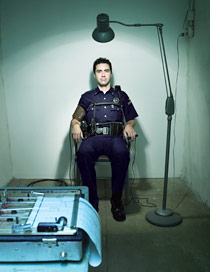
Image: Jeff Stephens
Bill Roche was so close to his dream job. An overachieving police officer in a Bay Area suburb, Roche had made detective while still in his 20s. Confident that his law-enforcement résumé was sufficiently impressive after seven years on the force, he applied to become a U.S. Secret Service agent in 1997. Throughout the yearlong selection process, his interviewers lauded him as an excellent candidate. But before he could earn his earpiece and Ray-Bans, there was one last detail to take care of: Roche had to submit to a lie detector test.
No problem, he shrugged. After all, Roche had already passed three polygraphs over his police career. But not long after he arrived at the Secret Service’s field office in San Francisco, things started to go awry. Roche was hooked up to a computer set to monitor his breathing and perspiration, and says he answered each question as truthfully as possible. But as the seven-hour session wore on, the polygrapher grew increasingly angry with Roche’s responses, insisting that his physiological reactions “were not in the acceptable range.” He accused the veteran cop of withholding information about his drug use, his criminal history, and his honesty on the job. The more strenuously Roche protested his innocence, the more confrontational the examiner became. “At one point, he’s sticking his finger right in my face,” recalls Roche, “and he’s yelling stuff like ‘Have you ever stolen a car? You better not have!'”
His pulse racing and his sweat glands in overdrive due to the bullying, Roche didn’t have a prayer. His polygraph results were labeled “deceptive,” he says, and he was abruptly bounced from the applicant pool. If he ever wants to apply for another government job, he’ll have to admit to failing the Secret Service’s polygraph — a black mark that will likely disqualify him from federal employment for life. “I was washed up at that point,” he says, fighting back tears. “To lose your career over a polygraph — my God, it’s devastating.”
Puzzled as to why he failed, Roche began to investigate the history and validity of lie detector technology. He soon discovered an enormous community of people like himself who blame flawed polygraph results for derailing their careers — as well as a host of reputable scientists, like John Fuerdy of the University of Toronto, who dismiss lie detectors as no more valuable than “the reading of entrails” by ancient Roman priests. Studies have long shown that polygraphs are remarkably unreliable, particularly for screening job applicants. As early as 1965, a congressional committee concluded that there was no evidence to support the polygraph’s validity; a 1997 survey in the Journal of Applied Psychology put the test’s accuracy rate at only 61 percent. Polygraph evidence is generally inadmissible in court because, as Supreme Court Justice Clarence Thomas noted in his majority opinion in the 1998 case U.S. v. Scheffer, “there is simply no consensus that polygraph evidence is reliable.” Indeed, the lie detector is so untrustworthy that Congress passed the Employee Polygraph Protection Act in 1988, making it illegal for private-sector employers to compel workers to take polygraph exams. Prior to the law’s passage, according to Senate testimony, an estimated 400,000 workers suffered adverse consequences each year after they were wrongly flunked on polygraphs.
But Congress exempted government agencies from the ban on lie detectors, and “going on the box” remains a key part of the hiring process for the FBI, Secret Service, and hundreds of other federal, state, and local agencies. At last count, 62 percent of the nation’s police departments require job applicants to take a polygraph test — up from only 19 percent in 1964. Polygraphs are also widely used to ferret out spies and to wring confessions out of military personnel suspected of criminal offenses. All told, the federal government now has at least 20 polygraph programs staffed by more than 500 examiners, and the CIA and FBI alone have tested at least 40,000 job applicants and employees over the years. “The polygraph is clearly one of our most effective investigative tools,” the Department of Defense reported to Congress last year.
By relying so heavily on such an unreliable device, however, government agencies have jeopardized the reputations and careers of honest employees and job applicants. A study in the journal Polygraph found that 1 in 4 applicants for jobs as police officers is disqualified solely on the basis of their polygraph results. Federal agencies report a similar failure rate: According to a 1997 letter submitted to the Senate Judiciary Committee by Donald Kerr, then assistant director of the FBI’s Laboratory Division, 20 percent of the bureau’s job applicants were “de- termined to be withholding pertinent information” on lie detector tests and were denied federal employment. Even if the machine is wrong only 2 percent of the time, as the nation’s leading trade group of polygraph examiners claims, the government is routinely denying jobs and promotions to thousands of people who are guilty of nothing more than nervousness.
Given the polygraph’s dubious record, resistance to the lie detector has started to stir. AntiPolygraph.org, a website devoted to the test’s inaccuracy, has attracted more than 170,000 visitors over the past two years, many of them disgruntled polygraph subjects. More than a dozen plaintiffs — Bill Roche among them — have filed a lawsuit in federal court seeking to have polygraphs declared unconstitutional for hiring purposes. In May, the Philadelphia Police Department stopped using lie detectors to screen applicants, on the grounds that too many qualified candidates were being disqualified by unreliable polygraph scores. And in recent months some federal employees have taken an increasingly vocal stand against the gov-ernment’s decision to conduct polygraphs of scientists who oversee the nation’s nuclear stockpile. “If this was just about the government wasting $10 million a year on polygraphs, I’d just say, ‘Eh?'” says Alan Zelicoff, a senior scientist at the Center for National Security and Arms Control in Albuquerque. “But this is about people getting hurt.”
Monitoring physiological cues for signs of deception is a concept that predates polygraphs by centuries. Suspected criminals in ancient China were once fed handfuls of dry rice during their interrogations, on the premise that liars tend to have dry mouths; if the rice stuck to their tongues, they were deemed to be untruthful.
The father of the modern lie detector was Dr. William Marston, a Harvard psychologist perhaps better known for creating the comic-book character Wonder Woman under the nom de plume “Charles Moulton.” Marston, who built his first primitive polygraph unit in 1915, believed that lies were invariably accompanied by an uptick in blood pressure. He often used his contraption during marital counseling sessions, just as other American scientists of the age relied on electroshock, handwriting analysis, and other “modern” techniques thought to be far superior to the mere observation of humans.
Today’s polygraphs typically measure subjects’ respiratory rate, heart rate, and “electrodermal activity” (fingertip sweat) as they’re interviewed. The paper scrolls and whirring needles of bygone police dramas have been replaced by laptop computers. But the underlying premise of the Chinese rice technique — that lying spurs physiological changes — remains the core theory behind the technology.
That assumption is the polygraph’s chief flaw, says Drew Richardson, a retired polygraph researcher for the FBI who is now an outspoken critic of the test. “Blood pressure, respiration, and so forth are all physiological parameters which we have been able to measure very accurately for a very long period of time,” he says. “People confuse the fact that we can accurately measure these with the fact that we can’t accurately connect these with emotional causes.” Indeed, no study exists to support a universal correlation between, say, sweaty palms and prevarication. And a polygraph cannot differentiate between anxiety caused by dishonesty and anxiety caused by other factors.
One of the most common of those factors is the aggressive tactics of many polyg- raphers. Job applicants are routinely treated like criminals, grilled for hours with repetitive questions about extramarital affairs or drug use. One Secret Service applicant who asked not to be identified recalls being assailed with drug questions again and again, at one point being accused of snorting cocaine prior to the exam. When he left the room after over two hours, he recalls being “filled with the worst anger I have ever experienced.” He was disqualified from the selection process; he asked to be retested, but the Secret Service did not respond to his request.
Another fundamental problem with lie detectors is how operators establish what a lie looks like. Subjects are peppered with a variety of “control questions” to which the examiner anticipates a dishonest answer. Those who insist, for example, that they never stole something as a child or never tried illegal drugs in their youth are assumed to be lying — and the examiner then uses those responses as a baseline for detecting deceptive answers to other questions. George Maschke, a doctoral student at UCLA who applied to be an FBI special agent in 1994, was shocked when his polygrapher accused him of “deception with regard to each and every relevant question,” including whether he’d ever sold narcotics, contacted foreign agents, or divulged classified information. He blames the test failure on his response to a control question about whether he had ever driven while under the influence of alcohol. “His assumption was that everyone who drinks will eventually drive when doubtful about their sobriety,” Maschke recalls. “But I was always very meticulous — I always waited so many hours so that I would be completely sober. So I felt quite comfortable answering that question ‘no.'” The physiological reaction associated with that answer became the baseline for a suspected lie, so all of Maschke’s subsequent truthful responses were judged deceptive.
“I figured I was in a small minority of people who fell afoul of the polygraph,” says Maschke. But the response to his book, The Lie Behind the Lie Detector, and to the website he created, AntiPolygraph.org, gave him an indication of how widespread the problem is. Many job applicants use the website to share “countermeasures” to ensure positive results — some not wishing to put their fate in a polygrapher’s unpredictable hands, others perhaps simply wanting to get away with lying. Taking measured breaths, biting the tongue, and thinking anxious thoughts during the control questions are all common — and effective — tactics.
Polygraphs not only falsely accuse honest people of lying — they also fail to detect skilled liars. Convicted spies Robert Hanssen and Aldrich Ames both passed repeated lie detector exams during their careers as double agents. A former Border Patrol agent who was rejected for a job with the Los Angeles Police Department after failing a polygraph says his fellow recruits swapped “tip sheets” on how to beat the test — in the hallways right outside the interview rooms. “I’ve talked to people who were less than truthful on the test, but employed countermeasures and breezed through it,” the former agent says. “What’s happening is there’s this whole antagonistic environment of ‘I’ve got to beat them because they’re trying to screw me.'”
There are no government statistics on how many people fail polygraphs each year, and those who seek legal recourse rarely succeed. In fact, many federal and local agencies have taken steps to prevent legal challenges to their methods. Before applicants to the lapd take their polygraphs, for example, they must sign a waiver agreeing not to question the examiner’s expertise or judgment in the event of a lawsuit. That may be because many attorneys would take issue with the training of many professional polygraphers: In many states, a 10-week course and a passing grade on a written exam is all that’s required to obtain certification.
Government polygraphers readily acknowledge that their exams are not faultless, since humans must ultimately interpret the physiological data. FBI Special Agent Thom-as Lewis, a polygraph expert, testified in federal court in 1996 that he had a “difficult time” agreeing that the process is a science. “In the FBI, we’re taught it’s an art,” he said.
But polygraphers also say that the public’s innate trust in the reliability of the equipment, reinforced through countless cop dramas, makes the lie detector an indispensable tool for extracting confessions. If people believe they can’t fool the machine, the theory goes, they’ll confess before they’re actually trapped in a lie. According to a recent Pentagon report, roughly 90 percent of the information it obtains during security screenings comes from confessions prompted by lie detector tests.
That’s small comfort to job applicants who have been wrongly rejected based on a polygraph exam. Flunking a lie detector test has long-term consequences: Fail one agency’s polygraph, particularly at the federal level, and other employment opportunities immediately evaporate. Maschke recalls a law student named Mark Doyal who was rejected for a job with the FBI in 1996 after failing a polygraph. (Doyal says he was falsely accused of lying about drug use merely because he had attended Southwest Texas State University, known as a “party school.”) Later, when Doyal applied for a job with the Secret Service, his examiner asked whether he had ever failed a polygraph. When Doyal responded “yes,” he was immediately unhooked from the machine and sent home; two months later, he received a rejection letter stating that he was “no longer competitive with the other agent applicants.”
When applicants and employees believe they have been unfairly rejected, however, it can be almost impossible to appeal. The former Border Patrol agent who flunked the LAPD polygraph recalls the reaction of his examiner when he asked how he could contest his rejection: “He just looked at me like I was from outer space.” According to attorney Mark Zaid, some 300 employees of the CIA remain in “polygraph limbo,” denied promotions and overseas assignments while they await investigations of their appeals. But the agency has little motivation to conduct reviews that could expose the inaccuracy of polygraphs, and some employees have waited for years without a resolution. “It is essentially the end of their career,” says Zaid.
In many cases, it appears that agencies are using polygraphs as a substitute for more costly and time-consuming background checks. The Aldrich Ames case, in particular, was an embarrassment for the CIA, which passed the notorious double agent on two separate polygraphs. During his nine years as a Russian mole, Ames spent lavishly on luxury items and an opulent residence. A simple stroll by his house would have sparked suspicion in any competent background investigator — but the CIA trusted the polygraph. In a letter from prison, Ames derided the polygraph as an ineffectual substitute for background investigations, saying it “has done little more than create confusion, ambiguity, and mistakes.”
The FBI’s polygraph program has similarly failed to yield any moles. But it has ruined careers, most famously in the case of counterintelligence officer Mark Mallah.
In 1995, Mallah, an FBI special agent since 1987, was polygraphed as part of the Bureau’s routine security screening. He was found to be deceptive when he denied ever having had unauthorized contact with foreign officials, and was summoned to Washington for two days of additional testing. His home was subsequently raided; he was placed under 24-hour surveillance; and several of his friends and relatives were asked to take polygraphs, too. The 20-month investigation ended with no charges being filed; Mallah resigned from the FBI shortly afterward with a clean record. Mallah’s case is frequently invoked by critics of the Department of Energy’s two-year-old plan to subject at least 20,000 of its scientists and engineers to polygraphs. Those who refuse the examination will be stripped of their security clearances. The testing has sparked widespread dissent at Sandia National Laboratory and other critical research venues. In a September 1999 letter to then-Energy Secretary Bill Richardson, Rep. Ellen Tauscher (D-Calif.) fretted that “even if polygraph tests match their optimistic expectations of 95 percent proficiency, 50 scientists out of every thousand tested could be put in a career-threatening predicament by registering a false positive.” Despite the protests, the tests at Sandia are now proceeding at an estimated rate of four per day — meaning that screening of all employees should be complete by 2022. The process has yet to uncover any spies, but some federal employees report that it has hurt morale. “People are losing faith in what they’re doing here, which is building and maintaining nuclear weapons,” says Zelicoff, the government scientist who has protested the screening. “If that’s not affecting national security, I don’t know what is.”
Some of those who have promoted polygraphs in the past have changed their tune when faced with the prospect of taking a lie detector test themselves. In August, several members of the House and Senate intelligence committees refused to submit to polygraphs as part of an FBI investigation of who leaked classified information regarding the September 11 attacks. “I don’t know who among us would take a lie detector test,” says Senator Richard Shelby (R-Ala.). “They’re not even admissible in court.” Shelby’s reticence was an about-face from his stance two years ago, when he spearheaded the expansion of the Department of Energy’s polygraph program as the only effective way of tracking down moles.
Whether the government will continue to have faith in the polygraph depends largely on an upcoming report from the National Academy of Sciences, which is intended to be the definitive evaluation of the test’s validity as a screening tool. If the academy echoes other studies that have found polygraphs unreliable, it could lead to a scaling back of lie detectors.
Zelicoff, for one, believes there’s a simpler way of demonstrating the polygraph’s deficiencies than waiting for a multimillion-dollar study. “Let’s take Aldrich Ames’ last two polygraphs and shuffle them up with 200 people you’re convinced are not spies,” he says. “Give those 202 different polygraphs to a polygrapher, and see if anyone can find Aldrich Ames.” No polygrapher has yet taken up that challenge.