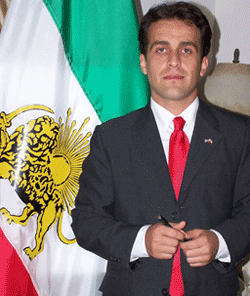
This past summer, an op-ed appeared in the Washington Post under the byline of Richard Perle, the influential former Pentagon adviser who was a chief booster of Ahmed Chalabi in the run-up to the war in Iraq. As he had prior to the invasion of Iraq, Perle urged the Bush administration to shun appeasement and take an uncompromising stand toward Tehran; as with Iraq, he argued that a hard line was critical to help the population overthrow a brutal regime. And once again, Perle had an exile leader he wanted America to know about: Amir Abbas Fakhravar, “an Iranian dissident student leader who escaped first from Tehran’s notorious Evin prison, then, after months in hiding, from Iran.”
Fakhravar, Perle wrote, had believed George W. Bush’s promise to Muslim dissidents that “when you stand for liberty, we will stand with you.” Now, as the administration was mulling whether to negotiate with Iran, Perle worried that “the proponents of accommodation with Tehran will regard the struggle for freedom in Iran as an obstacle to their new diplomacy.”
It was a rousing call to arms for conservatives, many of whom are convinced that American interests in the Middle East depend on fomenting an uprising in Iran, and who have been frustrated in their search for just the right allies. The Iranian opposition is deeply fractured, and a number of its leading figures are explicitly against U.S. intervention. Iran’s best-known dissident, journalist Akbar Ganji, rejected invitations to meet with administration officials on a recent U.S. visit, and asked instead to see the United Nations’ Kofi Annan and Noam Chomsky. “I advocate change of the regime in Iran,” Ganji told me in July. “But that regime must be changed by Iranians themselves.”
Enter Fakhravar, who is more inclined to say exactly what the hawks want to hear. He told me that Iran’s president wants to wipe Israel off the map, and that “any movement or any action whatsoever” by the United States would “help or enhance the people to rise up.” All the student movement in Iran needed to overthrow the regime, he said, was “a little bit of coordination, organization, and training.”
A virtual unknown both inside and outside Iran when he arrived in the United States in May, Fakhravar has in the months since then ascended to prominence at a dizzying clip. By midsummer he was rushing from testifying on Capitol Hill one moment to an Iran opposition gathering at the White House the next, meeting regularly with policymakers and influential advisers, chatting with the former Shah’s son on his cell phone, and generally being touted as the young, idealistic face of the movement to overthrow the mullahs.
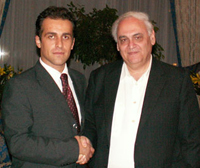
Fakhvavar and Richard Perle
But Fakhravar may be a false messiah. In interviews with more than a dozen Iranian opposition figures, some of them former political prisoners, a different picture emerged—one of an opportunist being pushed to the fore by Iran hawks, a reputed jailhouse snitch who was locked up for nonpolitical offenses but reinvented himself as a student activist and political prisoner once behind bars. Fakhravar and his supporters vehemently deny such allegations, saying that the attacks are motivated by petty jealousy and a vendetta by Fakhravar’s enemies on the Iranian left.
For those like Perle who want the United States to eschew diplomacy in favor of backing regime change, Fakhravar is an essential link in the argument for confrontation with Iran. Rather than reminding Americans of Chalabi, who is now known to have orchestrated much of the Bush administration’s bad wmd intelligence, they’d like to summon memories of the 1980s, when Ronald Reagan sought to embolden and unify dissidents in the Soviet Union. But by choosing Fakhravar, they may have inadvertently accomplished the opposite, exposing the ruptures in the pro-democracy movement and throwing into question the notion that America’s problems with Tehran will be solved by a saffron revolution.
By all accounts, Perle’s rapport with Fakhravar started more than two years ago, when Fakhravar was in and out of Evin, the infamous Tehran political prison where Canadian journalist Zahra Kazemi was tortured to death in 2003. From prison, Fakhravar had been calling the Persian-language pro-monarchist, anti-regime satellite stations broadcast from Los Angeles. Manda Shahbazi, an L.A.-based businesswoman and exile activist, told me that she heard one of those calls, was moved by Fakhravar’s plight, and managed to contact him. She then talked to Perle, who promptly mentioned the Fakhravar case at an Iranian opposition forum in Los Angeles in May 2004. In short order, Fakhravar called Shahbazi and asked to be put in touch with Perle. When Fakhravar left Iran this past April, his first stop was a Dubai hotel room where he met Perle.
“In my eyes I saw the prince of light,” Fakhravar told the New York Sun a few weeks later. “I could see in his eyes he is worried for our people as well as the American people and this is very important and this is very special.” Perle helped arrange for Fakhravar’s entry into the United States and organized a private lunch for him at the American Enterprise Institute; among those attending were State Department and Pentagon officials, selected journalists, and prominent Iran hawk Michael Ledeen.
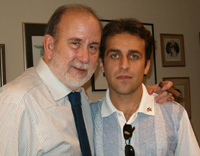
Fakhravar and Michael Ledeen
Shahbazi, meanwhile, was working to connect Fakhravar with top exile leaders in L.A. and around the world. She had platinum contacts through her father, Yaddolah Shahbazi, a prominent businessman who served as an adviser to the Iranian prime minister during the twilight of the Shah’s regime (and who, for Iran trivia fans, launched a shipping company together with Iranian and Israeli investors that at one point employed Manucher Ghorbanifar, the Iran-Contra arms dealer).
Shahbazi also did some contact-building of her own: In August 2005, according to filings with the State Department’s Office of Protocol, she gave Liz Cheney—the vice president’s daughter and a senior State Department official overseeing the Iran-Syria Operations Group—a Persian carpet valued at $4,000, as well as a glass plate engraved with a quote from Dick Cheney about Iran. The rug was among the dozen most valuable gifts bestowed on U.S. officials by foreigners in 2005. When I asked Shahbazi about it, she said she didn’t remember it.
In July of this year, Fakhravar joined Ledeen and other Iran experts in testifying before a Senate Homeland Security and Government Affairs subcommittee; that appearance caused him to miss the gathering of Iranian opposition activists the White House had convened that day. It was an only slightly extraordinary day in a schedule replete with official meetings and engagements at Iranian opposition gatherings, where Fakhravar regales audiences with tales of his time in various prisons and his escape, along with his plans to unite student activists.
For Mohsen Sazegara, it all seems a bit much. A soft-spoken Iranian dissident thrice imprisoned in Iran and now based in Boston, Sazegara was reluctant to comment on Fakhravar, saying he had nothing against the young man. When pressed, he told me that Fakhravar was at best a marginal player whose life story has been exaggerated by his allies. For instance, no one “escapes” from Evin prison, Sazegara said; instead, Iranian political prisoners can apply for temporary furloughs, and on one of them, Fakhravar simply decided not to go back. Cina Dabestani, a Virginia-based exile who sometimes translates for Fakhravar, told me that Fakhravar attended law school while in prison, and, at Shahbazi’s urging, went awol after an exam. His escape from Iran—which Fakhravar has claimed was undertaken despite an order to have him shot on sight—involved a regular flight from Iran to Dubai, according to several sources.
Iranian journalists and former fellow inmates also claim Fakhravar was never a political prisoner to begin with, but was locked up for a nonpolitical crime—“unchaste acts” involving fellow students—and then cultivated friendships with student dissidents. “Student circles and journalistic circles don’t recognize him as a student leader,” says Najmeh Bozorgmehr, the Financial Times’ Tehran correspondent who closely followed the 1999 pro-democracy student protests, the Tiananmen Square of Fakhravar’s generation of Iranian dissidents. Adds Hassan Zarezadeh, a journalist and human rights activist who now lives in Canada, “He accidentally got arrested and got interested in politics and opportunistically tried to get close to the center of power and get famous that way. He was never part of the student movement.”
Even more suspicious to some dissidents is the story of how Fakhravar first connected with his U.S. supporters. “I have been arrested 12 times since 1999, and I have never seen anything like this,” says Zarezadeh. “It’s impossible for a political prisoner to have a phone,” he adds, let alone use it to call the foreign press, the exile broadcasters, and a top Pentagon adviser.
Some dissidents believe they do have an explanation: “As far as the other political prisoners were concerned, he was an antenna for the security of the prison and for the security services,” Bina Darab-Zand, a recently released human rights activist, told me when I reached him in Tehran in late August. Nasser Zarafshan, one of Iran’s most prominent human rights attorneys and also recently released from Evin, echoed that claim. “He has been working for the police,” Zarafshan says. “In prison, everybody knows that.” Perle’s office referred questions to Shahbazi, who told me that Fakhravar got the phone by paying bribes; she refused to discuss details of his escape from Iran, saying that it would make it harder for other political prisoners to get out.
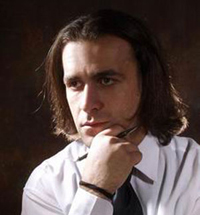
Fakhravar
I met Fakhravar recently in an office lent to him by the Foundation for the Defense of Democracies, a small Washington think tank that promotes U.S. intervention to support reform in the Middle East. With his gray suit, freshly shorn hair, and eager-to-please manner, the 31-year-old cut a figure remarkably different from the Fabio-like photos on his website (whose tag line reads “Love, Iran, Freedom”); he could have been a newly minted Ph.D. moonlighting on the Hill. But there was also an air of anxiety about him, a kind of Talented Mr. Ripley quality, as if he were struggling to perform a role. He spent the better part of an hour recounting his life, primarily a series of prison stints he said he had endured starting when he was 17 and in medical school. During the ’99 uprising, he said, he had been serving his compulsory military service in a Tehran clinic, but had managed to be in contact with the student protesters.
When I asked about his critics’ claims, Fakhravar threw his arms up in frustration. He said that among Iranian political prisoners, there is deep division between liberal and leftist blocks, and that Zarafshan and other leftists had “started rumors” about him that were “all false.” He opened his laptop to show photos of himself on a New York street talking with the dissident Ganji, then autographed a copy of his book, Scraps of Prison, printed by an L.A.-based Persian publisher. It is one of three books for which Fakhravar says he has been persecuted, though none of them appear to be widely known. On his website, Fakhravar says he was on the shortlist for a literary prize, the Paulo Coelho award, but there is no evidence that such an award exists—a point first raised on the blog “Moon of Alabama.”
Fakhravar urged me to call exile leaders, including the Shah’s son, who would vouch for him. The people he claims as his allies back in Iran, however, seem less than eager to embrace him. Ahmad Batebi, one of Iran’s best-known student leaders—pictured on the jacket of Scraps of Prison alongside Fakhravar—has distanced himself from him on his blog. Another key activist whom Fakhravar says he worked with, Akbar Mohammadi (the two are shown together in a picture on Fakhravar’s website), recently died on a hunger strike in Evin prison. When I tracked down his sister, Nasrin, she emailed me that Fakhravar and her brother were “not very close.” Fakhravar, she wrote, “is a young man seeking for fame.”