MOTHER JONES BY E-MAIL
A Bitter Leaf

A Bitter Leaf

News: In Bolivia, Evo Morales has tried to deliver on a populist revolution. But as impoverished peasants increasingly turn to the cocaine trade, will any hope of a better life be blown away? For a related photo essay, click HERE. For a related documentary video, click HERE.

July/August 2008 Issue

# there hasn't yet been a tin or copper war, but there once was a nitrate war, and in the past decade Bolivia has seen both a water war and a gas war—the latest struggles over the nation's only real riches, the lucrative resources granted by God and geology. In this country nearly twice the size of France, where Amazonian jungles butt against 12,000-foot plateaus, the winners have always come from elsewhere. The Inca royalty of Cuzco (in modern-day Peru) took power from the local Aymara; the Spanish took gold and silver; the British took tin; recently, multinationals Bechtel and Suez tried to privatize the water supplies of Cochabamba and El Alto, while other foreign companies fought for control of Bolivia's prodigious supply of natural gas; cartels continue to take the coca and its profits. Bolivia's losers have always been the same: the disenfranchised indigenous. With an annual income of just $1,150 per capita, Bolivia is the poorest country in South America. But it is a deeply organized, socially coherent poverty, rooted in centuries of survival through communal politics and labor cooperation. Even today, long columns of Aymara men can be seen stepping backward through the fields with foot plows, opening the ground as chanting women follow, seeding potatoes. And for the first time in history, the piratical outsiders have been stymied by a homegrown revolution and its thin but consoling power.
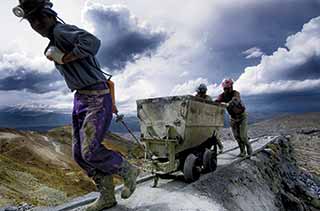
Bolivian Miners

In Bolivia's mines, men and as many as 8,000 young children endure horrific conditions to feed the world metal market; chewing on coca leaves offers the miners a traditional analgesic and appetite suppressant.
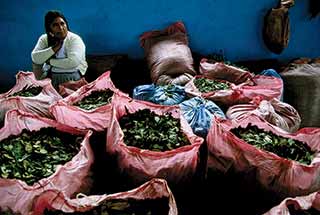
Bags of Coca Leaves

But these leaves in the Eterazama coca market are too bitter to be chewed—they are destined instead for the cocaine market.
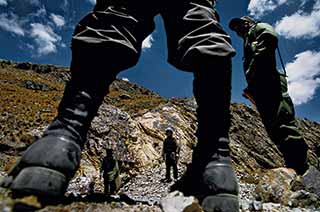
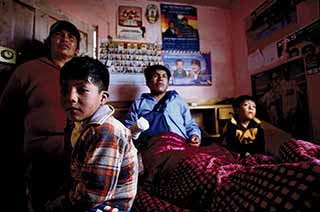
Bags of Coca Leaves Bags of Coca Leaves

In a clash between miners and Bolivian soldiers (top) , Nolberto Mamani Apaza (bottom) lost his hand. His 9-year-old son will have to take his place in the mines.
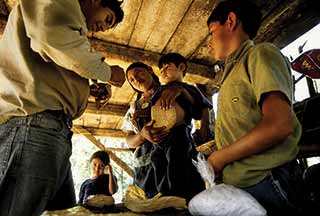

A Family Stomping on Coca Leaves

Along the Bolivian front of the war on drugs, buyers tape packs of cocaine to children (top) for transport to the city, while men work for hours stomping coca leaves with water, gasoline, and chemicals to create cocaine paste (bottom).

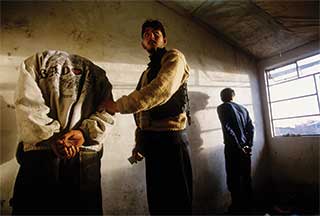
A Police Raid Arresting Drug Dealers

Trained and funded by the United States, Bolivian police do take out small labs (top) and arrest low-level traffickers (bottom), but interdiction efforts don't do much to stanch the flow of cocaine.


It was the gas war of 2003 as well as dissatisfaction with the American-led war on drugs that led the brown masses to march on La Paz and usher out the last of Bolivia's white-led, semi-colonial governments. Real, broad elections summoned for the first time an indigenous leader, Evo Morales, to the Palacio Quemado, or "burned palace," so named for being repeatedly torched during the more than 150 ruling-class coup d'etats that have marked Bolivian history. With its mixture of idealism and limited but sharp violence, this latest uprising was more like the Ukranian Orange Revolution than the Castro-style putsch feared by K and Wall streets. The alpaca-sweater-wearing Evo celebrated his inauguration at the ancient city of Tiahuanaco, at the ruins of a pre-Columbian site of sun worship. In accordance with mass demands for democracy and transparency, his administration struck a populist tone, signing trade deals with Venezuela's Hugo Chávez, nationalizing foreign-controlled oil and gas industries, paying students to attend school, and updating the face of nationalism, evidenced by the endless television programs in which indigenous people present their grievances and are, for the first time in Bolivian history, actually heard. The revolution is by no means perfect. Corruption persists, and Evo has not hesitated to toss the race card back in the face of the white elite who exploited it during the last century. Still, there is no turning back the clock on the rise of a new majority.

But having asserted their power, Bolivia's indigenous people—a clear majority in a nation of just 9 million, but divided into many language groups—face the challenge of forging a movement larger than identity politics. Increasingly the Aymara are fleeing altiplano poverty for the tropical promise of the lowland coca business, uprooting their ancient way of life for a risky, marginally profitable role as peons in the international drug trade. Urbanized "Indians" are in reality sharply divided between established cholos, a bowler-hatted business class with longtime roots in La Paz and other cities, and the ever-swelling ranks of newcomer refugees who crowd into El Alto and other chaotic, emerging neighborhoods, scratching out a living as porters, gardeners, and ditchdiggers. Regionalism is spinning the country apart, pitting the national government high in La Paz against the economic powerhouse of lowland Santa Cruz. Fresh, angry slogans in La Paz cry out eliminate private property, less a practical demand than a warning of the impossible expectations that await reformers.

Many who remain in the mountains resort to the pittance earned by mining for gold, silver, and tin. Under Spanish rule, these same mines cost the lives of millions of indigenous and African laborers. Thanks to the global boom in metal prices, mines previously considered exhausted tempt a new generation of boys who descend into impossibly dark, narrow, unventilated veins of the Andes, chewing coca to suppress their appetite, fatigue, and fear.

Coca has always been a palliative for Bolivia's poor, but only recently has the country become central to the global cocaine market. As Washington squeezed the coca balloon in Colombia, it has bulged out in southern Bolivia, where production has increased, even as the United States now pours $66 million a year into interdiction, military and police training, and dare anti-drug classes for 28,000 Bolivian students. America has focused on crop eradication, and efforts to help Bolivians cultivate replacement crops have mostly failed.

A former coca farmer and coca-union leader who railed against American-led programs, Evo Morales ran on a Coca Sí! Cocaína No! platform. He keeps a portrait of Che Guevara made entirely from coca leaves on his office wall and never misses a chance to serve coca tea to visiting politicians. But the leaf traditionally grown at high altitude and chewed by indigenous Bolivians has become a Trojan horse for the broader cultivation of a more bitter, unchewable, low-growing leaf useful only to narcotraffickers. Washington tabulates successes like body counts, claiming that in 2007, precisely 3,093 labs and maceration pits (often little more than plastic-lined ruts where cocaine paste is mixed) were destroyed, 13.8 metric tons of cocaine base were seized, and Bolivia's anti-narcotics police carried out 8,269 operations. The real gains are ephemeral. Armed and trained by the United States, Bolivian commandos chase low-level producers through Evo's Chapare region; meanwhile major traffickers sometimes walk out of jail, as pure and cheap cocaine floods onto world markets. On a fundamental level, the war on drugs is like all the other commodities wars Bolivia has endured: Rural peasants take all the risk—going so far as transporting coca by strapping it to the bodies of their young children—while outside traffickers take most of the profits.




Photojournalist Marco Vernaschi has spent years chronicling the plight of Bolivian miners. Patrick Symmes is a contributing editor for Outside, and the author of The Boys From Dolores.


TOOLS

EmailE-mail article
PrintPrint article


BACKTALK

E-mail the editor


Google


Post a Comment

Your Name: 

Your Comment: 
 
Please press "Submit" only once to avoid double-posting.
All HTML formatting is removed from comments.
Read the Mother Jones community rules here.

Comments:

As long as it keeps me High, I dont care where the Peruvian Marching Powder comes from. Viva El Puro, Viva Bolivia
Posted by:Franklin GrimesJuly 18, 2008 3:44:22 PMRespond ^
I wonder at the work and the risk these peasants endure for very little profit. People who use cocaine in the US are scum. They are the core reason this whole nightmare exists.
Posted by:NormanJuly 18, 2008 8:57:39 PMRespond ^
Bull sh*t Norman,
Get your facts first then talk about the cocaine trade. This is about power and control, not drugs. No different than the War on Terrorists. Scare the people so you can save them from the menace. If they wanted to they could buy all the cocaine and burn it, and save billions of US dollars. The same goes for the opium trade in Afghanistan, Nothing will change until we change our drug laws forced on us by J Edgar Hoover and Anslinger.
http://en.wikipedia.org/wiki/Harry_J._Anslinger


http://www.sourcewatch.org/index.php?title=War_on_Drugs
Posted by:RayJuly 22, 2008 2:09:31 AMRespond ^
The so-called "war on drugs" is a hypocritical attempt to justify the military-industrial complex after the collapse of the Soviet Union.
It's the peak of hypocrisy. If the US government were sincere, they would squeeze the domestic wholesale distributors (the Mafia), not offshore producers. Most of all, it's for show, so that they can broadcast TV reports of action in the field, sort of like waiting to attack Iraq until the TV crews were in place to broadcast it.
Drug addiction does affect everybody, since the addict will do whatever he can, including burglary and robbery, to get the money to buy the drugs. Most of all, it's a social problem that could be reduced by education and treatment, not by demonizing people and moralizing at other governments. Other countries have more enlightened policies, but it doesn't make for good television to justify the rah-rah Rambo tactics of the military-industrial complex.
Posted by:Bob ParkerJuly 22, 2008 8:27:31 AMRespond ^
Hi, I'm the author of this photo essay.
against my own interest, I decided to publish here a story that nobody in the US seems to be interested to talk about. Why? Read and you'll understand.

I apologize for my English, just remember that I'm Italian....

The First thing that must be clear: coca and cocaine are two different things. Cocaine doesn't have ANY medicinal value, while the coca leaf does.

Behind the coca leaf there's a big issue that nobody talks about: The billionaire interests of the pharmaceutical industry, in the US.

An international UN law bans the trade (import/export) of the coca leaves, as the plant is listed as a primary ingredient to make narcotis.

For this reason, the US Gov. provides a unique, special licence issued by the Drug Enforcement Administartion (DEA)to a US based chemical company, which name is Stepan. This licence is in total contrast with the international agreements.

An Illinois-based chemical company, the Stepan Company, is the only one in the planet allowed to import coca leaves from South America. Stepan Chemical Company have a special licence issued by the DEA that allows the exportation of tons of coca leaves every year, mostly form Perù and Bolivia.

Stepan sells the coca syroup to CocaCola, which use it to flavour the popular soft drink, after processing the leaves to extract the alkaloid of the cocaine. CocaCola make almost 500.000 bottles of beverage per day, turning the cheap leaf into gold. Moreover, Stepan makes more billions selling the cocaine alkaloid to the pharmaceutical industry, in the US and in Germany.

At this point, some big contraddictions need answers:

First, why should the US Administration fight to eradicate the coca crops, being the coca plant the essential base for a billionaire market that makes the USA rich, and fuel some of the strongest lobbies that endorse the Government?

Second, how the US Administration would explain the contraddiction of the same Federal Agency, the DEA, simultaneously trying to destroy every single leaf of the holy plant and then granting a chemical Company with a unique licence that allow to trade the same plant?

Beside the previous questions to be answered, the former coca-farmer and current President of Bolivia, thought it would make sense for his Country to enter this exclusive business, being Bolivia one of the three only Countries in the world where coca grows. How to blame him?

One of the answers to such questions has to be searched in the multibillionaire machine that feeds the lobby close to the US Gov. through a 660.000 million per year contract given to the DynCorp, a paramilitary private contractor that works in the Coca region (Bolivia – Colombia – Peru – Ecuador). As for Bolivia, DynCorp is officially training “police forces”.
Such police forces are actually some paramilitaries loyal to the extreme right-wing Bolivian party Nacion Camba led by Branko Marnovich who is preparing to destabilize Morales’ Gov.

Morales aims to enter this market, turning the coca crops into one of the Nation’s economical strengths. Before Morales was elected, Stepan Chemical used to buy huge quantities of leaves from Bolivia, and they also built a factory/storage in the Chapare region on this purpouse. But after the indigenous President came into office the Company moved on to Peru to buy most of the leaves, turning Bolivia into a marginal supplier.

In order to offer to the chemichal and pharmaceutical industry - and to CocaCola - the essential element which is at the base of their business, Morales’s Government - with the aid of Hugo Chavez - invested 400.000 USD to build the first factory ever to process the coca leaf in the Bolivian region of Chapare, and he’s working to change the UN law that bans its trade.

The UN response to his efforts, however, is discouraging. The UN released an official act in March 2008 asking the Bolivian and Peruan Gov’ts to ban even the traditional use of the coca leaf in their territories, transforming an already complicate political issue into a cultural issue. In the same time Internation Crisis Group released in late March 2008 an historiacal report about the failure of the War on Drug in South America.

If the Nation may rely on a legal and rewarding coca-based business, it would be logic to think that the indigenous people of Chapare would gradually move toward a legal business, leaving the cocaine production behind, not to mention the interest of the foreign pharmaceutical companies to invest in the Country.

Morales’ controversial friend Hugo Chavez and the revolutionary chages brought by the policy of nationalization of Bolivia’s natural resources – including the coca crops – led the US Gov’t. to study a special plan, in order to keep control over tha nation.
If Morales should achieve his goal on the legal coca market, the US would lose a billionaire market and the chemical and pahrmaceutical industry that lives on the cocaine alkaloid may choose to invest in Bolivia, dealing with better prices and a more flexible tax regime.
This would virtually cut the US out of the heart of Latin America: Perù may follow the example of Bolivia. Colombia would remain the only South American Nation where the US still have control, but surrounded by enemies in and out of its borders.

To avoid this scenario the Bush Gov’t. sent a special person in Bolivia: the current US Ambassador Philip Goldberg. Golberg was the Department’s Bosnia Desk Officer who studied and organized the fragmentation of the Balkans in the 90’s, known as Balkanization. He was previously based in Pristina - Kosovo - and he was suddenly displaced in Bolivia few months after Morales came into office.

He brought with him a lobby of investors from the Balkans, who are represented in Bolivia by Branko Marinovich (Bolivian leader of the Morales opposition) – ...but not a tipical Bolivian name.

The goal is to replicate the fragmentation scheme of the Bakans in Bolivia.

The indigenous President is facing now facing a political war in his own Country, against the right-wing opposition. Their strategy is to move the Capital City from La Paz to Sucre, creating a block of Eastern regions (called the Half Moon) that would isolate the left-wing, western regions that support Morales.
The Half Moon is the rich area of Bolivia, where oil and gas reserves supply Brazil, Argentina and Chile, and where a flourishing agriculture make the difference between the poor regions of the Altiplano and Tropic of Cochabamba.

The Half Moon is mostly inhabited and ruled by mestizos and european descendents who letterally hate the indigenous. The strategy to achive the separation of the Country is throwing fuel on the burning fire of racial hate. Just like it happened in the former Jugoslavia, in early the 90’s.

The opposition party, La Nacion Camba, is secretly training some paramilitaries with the suspected endorsement of the US Govt., and the on-site supervision Philip Golberg.

THAT'S ALL - hope it helps to have a more clear idea of the real situation.

Marco Vernaschi
Posted by:Marco VernaschiJuly 24, 2008 4:21:35 PMRespond ^
why are plants and their buy products so evil? Why are coporation allowed to fill lakes with lead and death, acid in the air and wind, yet no one ever goes to jail for that? What a world no? where plants are seen as wicked yet raping the earth is seen as progress.
Posted by:maya0July 29, 2008 4:11:34 PMRespond ^

Jail.org - Inmate Search
Criminal records, instant public records & people search & current court records. www.jail.org

U.S. Public Records Search
Search County & State Court Records, Criminal records, Vital and Adoption Records www.PublicRecordsInfo.com

Records.com - People Search
Public Records and Background Checks. Instantly Search Criminal Records, Addresses and Court Records www.Records.com

Court Records & County Records
Find Instant Public Records, Criminal Records as Well as County Property Records Search. www.PublicRecordsIndex.com


Sebastian Mallaby Has Had Enough

Charlie and Sarah

Drill, Baby, Drill

Torches and Pitchforks


More MoJo voices...


bookIN PRINT

CLICK HERE
for more great reading

headphones IN TUNE
New music every issue

CLICK TO LISTEN


This article has been made possible by the Foundation for National Progress, the Investigative Fund of Mother Jones, and gifts from generous readers like you.

© 2008 The Foundation for National Progress

About Us   Support Us   Advertise   Ad Policy   Privacy Policy   Contact Us   Subscribe   RSS