MOTHER JONES BY E-MAIL

How to Burn the Speculators

NEWS: Why is the price of oil so high? Because the Bush administration did to the commodities market what it did to housing.

September/October 2008 Issue


TOOLS

EmailE-mail article
PrintPrint article


BACKTALK

E-mail the editor


Google


RELATED ARTICLES

Whenever economies sour, politicians blame speculators. But on occasion, they are right to do so. Speculators did wreak havoc in 1630s Holland, 1720s France, and in the American stock market in 1929. That crash led to the Great Depression and 60 years of tight controls on speculation. Now, thanks to our 30-year infatuation with free markets, the controls are off, and the mad gamblers are at it again. Yesterday's burst bubble was housing; today's expanding ones are energy and food. True, we have major long-term energy problems that cannot be laid at the feet of speculators. To avoid catastrophic global warming, we will be obliged to reengineer the country, from housing to transport to forests, and How to Burn the Speculatorsalso to develop and export the technologies required for the rest of the world to do likewise. Eight years of George W. Bush's policies have made this much harder, and during that time the world may have passed "peak oil"—that moment when half the recoverable reserves of conventional oil have been drained and burned—so that from now on short supplies will be endemic. Meanwhile, demand grows, notably from China and India, which account for nearly 40 percent of the world's population.
But do supply and demand explain oil prices at $140 per barrel, with voices from Goldman Sachs projecting $200 for next year (a figure that would push gas prices above $5 per gallon) and Russia's Gazprom saying $250, despite a likely US recession? Do they explain the historic price hikes in rice, corn, and wheat, leading to hunger in the developing world? Do they explain the absolutely stratospheric price of copper? No they do not.

Yes, Virginia, speculators can affect the price—if they are large and relentless enough to dominate a market, and especially if they can store the commodity and keep it off the market as the price rises.

Futures markets exist to permit commercial interests to hedge their business risks. For a fee, a farmer (or oil producer) can put a floor under the price at which his product will sell. The forward price is normally a bit lower than the current price, but the contract protects the farmer from a catastrophic price slump—such as may occur in (for instance) bumper years. Speculators buy the futures on the chance that the market price will be substantially higher. They make a respectable profit on what is in effect an insurance function, and a killing in years of drought, flood, and war.

This system works reasonably well so long as speculators do not actually control or manipulate prices. For if they can drive prices way up, they can obviously cash in while the farmer (who has presold his crop) cannot. Strict regulation by the Commodity Futures Trading Commission (cftc) is supposed to prevent that.

But thanks to Phil "nation of whiners" Gramm—the former Texas senator who was until recently John McCain's top economic adviser (see "Foreclosure Phil")—futures market regulation went to hell. Under the "Enron loophole" pushed through by Gramm in 2000, energy futures were allowed to escape all federal and state regulation. Gramm embedded that loophole in a surprise 262-page rider, drafted at the behest of Wall Street and Enron, in an 11,000-page appropriations bill on a Friday evening two days after the Supreme Court handed down its Bush v. Gore ruling and as Congress was rushing home for Christmas. In a separate bit of absurdity, in January 2006, the Intercontinental Exchange (ice) of Atlanta, which trades benchmark US oil futures (West Texas Intermediate or wti), came to be treated by the cftc as a British market (the "London loophole") so that US regulators do not even track what is going on. (Even more surreal, the cftc was going to allow trades of US oil futures on terminals located in America to be "regulated" in Dubai; political pressure put an end to that idea in July.)

Worse still, Gramm's Commodity Futures Modernization Act of 2000 also opened the way for growth in deregulated "credit default swaps"—a way in which financial institutions "insured" that bad loans would not cause them losses. This, combined with other deregulatory moves by the cftc, broadened the "swaps loophole," an enormous backdoor into the commodities markets, basically permitting speculators making bets off the commodities exchanges to be treated as "commercial interests"—like say, farmers—and hence avoid the scrutiny (including limits on the size of their bets) normally applied to financial players. Thus today, when officials like Treasury Secretary Henry Paulson say that speculation is not a factor in the commodity markets, they're not counting hedge funds and investment banks as speculators—even though that's what they really are.

According to Senate testimony on June 3 by Michael Greenberger, who used to head the cftc's division of trading and markets, if swaps were properly labeled, about 70 percent of the oil futures now traded on the New York exchanges would be deemed speculative, not commercial, and subjected to a high degree of regulatory scrutiny.

Okay, let's think this through. First, vast sums of money are flowing through regulatory loopholes into the commodities markets, particularly for oil. Second, spot prices (those charged for immediate sale) in all commodity markets have been soaring. In particular, Americans now pay an average of $4 per gallon for gas. Is it possible that these two events are unconnected? Is it possible that Paulson—former ceo of Goldman Sachs—is right when he says that the price of oil is being driven mainly by supply and demand?

No, and Senate testimony in May by Michael W. Masters, a hedge fund manager, illustrates why not. Masters points to the spectacular rise of "index speculation," in which pension funds and other investors invest in the commodities futures markets according to formulas created by, among others, (guess who?) Goldman Sachs. Index speculation investments have risen from $13 billion to more than $250 billion since 2003. Masters calculates that the speculative demand for Texas oil futures from this source is now five times the actual 2003 stockpile (the baseline he used); for corn and aluminum the figure is about nine times; for silver it's a phenomenal fourteen times. There is of course no way that the orders represented by all those futures contracts could be met.

So the futures price goes up. As it does, supplies actually disappear. For instance, copper expert Frank Veneroso believes that 800,000 tons of copper has been hidden away in China, waiting to emerge closer to the market top. For Saudi Arabia and perhaps Russia the matter is simpler: Oil stays in the ground, and the oil not sold boosts the price of the oil that is. As current prices soar, the index speculators obey their computer programs, which tell them to pour still more money into the commodity markets.

There may be a further element at play, according to an April speech by Attorney General Michael Mukasey: "International organized criminals control significant positions in the global energy and strategic-materials markets. They are expanding their holdings in these sectors, which corrupts the normal functioning of these markets and may have a destabilizing effect on US geopolitical interests." To whom exactly Mukasey is referring, he does not say. But that organized criminal interests have the motive, means, and opportunity—handed to them by Phil Gramm—to destabilize the world energy markets seems quite clear.

On these matters, there is a quick fix. Under pressure, the cftc is closing the London loophole. Early in the next administration, Congress must slam shut the Enron and swaps loopholes. Index speculation should be curtailed by making such strategies illegal for regulated pension funds and by imposing limits for all traders on how much they can buy or sell. Investment banks using credit default swaps to enter the commodities markets should be regulated to the standards that apply to speculators, not as if they were heating-oil vendors hedging against a warm winter. Investigations now under way at the Federal Trade Commission, the Federal Energy Regulatory Commission, and the Department of Justice should be intensified, and criminal manipulation of the markets, if detected, should be punished.

Finally, the federal government should burn the oil speculators by selling up to 4 million barrels a day from the Strategic Petroleum Reserve. And as economist Tom Palley has pointed out, consumers can help too. An awful lot of gas is stored in cars. If people stop topping off and make do with half a tank, they'll back up supply and lower demand. It's a brilliant suggestion and definitely worth a try.

And while this is being done, and especially if all this smoke leads to fire, someone should ask, "What did Henry Paulson know, and when did he know it?"

James K. Galbraith is a contributing writer for Mother Jones.

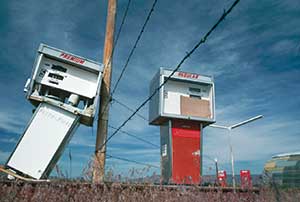
Photo: Phil Schermeister/Corbis | Cartoon by Steve Brodner


Post a Comment

Your Name: 

Your Comment: 
 
Please press "Submit" only once to avoid double-posting.
All HTML formatting is removed from comments.
Read the Mother Jones community rules here.

Comments:

I respect Galbraith a lot - but why the hell must we blame bush for this? It's DEMAND DAMMIT.

More importantly - repeat after me - High Gas Prices are a GOOD thing. I'll say that again: High Gas Prices are a Good Thing (at least at current levels, much higher might cause problems temporarily)

If this audience has any education then I won't have to explain myself further.
Posted by:FexAugust 18, 2008 2:28:35 PMRespond ^
$5 a gallon for gasoline in the US? Here in the UK, we already pay the equivalent of $3 to $4 a litre ... a litre ... and when the price of a barrel of crude goes down, the eventual decrease at the pumps never reflects any such reduction meaningfully or proportionately ...
Posted by:Russell CavanaghAugust 18, 2008 4:25:18 PMRespond ^
Bush is to blame and so is his father and grandfather, but so is Clinton, who sat on his thumbs when he had a chance to break (or seriously damage) the stranglehold which the oil-o-garchs have on our national security and our way-of-life. At least Bush-W told us the truth. He told us pretty much exactly how he was going to screw us and did precisely as he promised. Clinton pretended to be an altruistic liberal earth-o crunch-o environmentalist while he did NOTHING to improve mileage standards, did NOTHING to expand renewable energy and basically, set the stage whereby Cheney does not appear to have an extreme position. Clinton raped us but Bush sold us into slavery.

People, we are about to be screwed like few living Americans can remember. The 'economically powerful' have become the economically all-powerful. Its no longer about money for them. Its about their thirst and addiction for our life's-blood. The machine has taken over and the guy at the controls is just window-dressing. Like the guy at McDonalds--who pushes the button to lower and raise the fry basket. His job is 100% unnecessary as the same computer that times the fry can just as easily load and empty the French-fries. They keep him around for a cordial atmosphere.

As for speculation: It is always part of the problem. Part of the problem is the very low dollar, which was engineered that way by the Bush administration to favor the large corporations. Since oil is traded in dollars, essentially, the price of gas has NOT gone up in Europe as much as in the USA. The biggest part of the problem is human greed. While the greedy may never get over their abuse problem, we have to get over them. All of us, Ds and Rs and old and young and black and yellow and everyone.
Posted by:TrollsteinAugust 18, 2008 4:33:04 PMRespond ^
Well, Galbraith is spot-on, even if "high" gas prices are a good thing. Speculation causing high gas prices doens't convince folks in the U.S. to actually, seriously conserve. It is a taste of things to come.

The market for oil, and the oil companies, should be nationalized. Nothing this valuable should be left in the hands of the market...even 'non-speculators.'
Posted by:Gas PricesAugust 18, 2008 4:37:23 PMRespond ^
this point of view is so far from the truth as to be funny. To begin speculators did not cause the crash of 1928, the federal reserves high interest rates and decrease in money supply did. Large speculators do not take delivery of futures contracts, hence they cannot 'set' the price.
Posted by:larry williamsAugust 18, 2008 5:14:36 PMRespond ^
This article is completely misleading and not based on either fact or evidence.
Posted by:JimAugust 18, 2008 5:16:58 PMRespond ^
"If people stop topping off and make do with half a tank, they'll back up supply and lower demand."
Note to Galbraith reptilian brain: you won't lower demand by making do with half a tank if you refill your tank twice as frequently.
Posted by:Carbon taxAugust 18, 2008 5:24:39 PMRespond ^
The Congress of the USA is supposed to be our best and brightest citizens….? Should they not see and understand what is happening to our great society? The problems that have surfaced in the Market place were certainly not hidden from them. What happens to our Congressional Representatives when they get to Washington? Is there something in the drinking water? or do they believe that once elected they are entitled to adopt the Greed and Grab mentality. Some say the poor and needy should not be concerned with Entitlements; it seems that Entitlements are now more for the rich in Washington than the poor in the rest of the USA.

Contributors of email voice strong opinions, many have a point to be considered. Some of these contributors should be in politics; however, would they not also join the G and G.
For at least 40 years the GOP has been selling the American voters on the premise that a conservative government is necessary to protect against an overly powerful one that would sap the life from all of us. Well, if wealth is power what the hell do we have now? Federal controls have been lifted in the name of greed alone, and certainly, not for the betterment of society. Wealth and greed is power, and much more detrimental to all of us than a powerful Democratic Congress.
Ask, when these great open markets fail who pays the price? Certainly the wealthy, it is always the taxpayer, sooner or later.
Posted by:kish1934August 18, 2008 6:00:06 PMRespond ^
Oil prices are CONTROLLED--pure and simple. Simple ignorant Americans, with their 2-second attention span, completely forgot the 2006 election year when the price of gas dropped by almost dollar per gallon beteen July and November. Prices are FIXED by the 5 or 6 billionaires who own it ALL.
Posted by:allenAugust 18, 2008 6:04:02 PMRespond ^
We conserve gas by not having it available (out of sight out of mind) in our gas tank. Filling up less than half a tank will make you more aware of what you are using. It is a constant reminder. I do agree that the leaders only change identities, but are much of the same cloth. But that latests from a Bush admin. Paulsen opened the flood gates for this one.
Has anyone been watching the videos on The Bohemian Grove? If not, it shows how all the moguls, political, finance and otherwise all buddy around together and make decisions at a frat boys Druid ritual. Hey you can't make this stuff up!
Posted by:J. SpiritAugust 18, 2008 6:38:15 PMRespond ^
i wish we all owned as much petro stock as good ol boy "fex" after all anybody with half a brain knows how much our LoL "patriotic oil supplier -distributors " are keeping from the common citizens & taking from them, especially,their wallets, an exercise for all " locate full tankers on the ocean not allowed to dock & offload & you will see why the price of crud {yes i said crud } oil hasent been in the favor of citizens for so long {hint ya gotta access the gps systems mgmnt for the large oil tankers to see how much crud is on the sea with orders to stay at sea {this is how the oil supply is controlled and proclaimed a shortage} once again as our esteemed politicians especially gramm have done their best to deliver us from our wages & saveings & now the rich are crying because nobody has the money to purchase their goods with prices in the astronomical range. the wealthy s have lotsa stock & less & less demand because of corporate greed & criminality. no body can afford to buy from them. soon they will have to drop their prices or starve with the rest of the world it will just take em longer but happened to all dominant world powers thru history yes it does repeat itself when the criminals are uncontrolled like they are at Pennsylvania ave corrupt breeds more corrupt & all fall what did we do to deserve this VOTED 4 THE WRONG REPUBLICANS signed a supporter of Ron Paul go Ron
Posted by:wildemanne August 18, 2008 7:14:40 PMRespond ^
Well then, I suggest we hunt down Mr. Gramm and the speculators and we make them "Whine" a bit.
Posted by:Fred FarkleAugust 18, 2008 8:12:59 PMRespond ^
Peak Oil is a catastrophe that we must now face, this is no time for scapegoating.

According to energy investment banker Matthew Simmons and most independent analysts, global oil production is now declining, from 74 million barrels per day to 60 million barrels per day by 2015. During the same time demand will increase 14%.

This is equivalent to a 33% drop in 7 years. No one can reverse this trend, nor can we conserve our way out of this catastrophe. Because the demand for oil is so high, it will always be higher than production; thus the depletion rate will continue until all recoverable oil is extracted.

Alternatives will not even begin to fill the gap. And most alternatives yield electric power, but we need liquid fuels for tractors/combines, 18 wheel trucks, trains, ships, and mining equipment.

We are facing the collapse of the highways that depend on diesel trucks for maintenance of bridges, cleaning culverts to avoid road washouts, snow plowing, roadbed and surface repair. When the highways fail, so will the power grid, as highways carry the parts, transformers, steel for pylons, and high tension cables, all from far away. With the highways out, there will be no food coming in from "outside," and without the power grid virtually nothing works, including home heating, pumping of gasoline and diesel, airports, communications, and automated systems.

This is documented in a free 48 page report that can be downloaded, website posted, distributed, and emailed: http://www.peakoilassociates.com/POAnalysis.html

I used to live in NH-USA, but moved to a sustainable place. Anyone interested in relocating to a nice, pretty, sustainable area with a good climate and good soil? Email: clifford dot wirth at yahoo dot com or give me a phone call which operates here as my old USA-NH number 603-668-4207.

Posted by:Clifford J. WirthAugust 18, 2008 8:44:45 PMRespond ^
All I can say America is going to slide into the ditch like a pig on a greased plank. I went downtown, no bus stations, no bike paths. I dont care for town, yet them city folk going to pay for their uppity way's. Yes sir.
Posted by:Franklin GrimesAugust 18, 2008 9:37:10 PMRespond ^
this article is way off base with cold hard economic facts and is actually misleading. i love mother jones but not this time. btw, [deleted] bush.
Posted by:rudyAugust 18, 2008 9:46:51 PMRespond ^
the crash of '29 was caused by speculators is true. You could buy stocks with little or no money down. As long as the price of the stock rose all is well. The market went flat, margins called in and wham. meltdown. To say high gas prices is a good things is ludicous. Every commodity has to be trucked in, trained in, bused in or flown in, all these methods used fuel. If the transportation costs rise the cost of goods rise. Unfortunatedly so will everything else. Bush made a commiment to the American public to serve them, not cronyism.
Posted by:docgizmoAugust 18, 2008 9:54:19 PMRespond ^
Hey we are to blame we domt demand our people in congress work for us write your congress man or woman tell them your views on reneable energy anuff of us do it thay will change some of what thay do in congress and support it more but thay must hear from you,only one percent contact there congressman so if big money or oil is knocking on there door every day "lobbies" then thay will lean there way we do need third partys in congress so if someone is runnning on a third party ticket learn there views and if you like them vote for them five to eight vote that could go any way would shake up how the D's and R's do there thing in congress and might force them to work for us for a change and not big oil
Posted by:Glenn M.August 18, 2008 10:44:22 PMRespond ^
High gas prices are NOT a good thing. If you're saying it's good because of the enviroment, you are incredibly dull, for someone who obviously views himself as bright. As long as people are making a killing from gas prices, we will never move to alternatives. It's just about too late anyway; I don't think people understand the enormity of changing our entire infrastructure. And who are you to say when gas prices are high enough or not high enough? If you can afford it, then it's okay, but if it gets too high and starts to affect your budget then it's too high, I suppose?
As far as Bush--most problems we are facing have been either caused by his direct action, his neo-con buddies actions, or their lack of taking action to protect anyone but the already filthy rich. It's always "me, me, me." I can't believe they call themselves Christians. If there were a Christian God, he would surely strike them down, for they are the most un-Christian of people--filled with greed, and lust for war. We have a Defense Dept. that is getting ready to throw away billions in parts they haven't yet even received, yet they want to cut money from Social Security. They all deserve a vacation at Guantanamo, with some recreational water-boarding.
Posted by:AlanAugust 18, 2008 11:02:06 PMRespond ^
I don't know bout you but I and my family can't afford the price and many I know only buy 10.00 worth at a time Where do you live 90210.
Posted by:EricAugust 18, 2008 11:29:01 PMRespond ^
previous post was to carbon tax
Posted by:EricAugust 18, 2008 11:30:30 PMRespond ^
Oh sure, the government does such an outstanding job of most everthing...lets definitely nationalize it...get a clue.
Posted by:RonmacAugust 19, 2008 12:29:11 AMRespond ^
Water boils at 212F, and, at that temperature, starts to develop 'vapor pressure' as a gas. It doesn't take that much heat to boil water, and if you use your fuel to heat the water, and the resulting vapor pressure to do mechanical work, a fairly efficient system can be devised, which is largely how things got done prior to the advent of diesel and gasoline liquid fuels. Steam technology has improved quite a bit over the decades, and it's not inconcievable that Peterbilt or other freight tractor could be converted to steam, complete with a condenser system for water efficiency. The inventors, the independents, are going to tear this problem down, and the oil peeps are going to wish they hadn't tried to 'jack' the market around like they have. They've had their fun, but now it's time for the Edisons out there to 'make it so', and, if you do a little reading, there's answers on the approach that are going to make oil basically obsolete, which the oil peeps know, which is why they're trying to grab all the cash that they can right now.
Posted by:BertAugust 19, 2008 1:15:58 AMRespond ^
"But do supply and demand explain oil prices at $140 per barrel, with voices from Goldman Sachs projecting $200 for next year (a figure that would push gas prices above $5 per gallon) and Russia's Gazprom saying $250, despite a likely US recession?"

Sure they do Mr. Galbraith -- if the real worth of what we get from oil is actually much higher than $150. Until recently spare capacity allowed OPEC to manage prices. Now that supply is very thight we figure out the real worth of this amazing stuff called oil. Think of it -- a few cents and you can transport yourself, your family, all your luggage and your car over a couple of miles. If you had to push all this by yourself i'm quite sure you would be glad to pay dollars not cents to accomplish this task. Let's face it, even at $150 oil is still cheap for what we get from it.

Best hopes, pg
Posted by:pgAugust 19, 2008 7:42:01 AMRespond ^
Seems to me that if everyone only made do with 1/2 a tank, that would only create a one-shot drop in demand -- their overall consumption rate would not change.
Posted by:AdamAugust 19, 2008 8:55:38 AMRespond ^
Bert, from the considerable research I've done, I don't see how steam can possibly be any more efficient than internal combustion. All heat engines are governed by their Carnot efficiency, and each energy exchange (chemical to heat, to steam, to mechanical vs. chemical to heat to mechanical) suffers a loss due to entropy and the Second Law of Thermodynamics.

It was largely due to the inefficiency of steam power that Rudolph Diesel invented his heat engine, which after more than a century, remains the most efficient way of converting heat energy into mechanical energy, at 40% to 50% of Carnot efficiency.

Like Clifford Wirth, we are working on solutions. We currently produce about 2/3rds of our own energy. We're looking for skilled people to help us become debt-free. http://www.EcoReality.org
Posted by:Jan SteinmanAugust 19, 2008 1:10:38 PMRespond ^
Supply and demand is a concept, not a truism. The idea is, "If people want or need it bad enough, they will sacrifice all they can to get it." This has little or nothing to do with the "value" of that item.

If gas prices jump to $15 per gallon, is that "too high" so that people will stop purchasing gas? Or maybe they'll just fill their tank halfway? Or maybe they are forced to continue to sacrifice other elements of their life in order to pay that amount.

Maybe if somebody who "owns" water ... a very similar commodity ... started charging more and more money for its use, then people wouldn't use so much of it? Or maybe just use half?

Arguments like that are specious, as they ignore the truism that people do what they must to survive. People will continue to pay ever-increasing prices for gas not because they feel it is "worth it", but because they MUST use it, in the absence of a viable alternative. This is not to be confused with someone who pays $250,000 for a Mustang GT because they think the car is "worth it", which IS a value proposition.

High gas prices are an abomination, just like high water prices or high air prices would be. I wish that it were otherwise, but the world has been reorganized around petroleum, and it has come to the point where gas is a necessity, like it or not.

Let's work harder to develop alternatives. You won't find any help from BushCo or its ilk, so it will be expensive and it will take longer than it should to get around the roadblocks that the vested interests have put in place (EVO, anyone?), but it is required if the world is ever to get out from under the heavy hand of the profiteers.
Posted by:James ButlerAugust 19, 2008 7:49:40 PMRespond ^
Phil Gramm is cool, but Beavis, if he caffeinates into The Great Cornholio, refuses to acknowledge The Great American Corporate Lackey, so I think we should leave Phil in South Park, where he feels safe and truly belongs.
Posted by:ButtheadAugust 20, 2008 2:27:07 AMRespond ^
Thank you Mr. Galbraith. Ultimately, we need to make collectively hard decisions, from the upper 1/10 of 1% to the lower 20% financially speaking. The United States has been the model for capitalism, waste, insatiable demand, pop culture, imperial yet restrained destiny, and we have a few years left in the limelight to define something new for the world...something self-loving. By self-love I mean loving ourselves by caring for our environment, our needs, one another, conserving energy, protecting wildlife while not infringing upon human rights, etc. etc. etc. We have that ability for perhaps only ten more years before the world looks elsewhere for models of inspiration and political philosophies.
Posted by:MarkAugust 20, 2008 6:31:45 AMRespond ^
I have already started driving on half a tank. My vehicle averages 36 mpg and I can go 350 miles on half a tank.
Posted by:radline9August 20, 2008 9:25:31 AMRespond ^
Oh yes, you patronizing jerk, for those of us who were denied your obviously superior education, please explain it in detail.

Thank you.
Posted by:CherylAugust 20, 2008 3:42:17 PMRespond ^
I agree with Fex. Keep gas prices where they are now. People will continue to conserve, lowering demand thus keeping prices stable if not falling. In fact, the demand in the US has slacked off so much that the US has exported 33% more oil to foreign nations compared to what we exported the first four months of last year. We are currently exporting 1.8 million barrels a day as reported by the Dept of Energy. There is no crisis folks. Even if we started drilling tomorrow and hit the mother load, there would be a bottle-neck as we still lack the ability to refine.
Posted by:seekerAugust 21, 2008 12:52:10 AMRespond ^
Generally, Galbraith view is sound; those of you who oppose this view do not provide specifics. So am I to believe that Enron, Bush & Co., naked short sellers, all investment bankers and hedge funds are pure market players, and Fannie Mae and Fredie Mac caused the sub-prime mess. What this education?
Posted by:MEAugust 21, 2008 10:23:24 AMRespond ^
I am so surprised so many people still have no clue how the market moves and how easy it is to manipulate the market. Blame Bush, blame supply and demand, seems we blame everyone but the real cause. Any person with a second grade education can see that speculators move the price of oil hourly M-F 8 - 5 PM. And those that compare US price of fuel to Europes price of fuel should compare the Euro healthcare system to the US heatlchare system and claiming we get cheap fuel here in the USA.
Posted by:JenardAugust 21, 2008 12:51:17 PMRespond ^
Today it is oil, copper etc. Tomorrow it will be??? Bottom line is: we have the constitution to protect us from government but have NOTHING to protect us from the corporation. If we really believe in freedom and democracy this has to change by whatever means necessary. Nationalizing the oil companies would be great fun!
Posted by:R. AllenAugust 21, 2008 2:46:30 PMRespond ^
This article is insane.. you might verify the facts before you print article for this gentleman in your publication.. I am not familiar with you but if this is your approach to telling the truth I won't be subscribing.
Posted by:Dennis ShirleyAugust 22, 2008 5:29:54 AMRespond ^
I have one better for Bert, seriously... Development on the compressed-air car has been going on for some time by different companies. The idea seems to be you don't need heat to convert water to steam to achieve gas pressure. Go ahead! Check "compressed-air car" on wikipedia. This concept deserves more attention and study than it's getting...
Posted by:pete r.August 22, 2008 1:01:35 PMRespond ^
Anybody who has at any point in time engaged in stock trading would recognize the exact same patterns as during the NASDAQ bubble. Whether it is oil or rice or what ever.

Anyway, peak oil is not "that moment when half the recoverable reserves of conventional oil have been drained and burned". It is the point in time when the maximum rate of extraction is reached, either locally or globally. If it is true that we have reached peak oil it means that it is not possible to further raise supply.
Posted by:Benny MullerAugust 22, 2008 2:40:19 PMRespond ^
I remember back after they had just passed the Graham Rudhamm Act when I was flying as a Corporate Pilot for a sleasey Savings and Loan out of Addison TX (Dallas). When the S&L and plane owner lent his plane to Graham to fly down to TX for some BS dinner engagement. After dinner we flew him and Rudman back to D.C.. For refreshments we had put on a 12 pack of Coores Light Beer, This was in a old fuel hungry Jet and we had to stop in Nashville TN for a refuel, Rudman who didn't drink told us to "call ahead and have them get another 12 pack for Phil" because he was out and needed another 12 pack to get to D.C..
I guess he was researching the market.
Posted by:FleetfootAugust 22, 2008 4:02:18 PMRespond ^
I agree with the comment posted by Allen (above), when he wrote that the gas price is controlled - simply follow the money! As the price of gas skyrocketed, the only ones who benefited in this country were the large oil companies. The Government lost tax dollars as the gas price went up due to a decrease in the purchase (demand) of gas by consumers; and the owners of retail gas stations complained of losing money as the gas price went up for the reason. The major oil companies, however, reported record earnings as the gas price shot up, even as demand decreased. If this does not reflect control, then keep living in your dream world. As a matter of fact, keep electing these Republicans who have long since sold this country out in pursuit of their greed.
Posted by:EdwardAugust 23, 2008 5:21:12 AMRespond ^
This article makes me want to go outside and tell everyone to stop topping off their gas tanks!

Burn, speculators, burn!
Posted by:Dove JohnAugust 23, 2008 1:35:41 PMRespond ^
This article is correct about why our gas prices are so high. Some of the responses must be frustrating to the intelligent author trying to help the ordinary citizen.
For those that really want to know more:

http://energycommerce.house.gov/cmt e_mtgs/110-oi-hrg.062308.EnergySpec.shtml

I liked Michael Master's work too.

BTW: President Clinton signed Gramm's bill, not President Bush.

Posted by:The Political Stray.comAugust 25, 2008 12:40:13 AMRespond ^
I dont know how people can say this article is misleading. It isnt. The speculators called themselves commercial traders, this is part of the loophole. As well many of the specualtors only put up about 6 dollars a barrel and the investment banks put up the rest. It, as the SIV's, are highly leveraged. The whole reason for the Gramm Leach Bliely act was to abrogate the Glass Steagall act.

If you dont think this loophole was created for large profits please explain the purpose of the Gramm legilation and why it was snuck in.
Posted by:JetAugust 25, 2008 11:50:07 PMRespond ^
In 1929, it wa possible to purchase stock with as little as 10% down with 90% on the margin. Everyone was way over-leveraged. So when the margin calls came, people went broke. That created a downward spiral. Sounds like the "mortgage problem?" To prevent this from happening again, strict rules on stock and commodity trades were passed. It was those regulations that Phil Gramm "reformed."
Posted by:NJ OspreyAugust 26, 2008 6:08:43 PMRespond ^
It's well past the time for the Democrats and Republicans to grow a spine and win back our respect. They can be much more persuasive with honesty, rather than deception. A ban on offshore drilling is not a significant explanation for high gas prices.
The top reasons for high gas prices:

1. Lack of competition translates into paying more at the pump.(Exxon merges with Mobil, ChevronTexaco, BPArco, etc )

2. Were the diplomatic skills of this administration up to par, oil prices would be far more stable. Invading Iraq has only brought instability. Angering Russia by placing our military and our missiles at their doorstep only brings more instability.

3. If the dollar was as strong today as it was when Bush took office, $140 would fetch closer to 2 barrels of oil.

4. Weak CAFE standards. Stop wainting for future technology. Just by making cars lighter and more aero-dynamic, efficiency could double.

It seems like our President wants high oil prices. But that would make him an oil man...inconceivable!

WE NEED ATTACK DOGS BRAVE ENOUGH TO STAND UP TO BIG OIL! Instead we get politicians too eager to roll over.
Posted by:Shane AlgarinAugust 26, 2008 6:15:25 PMRespond ^
Bottom line on the "Supply and Demand" reason for high prices, CRAPIOLA! Remember that there is a Cartel that controls production and a Cartel that controls prices. This is not true supply and demand. Look at an Economics book. We need government to protect and make sure that there is a level playing field for consumers as well as for producers. No one must have an upper hand in monopolizing a commodity that is a need and not a want. Economics explain a need as something you cannot do without and a want is something you can afford and have a choice in obtaining. We all need fuels and food for survival but we do not need five mansions only if you are rich and can afford them.
Posted by:lucero1946August 27, 2008 11:29:04 PMRespond ^
Fex, you are a Republicon stooge. As for education, you are a student left behind.
Posted by:dbAugust 30, 2008 12:30:37 AMRespond ^
"Gramm embedded that loophole in a surprise 262-page rider, drafted at the behest of Wall Street and Enron, in an 11,000-page appropriations bill on a Friday evening two days after the Supreme Court handed down its Bush v. Gore ruling and as Congress was rushing home for Christmas."

And Galbraith's point would be what: That the holiness that lingered over the time at which the move (not even a new one) was made demands that Congressional Dems be seen as victims?

I'm a Dem who's tired of journalists expecting me to carry on my back a bunch of mulitmillionaires known as Congressional Dems.

Posted by:my aching backSeptember 1, 2008 6:51:59 AMRespond ^
I remember gas being under $1.00 a gallon during the late Clinton years.
One of the first things Bush did was to rip up mandatory higher mileage stndards for US cars and trucks when he took office. Oil men don't want cars with great gas mileage but, Bush has effectively put the big three out of business, and all you Jap and Korean car drivers will be paying tripple for the price of the high mileage car they have flooded the American market with. Why is it all the countries we were at war with seem to be hell bent in destroying the American car market, although driving a big Escalade in Hong Gong is considered the ultimate status symbol, go figure.
Posted by:ccalde1961@aol.comSeptember 4, 2008 10:41:21 PMRespond ^
Another innumerate "engineer" gives us a non-physics take on transportation.

Oil is half what it should be. A carbon tax satisfies the parameters life set up.
Posted by:OrmondSeptember 7, 2008 10:40:14 PMRespond ^
Anyway, peak oil is not "that moment when half the recoverable reserves of conventional oil have been drained and burned". It is the point in time when the maximum rate of extraction is reached, either locally or globally. If it is true that we have reached peak oil it means that it is not possible to further raise supply.
Posted by:Benny MullerAugust 22, 2008


Actually, in theory both statements are true. The peak oilers state that oil production follows a standard normal curve at any scale, so the point at which there is no further increase in extraction is also the point at which extraction rates will fall symmetrically to production. By this logic, the area under the curve is the same on both sides of the "peak" and as such, half of the total global capacity will have been extracted (assuming that extraction will continue until the last well goes dry)
Posted by:Mr. HushSeptember 9, 2008 6:13:17 PMRespond ^
None of these specious arguments takes into consideration the unGodly profits realized by Big Oil. You run up 8 credit cards to their max and then blame it on the mailman for bringing the bills.
Big Oil=Big greed.
Posted by:BelvedereSeptember 11, 2008 8:18:12 PMRespond ^
Apparently, some of the comment posters here are so busy looking for partisan smears from the other commenters, that they really aren't absorbing what they're reading, and they're not checking out the links that provide support for this very excellent article. I just spent my lunch hour reading the testimony of Michael Greenberger regarding the lack of oversight of the energy markets, which was due, in no small part, to Phil Gramm's bill that was slipped through Congress on Dec. 15, 2000, virtually leaving commodities trading unsupervised and unmonitored. This means that the Subprime debacle, AND the unprecedented (and until I read this, the unexplained) increase in gas and grain prices can be traced directly to actions taken by Mr. Gramm in his never-ending frenzy to deregulate everything. Since these people apparently read comments more carefully than they seem to read the actual article, let me point out to them that Phil Gramm had been McCain's campaign financial advisor until he made a public comment about American's "whining" about the economy and that the state of the economy was "psychological." He may no longer be visibly working on McCain's campaign, but I'm certain he's still McCain's person of choice to run the Treasury if McCain’s elected. Phil Gramm and his wife made millions of dollars after the energy markets became deregulated, and that’s why he has no reason to whine. The republican-backed agenda of privatizing and deregulating everything has caused rampant, unbridled greed so pervasive that it’s about to collapse not only the U.S. economy, but the world-wide economy too. This began with Reaganomics, then continued in full force when the republicans took over Congress in 1994 (or 1996?) and was part of their “Contract with America.” Any complicity the democrats may have had with this was on a small scale because they at least worry about how the average American will fare (although they don’t necessarily do anything about that worry). But, unless you’re a member of the group of American’s in that top 1% of personal wealth, you have no business voting for any republicans in the upcoming election. Bush and the republican-controlled Congress have done absolutely NOTHING to help the average American, and they’ve done plenty to harm us, our democracy and our government, possibly permanently.
Posted by:OligarchyNotSeptember 17, 2008 4:06:59 PMRespond ^
Apparently, you didn't click on the links to the information this article was based upon. I realize right-wingers aren't used to being supplied with links supporting the info being published, but if you check out the links, you will find some very credible evidence from some very credible people who were providing testimony supporting what is reported in this article (imagine that!). That testimony is full of footnotes containing links to what is being testified to. That's called credibility in journalism, and it's something you won't find in the mainstream media, who are just parrots repeating what the bush administration tells them to and don’t even both to check out the veracity of what they’ve been told to say.
Posted by:OligarchyNotSeptember 17, 2008 4:20:02 PMRespond ^

Jail.org - Inmate Search
Criminal records, instant public records & people search & current court records. www.jail.org

U.S. Public Records Search
Search County & State Court Records, Criminal records, Vital and Adoption Records www.PublicRecordsInfo.com

Records.com - People Search
Public Records and Background Checks. Instantly Search Criminal Records, Addresses and Court Records www.Records.com

Court Records & County Records
Find Instant Public Records, Criminal Records as Well as County Property Records Search. www.PublicRecordsIndex.com

Real Viagra, Cialis Levitra Deal
Dare to compare our competitive prices. Free overnight delivery to new patients in the US. No catch 22!

Bob's Red Mill Organic Flaxseed Meal
In addition to its great nutty flavor, our flaxseed meal is high in fiber and packed with essential Omega-3 Fatty Acids.

PEACEFUL HOLIDAY GIFTS
Items featuring the 1958 peace symbol shirts, buttons, hoodys, signs, stickers, pins...more.
union made • detroit peacebuttons.info

End the genocide in Darfur
Every day, Darfuris face rape, murder, and starvation. Be a Voice for Darfur: tell Obama to end the suffering.


Miscellaneous Felix Salmon Review

Remembrance of Houses Future

The Shootout in Mumbai

Fairness Doctrine Update


More MoJo voices...


bookIN PRINT

CLICK HERE
for more great reading

headphones IN TUNE
New music every issue

CLICK TO LISTEN

Advertise Liberally

This article has been made possible by the Foundation for National Progress, the Investigative Fund of Mother Jones, and gifts from generous readers like you.

© 2008 The Foundation for National Progress

About Us   Support Us   Advertise   Ad Policy   Privacy Policy   Contact Us   Subscribe   RSS