MOTHER JONES BY E-MAIL
The New Economy

How Ford Lost Focus

NEWS: For a decade, Bill Ford Jr. talked up fuel economy while his company peddled gas-guzzling SUVs and monster trucks. Is it too late for the automaker to shift gears to alternative fuels?

November/December 2008 Issue


TOOLS

EmailE-mail article
PrintPrint article


BACKTALK

E-mail the editor


Google


RELATED ARTICLES

On july 27, 2000, Jacques Nasser, then president and ceo of the Ford Motor Company, stood before a packed audience at the National Press Club and made a surprising declaration. Ford, he pledged, would boost the fuel economy of its suvs by 25 percent within five years. Reporters scribbled furiously as Nasser spoke; this was not the sort of thing anyone in Detroit went around promising, least of all America's most iconic automaker, flush with profits from its big trucks and suvs and a recent victory putting the kibosh on tougher federal mileage standards.

Then again, no other company had a chairman quite like William Clay Ford Jr. A self-described environmentalist, Bill Ford was fighting a dramatic battle to transform his great-grandfather's company into a model of sustainability. (Full disclosure: I was a Ford media liaison for six months in 2000.) Unlike other auto execs, he acknowledged the problem of global climate change and his industry's role in it. He drove an electric Ford Ranger truck and successfully launched a $2 billion renovation that made the company's Rouge assembly plant one of the industry's greenest. He talked up fuel efficiency and promised to expand hybrid production. "There is a rising tide of environmental awareness and activism among consumers that is going to swell to undreamed-of heights in the 21st century," Ford told Automotive News after being named chairman-elect in September 1998. "Smart companies will get ahead of that wave, and ride it to success and prosperity. Those that don't are headed for a wipeout."

But if outsiders were impressed with Nasser's "25 by 5" announcement, many within the company saw the project as doa. Jim Schroer, then Ford's global marketing chief, had first heard about it two months earlier at an executive test-drive of a prototype tricked out for fuel efficiency. "I'm sitting there, and I think, 'Oh boy, that's not going to happen,'" he recalls. Sure, Ford knew what it would take—the necessary technologies, such as ultralight carbon-fiber parts and advanced electronics, had all been tested by its labs—but adding those features would cost more, and Schroer didn't think American consumers would put up with that. "By anybody's financial present-value calculation, you'd be crazy to do it," he says.

In hindsight, of course, it seems Ford was crazy not to. As Schroer predicted, Nasser's pledge fizzled due to its price tag, and despite a decade of environmental prophesying by its chairman, the Ford Motor Company is only now beginning to view matters like fuel efficiency as business imperatives. In July, battered by soaring gas prices and plummeting sales, Ford announced that it would slash production of the trucks that have been its lifeblood—from half of its vehicles today (and 70 percent in 2005) to about one-third by 2012. To replace them, it will adopt a number of its small European models, some to be assembled in plants that once built the F-Series trucks, until recently the nation's top-selling vehicles. Alan Mulally, Ford's current ceo, will also speed up launch of the Ford Fusion and Mercury Milan hybrids, and double overall hybrid production to 50,000 units in 2009—impressive until you consider that it represents less than 2 percent of Ford's 2007 US sales.

Is it too little, too late? "They did squander an opportunity," says Mindy Lubber, president of Ceres, a green-business coalition of which Ford is a member. "If the company had followed what [Bill Ford] wanted they wouldn't have had to make these changes in the 11th hour. They could have been out there in front. They could have gained market share."

But what happened at Ford is more than just a Wall Street campfire story. Perhaps no other company so embodies the difficulties America faces as we confront a growing energy crisis and the urgent reality of climate change. If a well-intentioned leader whose family owns 40 percent of the company's voting stock can't make lasting changes, then who can? Change is an easy sell when a company is in free fall, but overcoming marketplace myopia during better times requires long-term vision, a strategic business plan, and the ability to sell them both—not only to consumers, but to corporate stakeholders, whether gas costs $5 a gallon or 89 cents.


A gallon of regular, in fact, was retailing for less than a buck when Bill Ford began his term as chairman in January 1999. Ford trucks were selling like mad, and the company was on an acquisition binge. During the chairman's first year, Ford hauled in more money than any car company ever had: a $7.2 billion profit on sales of $163 billion. Its 25 percent US market share put Ford within reach of General Motors, the world's top vehicle manufacturer. (Earlier this year, Ford's market share fell to around 15 percent, putting it well behind Toyota.)

In theory, the gangbuster sales should have given executives leeway to experiment. Bill Ford also had Nasser, a president and ceo 10 years his senior with the clout to implement his vision. Former company executives say there's a reason Nasser, not Ford, announced the fuel-economy initiative: "Nobody dared defy him," one of them recalls. "Nobody was afraid of Bill Ford."

Indeed, nearly everyone I spoke with—from auto executives and industry analysts to environmentalists and activist shareholders—agreed that no matter his personal convictions, Bill Ford had neither the operational skills nor the management talent to make his green aspirations a reality. Instead, the chairman tried to tack environmental changes onto a business model focused obsessively on bigger, badder trucks—Built Ford Tough. "Bill is a very idealistic guy, very principled," says David Cole, chair of the Center for Automotive Research in Ann Arbor, Michigan, and a longtime informal adviser to Ford and other automakers. "But he was relatively young and he had never been in the trenches. Now all of a sudden he is captain of a ship and he hadn't been in the engine room...Ultimately, that kept his wish from being fulfilled."

The company also had serious organizational problems. Many of its plants were inflexible, designed to make just one type of vehicle. And Ford usa, while still profitable, was an island in an increasingly globalized world. Toyota and other rivals were able to build vehicles that sold anywhere, but Ford operations in North America, Europe, Asia, and South America shared little more than a logo. Even that was contentious, Schroer recalls. "It took two years to agree that we should use the same Ford oval for the planet. That's how separatist it was."

To compete, the company needed to collapse its far-flung operations into a single, global company. This would have allowed Ford to bring fuel-efficient models to the US market far more quickly and spread efficiency technologies across its product lines, reducing the unit cost and giving its chairman a better business case for his vision. But it didn't happen.

Nasser and Ford (both men declined to be interviewed for this article) treated one another respectfully, according to those who worked with them, but they clashed over the company's direction. Nasser saw himself as a corporate change maker on the order of GE's Jack Welch. He wanted a Ford built on brands and responsive to consumer desires, which in his world meant nifty electronics like navigation systems and satellite radio, and a hip aesthetic; he promoted J Mays, designer of Volkswagen's popular Beetle remake, to give new life to the brand. (Slogan for Ford's new Flex, an suv-like seven-seater: "For people in search of stimulation.") Far from integrating Ford's global operations, Nasser further balkanized them, buying up Sweden's Volvo and the British Land Rover. On his watch, the company even branched out into e-commerce, junkyards, and auto-repair shops.

As Nasser barreled ahead, Bill Ford neither constrained him nor did he put forward his own viable business plan. "He didn't have their respect," one former executive says of Ford. "He's the name on the building...He never had the business credibility with the decision makers for them to ever take him seriously."


Bill ford's—indeed, the company's—greatest environmental accomplishment has been the Rouge factory overhaul. The rebuilt plant has one of the world's largest living roofs, plus solar cells and skylights to reduce lighting costs. Rouge now serves as a benchmark for Ford's other factories; overall the automaker has reduced energy use by 30 percent and trimmed emissions from its manufacturing facilities by 39 percent since 2000, boasts John Viera, the company's director of sustainable business strategies. However, as Jennifer Krill of the Rainforest Action Network points out, "They are still building F-150s under that green roof." Indeed, on the product end, top executives viewed their chairman's vision as a "nice thing to do," according to one insider—not as a must-have for the company's future.

"The premise of what Bill Ford did, and it tends to be the premise that a lot of corporate environmentalists take, comes from a kind of noblesse oblige approach. It's about what we will deign to do," says John DeCicco, a senior fellow with the Environmental Defense Fund who has long been involved with automotive issues. "The '25 by 5' pledge is a very instructive story because it really points out the inability of the individual corporate actor to go in a different direction from where the competitive marketplace wants to go."

In fact, when Nasser announced Ford's fuel-economy plan, environmentalists wondered whether the company had even considered how it would pull it off. "What they always said to me is, 'Look, we chose a goal somewhat arbitrarily in order to please people like you,'" says Dan Becker, former director of the Sierra Club's global warming program, who attended Nasser's National Press Club speech.

"Bottom line," says Viera, who back then was a chief engineer on Ford's Ranger pickup, "the cost of the technologies at that point wasn't aligned with the price the customer was willing to pay. So we didn't have any business case at all."

There was indeed a business case. It just happened to be a long-term one. But even if top executives had been listening, a series of crises kept them distracted, allowing competitors to take the lead in fuel efficiency and global strategy alike. First came the Firestone tire fiasco of 2000; next was 9/11, which hit the industry hard. Seven weeks later, with Ford on track to lose $5.5 billion, the board fired Nasser. Bill Ford himself took over as chief executive just as Nasser's late-1990s acquisitions and the company's global shortcomings began to cause major problems. "Fires were raging everywhere," Ford later told Newsweek.

Lacking clear direction, Ford usa reverted to what it knew best: making and selling powerful trucks, which made the company profitable for a couple more years. But the writing was on the wall. Ford's Escape Hybrid suv didn't hit the market until 2004, five years after Honda's Insight first appeared on US dealers' lots. And while Toyota has been selling hybrid cars in the US for almost a decade, Ford won't have its first one on the market until 2009. Ford didn't even have much of a conventional small-car business to fall back on when US consumers pulled a U-turn.

By 2006, Bill Ford was desperate, admitting to auto consultant Cole that "I'm over my head." And he was. The company lost $12.7 billion that year, its biggest hit ever, and Ford was looking to cut tens of thousands of workers.

That September, Ford reached outside the company to hire Alan Mulally, then a top Boeing exec, as the new ceo. Since coming on board, Mulally has overhauled corporate structure, integrated global operations, and accelerated plans to bring over small cars from Europe. The Fiesta and five other models, some smaller than the Ford Focus, will hit US roads by the end of 2012; in the interim, the company expects to bleed more cash, adding to its nearly $23 billion in losses over the past two years. Ford doesn't predict a return to profitability until after the small cars start rolling out in America.


Publicly, Bill Ford pinned his failure on consumer behavior. The market had demanded bigger and bigger vehicles despite his warnings, so that's what Ford provided. "Gasoline prices were cheap," he recently told a columnist for Business Week, "and customers were buying many more of our big F-150s than they were of our Escape hybrids. Now everyone's aligned behind this [fuel-efficiency] vision."

The subtext, of course, is that public companies are slaves to short-term consumer demand. "The conventional wisdom of financials never, ever directs you to investments that pay off in years five through ten," notes Schroer, Ford's former marketing chief. "Would it be the economically rational thing to bring small cars here years ago? Hell no, not when every one you bring over here is less profitable than selling a big truck."

Indeed, selling Priuses in the US was a money-losing proposition for Toyota at first—but now the Japanese carmaker is reaping the benefits. "I don't see any evidence that any of the companies are motivated by environmental goals," says Dan Becker, who now runs the Safe Climate Campaign. "I don't see it in Honda, and I don't think Toyota does it either." But when these companies look at their bottom lines, Becker adds, they see the need to invest for the long term.

Mulally has given sustainability top billing in the Ford hierarchy, promoting a senior vice president to oversee it, and Viera leads a four-person corporate sustainability team. That Ford plucked him, a truck guy, to handle the new push, Viera says, shows that the company is getting serious. "My previous 22-plus years were all on the product-development side, from trucks [to] large suvs," he says. "I've had a lot of experience driving concepts into production and into reality." He's also well aware of the pitfalls.

Ford's most recent sustainability report lays out a blueprint for reducing its new cars' CO2 emissions by 30 percent in Europe and the US by 2020. This will require increasing fuel economy by 40 percent to 35 mpg, a target identical to the one Congress mandated last year. Viera insists that Ford set its goals before the bill was passed. "Climate stabilization: That is how we set our target," he says. Environmentalists, burned by Ford's past broken promises, remain skeptical. "Why should we believe anything Ford tells us?" asks Becker, summarizing the attitude of green groups in the wake of the "25 by 5" debacle.

Ford's blueprint did quiet activist shareholders who were demanding that the company disclose how it planned to reach the congressional mandate. They wanted more than just promises, Viera notes as he flips through charts outlining Ford's goals for the short term (fewer trucks, smaller engines, better transmissions), medium term (plug-in hybrids), and long term (fuel-cell vehicles and other experimental technologies).

Viera says the rapid changes in consumer demand have already put the blueprint on a fast track; "EcoBoost," Ford's new fuel-efficiency package, will be available on more than 80 percent of all vehicles by 2012. Will the company stand by its latest promise regardless of marketplace fluctuations? Viera says yes, but he admits that "we are not all there yet" on making sustainability a core part of the business model. Perhaps most telling, though, is that EcoBoost is being introduced as a nonstandard option that costs extra. When I asked Mulally about this at a crowded luncheon in September, the ceo seemed surprised, and had to turn to his PR staff for confirmation.

Given Ford's painful lessons, it's worrisome that the company is now depending on optional technologies to reduce fuel consumption. Analysts like David Cole point out that as gas prices rise and fall within their new, higher range, consumers are already becoming more comfortable with them—and that comfort could push some of them back toward trucks and suvs. If consumers, politicians, and business leaders can't plan for a more efficient future regardless of the price of oil, steep declines in shareholder value will be the least of our worries.

Related article: Geens Gone Wild

Fara Warner, a contributing writer for Fast Company, reported on Ford in her Saab.

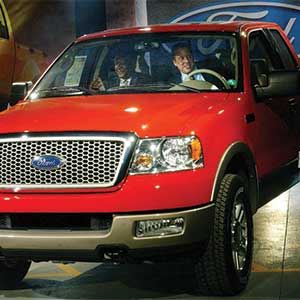
Photo: Rebecca Cook/Reuters


Post a Comment

Your Name: 

Your Comment: 
 
Please press "Submit" only once to avoid double-posting.
All HTML formatting is removed from comments.
Read the Mother Jones community rules here.

Comments:

Ford's problems are a typical example of American business. Business does not exist to offer jobs. It exist for the interest of the owner. The problem with the economy is that it is no longer good for yhe bottom line to have employees, care for them, or provide them with anything that is not producing to income for the owner. The "New" New bill, as proposed by Obama is to give employment back to to workers. it is the only way to ensure the work is as productive for their lives as their wallets. It may take that the government usses its stake of purchasing bail outs to change the direction of companies to get us back to the head of production and technology by seating students and experts together to find the components of our future as a nation. we need things and we need to use all those needing jobs to get what we need. With that type of system as socialistic as it may seem will keep wages fair and appropriate. It wil also reduce the million dollar CEOs and their parachutes.
Posted by:1-4 Dat realNovember 17, 2008 1:47:03 PMRespond ^
"Fara Warner, a contributing writer for Fast Company, reported on Ford in her Saab." makes it sound like she lives in her car. Great story though.

The most interesting point was that if and when F-150 really drop off, Ford will essentially be a forign car maker, building small cars in Europe and selling them in the U.S.
Posted by:Robert HahlNovember 18, 2008 2:04:59 AMRespond ^
If Ford were capable of learning the lesson that MPG is important it would have learnt it in the 70's and 80's...
Posted by:Dog GNovember 19, 2008 1:06:14 PMRespond ^
For decades, European (incl. Ford UK and GM UK) car makers have been building and selling quality, fuel efficient cars in nations with strong labor unions. The difference, it appears, has to with poor management.
Posted by:Robert FultonNovember 19, 2008 1:11:34 PMRespond ^
The only way to deal with the bankrupt American automotive industry is to let them die—we are at war because of these anal brained idiots so fu€k’em. Had Uncle Sam (that’s us) simply taken the heads of these corporations and liquidated them Stalin style along with the heads of oil companies we might be better off—a good Ford executive is a dead Ford executive and the best petro-executives are dead ones—kill the terrorists. These companies have had the handwriting on the wall since 1972 and their solution was the SUV the most inefficient automobile in the world—I think that this earns these people the death penalty without even a need for a trial—just shoot the scumbags (because that is the most cost effective solution to change management) lop off their heads and put them on the hoods of their SUV’s and park them in front George W. Bush’s and Dick Cheney’s house in Washington and say, “You’re next!” (this is cost effective marketing at its best and it is a form of lobbying to boot--call it an offer you can't refuse lobbying) and then make a substitute for the Patriot Act called the Inefficient Automobile Terrorist Act which makes anyone driving one of these cars a “terrorist sympathizer”. By defining the automobile industry as “terrorists” and executing the executives we might actually get some people with immediate answers who can start producing American cars that will compete on the world market—within a single year (call it war!). It is time for a change of elite in American, because since Ronald Retard Reagan the American elite has done nothing but sponge off the sweat of American labor (the socialist “free riders” in the US are the corporate elite and time to make eunuchs’ of them is now!)—such changes are always bloody but fun too because you can behead the people who keep you in bondage and bath in their blood—it’s euphoric—like listening to the Grateful Dead.

The above in its entirety is not meant to be taken literally but rather it is supposed to be satirical in nature
Posted by:KirilovslogicNovember 19, 2008 1:30:20 PMRespond ^
The only poor mgmt that Ford suffered from was not bringing it's European vehicles into the U.S. sooner. It looks like they have a business model to get out of trouble. The market is consumer driven and until gas spiked this year everone wanted big SUV's and pickups. I've driven a Focus for 3 yrs now and its been in the shop once, to change out a radio. In the meantime I'm luvin my 35 mpg highway and 29 city legit.
Posted by:Bob W.November 19, 2008 1:36:58 PMRespond ^
One of the most incompetent and corrupt bought off bodies in the Governments of the World is telling the U.S.Auto Makers that they don't know what they are doing!Bush and Paulson and the Head of the SEC allowed Big Oil to go through the roof and caused the Auto Companies and the Economic Failures of Wallstreet and the Bank Failures-Not one cent of Bailout Money has gone toward getting people back to work but has allowed Paulson's Buddies to buy out major banks and the Bailout Money to pay for it. When is the CRAP in D.C. going to end-When Bush and his entire Gestapo Body of Administrative takeovers leaves office and not one moment before!
Posted by:Mr. IndependentNovember 19, 2008 2:13:06 PMRespond ^
Ford built vehicles with major flaws, then let the consumers take the consequences unaided. I bought a used Taurus and found out immediately AFTER I had a $1200 repair done that it was a widespread (potentially life-threatening) problem that had triggered a recall. Should have been a free repair at the dealer's. When I contacted Ford about reimbursing me for the recall repair expense, they "generously" refunded $300 of the $1200 I had shelled out. I had to eat the rest. And even then the attitude I got from all the Ford "customer service" people was appalling. Right then I realized that this was a company which had no interest in standing behind its products or looking out for its future customers. I do hope the auto industry gets help from the Feds, for the sake of all the people who do work hard at their jobs, but I'll never go near a Ford dealership again. If you truly do take pride in your product, you back it up.
Posted by:kesmarnNovember 19, 2008 3:17:53 PMRespond ^
I cringe every time I hear the claim that efficient cars are more expensive.

You don't need carbon fiber, hybrid motors, or special tech to make cars with better mileage.
All you need is small cars, with low powered engines.
These things invariably make them far LESS expensive.
Americans only take our overpowered engines for granted because thats what they have been offered for so long, (a typical minivan can go 120moh, even though they are geared towards families and most states have a maximum speed limit of 65-75). Back when cars typically had 100hp or less no one complained that they didn't have enough power.
Auto companies prefer promoting large powerful cars because they can sell at a higher mark up.
As long as we allow corporations to do anything it takes to increase profit, we can expect environmental, social, health, and other concerns to take a back seat. Even future profitability comes second to money to be made *right now*.
As we are seeing, Ford's leadership was right to keep making large vehicles even as gas prices went up - the government is not set to take tax payer money and give it to them, so they will never suffer the consequences of their own "poor" choices.

Note that the Geo Metro got 50mpg, and cost less than $10,000.
Cheap car = efficient car.
The Ford Fiesta, mentioned in the article, and not available for sale in the US, can get from 50-65 mpg (better than the best available here, the Prius) and costs around 12,000 to 15,000 - half what the Prius costs.
Posted by:Bakari KafeleNovember 19, 2008 3:51:08 PMRespond ^
Ford Motor Company has been under a boycott for many years by people offended that Ford donates tons of cash to further the extremist homosexual agenda. I understand that one of the Board members or a vice-president is openly "gay." The company was asked by Christian organizations to back off and stay neutral on the social issue and pay attention to producing economical, fuel-efficient vehicles. Ford refused and brought this upon themselves, the devil is in the details.
Posted by:Truth in AdvertisingNovember 19, 2008 4:23:59 PMRespond ^
"Truth in Advertising" states that "Ford Motor Company has been under a boycott for many years by people offended that Ford donates tons of cash to further the extremist homosexual agenda ... Ford refused [to back down from a boycott] and brought this upon themselves, the devil is in the details."

I don't understand the relevance of these remarks to the subject at hand. Comments like these suggest that the author (and by implication other fundamentalist "Christians") are totally intolerant of homosexuals as a group. Even as a "straight" and non-religious guy, I am appalled if that is the case. There are anti-discrimination laws on the books. More importantly, is that the way Jesus wants you to behave? Mull that over as you drive your Hummer to church next Sunday.
Posted by:Bruce HigginsNovember 19, 2008 5:36:04 PMRespond ^
the idea of moving to brazil to grow rubber trees was the beguining of the Ford monetary problems wich haunts till today
Posted by:Dr.QNovember 19, 2008 5:47:36 PMRespond ^
I work for Ford,hourly,for 15 years.Management and engineers always tell us we(the line workers) are the experts and we should have input into the companies decisions.But they never listen!!It's to bad Bill Ford didn't have the stones to implement his goals.He is,seemingly,a nice guy,but as our CEO he was in way over his head.jaques Nasser's nickname is "Jaques the Knife" and the buck stopped at Jaques when he was CEO.
Posted by:walterReutherNovember 19, 2008 8:28:44 PMRespond ^
That's a funny way of looking at a company. As if it were the same fellow sitting behind the desk at Ford that was there in 1972. Ford's leadership today comes from Boeing, Toyota, Mazda, etc. I think you don't give them enough credit.
Posted by:tjbNovember 20, 2008 9:20:34 AMRespond ^
Well, then you'll be happy that the new CFO of Ford here is Lewis Booth, who came from Europe.
Posted by:tjbNovember 20, 2008 9:21:23 AMRespond ^
>I understand that one of the Board members or a vice-president is openly "gay."

Ah, so that is the problem. Thank you.
Posted by:tjbNovember 20, 2008 9:23:16 AMRespond ^
This is just another example of the failing of the short-term profit concept demanded by shareholders and for which CEOs are rewarded with big bonuses. This pressure is sure to prevent far-sighted planning and expenditures that reduce the immediate profits and ensure the future success of a corporation. So the CEOs reap the bonuses until things go bad, then pop open the golden parachutes and depart. Is there a solution to this problem?
Posted by:Art NaebigNovember 20, 2008 9:38:03 AMRespond ^
too much on short term mentality

too results only oriented

failed to understand customers need for long term mileage relability and quality

too much exec pay

too many execs

too much management

need I go on.

an american phenomena not just ford's
Posted by:researcherNovember 20, 2008 9:47:17 AMRespond ^
oh forgot to mention that gay guy. :-)

while we kill thousands of iraqis and we killed over one million vietnamese we worry about the gay guys.

welcome to america and family values where 47 million without health care and we call ourselves a christian nation.

yea right and cheney loves the middle class
Posted by:researcherNovember 20, 2008 9:49:46 AMRespond ^
Now that you've read the article and, judging by your comments, have framed your opinions, let your elected representatives know how you feel about the "loan" that the Big 3 are now asking for. This may be a lame duck legislative session, but we are not lame duck citizens. Use your voices and your pens to get your message out, because, ultimately, it's your money. Please use the same energy that you all use to comment on Mother Jones articles to pressure those who hold the purse strings.
Posted by:MarsNovember 20, 2008 10:28:26 AMRespond ^
First, nothing gets done without government intervention (i.e. safety standards, environmental laws). It's really the failing of regulation that has crippled the industry. Notice how the products of Europe's regulated market is now being emulated here. The market doesn't know what's best. The market is extremely short-sighted and has no overall vision or plan for society.
Second, if the government does, and no doubt they will, aid the crumbling auto giants it should be a stock injection plan only. With the taxpayers owning preferred stock, we can impose standards that should have been issued the whole time. Also, workers should have a say in effective methods for production. Floor workers and middle managers have more of a stake with the over-all health of the company -- more than millionaire executives do.
Third, if we had a universal, one-payer health care system, that would take off additional financial pressure from large employers.
I'm sure Jennifer Granholm (MIchigan governor) has a plan loaded with corporate welfare and unwarranted assurances for unions that no doubt have been thrown together by auto execs and union muckity-mucks. Unfortunately, the people engulfed by the corporate culture are the reason for the failure. Actually, it's that arrogant corporate culture itself loaded to the hilt with hubris that's to blame for much of our country's slump. Gosh, when you think of it that way; a complete culture failure, it seems like a daunting task to correct.
Posted by:EddieNovember 20, 2008 10:42:09 AMRespond ^
Economics people! Let the big car companies die! They are not profitable because they don't make a product people will buy for the cost to make it. Econ 101. How will an injection of my money fix that? A cheaper way out would simply be to pay the people who worked there with the bailout dollars.
Big companies need to be held accountable and it's not to the government, it's toi the market and the market apparently has spoken, only now we don't want to let that mechanism weed out the dead wood. We want to put money in the hands of management who has lost all of there compnays money.
Posted by:Adventure BobNovember 22, 2008 6:46:01 AMRespond ^
Really bad pun on "Lost Focus" but let's give G.W. credit along with the greed of Big Oil and incompetence of the Head of the SEC and Paulson to rein in rising gasoline prices-You have to admit that $4.00 per gallon gas may have been a contributing factor to the downturn in both the economy and car sales. As far as the rest of the opinions about how badly GM ,Ford, and Daimler are doing, my only comment is the people that run these car companies are so many times more competent than our President and entire Congress that the comparison cannot be graphed in finite space!
Posted by:Mr IndependentNovember 22, 2008 12:09:40 PMRespond ^
So Bill was a patsy with a vision and the rest are morons. Great! on the rare occasion you hear CEO's of Japanese companies they DO have vision, its not just for profit. I know a while back Toyota's CEO's vision was that a car will eventually clean the air, a seemingly impossible proposal except with sustainably-produced fuels of hydrogen, Also, look at Nintendo, they did a ballsy 'bet-the-company' move and it paid of, I cant come up with one American company that did a bet the company on a vision, maybe Atari.
Posted by:UvamanNovember 23, 2008 1:31:31 AMRespond ^
As noted by others, Ford and GM produce and sell competitive small cars in Europe. Americans don't buy them because
a) fuel costs half what it does in Europe, and b) US cities devote a large fraction of their space to car parking.

Throw in the CAFE exemption and tax deductions for heavyweight behemoths, and the US government is practically begging its auto manufacturers to churn out large, powerful, inefficient pickup trucks.

Under such circumstances, Ford's decision to concentrate on large trucks which it could build cheaply and sell at a premium price was probably the only way they could remain profitable, given the disadvantage of dumb legacy decisions by management decades ago.

And, frankly, if oil prices stay low (and they might for a couple of years, given current economic conditions) I fully expect that Americans who can afford it will continue to by 10mpg behemoths.

Unless Obama finally bites the bullet and imposes a sensible level of taxation on gasoline, nothing will change, until the cost of carbon emissions and/or peak oil really bite.
Posted by:Robert MerkelNovember 24, 2008 3:29:35 AMRespond ^
Ford makes not a single car that I would even consider buying and the few that almost make it are so overpriced relative to their value as to be out of the question.

I should be able to buy a reasonably well engineered compact sedan that is safe and fuel efficient without leather seats, DVD navigation, paddle shifters, gaudy boy racer styling and all the rest. How about putting some of the build budget into decent engines, transmissions, suspensions and quality components that don't crap out when the car is 4-5 years old?

Detroit's problems are many, but come from the 'Not Invented Here Syndrome', the me too gutlessness that has been a hallmark of American autos and an incestual corporate culture that is about as detached from reality as any in the developed world. The Big 3 always did their best when they broke the mold and tried to innovate but have largely settled for the status quo.

If Ford was serious about getting fuel efficient cars to market they would put the Fiesta on the market now. With an accelerated program they could overcome the EPA and NHTSA regulatory changes quickly and import them very quickly. That's not what is going to happen.

They are going to restyle the Fiesta, 'pimp it up' and load it up with a bunch of crap to allow them to push the price of an 'economy' car into the stratosphere. Why should I wait 2-3 years for Ford to deliver when Honda's Fit is the target they are shooting at. By the time they bring it to market it will be outdated, overpriced and more poorly made than what I can buy today from Honda.
Posted by:David GregoryNovember 29, 2008 12:00:38 PMRespond ^

Jail.org - Inmate Search
Criminal records, instant public records & people search & current court records. www.jail.org

U.S. Public Records Search
Search County & State Court Records, Criminal records, Vital and Adoption Records www.PublicRecordsInfo.com

Records.com - People Search
Public Records and Background Checks. Instantly Search Criminal Records, Addresses and Court Records www.Records.com

Court Records & County Records
Find Instant Public Records, Criminal Records as Well as County Property Records Search. www.PublicRecordsIndex.com

Real Viagra, Cialis Levitra Deal
Dare to compare our competitive prices. Free overnight delivery to new patients in the US. No catch 22!

Subscribe Now!
Don't lose sight of the facts. Every issue of Mother Jones is loaded with hard-hitting reporting you can't afford to miss.

Big Bang, Little Bucks
Mother Jones Text Links is a great way to get on the site for an affordable price. For more information please click this the headline

End the genocide in Darfur
Every day, Darfuris face rape, murder, and starvation. Be a Voice for Darfur: tell Obama to end the suffering.


Invade the Caymans!

The Housing Market

Attention Spans

Pipeline Politics


More MoJo voices...


bookIN PRINT

CLICK HERE
for more great reading

headphones IN TUNE
New music every issue

CLICK TO LISTEN

Advertise Liberally

This article has been made possible by the Foundation for National Progress, the Investigative Fund of Mother Jones, and gifts from generous readers like you.

© 2008 The Foundation for National Progress

About Us   Support Us   Advertise   Ad Policy   Privacy Policy   Contact Us   Subscribe   RSS