MOTHER JONES BY E-MAIL

Homeland Insecurity: Floating Targets

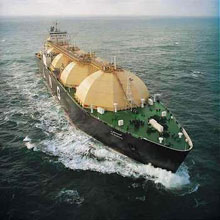
NEWS: An attack on a liquefied natural gas tanker could cause a massive explosion. Is enough being done to protect American ports from this devastating risk? Second in a seven-part series on the lessons of 9/11.

September 6, 2007


TOOLS

EmailE-mail article
PrintPrint article


BACKTALK

E-mail the editor


Google


RELATED ARTICLES

RE:ACTION

The attacks of September 11, 2001, came from the sky, but the next terrorist attack on the United States could come from the sea in the form of a small-boat strike—like the one on the USS Cole in October 2000—against an enormous liquefied natural gas tanker. While the discussion of potentially dangerous shipping cargo has focused largely on hidden nuclear devices in shipping containers, LNG is perhaps the single most dangerous substance routinely plying our coastal waters and coming into our ports.

On land, most natural gas is transported by pipeline, but to ship it by sea, it first must be chilled into a liquid form that takes up 600 times less space than gas and can be carried, like oil, in tankers. Natural gas accounts for 22 percent of all energy consumed in the United States, and as domestic natural gas production slows, LNG promises to provide even more of our energy. There currently are six LNG terminals in the country, in Everett, Massachusetts; Cove Point, Maryland; Elba Island, Georgia; Lake Charles, Louisiana; Kenai, Alaska; and Peñuelas, Puerto Rico. Around 29 additional facilities are in the planning stages; 14 more have been proposed. Several of the new facilities would be near urban areas, including Long Island, Philadelphia, and Baltimore. The facilities would receive gas shipments from West Africa—primarily Nigeria—as well as from Qatar, Norway, and Trinidad and Tobago. Australia and Indonesia also supply LNG, and Russia is expected to become an important exporter in Asia within a year or so.

An exploding LNG tanker would be devastating—by some estimates, it would incinerate everything within a one-mile radius or beyond. Edward Teller, the father of the hydrogen bomb, once speculated that an LNG tanker explosion could rival that of a nuclear bomb. Others have compared such an explosion to the devastating 1883 Krakatoa volcanic eruption in Indonesia, which generated the loudest sound ever recorded.

Once LNG tankers are in port, they are sitting ducks, susceptible to being bombed from the air, rammed—like the Cole—with an explosive-laden boat, or hijacked. A 2004 study by the Sandia National Laboratory made it clear that an attack on an LNG tanker could puncture its tanks, causing their cold liquid contents to spray into the atmosphere, where they could ignite. "The fire from such a spill would be very large... perhaps up to half a mile in diameter, or larger if more of the containment system fails," Jerry Havens, a former officer in the Army's chemical weapons division, told the Associated Press. In March, the Government Accountability Office issued a report calling for the Department of Energy to conduct further research on the effects of a terrorist attack on an LNG tanker. "The GAO found that there are widely conflicting estimates regarding the worst-case consequences of a terrorist attack on LNG tankers," said Democratic Massachusetts Congressman Ed Markey, whose district includes the nation's only urban LNG import facility. "Given the fact that LNG is being transported into Boston harbor every several days on the way to the Everett terminal, it is very troubling that knowledge about potential public safety consequences of a terrorist attack on these vessels is not better," he said.

But strengthening safeguards against an attack on LNG vessels and facilities is difficult without support of the industry, which is dominated by international companies such as ExxonMobil, BP, and Shell. In 2006, according to the Center for Responsive Politics, the oil and gas industry gave federal candidates $19 million, with 82 percent of that going to Republicans. In 2005, ExxonMobil made $7.14 million in political contributions. Even small firms banking their futures on the LNG trade are actively courting Washington; Cheniere Energy, a Houston-based firm, has spent $320,000 on lobbying. So far, the Bush administration has been reluctant to review the current regulations. In a 2004 letter to Markey, Homeland Security assistant secretary for legislative affairs Pamela Turner wrote that "there is no economically feasible engineering or design solution that could mitigate the consequences of a large scale LNG release on the vessel's hull." In other words, safer tankers are too expensive.

LNG ships are built according to standards by the U.S. Coast Guard and the International Maritime Organization. Ship owners also must meet design specifications and other requirements set by various private organizations, whose approval is needed to obtain insurance. The ships' containers are surrounded by insulation. During construction, this insulation has caught fire, leading to questions about its safety. The LNG industry dismisses such fears, citing its long safety record. Indeed, the precautions already taken are elaborate: LNG tankers must provide 96 hours' notice before approaching the American coast, and a small flotilla of tugs, choppers, firefighters, police, and divers must be assembled to escort them. Bridges along the way are closed, private boats are warned away, and the tankers are inspected and screened for explosives before they are allowed to approach land. Tanker crews also must pass security checks.

Many consider these safeguards inadequate. Rep. Markey has been a leading congressional critic of the current policy. He says that LNG terminals should not be based near urban centers; some experts have even suggested that they should only be sited offshore. He has suggested that regulations could require improvements in tanker design and construction, in particular a ban on flammable insulation. Additionally, maritime security risks such as LNG tankers have prompted calls to strengthen the Coast Guard. However, the Coast Guard's modernization program to replace its old cutters and other ships has been caught up in a construction scandal. Should the Coast Guard have to defend against a terrorist attack in the open ocean with its current fleet of cutters, there is concern that its aged ships are not up to the task.

Tomorrow: The hidden risks of transporting chemicals by rail.

James Ridgeway is Mother Jones' senior correspondent.


Post a Comment

Your Name: 

Your Comment: 
 
Please press "Submit" only once to avoid double-posting.
All HTML formatting is removed from comments.
Read the Mother Jones community rules here.

Comments:

The same GAO report quoted here found that LNG does not explode. The LNG is not stored under pressure and contains no oxygen, so it is incapable of an "explosion". The worst case scenario is a large leak resulting in a pool fire, whose diameter reaches a maximum of less than 200 meters. Radiation from the resulting fire can be easily avoided by seeking shelter or even using a single sheet of newspaper to shade oneself from the thermal radiation. Mother Jones fans the flames of ignorance and fearmongering with such an irresponsible article.
Posted by:Mr. LNGSeptember 6, 2007 12:46:38 PMRespond ^
Funny with no air and super cooled it wont explode? sure i can see that. what happens when the cooling fails? How about if water is let into the tanks? a simple thermite explosion would render all of the safe guards moot or better yet an air gas explosion in the void tanks, or simply a small homemade sub with a few scant pounds of high explosive (rock gel comes to mind). this stuff warms to a heavy gas the drifts miles. along the way you can touch it off with a match or bullet or almost anything. nope it wont blow in the tank as a liquid but it sure will out of it as a gas. better put your thinking cap on cause i can think of at least 1000 ways to blow up a tanker; i know there are folks who are smarter than me. your argument is like the PATEOTS argument full of holes when examined in light of the reality of the subject.---- -------------------------------------- Also for those folks who want to know. one planned LNG terminal is due in Oregon on the Columbia river. what do you thinks gonna happen if there is a problem the prevailing wind will sweep the cloud into forest land and residential areas, with no air people, animals, plants ETC. will die and if a single spark happens at the cloud edge the whole thing explodes. setting forest , houses, cars and paper on fire. its not the flame in proximity its the over pressure. the fire danger is in the cloud the blast danger is around the cloud. if you want a simple experiment you can fill a balloon with gas and touch it off. then you will know what this stuff turns into.
Posted by:2MTSeptember 6, 2007 1:14:59 PMRespond ^
I missed a small detail the gas is heavy so it will collect in low spots down where the wind can disperse it and it will sit there till it breaks down. kinda like a giant invisible land mine killing through suffocation or if conditions are just right (say wild fire) exploding into an inferno.
Posted by:2MTSeptember 6, 2007 1:20:11 PMRespond ^
LNG is stored in heavily insulated tanks. There is no active cooling. The LNG is a boiling cryogen that remains cool by a natural process known as autorefrigeration. The flammable vapor range for LNG (depending on its composition) is from about 4% to 15%. LNG tanks are kept at low pressure to prevent air from entering the tanks, keeping the void spaces too rich for ignition. Any accident or intentional event large enough to cause a leak in the tank will almost surely ignite the LNG, resulting in a localized pool fire. Once released, LNG vaporizes into natural gas. The resulting cold gas remains heavier than air until it reaches -158 F. At that point it becomes bouyant and the vapor cloud rises. Again, as the leading edge of the cloud mixes with air it remains flammable between 3 and 15%. Yes, any small flame source can ignite the cloud, which then burns back to the pool, resulting in a small pool fire. Asphyxiation could be a risk to the workers and tanker crews, but not to the general public. LNG has a stellar safety record. In nearly 40,000 voyages, there has never been an accident resulting in the loss of containment of an LNG ship. Since the 1944 East Ohio Gas Company disaster, NO member of the public has lost their life or been injured by LNG anywhere in the world.
Posted by:Mr. LNGSeptember 6, 2007 3:02:21 PMRespond ^
The flame propogation speed for natural gas is incapable of generating damaging overpressures. My high school physics teacher filled balloons with natural gas and then ignited them with a lighter. They did not go boom. Instead they "puffed" with a lazy visible flame. Baker Risk has done some nice work on LNG. You can Google them or go to their site at: http://www.bakerrisk.com/Applied-En gineering-Services/Risk-Analysis/LNG-Loss-Prevention There is a nice picture of a vapor cloud lift off, it only takes 200 meters before the cloud warms up. Somewhere Baker has a video of a frame structure filled with natural gas that is ignited. It doesn't explode. Experiments on LNG in th 1970s used dynamite in an effort to detonate an LNG vapor cloud. There was no affect from the detonation. The exloding LNG myth has been well and truly busted by a number of researchers, including the most recent Sandia National Lab studies. Mr. Ridgeway isn't much of an investigative reporter or surely he would have known all this.
Posted by:Mr. LNGSeptember 6, 2007 3:10:50 PMRespond ^
More pathetic NIMBY fear mongering from 2MT that has no basis in fact. I'm guessing he lives in Oregon and doesn't like the pending LNG terminals.
Posted by:Mr. LNGSeptember 6, 2007 3:14:04 PMRespond ^
Look, guys, I just had six nuke tipped cruise missiles fly over me a few days ago and nobody in the United States knew where they were. Do I feel more secure? From who?
Posted by:steppenRazorSeptember 6, 2007 3:28:21 PMRespond ^
Oh, yeah. LNG dude. I was a welder for 25 years. And welders love authorities. So, tell you what. Why don't we give you an acetylene torch and you can walk up and cut a hole in the sucker and show us how safe it is? Let me know when, I'll sell tickets!
Posted by:steppenRazorSeptember 6, 2007 3:33:52 PMRespond ^
Mr. LNG is correct. There will be a big fire but no explosion. Mother Jones is listening to all of the usual suspects and their anti-LNG talking points. I read the Sandia report - its okay as far as it goes. The truth is that is would be hard to create a big hole in the side of a ship and make a big spill. It sure is fun to read the disaster scenarios that 2MT describes. Too bad our school system is so poor at teaching science...
Posted by:JaySeptember 6, 2007 4:13:08 PMRespond ^
YYou fail to mention that the only newly constructed terminal in the USA is located over 100 miles offshore, or that two more currently under construction are approximately 13 and 16 miles offshore of Rep MArkey's district. Marad is fastracking proposals to build facilities that are promising to use American mariners on the tankers that will be calling on those ports.
Posted by:Alan ValleySeptember 6, 2007 7:27:05 PMRespond ^
tell you what you go and open a can of nat gas in a hole in the ground and drop a match in it. then tell me that several cubic feet of this stuff wont over pressure. further more your voids are not gas rich or they would not rust. and your super insulated tanks wont stand up to a fire for very long. Ive worked the liters and been down in the holds a little crack in the hull is gonna cause a whole heap of trouble. you folks Ever been across the Columbia bar? I have its nasty and will do ships damage. I'll bet money your captains are pushed to deliver and will try the bar when they shouldn't. any crack in the tanks is a leak any fire is an explosion danger. ---------------------------------------- Mr LNG is selling a bill of goods. and i wont bet on a guy who wont test his guess. I have seen a house explode and a fire ball from a gas leak in a low spot go up. the auto cooling is a nice trick that is used in refrigeration all over the world I especially like the ammonia systems that use it. funny how they leak. ahh the ships built to coast guard and maritime spec.... big deal so are oil tankers they still leak and crack and breakup in storms; bombs and explosives are just more directional. --------------------------------------- all of your posturing and blathering is dealing with your intact tanks. you folks shout about the safety of your tanks but you wont address the issue of a ship wreck or a leak you use the models of a small cloud of gas in an open room. but wont tell what happens if the explosion is in any way constrained. why do you folks think the CG has made it a rule that you don't make land fall w/out an escort. oh and one other small thing when the liquid gas heats the tanks pressurize and you get a blow torch effect. --------------------------------------- in a perfect lab environment you are correct these things are likely safe. in the real world where we have storms and humans and terrain; all bets are off.
Posted by:2MTSeptember 6, 2007 7:39:27 PMRespond ^
http://www.energy.ca.gov/lng/projects.html little lie mongers aint ya? well the link is to the PROPOSED west coast LNG Facilities etc. half mile off shore my ass.
Posted by:2MTSeptember 6, 2007 9:19:33 PMRespond ^
Pick your risk. How many folks die or are hurt each year due to driving while using a cell phone? We don't like giving up convenience and will take risks to preserve it. America has an energy appetite and WILL fill it. I sailed in tankers for many years -- LNG is safer and cleaner to transport than any other imported fuel. Because of occasionally overheated or poorly researched public rhetoric, sometimes (but not always) motivated by perceived safety concerns, the attention focused on LNG and all LNG operations is intense. I know something about modern LNG ops, and can say that LNG tankers are sometimes held out in deep water for days until all the regs are satisfied - - they don't hurry "over the bar" or in any other way. It's a very high-profile business in which no one wants to be the guy who screws it up. One incident -- even perceived -- and the public & political ramifications would probably close most terminals. They can't afford less than the best in security or safety. Would you prefer nuclear? It's suddenly respectable again. Pick your risk. And put that cell phone down! RGS
Posted by:RGSSeptember 7, 2007 1:24:09 AMRespond ^
2MT is so far off the line it is almost comical if it was not so wrong. Drop a can of Natural Gas in a hole. First show me how to make a hole in the water to fill in the gas. Show me how you will pour the gas which vaporizes immediately at natural ambiant temperature, even in Alaska in the middle of the winter. As for the welding expert, the ship may be made of steel, but the containment system inside the hull is not, so yeah, the shipyard cut holes in the sides of these things every day with no problems. The nukes flying overhead, yea now that is a problem. The gas going into your house every day to heat, cook, dry your clothes is not a problem. If you want a problem with ships coming into and out of port start taking a look at the chemical industry and their records with shipping.
Posted by:EJSeptember 7, 2007 8:40:34 AMRespond ^
yep im off my rocker. did you look at the link. did you think before you responded what is the volume of a liquid? what is the volume of a gas? ?????? go back to your basic chemistry and look it up. next-------------- -------------------- what is a heavy gas and what are its characteristics? -------------------------------------- a hole in the water is a ship; however the pipelines and storage tanks aint in the water.---------------------------------- since when did image get in the way of profit. those ships as I said are as bad as oil tankers. in the fall rains you betcha they are gonna try the bar. don't try he nobility of business on me i worked in this particular arena for way to long. -----------------------------RGS the risk is not a few dead from driving around with a cell stuck to there heads. it is a few hundred to thousand dead in an accident, more toxics in our rivers, years worth of lies, a clear danger to the surrounding communities, and little advantage to either side of the issue for the long term. LNG wont be around long; for most communities. like fuel oil its getting costly most wont be able to afford the price.
Posted by:2MTSeptember 7, 2007 9:09:10 AMRespond ^
Natural gas in a hole or inside a house would be confining the gas, which could cause some overpressure. What we are talking about is detonation of an unconfined vapor cloud. A ship on the water with a leak would produce an unconfined vapor cloud. Ammonia has nothing to do with autorefrigeration. It is used as a conventional Joule-Thomson refrigerant. It is a great refrigerant and is still used today in some commercial systems, it was replaced by less hazardous refrigerents like Freon. The welder guy is wrong. There are several layers of containment, the outer hull, then a 1-2 meter void space, then an inner aluminum containment, insulation and then the final containment. You could safely cut through the first two layers without getting to the LNG. Most conventional storage tanks are made of concrete with a 9% nickel steel inner tank. You could cut all you want on the outer concrete tank with a torch to no effect. And yes, I have welded on cryogenic LNG lines with liquid in them. It is perfectly safe if you know how to do it.
Posted by:Mr. LNGSeptember 7, 2007 9:20:58 AMRespond ^
Safety is only one in a long line of concerns over the U.S. LNG gold rush. Setting aside the environmental, policy, and state's rights implications deeply imbedded in most of the new proposals, experts are now starting to say that due to the rapid global market, we may be positioning ourselves to overbuild LNG infrastructure. This would result in numerous facilities running at partial capacity instead of a few facilities running at full capacity. Given the societal costs and the difficulty in siting these industrial complexes in appropriate places, wouldn't thoughtful planning and a national approach make more sense than the current haphazard 'first come, first served' mentality? Actually, shouldn’t the first step be a thoughtful process to decide whether the nation should be getting addicted to another source of foreign fossil fuel at all? And, while it is true that in its liquid form natural gas does not explode, it also does not catch fire; but this is only the first half of the “flammability factoid.” Here is the rest-- it is the revaporized LNG that can be ignited. If the ignition takes place in the open with the correct air-to-fuel mix, it will burn; if the ignition takes place in a confined area (in the correct air-to-fuel ratio), it will explode. Add to that rapid phase transitions, mobile vapor clouds that can move nearly 5 miles before finding an ignition source, and all of the non-safety related issues (like hidden costs, inadequate Coast Guard funding and equipment, negative environmental impacts, and corporate usurpation of public lands) and it is not too hard to see why the public is fighting back.
Posted by:concerned citizenSeptember 7, 2007 10:46:39 AMRespond ^
Fantastic and valuable research and crucial warning.
Posted by:Caroline RamsaySeptember 7, 2007 11:29:09 AMRespond ^
Natural gas in a hole or inside a house would be confining the gas, which could cause some overpressure. What we are talking about is detonation of an unconfined vapor cloud. A ship on the water with a leak would produce an unconfined vapor cloud. Ammonia has nothing to do with autorefrigeration. It is used as a conventional Joule-Thomson refrigerant. It is a great refrigerant and is still used today in some commercial systems, it was replaced by less hazardous refrigerents like Freon. The welder guy is wrong. There are several layers of containment, the outer hull, then a 1-2 meter void space, then an inner aluminum containment, insulation and then the final containment. You could safely cut through the first two layers without getting to the LNG. Most conventional storage tanks are made of concrete with a 9% nickel steel inner tank. You could cut all you want on the outer concrete tank with a torch to no effect. And yes, I have welded on cryogenic LNG lines with liquid in them. It is perfectly safe if you know how to do it.
Posted by:Mr. LNGSeptember 7, 2007 11:40:18 AMRespond ^
I'm a dyed in the liberal and I'm used to being appalled at government safety standards .... but, I've got to say, the choppers, firefighters, divers, coastguard, etc. that are used when these ships come in sound like good precautions and about as safe as you can get in the real world.
Posted by:mdgSeptember 7, 2007 1:22:17 PMRespond ^
Thank you, Mr.LNG,for including the website of BakerRisk for our commenters.One of their opening paragraphs pointedly places the LNG risk concerns in a proper light: "Currently, technology gaps preclude accurate and defensible scientific basis for predicting LNG hazards in several key areas." It is not enough in any discussion of LNG safety to simply quote the 40-year history of LNG. Thankfully, BakerRisk is one of several safety engineering firms doing studies to enable a better grasp of the potential hazards. My No.1 issue addresses the concept of placing LNG facilities in "harms way" of populated areas. There is a TV documentary series titled "Seconds From Disaster" that correctly addresses the sequences of unexpected events that can often result in catastrophic outcomes. I adhere to the basic rule of reason whereby; if any energy infrastructure can incur massive loss of life or property particularly owing to its proximity to populated areas, then the first order for advancement is to provide a generous buffer zone;to allow minimization of the scale of required attendant safety requirements without neglect to the maximum hazard. It appears that we are being soft-soaped into thinking that things are safer than they actualy are. Would an LNG import terminal be safe in ANY location of choosing merely based on its 40 year history or would it be prudent to establish new minimum exclusion zones based on worst case scenarios? I really don't care if LNG cannot explode, I care more about the RPT (those who live and play in proximity.) I make no distinction between being blown apart or being incinerated. Studies made by Dr.Jerry Havens and Professor Emeritus James Fay indicate the need for a wider exclusion zone in populated urban areas. The gas industry and regulatory agencies refuse to broaden their safety parameters. Mr. LNG, you stated that "radiation from the resulting fire can easily be avoided by seeking shelter". That is the classic answer the gas industry promotes. Injury from the resulting heat radiation will occur literally, in a flash!There is NO time to seek shelter. No doubt you are a principal of one of the LNG proposals.
Posted by:Mr. NOLuNGsSeptember 7, 2007 1:50:11 PMRespond ^
Quentin Baker and I are friends. He and his company have done risk analysis on several of my projects. If you ask him, he will tell you that LNG can be managed to an acceptable level of risk, even in a populated area. As for fires, the LNG terminal workers and ship crew are the ones most at risk from a pool fire. This zone extends only a few hundred feet from the center of the pool, and is usually covered by the onshore exclusion zones surrounding the facility. There is a 500 yard exclusion zone around the tanker itself. As long as civilians stay out of the 500 yard zone, there is very little risk. Radiation drops exponentially at distance, outside the 500 yard zone you have time to react and take shelter. Fay's work is suspect as he keeps changing the "circle of dooms" depending on what audience he is talking to. Also he doesn't show his work so there is no way to verify his assumptions or check his math. Havens relies on an outdated model that DOE has pulled funding from. I found a major validation problem in results that his colleague, Tom Spicker presented at a conference in Houston. Their model doesn't represent real life very well. The argument seems to be that putting LNG in a "populated" area invites a terrorist target. Funny but just about anywhere someone proposes an LNG terminal becomes a "populated" area. People in New York believe the middle of Long Island Sound qualifies. Some folks in Maine thought sparsely populated Harpswell was too populated. Now our friends from Oregon believe there is no unpopulated area there either. That is why a regional approach WON'T WORK. Suppose that was tried and the best place to put an LNG terminal turns out to be offshore Malibu, California. Do you think Pierce Brosnan and the swells in Hollywood will just say "Oh nevermind, we had a regional debate, we lost." I guess citing false security concerns sounds a lot better than just plain old NIMBY.
Posted by:Mr. LNGSeptember 7, 2007 2:36:16 PMRespond ^
Its interesting that no one has mentioned the Society of International Gas Terminal and Tanker Operators (SIGTTO) world-class LNG-industry standards for LNG terminal siting, as published by SIGTTO in "Site Selection and Design for LNG Ports and Jetties," distributed by Witherby & Co Ltd in London, UK. 95% of the world's LNG capacity are members of SIGTTO. The organization's purpose is to establish best practices for the industry. See: http://www.sigtto.org/ SIGTTO's siting standards might surprise readers on both sides of the LNG siting argument. One reason that the LNG industry has had its relatively incident-free record is because the industry tries to adhere to SIGTTO's standards. Those standards indicate that LNG terminal facilities should be sited in locations where escaped LNG vapor from a catastrophic incident will not impact civilian population. Thus, by way of these standards, the LNG industry indicates that it doesn't matter if there is a small number of civilians or a large number in the affected vicinity -- terminals must be located were they and the LNG route can't harm them. Using SIGTTO, offshore terminal siting makes more sense than shoreside terminals. The standards also warn against terminals that use long, narrow waterways, since they present more hazards than large waterways or open water. SIGTTO also observes that the human factor is the real determinant of gas industry accidents. "Risk management" and technology do not eliminate human error. Thus, LNG terminals must be located where catastropic events would be unimaginable, and should human error still result in a catastrophic incident, civilian populations cannot be affected. FERC defines "Zones of Concern" (a euphamism for "hazard zones") that accompany LNG carriers. The three zones extend to 2.2 miles around the carriers. Anyone living within that area -- according to the US Government, not simply "NIMBYs" -- as indicated by government, would be at risk of injury or death. Members and advocates of the LNG industry who poo-poo civilian safety concerns are being unrealistic and are defying industry standards. "History" protects no one. It merely indicates what has happened in the past. Different current world conditions can result in different results than have occurred in the past.
Posted by:Passamaquoddy BaySeptember 7, 2007 4:33:25 PMRespond ^
Super cool this...I live in Eastport, Maine where in nearby communities two LNG receiving plants are proposed. The ships will have to make passage through a difficult water way into Passamaquoddy Bay and enter Canadian water as well. The Canadian Govt. does not want these ships in their waters. The LNG speculator company's are busily working to meet FERC requirements for siting purposes. All Siting applications must get FERC approval and the USCG must approve the safety of the waterway route that the 1000 foot LNG carriers will take. The Canadian problem will be leftSuper cool this up to the US State Dept. if the the projects are approved. If these two approvals are granted the LNG companies will be able to build the plants. Eastport is situated on a small island called Moose Island. If there were to be a ship board tank breach ether deliberately or accidental and a flash thermal radiation burn were to occur...It would pretty much destroy Eastport and its inhabitants. It would be a Fire Storm. No one will dispute this not even Mr. LNG I am sure. We citizens of Eastport have absolutely no say regarding the safety of our community. Yet we will be most exposed to the hazards Of these behemoth ships as they navigate around our island. This will occur without any compensation to the town or its people. Our sales values for property on the island has already been effected downward by this action and we have not even seen final approval. All of this is thanks to the energy lobby in D.C. and the sitting congress who changed the governing laws of FERC so no local community could any longer resist the attack of the LNG development speculators. The Bay is host to the Right whale for spawning. There are seals, porpoise and Puffins as well as an abundance of Flore and Fiona specific to the area. We have lobster, crab and scallop fishermen who will be disrupted by LNG Carrier passage and stoppage of traffic in the narrow passages. The large storage tanks facility is not compatible with the surrounding scenery. There will be no appreciable number of long term jobs for this economically depressed area. And so yes I am one of those NIMBY's. And rightly so.
Posted by:Guy from Eastport MaineSeptember 8, 2007 5:16:12 AMRespond ^
This article makes too much sense for a politician or the military to consider it because of its simplicity. Since Viet Nam it has been learned that low tech is the successful method for combating high tech weaponry. Some of the best low tech weapons are created from the waste product of high tech weapons.
Posted by:bogi666September 8, 2007 6:55:29 AMRespond ^
Guy from Eastport - I do dispute your claims. The edge of Eastport is more than 1/2 mile from the navigation channel. It would be well outside the diameter of a pool. Large diameter LNG pool fires aren't particularly radiant and don't last long enough to cause secondary fires from radiation alone. Someone standing along the shoreline during a fire would receive some thermal radiation exposure, but would instinctively seek shelter.
Posted by:Mr. LNGSeptember 8, 2007 8:19:15 AMRespond ^
Going back to Ridgeway's original premise, he says LNG ships explode. That isn't true. The sequence of events is loss of containment, liquid vaporizing pool spill, vapor cloud, and then ignition. There may be some very limited theoretical instances where the vapor cloud might be capable of detonating with damaging overpressures, but those conditions are not likely in a navigable waterway. Large fires, yes, explosions no. Any accident or deliberate event capable of breaching an LNG tank likely results in an immediate pool fire, limited in diameter by the vaporization and burn rate.
Posted by:Mr. LNGSeptember 8, 2007 8:26:19 AMRespond ^
EJ made the comment that "the gas coming into your homes...is safe". Usually, yes. Not often, but occasionally, you hear of a house/structure explosion caused by a gas leak. There is a nationwide grid of gas delivery piplelines, not to mention transatlantic/worldwide lines. Is an explosive 'domino-effect' possible as a result of a LNG explosion near, or the drift of a gas cloud to, an urban center? Is it concievable that our entire nation, continent, even globe erupt into a fiery inferno of such overwhelming intensity as to be unextinguishable? Just curious.
Posted by:another concerned citizenSeptember 8, 2007 12:14:21 PMRespond ^
Concerned citizen - No, not possible for fire or explosion to travel down the line. The natural gas in the pipeline contains no oxygen, therefore it can't burn until it mixes in the burner in your furnace or other appliance.
Posted by:Mr. LNGSeptember 8, 2007 4:46:07 PMRespond ^
... which is like saying plastic explosives won't detonate until they are exploded. Gee - what brilliant logic. LNG won't explode unless it's warmed up into natural gas. OOPS! That's what happens in a leak. But don't worry if there's a leak, because the expanding odorless and colorless methane cloud can't burn. OOPS! The methane cloud will deprive every living thing of oxygen as it expands, asphixiating everything. But don't worry, it won't explode unless it gets near an oxidant. OOPS! The air is full of oxygen. But don't worry, the oxidized, explosive methane can't explode unless there is an ignition source. OOPS! Those are everywhere! But don't worry, a massive spill's effects are well-charted through extensive research and testing. OOPS! The GAO study says virtually no large-scale testing has been done, The GAO found that the current "state of the art" knowledge about massive LNG spills and pool fires to be nothing more than outdated 1970s test of very small LNG spills, assumptions, multiplied by guesses, and then multiplied again by more assumptions. Mr. LNG, if you accept the GAO report as gospel, then you should run for the hills. And stop being so supercilious about the strict, technical definition of explode. Using your scientific definition, gasoline won't explode either. But to common nonscientists, an explosion is an explosion is an explosion. LNG may be needed in America, and science may be able to design a safe LNG terminal. But neither of those possible facts has been established by any reasonable means.
Posted by:A ReaderSeptember 8, 2007 9:48:45 PMRespond ^
Actually gasoline vapor clouds are explosive, so are propane. By "A Reader's" definition, most household products are also explosive. Flour and sugar can be made to explode, so can chlorine. An LNG spill doesn't lead to conditions that support explosions.
Posted by:Mr. LNGSeptember 9, 2007 1:41:30 PMRespond ^
True enough that current LNG models are based on small pool fire tests. But larger scale testing will likely lead to SMALLER estimates of impacts, not larger. To be conservative, modellers assume the larger impact when in doubt. Two points, small LNG pool tests produced virtually no smoke, so the fire was very bright. This assumption was scaled up to a large fire, likely overestimating the radiation by a substantial amount. Secondly, data collected by Gaz de France shows that LNG fires radiate in the CO2 and H2O band. At a distance humidity in the air and CO2 from the fire absorb much of the heat radiation. In tests at 1,000 feet only 12% of the radiation reached the IR absorber. Current fire models assume 80% of the radiation remains. The large scale tests planned by Sandia National Labs will measure these effects and others. I am confident the science will show less impact not more.
Posted by:Mr. LNGSeptember 9, 2007 1:50:06 PMRespond ^
it is decoy time... Dr.Q
Posted by:Dr.QSeptember 9, 2007 8:24:03 PMRespond ^
Know your enemy!: "Individual Moslems may show splendid qualities, but the influence of the religion paralyzes the social development of those who follow it. No stronger retrograde force exists in the world. Far from being moribund, Mohammedanism is a militant and proselytizing faith. It has already spread throughout Central Africa, raising fearless warriors at every step." -- Sir Winston Churchill - circa 1899
Posted by:Ames TiedemanSeptember 10, 2007 1:36:34 PMRespond ^
Yes, stop the dreaded LNG from entering the US. OOPS! You forgot the comfy pillow. No use saying the comfy pillow is safe, OOPS! We can sneak into your house at night and OOPS! hold the comfy pillow over your face. OOPS! Don't worry about LNG. It is far from your house. OOPS! It is the comfy pillow that you must worry about. OOPS! How many people today died in their sleep? OOPS! Every one of them sleeping with THE COMFY PILLOW! OOPS!
Posted by:Cardinal BigglesSeptember 11, 2007 10:59:52 AMRespond ^
If you want to light one of these things off, you don't even need to get close. Someone with a .50 cal rifle, Raufoss incendiary bullets, and a clear line of sight could light one on fire from literally miles away.
Posted by:FPGSeptember 12, 2007 8:45:01 AMRespond ^
FPG watches a bit too much TV. Gun vs. 1,200 foot tanker with 2 hulls, several feet of insulation, and inner tank? I'll bet on the tanker and give you points.
Posted by:I doubt itSeptember 13, 2007 3:20:40 PMRespond ^
Sorry 'Passamaquoddy Bay'...but you don't have your facts straight. There is no such thing as a "SIGTTO Siting Standard. The Membership of SIGTTO never agreed to the document you cited as a Standard, instead believing that the 'guidelines' were way to specific to European conditions and not broad enough for the geographic scope of the LNG industry. You only demean your argument and self when you don't get the facts straight. Or is that not of concern to you???
Posted by:Mainer alsoSeptember 18, 2007 12:05:35 PMRespond ^
Can anyone answer the question of what will happen if a Lng Carrier moored at a berth ,has a Pool Fire at one side of the carrier,due to a 1 sq mtr hole after a collision or an intentional act.Will the mooring ropes melt from the 1000+C thermal flux of the Pool Fire.What "Domino Effects" can we expect if tide,current and wind take charge of a 265,000cu mtr Lng Carrier ?
Posted by:SparkplugOctober 17, 2007 11:30:28 AMRespond ^
Chittagong.Bangladesh
Posted by:Bakthier uddinOctober 29, 2007 10:54:08 AMRespond ^
For those of you who believe the US gov't propaganda that "unconfined" LNG won't explode, Havens recently presented a movie showing such an accidental explosion, during an experiment designed demonstrate how LNG spreads and incorporating safeguards to PREVENT any explosions! http://www.kerryman.ie/news/experts -fireball-demo-shown-at-lng-hearing-1278754.html
Posted by:RFebruary 3, 2008 7:15:53 AMRespond ^
The GAO report didn't indicate that LNG does not explode. They indicated that explosion is unlikely. Besides, the "LNG explosion" terminology is misleading. Do you also state that gasoline doesn't explode? The vapors can explode in confinement, like a ship's hull or beneath a pier; and, they can explode in some unconfined circumstances, such as being detonated by an confined LNG explosion, as was demonstrated by the US Coast Guard in China Lake in 1978.

Claiming that a pool fire would be merely 200 meters in diameter defies credibility, as does the claim that thermal radiation from such a fire would be easily avoided. How about someone in a nearby kayak, or a child playing nearby? Sandia National Laboratories' "Zones of Concern" (Hazard Zones) extend a full 2.2 miles from LNG tankers. Within the first 500 meters, everything would be destroyed by cryogenics, asphyxiation, or fire. Within 1 MILE, fire, explosion, burns, and asphyxiation are possible. Within 2.2 miles, fire, explosion, and asphyxiation are possible.

The LNG-industry's de facto authority, SIGTTO, warns that LNG ports should be located where LNG vapors will not affect civilians. If that's fear mongering, then the industry, itself, is guilty of it.
Posted by:Passamaquoddy BayMarch 8, 2008 2:22:07 PMRespond ^
Mr LNG mentions a 500 yard Exclusion Zone around ships. LNG ships don't have Exclusion Zones. They have Safety and Security Zones that are defined on a case-by-case basis by the Coast Guard, to prevent attack on the LNG carrier, and to prevent collision with other vessels.

The Zones of Concern (Hazard Zones defined by Sandia National Laboratories) that accompany LNG carriers are 500 meters, 1 mile, and 2.2 miles. Within those zones, people and assets could be injured or destroyed. The probable degree of injury or destruction decreases with the distance away from the vessel.
Posted by:Passamaquoddy BayMarch 8, 2008 2:33:54 PMRespond ^
Mr LNG states that Eastport is more than 1/2 mile from the navigation channel. No matter, since Zone of Concern #1 from the LNG vessel would include houses at the north end of Water Street in Eastport, and the campground on Deer Island. Zone 1 hazards include cryogenics, asphyxiation, fire, and explosion.

To claim that someone "would instinctively seek shelter" ignores real possibility for injury by, say, a kayaker or sailboater, a child, etc., who can't seek protection in the 30 seconds he'd have before being burned.
Posted by:Passamaquoddy BayMarch 8, 2008 2:39:37 PMRespond ^
Mainer_also states that there is no such thing as a SIGTTO Siting standard. The SIGTTO publication is "Site Selection and Design for LNG Ports and Jetties," available from Witherbys Seamanship International. SIGTTO claims that they're the authority on this issue, not I.

You don't provide any evidence for your own argument.
Posted by:Passamaquoddy BayMarch 8, 2008 2:43:57 PMRespond ^

Jail.org - Inmate Search
Criminal records, instant public records & people search & current court records. www.jail.org

U.S. Public Records Search
Search County & State Court Records, Criminal records, Vital and Adoption Records www.PublicRecordsInfo.com

Records.com - People Search
Public Records and Background Checks. Instantly Search Criminal Records, Addresses and Court Records www.Records.com

Court Records & County Records
Find Instant Public Records, Criminal Records as Well as County Property Records Search. www.PublicRecordsIndex.com


bookIN PRINT

CLICK HERE
for more great reading

headphones IN TUNE
New music every issue

CLICK TO LISTEN


This article has been made possible by the Foundation for National Progress, the Investigative Fund of Mother Jones, and gifts from generous readers like you.

© 2007 The Foundation for National Progress

About Us   Support Us   Advertise   Ad Policy   Privacy Policy   Contact Us   Subscribe   RSS