Image: William Duke
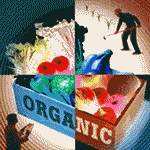
Last Friday the USDA and big business lost, and activism won. The saga of how the USDA was forced to drop its proposed business-friendly regulations that would have allowed all manner of ugliness—toxic sludge fertilizer, irradiation, altered genes, and much more—into foods labeled organic (see “Organic Engineering,” Mother Jones May/June 1998) is a phenomenal story. The USDA received some 200,000 letters, faxes, and e-mails from outraged consumers on an issue that was utterly invisible five months ago.
It’s hardly a definitive victory in the struggle to clearly label the food we buy and eat. The same regulators will be drawing up the next batch of proposed regulations “from scratch,” probably hoping to “scratch” public input next time. Continued vigilance and pressure will be needed. But those 200,000 responses, by far the largest number USDA has ever received on any proposed rule, came “from scratch,” too, in a movement that mushroomed— organically, no less—in mere months. It should give heart to any citizen concerned that the accelerating grip of big business on public policy is unstoppable. How it happened holds important lessons for all such grassroots struggles. Here are a few:
The issue hit home. People may not care what happens in Kosovo or East Timor, but everyone puts food in their bodies, and even in late capitalism, many of us care what’s in that food. This was not an abstract issue. The impact was direct enough to motivate many people who rarely do so to act.
The issue was non-ideological. Truth in labeling food cannot be said to be a Republican or Democratic, left or right issue. People couldn’t pigeonhole; they needed to make up their own minds. Many did.
People are tired of being lied to and insulted. Advertising is, by definition, lies. Everyone knows it. For once, they could talk back.
Protesters included business allies. The “legitimate” organic food industries—the ones whose livelihoods and profits were threatened as giant agribusiness set its sights on market share—chimed in. Even before consumer campaigns got moving, many businesses and co-ops took the initiative, not only to take action, but to encourage their customers to do the same.
Everything’s faster now. The Internet has done for grassroots organizers what NAFTA and the WTO have done for corporations. Even five years ago, it is inconceivable that such a response could have been marshalled in a matter of months. For spreading resources—such as the proposed standards themselves—and word of mouth, the Web and the Internet, while still elitist, are now invaluable for rapid organizing.
Nothing’s solved yet. Those regulations still need to be drafted. The movement that rose up to thwart USDA and Monsanto et al. could also use a positive agenda—not just better proposed regulations, but community support of organic farming: for example, public money to help all-organic markets, neighborhood pea patches in urban areas, and community-supported agriculture (CSA) to keep family farmers on the land.
Finally, freedom of speech counts. Of course, this should include the right to mention if a product is free of, say, bovine growth hormone or irradiation. But another kind of free speech is threatened, too. Even as astonishing anti-corporate victories like organic food standards and last year’s mobilization around fast track show the organizing potential of the Internet, efforts to commerialize and restrict this new medium are well underway by both corporations and governments. Access to the Net must be widened, and barriers to free speech on the Net dropped. Otherwise, what is rapidly becoming the most essential means of free public exchange of information in a democracy may be lost as soon as we get it.
Geov Parrish is a long-time activist, co-editor of the weekly newsletter Eat The State, and political columnist for the Seattle alternative weekly The Stranger.