Ours is a nation obsessed with size. The quest for something larger – often mistaken for grandeur – becomes a source of competition, and its attainment a cause for bragging rights. We want larger houses, larger SUVs, larger plasma televisions, larger breasts, larger penises. And yes, larger portion sizes.
But what we get, mostly, is larger waistlines.
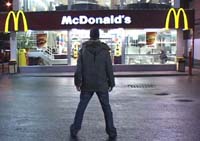
Just ask Morgan Spurlock, the first-time filmmaker who came up with what he called “a great bad idea” for his first film, Super Size Me. Struck by the growing incidence of obesity in the United States, and intrigued by two lawsuits filed against McDonald’s by two young women who blamed the fast food chain for making them fat, prompting the chain to retort, improbably, that Mcfood is healthy and nutritious, Spurlock decided to see for himself –- and to document his experience on film. Putting his body on the line, he traveled the country, eating and drinking nothing but McDonald’s — three times a day for thirty days. And if the McDonald’s cashier asked if he “want[ed] that super-sized,” he made himself say yes.
Sound crazy? Spurlock’s doctors, who periodically monitored his fast-failing health, thought so. But even after Day 22 of his McDonald’s marathon, by which time he’d gained twenty pounds, was having heart palpitations, and had, so his doctors told him, the liver of a binge drinker, Spurlock kept at it.
Spurlock took two months to get healthy again, but his masochism has begun to pay off. His documentary made it to No. 11 on the box office charts after its first week in theaters, and it’s ratcheting up the pressure on the fast food industry — and not just McDonald’s — to take responsibility for its impact on public health.
I sat down and spoke with Spurlock in Austin, Texas this past March.
Motherjones.com:What inspired you to make Super Size Me?
Morgan Spurlock: Well, for me it was really inspired by the lawsuits [brought by two obese girls against McDonald’s for making them fat]. But what really did it for me was in 2002, at Thanksgiving, you couldn’t open a magazine or turn on the TV without hearing about the obesity epidemic in America, and everyone always singled out fast food as a big problem in the epidemic. People were always pointing the finger at the fast food industry. And I was a big fan of personal responsibility — you know, no one is forcing you to eat. We’re not geese being stuffed with corn.
But the more I started to hear about the lawsuits, I started to say, “Well, there’s something here. There’s something in the marketing, the advertising campaigns. The content of the food is something they really don’t make known, how much fat and sugar is in [the food] you’re eating. There’s definitely a side to this I can understand.
For me, I was sitting on the couch watching a television program, and I can’t remember if it was someone from McDonald’s or someone from the food company, but they’ve got a lobbyist who came on and said, “You can’t link our food to these two girls getting sick. You can’t link our food to these girls being obese. Our food is healthy; it’s nutritious; it’s good for you.” And I thought, if it’s that good for me, then I should be able to eat it for breakfast, lunch, and dinner for thirty days straight and be fine.
MJ.com: So on about day 22—
MS: I was so sick and so unhappy.
MJ.com: Did you consider stopping?
MS: Yeah, that day when all three doctors, my nutritionist, my girlfriend, and everyone [said], “You proved your point. Enough’s enough. You’ve got to stop now,” because the doctors didn’t know what was going to happen. They said they didn’t think I should’ve ever done this. “We don’t know what could be next, you need to stop.” It got very, very scary there for a while.
But I decided to persevere. I called countless people. I called my parents. I called other doctor-friends of mine, and all of them were like “You should quit, you should quit.” But when I called my brother he gave the most sound advice of all. He said, “You know, Morgan, people eat this stuff their whole lives. You think you’re going to die in nine days?” I thought, that’s a very valid point, and pressed on.
MJ.com: You were back to your normal health after a month or so—
MS: Two months.
MJ.com: Have you been to McDonald’s since then?
MS: No. Nuh-uh.
MJ.com: Do you think you’ll ever eat at McDonald’s again?
MS: Well, in the movie, the doctors say you should eat McDonald’s about once a month at most. So based on that I ate enough McDonald’s in the course of a month to last me for eight years. So maybe in eight years.
MJ.com: The U.S. House of Representatives recently passed a bill to exempt restaurants from being sued for serving portions that are too large—
MS: House Resolution 339. It will make it illegal for anyone to sue a food company.
MJ.com: What do you think about that?
MS: I think we need to let the judges decide what is and isn’t just and what is and isn’t a valid lawsuit. That’s why we have the three branches of government.
And I think that we can’t start passing legislation that protects these corporations from any type of exposure because then what will happen next? Corporations make mistakes all the time. Firestone makes bad tires … People have encountered a multitude of problems in corporate structure, so we can’t suddenly [allow] these people [to avoid taking responsibility] for their actions.
From one standpoint you can see why they’re trying to do this. They’re trying to shield themselves from the potential that could come from this movie coming out, and even more in the future as things start to happen, but that’s we have judges and that’s why we have a justice system.
MJ.com: Obviously you still haven’t heard back from McDonald’s, and you probably never will. But it seems like McDonald’s is a little freaked out. They’re no longer going to offer ‘Super Size’ options, except for special promotions–
MS: Yeah, they’ve completely done away with ‘Super Size’ options. It’s a huge accomplishment. [But] for me, the film is not an indictment of McDonald’s; it’s an indictment of fast food culture. It’s an indictment of the food industry as a whole. It’s an indictment of a food industry that sells gigantic portions, that sells food that is filled with fat and sugar, that markets to kids.
For me, McDonald’s is iconic. McDonald’s represents “everyfood.” They are the biggest chain in the world, and by being the biggest chain, they’re the ones that most easily can institute a change, that most easily can institute a shift in the paradigm, and that’s what’s happening. Now they’ve said, “we’re a part of this problem. We’re a part of what’s going on, so we’re going to change our menu.” By them doing this, it will happen across the board. It will happen at Wendy’s, Taco Bell, Burger King. All of them will now say, “You know what, we need to do this as well because you know what? Because we care about you.” They don’t want to be seen as the guys who don’t care about you now. They want to say they care about you as much as McDonald’s. So they’re all going to follow one into the other. So as McDonald’s introduces public health into [its] menu, so will everyone else. It’s a great, great thing.
MJ.com: Why do you think Americans are so much fatter than the rest of the world?
MS: It’s an epidemic that’s spreading worldwide. A third of Europeans are becoming overweight or obese. So it’s really hitting on a global scale. And it’s a multitude of things. A lot of it is fatty calories and liquid calories, empty calories that people are taking in. I would eat this food, and then a few hours later, I’d be hungry again. There’s a lot of empty calories there.
It’s [also] a sedentary lifestyle. Sixty percent of Americans don’t exercise. What a coincidence that also more than 60 percent are overweight or obese. These do go hand-in-hand.
I really wanted to make a film that would make people think about what they are putting in their mouths because a lot of people don’t. You just go; you eat. You’re hungry, you eat, you snack. That’s the other thing: We’re a big snacking culture.
MJ.com: What will it take for corporations to take more responsibility?
MS: This goes back to what I was saying about House Resolution 339. If we’re going to pass legislation, let’s pass legislation that makes sense. Let’s pass legislation that is going to start to even the playing field when it comes to advertising, when it comes to marketing.
You know, the five-a-day fruit and vegetable campaign gets only $2 million a year in all media. Let’s make these giant corporations that sell junk food give one percent of their marketing budgets toward healthy advertising, toward healthy food, toward kids, toward fruits, toward vegetables. Even if it’s just McDonald’s, you’re talking about $12 million if it’s just one percent. So now they’re going to give $12 million. If it’s Pepsi, Pepsi’s going to give $10 million, and you have all of these corporations giving one percent of their entire marketing budget to a healthy campaign. Suddenly you’re talking about a campaign that’s going to have hundreds of millions of dollars that puts really smart options in front of kids and [help them choose healthy] lifestyles.
They just cut the funding for VERB, the campaign that was put on by the Center for Disease Control. And it was funded by the government; it was an action campaign to show kids [that they can] go out and run and jump and play — “You know, the VERB, it’s what you do.” It was a tremendous campaign. They already had studies that showed what an impact this campaign had. Kids were living more; they were going outside more. So now they’re cutting the funding from that, from something like $30 million to like $5 million in the next year.
So where are our priorities? What are we doing? Our priorities are so out of whack in this country. These legislators have become so controlled by these special interest groups and corporations, and their responsibility to their constituency is disappearing. And what they need to do is say, “Listen, our priorities need to be in education. Our priorities need to be in our kids.” And they’re not; that’s the problem. You can’t keep blaming the parents. There are two sides to this coin. There’s corporate responsibility, and there’s personal responsibility, and that’s what we deal with in the movie. Now we need to continue to address the corporate responsibility side and let the personal responsibility side take shape.
MJ.com: You traveled all over the country to make the movie. Why did you choose to do that rather than just eating at your friendly neighborhood McDonald’s for thirty days?
MS: Because McDonald’s is everywhere. I really wanted to show that everywhere you go, this food is there. But also it was important for me to show how this is a nationwide issue. I live in New York City, where you walk everywhere. I came to Texas, where I walked just over half a mile a day in those three days.
Once you leave the cities, your healthy food choices really become [limited]. If you’re only eating at restaurants, [you won’t find many] healthy options. It’s really a chain mentality, and that’s what the film is examining. We’ve really become a chain culture. It’s not just fast food. It’s not just McDonald’s, Burger King, Taco Bell. It’s Outback; it’s Chili’s; it’s Applebees. It’s all of these chains. You think you’re getting better food, but the portion sizes are massive. You get this plate of pasta at the Olive Garden that’s 1500 calories by itself. People really need to examine these choices.
MJ.com: Were there certain places where the people seemed to be fatter?
MS: Well, in Texas, there were definitely big people, and in West Virginia, where I grew up, there were definitely big people there. This isn’t a picky epidemic. It isn’t choosy where it strikes. It’s pervasive across the entire United States. It’s really enveloped our entire country, and so that’s part of what we wanted to show. It’s not just here and there. I mean, in New York City, where these people walk all the time now, there’s a 25 or 30 percent obesity rate now. It’s very, very huge.
MJ.com: As far as you know, did McDonald’s try to block distribution of the film or deter people from seeing it?
MS: It’s already having an impact on corporate America. There are front groups that are funded by the food companies that are starting to put out their propaganda to attack me rather attack the film because you can’t refute the truth. I mean the entire film is based on fact. There are front groups that will attack the messenger rather than the message, but the movie is going to have a life of its own. I think the personal responsibility aspect and the regular people want to see this. I think it will play in metroplexes; I think it’s going to play in places where big movies play because people are going to want to see this.
Film is such a powerful medium. It can really affect change; you can affect so many different people in different ways. I mean, what has happened [with McDonald’s discontinuing its ‘Super Size’ option] has really been a testament of the power of filmmaking. For the food companies to come forward and make this announcement has shown that one person can make a difference. And one person with a video camera can make a world of difference.
MJ.com: So what’s next for you?
MS: The next year is going to be focusing on Super Size Me.
For me the goal with getting the film out in the theaters is in the fall, then going into schools – going to colleges, high schools, junior highs. You know, really getting the word out to kids and get [school boards] to change these horrible menus that these kids eat in school lunch programs, so they can get the junk food out and get healthy food options in these schools.
You know, No Child Left Behind has destroyed the education system. It’s taken away recess, health, art, music, and things that would really help make our kids bright, vibrant, well-balanced, active kids. We need to really focus our efforts on bringing back the things that matter, which are health and nutrition, and not just being able to read. Like James Rozey says in the movie, “We’re going to be a nation of fat readers.” You’re going to be able to read, but you’re only going to live to see fifty. Great. Can’t wait.