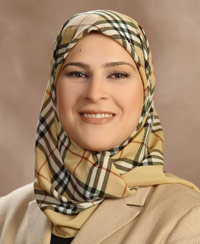
One third of the candidates in Iraq’s January 30 elections are women, and women have been guaranteed 25 percent of the seats in the country’s new national assembly. But even with such provisions in place, the status of women in Iraqi society after Sunday’s vote remains uncertain. Women are facing a growing backlash, according to Manal Omar, the director of Women for Women International’s program in Iraq. “It’s been really difficult coming to terms with how bad the situation has become,” she says. “We’re seeing women’s rights leap backwards.”
The precarious position of Iraqi women is outlined in a recent report (PDF) by the WWI, which is based in Washington, D.C., and assists women in post-conflict countries. It paints a bleak picture: Iraqi women are under siege from all sides, and they’re losing their access to civil society in the process. Much of the blame lies with the bloody insurgency and the strictures of religious conservatives, but the report also criticizes the U.S.-led coalition and the interim Iraqi government for ignoring — and at times undermining — women’s concerns. A WWI survey found that while Iraqi women overwhelmingly want opportunities for education, work outside the home, and political participation, their most basic needs are not being met. Ninety-five percent said their families did not have adequate electricity; only five percent said the government had done something to improve their lives in the past year. Omar criticizes the U.S. for supporting policies on paper — such as the 25-percent representation rule — without creating the conditions that would make those changes stick once a new government takes over. “The Kodak moment has been more important than the reality,” she says.
During the past year and a half in Iraq, Omar has worked with hundreds of women, helping them start small businesses and build local women’s groups. However innocuous, such efforts have become almost impossibly dangerous during the past few months. Omar has lost several friends and colleagues, and has narrowly escaped attempts on her own life. Even as her project has gone virtually underground, the 29-year old activist says she’s not deterred by the increasing violence and official indifference toward her work. She spoke with MotherJones.com from Amman, Jordan.
MotherJones.com: Women for Women International’s recent report on Iraq is dedicated to 14 women who were murdered during the past 18 months. Why were they targeted?
Manal Omar: It’s a wide range of women on the list: You have everything from a businesswoman to a pharmacist to women who are on district councils to an adviser to a government minister. So it’s clear that Iraqi women who are active are being targeted. [The insurgents] are trying to intimidate them as much as possible and force them back home. Just recently, I found out that a hair salon that I usually frequent was bombed — like the Taliban.
MJ.com: How has this violence towards women affected your work?
MO: We are completely underground. We even try and confuse people and tell them that we’re closed because we don’t want anyone to have a clear idea of where we are or what we operate. I can’t really go into detail for security reasons. But we’re still operational.
It’s extremely dangerous for expats in Iraq right now. I’m Arab, I’m covered, I’m Muslim, but that does not make a difference. Everyone is a target if they’re working as an expat. [Murdered CARE International director] Margaret Hassan was the perfect example. But everyone is a target, even Iraqis. My biggest fear is for the Iraqis themselves. The more desperate [the insurgents] are for targets, the more local they are going to become. We’re already seeing that in the increase of assassinations of so many Iraqi women. Every time I get a phone call from Iraq, my hand is on my heart. I’m so worried that something has happened.
MJ.com: How much longer can NGOs like yours continue to work under these conditions?
MO: The last time I was there, in November, I talked to my staff about closing. I said, “You know, we need to be realistic. The situation is just too dangerous.” We’ve escaped death by seconds way too many times. I was determined to close the office, but they refused. And they said, “If you close the office, you might as well dig a grave and bury us. This is the only lifeline we have. Whatever you want us to do, we’ll do, but don’t close the office.” They fought me tooth and nail, every single one of them. So at that point, I felt that they recognized the risk and were willing to continue. That’s the only way Iraq is going to change, if people do that. I wanted to support them in whatever way we could.
MJ.com: Have you gotten any support or security from either the interim government or the U.S.?
MO: No. There’s nothing. At the house that I lived in, two Lebanese were kidnapped from the house in front of us. The guards went out to the police and the police were like, “Please. Spare us. We’re not going to go out there because we can’t do anything. They’re better trained and better equipped than we are. Sorry.” The police are targeted themselves. Soldiers are being kidnapped and killed — what protection can they offer? It’s unfair to them. Too much has been thrown in their laps in too short a time.
MJ.com: One criticism in your report is that the Coalition Provisional Authority rushed the transition period. If the U.S. had held onto official control a bit longer, what could it have accomplished?
MO: I think that if the U.S. had institutionalized things more before they handed them over, it would have helped. Everything’s been on fast forward. The Kodak moment has been more important than the reality. We’ve invested money; we’ve invested human life; but if we would invest the right amount of time, Iraq will take off on its own. But we’ve just rushed everything too much. It’s sad to see, because during the first six first months there was so much opportunity, there was so much hope. It was contagious to the point that I became hopeful that something was going to materialize out of Iraq, and I’m generally against war. The Iraqis convinced me that things were going to change for the better. But seeing it now, I feel fooled. So imagine how the Iraqis feel. They put themselves into this with all their heart and now are seeing things spiraling into chaos.
MJ.com: Yet in your report, 90 percent of women surveyed said they were optimistic about the future of the country. How do they reconcile this hopefulness with the dire situation you just described?
MO: That’s what’s amazing. When I saw that, I went back and talked to the women myself. And what they said was that under Saddam you couldn’t even imagine change. It was almost a crime to dream that things would change. So the reason that they’re hopeful is that Saddam is not there, so whatever happens, there still can be change.
I can not tell you how inspiring the women we’ve been working with are. We focus on the most socially and economically excluded women, so we usually find them really hopeless, ready just to give in. I’ve heard a lot of them tell me, “Just leave us alone. We can’t do this; we’d rather just die. Don’t even waste your effort on us, go to someone who is younger.” These women are in their mid-30s and they’ve already given up on life. But they eventually regained confidence in themselves. One of our women in the south is running in the election, which I think is fabulous, considering where she’s coming from and how she started.
MJ.com: Based on that and what else you’ve seen, how is women’s participation as candidates in the January 30 election shaping up?
MO: As candidates, they’re definitely out there. The Iraqi election commission requires that every third person on each party’s list be a female. So one third of the candidates are women. But when a list is voted in, the party will then select who represents them [in the national assembly]. It doesn’t necessarily mean they’re going to elect the women.
There are some really good female candidates. We try to distinguish between just having a female there and having people who are going to be defending women’s rights. Most of the women candidates that I know of are refusing to be intimidated. They’re targeted; a lot of them have had family members killed. I know of at least one whose son was killed in an assassination attempt against her. Four American members of Congress recently came to Jordan to do training for the candidates. At least 25 of the female candidates participated. During the training, [the members of Congress] brought in fliers and bumper stickers. They were talking about how you get your name out in the streets. And the candidates, when I talked to them, were just flabbergasted: “Are they serious? Most of us are scared to tell our husbands we’re running for office. None of our relatives know we’re running for office.” I think that was a big disconnect. But these women are very strong and absolutely refuse to be forced back inside. They also recognize what’s at stake, and that’s why they are so committed to the process.
MJ.com: What about women’s participation as voters?
MO: In terms of voting, I just don’t see many people going out to vote, men or women. Women are targets of opportunity, so it’s going to be harder for them to go out and vote. Particularly if you’re talking about the large number of female single heads of household — the widows, the divorcees. It’s not like they have something to protect them in the house so they can take such a risk. So I’m not really confident about the turnout of women at the polls.
MJ.com: Do you think that the current backlash against women’s rights was always simmering or is it a reaction to the current situation?
MO: I think it’s a combination. It’s a reaction to the current situation because one of the things automatically connected to the West is women’s rights. Even women themselves are against this. The other thing is economics. You have a high unemployment rate; you have so much frustration, and the easy target in the household is women. And they’re an easy target in the community as well.
In the past, Iraq was incredibly advanced. In 1959, Iraq had a personal status law that people in the Middle East are still fighting to try and get. You actually had Iraqi women establishing NGOs in Kuwait to help Kuwaiti women. They were a donor country in terms of women’s rights. In the ‘70s and the ‘80s, women saw huge progress. But in the ‘90s under sanctions, Saddam only rewarded women who were part of the Baath party. The laws [protecting women’s rights] remained on the books but stopped being implemented, particularly because Saddam was appealing to the religious and tribal leaders. For example, he passed a law allowing shorter sentences for honor killing. He started banning women’s work. There was an official decree for all secretaries in the ministries to be fired, in order to give men the positions.
MJ.com: Your report says that women have been “marginalized and excluded” by Coalition and the interim government. Can you give some examples of how this happened?
MO: Definitely. It’s actually a little shocking when you look at it. The Transitional Administrative Law says that the target is 25 percent [for women’s representation in the new government]. Yet when the Allawi government was appointed, you had only 18 percent women’s representation. So we had the Coalition putting in an administrative law and then they themselves contradicted it, therefore setting a dangerous precedent for any future Iraqi government, because they can say, “Well, the Americans and the Brits didn’t follow this law, why should we?” They undermined themselves by doing that.
There also was a female judge, Judge Nidal, who was appointed in Najaf. There were protests and she wasn’t sworn in. The Coalition said, “We’re trying to respect Islamic values. This is Najaf; we don’t want to force a woman on them.” Judge Nidal went to imam [Grand Ayatollah Ali] Sistani and he actually wrote a fatwa — which is very difficult to get — that says that a judge has to have masculine qualities but doesn’t necessarily have to be a male, therefore allowing her to be sworn in. It was a beautiful move, putting the ball back into the Coalition’s court. But when Nidal went back to the Coalition, they told her, “We’re afraid to swear you in because of what some crazy people might do to you.” Now, it’s ironic, because that’s the same reason conservatives are using to force women to cover themselves. We were very disappointed at the failure to swear her in.
MJ.com: It sounds like the Coalition backed down because it was afraid to offend Iraqi men.
MO: Women were being used as a negotiating chip. Let’s say that the Coalition is negotiating with one of the conservative parties, and the conservative party says, “We want A, B, and C. B being women.” Then I could see the Coalition saying, “We can’t do A. C is a maybe. But we can give you B.”
MJ.com: Where has all this left Iraqi women?
MO: I’ve been there for 18 months now. The first six months were nothing like these last six months. During the summer of 2003, people were very excited about what women could accomplish. It’s been really difficult coming to terms with how bad the situation has become. After the U.S. Army entered Afghanistan, women’s rights didn’t drastically improve, but they didn’t go backwards, either. But in Iraq we’re seeing women’s rights leap backwards. It’s sad to me that we’re fighting to keep the status quo instead of leaping forward.