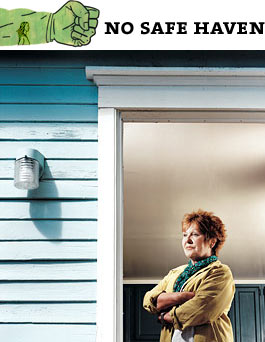
Photo: Gregg Segal
ON A WARM DAY IN 2001, Patty Prickett sat in her office in the West Los Angeles police station, trying not to cry. With her were a five-year-old boy and his younger sister, a week shy of her fourth birthday. The children did not know yet that their mother was dead. Six months earlier the woman had come to the station seeking safety. Her husband, she said, was unemployed and had been drinking heavily. When she refused to have sex with him he had attacked her, prevented her from calling for help, and held her captive in their home, blocking the bedroom doorway when she tried to flee.
Prickett, then head of the domestic abuse response team at the station, had accompanied the woman to court to secure a restraining order and advised her to quit her job, pull the children out of school, and leave home. The woman agreed, and Prickett located a scarce spot for the family in a shelter. “That is a very hard thing for a woman to do,” she says. “To go into hiding while her batterer is running around free.”
The woman was grateful for a respite from the constant threat of violence. But cut off from work and the emotional support of family and friends, she and the children soon became depressed. They left to stay at a relative’s, where her husband quickly found her. She moved repeatedly, but he always tracked her down. Over the next six months her husband violated the court order many times—the woman filed at least six police reports recounting escalating incidents of death threats, stalking, and harassment. Prickett pressed the police and the Los Angeles city attorney’s office to take action. Nothing happened. “One day he came and got her,” Prickett says. “The kids saw them leave.” Later that day the woman was found strangled to death with a belt. “She did everything right and the system wouldn’t protect her,” says Prickett. “They just wouldn’t take it seriously. He kept saying he was going to kill her, and by God he did.”
The murder that confronted Prickett in 2001 bears an eerie resemblance to the crime at the heart of Castle Rock v. Gonzales, a bellwether domestic violence case recently considered by the U.S. Supreme Court. In that case, a husband abducted three children from his estranged wife’s custody, but when his wife, who had obtained a protection order for herself and the children, alerted police, they repeatedly put her off, telling her to call back later. That night the husband arrived at the police station and opened fire. He was shot and killed by police, who then discovered the children, dead in his truck. The question before the Court was what action, if any, the police are obligated to take when confronted with the violation of a restraining order. Every state now provides such civil protection orders to victims of domestic violence, and they are considered a basic tool in shielding victims from their batterers. But in both the West Los Angeles murder and the case before the Supreme Court, as well as in numerous cases across the country each year, the orders fail to fulfill their promise, and victims are subjected to harassment, beatings, and death.
For Prickett, the 2001 murder in West Los Angeles marked the nadir of her career as an advocate. For 15 years she has been on the front lines of the battle against domestic violence, counseling both batterers and victims, fighting to find funding for programs that lock up abusers and keep victims safe, and growing increasingly frustrated with a legal system ill-equipped to handle the problem’s complexity. Over the years she has shifted her focus several times, in each instance retrenching from burnout and from an approach she felt wasn’t working. Her trajectory parallels that of the battered women’s movement, as the euphoria of identifying a seemingly simple goal of safety succumbed to the realization that neither the end, nor the means of achieving it, was going to be easy. “The whole battered women’s movement is set up to get women to leave their abusers,” she says. “When they leave, we tell them we’ll protect them, so what happens when we don’t?”
Each year between 1 and 4 million women in the United States are victims of domestic violence, and 31 percent of women slain in this country are murdered by husbands, boyfriends, or exes—the majority killed after attempting to leave an abusive relationship. The fact that such statistics are routinely compiled and readily available is a testament to the mainstreaming of an issue that was barely acknowledged in the popular consciousness three decades ago. Since the 1970s, when domestic violence activism first emerged as an outgrowth of the women’s movement, proponents have won dramatic changes in policy, leaps in social awareness, and major infusions of cash from state and federal government.
But sustained institutional change requires vigilance, and the police indifference that greeted the murder in West Los Angeles illustrates a larger flaw in the evolution of the movement itself. What began as a scrappy, grassroots effort has become a bureaucratized entity allied so closely with the criminal justice system that it has sacrificed much of its ability to effectively critique that system and push for reform. “Twenty-five years ago we had a notion that we were organizing to change the system,” says Ellen Pence, a founder of the Domestic Abuse Intervention Project in Duluth, Minnesota, a leader of the national movement. “Then this funny change happened, where instead of us advocating for what women needed from the system, we started advocating the system to women. There has to be a new confrontation of what’s going on.”
Prickett believes that lack of confrontation, and of any larger consequence for police inaction, enabled officers to brush off her warnings about the homicidal batterer in 2001. “What they will say, what they always say, is you never know which ones are going to wind up killing someone,” she says. “But there are signs, and once you see them, you have to act, and you have to be aggressive. Otherwise women are going to keep on getting hurt and getting killed.” After the woman’s death, Prickett heard that the husband had been seen hanging out at a bar near the scene of the crime. She begged the cops to stake it out. They refused. He was never apprehended.
THE WEST LOS ANGELES POLICE STATION guards a geographically and economically diverse region spanning 65 square miles, encompassing no-frills apartment complexes and some of the most affluent addresses in the city, like Pacific Palisades and Brentwood, the neighborhood where Nicole Brown Simpson was murdered in 1994. The precinct boasts the lowest crime rate in the city and, partly as a result, officers and advocates say, the station is resistant to change. “People here think they’re doing just fine,” says Rashad Sharif, a senior lead officer at the station and a friend of Prickett’s. “They say, ‘If it ain’t broke, don’t fix it.'”
Prickett set up shop at the police station in 1998 under a four-year, $540,000 program funded by the Violence Against Women Act. That landmark legislation, passed by Congress in 1994, provides essential funding for hundreds of criminal justice programs that now undergird battered women’s advocacy nationwide. Prickett’s program was intended to educate officers, help victims get access to services, and increase arrests and prosecutions of batterers. Though the funding was awarded to the police department, Prickett came in as an advocate, a stance that fueled an adversarial dynamic between her and a station considered within the local advocacy community as one of many mired in a “good old boy” culture.
Prickett confronted the station’s disregard the day she reported to work and was shown to her office—a former holding cell, complete with iron bars and a concrete floor. A detective told her dismissively that “rich men don’t beat their wives.” Undeterred, Prickett sponge-painted the walls peach, carpeted the floor with remnants, and tacked up posters of Sojourner Truth and Rosa Parks. On the weekends when she went to political protests, she made a point of hugging any police officers she recognized. “They never quite knew what to make of that,” she says, laughing. “But I wanted them to see things from a different perspective, to see the crowd as people.”
At the station, she and her staff of five held marathon training sessions on rape, on determining the dominant aggressor in domestic violence situations where both individuals are injured, and on writing effective reports, crucial because “the chances of getting a victim to testify are slim to none,” she says. “That initial report has to be of detective caliber so that it can stand alone in the prosecution.”
Prickett wrote manuals for the officers, passed out pocket-size how-to-identify-a-batterer guides, and went out on more than a thousand domestic violence calls. She or one of her staff members was on duty, in a police car accompanied by officers, from 6 p.m. to 2 a.m. five nights a week. “When I first started, the last thing I wanted was to be part of a responder team,” she says. “I mean, 2 a.m. in a black-and-white? Give me a break. But as time went on I realized that was the way to go. You can really intervene and help the woman get hooked up to services before she gets spooked.”
Whatever Prickett’s success in the field, her suggestions back at the station fell on deaf ears. “Everything I would write up, they would sort of laugh at me and pat me on the head and tell me why we couldn’t do it,” she says. “I was like, ‘What do you mean we can’t do it? Fresno P.D. is doing it.’ They’d say, ‘Well, we just don’t do that.'”
Michael Hillmann, a captain in West L.A. during part of Prickett’s tenure, says the station was supportive of the program, but that domestic violence calls often lose out to more pressing crimes. “In the grander scheme of things, reduction of homicides and the ability to save the lives of people subject to drive-bys is a competing priority,” says Hillmann, now a deputy chief supervising drug and gang operations. “We’re trying to balance all that. To take police officers out of the field and put them with a domestic violence program means that we have one less officer in a position where they are able to prevent a shooting or some other type of crime.”
Multiple studies have found that when a coordinated model is properly applied, domestic violence-related homicides and felony assaults fall by as much as half. “I don’t think the criminal justice system can get rid of wife-beating,” says Pence. “But if everyone is very aggressive and very consistent, it makes an enormous difference.” Yet sustained results have proved elusive. In 1977, Los Angeles became one of the first cities in the country to establish a separate domestic violence unit and adopt a vertical prosecution model, boosting their success rate by assigning each case to a single attorney from beginning to end. Even with those innovations, says Maureen Siegel, special counsel in the criminal division for the Los Angeles city attorney’s office, her office accepts for prosecution only about a third of the domestic violence cases that come in. “No matter how strongly we may believe an incident has occurred,” Siegel says, “knowing something and being able to prove it in court are, unfortunately, two very different things.”
Peter Macdonald, a retired judge from Kentucky who leads judicial domestic violence training programs, says judges tend to come under the sway of batterers who appear charming and polished, while victims are intimidated into recanting or are made to look hysterical. “This happens all the time,” Macdonald says. “I’m embarrassed to say that when I started out in 1978, I was one of those judges.” Some judges have never heard of the Violence Against Women Act, Macdonald says, and are ignorant of changes in the law affecting battered women. At one training session he conducted, he says, only 1 of 47 participating judges knew that a protection order issued in one state is valid in every other.
Yet ignorance is no longer the main enemy. “Twenty years ago we could say nobody understood domestic violence and we have a lot to educate them about,” says Joan Meier, a professor of clinical law at George Washington University. “Well, we’ve done that. People understand it a lot better now. Now we face a much more difficult challenge, because the resistance is much more deep and fundamental and bedrock.” Advocates say the time has come for the movement to address the burgeoning resistance associated with the men’s rights movement, the legal challenges being mounted on behalf of batterers by the defense bar, and entrenched resentment and apathy within the criminal justice system itself.
“There’s a huge backlash right now,” says Susan Millmann, a legal aid attorney who heads the L.A. Domestic Violence Task Force. “There are many, many people who are trying to turn back the clock.” Millmann finds Prickett’s experience in West Los Angeles unsurprising. There, as in many police stations around the country, line officers have little incentive to embrace an effective approach without a push from the top. “The officers say what they’re supposed to say,” Prickett says. “That is, ‘You don’t decide whether to prosecute, ma’am, the state prosecutes.’ And then they put some detective on the phone. We had one guy who spent more time talking victims out of prosecuting, which is totally against policy. But as a civilian, you can show L.A.P.D. their own penal code and their own policy manual and it doesn’t matter unless you’ve got backing from the captain. Somebody has to care.”
PATRICIA PRICKETT, who is 58, divorced, and the mother of two grown sons, never imagined she’d wind up as an advocate for battered women. She came of age in the 1960s and 1970s, dividing her energies among the antiwar movement, the environment, and lefty political campaigns. Her manner is both direct and disarming, and she frequently employs a mischievous humor that challenges social taboos—at one point she and some friends started a group called Tough Women Against Toxics, wearing T-shirts with the acronym on prominent display. “We’d go to nice parties and watch people’s responses,” she says with a raspy smoker’s laugh. “They’d start off like, ‘Oh that’s great,’ and then they’d be like, ‘Oh.… Oh…. Oh.’ And then they’d run away.”
Meanwhile, domestic violence was gaining ground with women’s rights activists and in the courts, especially after a 1978 New York court case, Bruno v. Codd, in which 12 battered women seeking damages for inadequate police response provided affidavits detailing gruesome accounts of abuse. The court sympathized with the women and expressed dissatisfaction with the police. “It was the first judicial airing of what was wrong with the way society responds to battered women, and how out of date it is,” says Meier, who is director of the Domestic Violence Legal Empowerment and Appeals Project. “It was very powerful in bringing the truth to light.”
For the next decade, the movement continued to grow, manifested mostly by the emergency shelters and hot lines that were established. In 1983, the problem entered the mainstream when Time featured a graphic cover photo of a battered woman. “That was a measure of where we were then,” Meier says. “It wasn’t talked about, and it wasn’t understood. All of us who were interested in the field went and snatched up all the copies.”
It was around that time that Prickett, weary of the constant hustle of activism, changed course. Her father had been a Marine and had spent three and a half years in a Japanese prison camp during World War II. He didn’t talk much about his ordeal, but what he did describe—being kept immobile in a hole for a month, eating raw flour until he threw up—moved and disturbed her. “I was always interested in the concept of abuse of power,” she says. “I felt like it was time to take that on.”
She went back to school for a master’s in clinical psychology, intending to become a marriage and family therapist. Mindful of her father’s experience, she sought out course work on abuse, which in a family setting included domestic violence. What she found dismayed her. The only related writing focused on sexual abuse, and it placed the blame squarely on the victim.
Beyond the confines of the classroom, the social landscape was changing. In 1984, more than 200 battered women created the Power and Control Wheel, a diagnostic tool describing abusive behavior patterns. The wheel has since become the talisman of the therapeutic model for addressing domestic violence and is still widely applied. Domestic violence had also gained enough recognition that courts began ordering counseling for abusers, and Prickett found an internship at a community clinic in Los Angeles that ran such a group. “The batterer thing appealed to me partly because at the time nobody else wanted to do it,” she says. “And I was attracted to the idea that if you could do good work with them you would have an impact on a lot of people, as opposed to working with survivors, where it’s one at a time.”
Batterers’ groups were seen as the humane antidote to abusive behavior. But a series of studies called into question whether they actually altered the way men viewed their actions enough to prevent them from repeating the abuse. In 1984, a study conducted by the Minneapolis Domestic Violence Experiment found that batterers are half as likely to commit repeat violence within six months if they serve jail time. In 1987, in a landmark case called Thurman v. City of Torrington, a federal district court awarded a battered wife $2.3 million after police refused to arrest her husband. This case, along with the Minneapolis study, spurred a wave of tough arrest laws around the country, begetting an uneasy alliance between the battered women’s movement and the traditional advocates of law and order.
At first, Prickett believed that counseling alone might work. Eventually she, too, concluded that it could be effective only if men attended for several years—in conjunction with jail time. “There has to be desire for change on the part of the batterer,” she says. “That’s why jail works. Sometimes the only desire is to stay out of jail.”
While Prickett immersed herself in batterers’ counseling, O.J. Simpson, an alumnus of court-mandated counseling programs, went on trial for the murder of his ex-wife, Nicole Brown Simpson. The trial achieved what 20 years of activism had not, legitimizing battering as a crime category and persuading millions of Americans that domestic violence was not solely an issue for the poor and drug-addled. Lynn Rosenthal, director of the National Network to End Domestic Violence, was running a shelter at the time. By 1995, the year of the trial, calls for help had soared by 40 percent. “The O.J. case changed our work forever,” Rosenthal says. “We had to rush to keep up, and we’re still catching up.”
The year before, Congress passed the Violence Against Women Act. Many states enacted civil protection orders and mandatory arrest laws, requiring cops to arrest batterers even against the wishes of the victim. To further protect against victim intimidation, cities adopted no-drop policies; prosecution would continue even if a woman backed out.
Those changes led to a dramatic uptick in attention to domestic violence within the criminal justice system, and in 1996, at a training session at the Los Angeles Police Academy, Prickett heard a former sheriff’s deputy speak about being beaten by a boy- friend, an L.A.P.D. officer. Thanks to new federal and state funding, the woman told the crowd, anti-battering programs could educate the police by partnering with them. For the first time in a long while, Prickett felt inspired. “I thought, ‘I want to work with her; I want to do what she’s doing.'” The following year she reported for work at the police station in West Los Angeles to begin her second chapter as an advocate in the battered women’s movement, this time with a focus on enforcement instead of counseling. That chapter would end in disillusionment, when the 2001 murder indicated to her that her efforts were futile. “Four years sitting in a cell,” she says. “From the day I walked in the door I fought the same battles, over and over and over again. Nothing changed.” In mid-2002, when the funding for Prickett’s program ran out, the station declined to seek a renewal.
THREE YEARS LATER, Prickett paid a visit to the precinct house and saw little evidence of her tenure. Her “cell” had been converted into normal office space—a microwave sat in the spot that had been the intake desk for sex offenders. There were no domestic violence posters in the lobby, just a few pamphlets stacked alongside brochures on Halloween safety and real estate fraud. And more importantly, there was no longer specialized training for officers, and no volunteers to accompany them on domestic violence calls.
“While Patty was here it got people talking about domestic violence,” says Officer Rashad Sharif. “Maybe they cared, maybe they didn’t. But at least they were aware of the issue and they had been trained on how to handle it. Now it’s back to just the basics, whatever they get at the academy, which is more than what they offered when I was there, but it’s still not at the level of robbery, rape, and drugs. It’s still on the fringe.”
After the West Los Angeles experiment, Prickett lost some of her enthusiasm for laboring in a confrontational environment. “It’s hard to work in a place where people are happy when there’s an execution,” she says. “It’s exhausting.” As a member of the city’s Domestic Violence Task Force, she tried to secure funding for a range of programs. She revived her private practice, taking on victims of domestic violence, and also became a counselor in the health clinic at Manual Arts High School, one of the most dangerous and academically underperforming high schools in the city, thinking the position would provide a break from battered women’s advocacy. Instead, she’s been confronted with the issue yet again. “These kids see violence every day,” she says. “They see shootings and all kinds of brutality, in the streets and in the home.”
Once again, Prickett’s transition reflects the evolution in the battered women’s movement, which is broadening beyond the current focus on cops and courts to include social services like the kind Prickett is providing at Manual Arts. Outside her office at the high school on a morning in mid-April, a dark-haired teen in baggy pants and a hooded sweatshirt stands waiting as Prickett approaches. They embrace in greeting, and she ushers him inside. More than half of the students she counsels at the school have witnessed domestic violence—a bad harbinger, considering that children who witness abuse are more likely to become perpetrators. Recent reports indicate that domestic violence in teen relationships is on the rise. Prickett’s work with students is one small bulwark against that trend. “You just can’t get away from it,” she says. “The longer I do this, the more I’m reminded that domestic violence is everybody’s problem.”
Contrary to what she believed starting out, she has learned that helping one victim helps many—the woman, her children, and the relatives and the extended community affected by abuse. As Prickett aids the students, the students aid her. Through them, she has gained direct access to some of their victimized parents, whom she talks with on the phone, directs to services, and sometimes persuades to come in. In each case she hopes she might do something, any small thing, to avoid a repetition of that day in 2001 when she sat in her police station office before two young, motherless children, and didn’t know what to say.