|
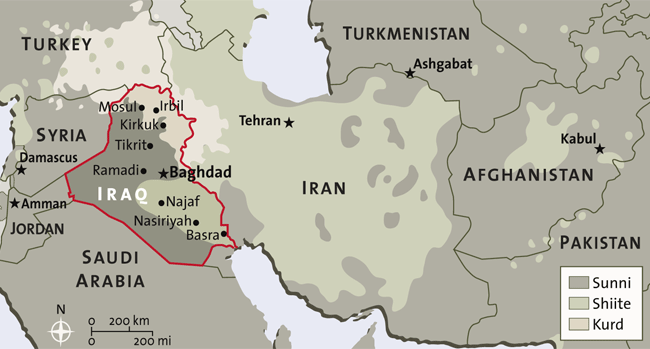
Iraq is 60 to 65 percent Shiite Arab, 12 to 15 percent Sunni Arab, and 18 to 20 percent Kurd. But it’s not a neat breakdown: The big cities, where the majority of Iraqis live, are thoroughly mixed, and many Iraqis live in blended Sunni-Shiite families; some call themselves “Sushi.” Sunnis were favored by Saddam Hussein and the Baath party, whose fall gave rise to a Shiite backlash; today, most ordinary Iraqis are horrified by sectarian violence but turn to their own groups for protection. Shiites |

Shiism is a minority branch of Islam followed by about 10 percent of all Muslims, including nearly all of Iran and Bahrain as well as parts of Iraq, Yemen, Lebanon, Azerbaijan, and Afghanistan. The schism began after the death of the prophet Muhammad in 632, when one group of disciples followed his cousin and son-in-law, Ali, and a line of imams after him. “Shia” is short for Shiat Ali, or “followers of Ali.” Many Shiites believe that the 12th imam, Muhammad al Mahdi, did not die but went into hiding, and will reappear as a messiah. Sunnis often portray Shiites as heretics—a claim that much of Western scholarship has embraced in describing Shiism as a “sect”—but the two branches’ theology differs little, and both read exactly the same Koran. The Shiite branch is more centralized, with a Vatican-like hierarchy of clergymen led by grand ayatollahs. Since the 1979 revolution in Iran, Shiism in the activist mold of Ayatollah Khomeini and the Lebanese movement Hezbollah has developed into a militant force across the Middle East, and that strain is now also evident in Iraq.
Sunnis
Islam’s majority branch is dominant in Saudi Arabia, Egypt, North Africa, Turkey, Pakistan, Bangladesh, and Indonesia. Rather than following Ali, Sunnis (from sunna, “tradition of the prophet”) consider Muhammad’s father-in-law, Abu Bakr, to be the prophet’s legitimate successor and the first in a line of caliphs (“commanders of the faithful”); Shiites believe Abu Bakr usurped the post. The vast majority of Sunni clerics are apolitical, moderate, and concerned chiefly with religious law and theology; the minority hardline strains are associated chiefly with the back-tobasics fundamentalism of the Salafi movement and the Saudi-based Wahhabi school. The most militant and political Sunni elements emerged in the 20th century in a string of activist movements starting with the Egyptian Muslim Brotherhood and culminating in Al Qaeda.
Kurds
An ancient, mountain-dwelling ethnic group numbering perhaps 30 million in all, with 5 million in Iraq, the Kurds—who are mostly Sunnis, but politically align with whomever will support their goals—have revolted numerous times in Iraq, Iran, and Turkey. Ever since U.S. and British warplanes established a no-fly zone in northeast Iraq in the 1990s, Iraqi Kurds have enjoyed de facto autonomy, a privilege enshrined in the new constitution. But many want full independence, and their political leadership has staked a claim to the mixed Kurdish and Arab city of Kirkuk and its massive oil fields. Seizing Kirkuk could spark civil war with Iraq’s Arabs and provoke an intervention by Turkey, which fears few things more than an oil-rich Kurdish entity on its border.
<< Iraq 101 Table of Contents << >> Players, Haters: Iraq Politics at a Glance >>