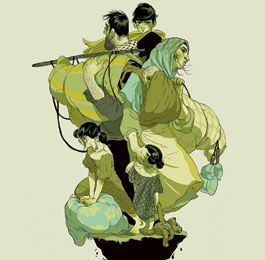
Illustration by: Tomer Hanuka
On the day the American tanks rolled into Baghdad, Abather Abdul Hussein and his wife, Balqes Abdel Mohammed, threw flowers. Literally. After a lifetime of turmoil and tyranny, the couple fervently believed the invasion would bring peace. Abather joined U.S. “democratization” efforts, such as a project to create a governing council for his neighborhood, and he occasionally ended up in the good-news Iraq stories that still seemed plausible in those days; one U.S. paper ran a five-column photo of him perched on a classroom chair surrounded by American soldiers, with a story about the “new Iraq.”
These days, Abather and his young family are among the hundreds of thousands of Iraqis who have fled in fear for their lives. After months spent dodging insurgents who had targeted them for supporting the Americans, he and Balqes are relieved to have escaped—and bitter, like thousands of fellow refugees, that the superpower for which they risked their lives has abandoned them.
A short man who bundles his shattered body in layers against the desert’s winter chill, the 34-year-old Abather is polite and relaxed, with an easy smile. An engaging conversationalist even in broken English, he loves to talk about Baghdad, his infant daughter, and his wife, an outspoken woman several years his senior, whom he calls a genius. “When we met she was a professor at Baghdad University,” he boasts. “I was her student. When she walked into a room, hundreds of people would stand to pay her respect.” Considering that his life savings will run out in two months, that he can’t work legally in Jordan, and that he could be deported at any moment, Abather is remarkably stoic, though the anxiety leaks out in tics. He chain-smokes cheap Craven A cigarettes, crushing the charred filters in an overflowing ashtray; when Balqes complains, he sheepishly offers that “smoking is my only work.” It’s not quite true—his one other job during the past 18 months has been recounting his nightmare, over and over again, to border guards, embassy workers, and aid agencies. In December, he reluctantly told it to me, pulling documents from a worn leather folder to corroborate the details.
The story began after the ouster of Saddam, when Abather and Balqes, like many Iraqis, launched a de-Baathification program of their own. Their target was the dean who had been Balqes’ boss at Baghdad University (and who, as Abather tells it, had forced her out when she resisted joining the Baath Party). Balqes wanted her job back; one day Abather confronted the dean, and tempers flared. American soldiers broke up the brawl, bound Abather’s wrists with a zip tie, and interrogated him. He explained Balqes’ gripe and what the loss of her job had meant for their family, including their 3-year-old son and Balqes’ 14-year-old son from a previous marriage (her first husband had been killed in the Iran-Iraq War). Though he held a master’s degree in engineering, Abather hadn’t been able to get a job in the doldrums of sanctions-era Iraq, so he was scraping together a living repairing watches, his wife and children crammed into his father’s small home.
“The soldiers were very understanding,” Abather recalls. “I was impressed.” They offered the family an apartment in a place called Iraqi Village, a compound near the Baghdad airport where Saddam had housed orphans he was grooming to become fedayeen loyalists. In return, the couple translated for the Americans, and eventually the Washington National Guard’s 1st Battalion 303rd Armored Regiment hired Balqes as an interpreter, at $15 per day. Abather ended up leading a U.S. Army-contracted security squad with a monthly salary of $130. Learning that he was an engineer, soldiers later gave him lucrative reconstruction assignments. He started an engineering firm and worked with contractors such as ABB and Kellogg, Brown and Root; in one heady year, Abather’s contracts would mushroom from a few thousand dollars to an $862,000 electrification project (later canceled because he couldn’t procure the needed equipment).
Abather and Balqes glow with wonder when they speak of those days, of earning a good living and having their own home for the first time. Most of all, Abather enjoyed hanging out with the Americans. He seems to remember every soldier he ever met: Captain Philips and Sergeant Buchard gave his children toys, a soccer ball, and school stationery; Lieutenant Glenn Allen got so close to the family they called him “Uncle Allen.” (Allen confirmed Abather’s story in emails to me, calling him and Balqes “very helpful individuals” who “risked their lives by meeting with us.”) It was as if they had suddenly found themselves citizens of the 51st state.
And so, in October 2004, when Abather got his first death threat, he thought it was a joke. It was handwritten, tucked under the windshield wiper of his car inside Iraqi Village, a gated community with American checkpoints at both its entrances; how, Abather wondered, could an insurgent even have gotten in? The note read:
Abather,
Leave your work with the Americans. Otherwise you will be killed by jihadis because you are a traitor.
Jihad Army
Then the killings began. Lieutenant Allen had once given Abather a photo depicting two American soldiers with five of their Iraqi friends. Three of the Iraqis were assassinated in short order. Abather began to notice cars following him, and a few times shots were fired at his car. The anonymous notes grew increasingly menacing. Eventually, Iraqi Village felt so dangerous that Abather and Balqes moved the family back to his father’s house. A death threat arrived there almost immediately. Still Abather continued working with the Americans.
One day in August 2005, Abather was driving Balqes, six months pregnant with their second child, to a doctor’s appointment. At an intersection, he noticed a gold car parked by the road; suddenly the two men in it leveled guns at him. “This is the end,” Abather thought, and then a U.S. patrol appeared and the assailants vanished into traffic. Within days, Abather and Balqes had sold off their belongings and fled to Amman. Their troubles had only just begun.
The U.S. Embassy in Amman is an attractive, Arabian-style fortress, heavily guarded machine-gunners in Ford pickups. It sits high on a hillside, and the view is so phenomenal that you can imagine your gaze reaching all the way to the Iraqi border, some 200 miles away.
In the foreground, Amman’s rolling mosaic of pale, boxy limestone buildings shimmers against the azure sky. At its edges, in dank apartments on outlying hillsides, lives a substantial portion of Baghdad’s educated middle class. Almost all fled in a panic, after getting death threats or seeing loved ones murdered; many were targeted by insurgents or jihadis because they supported, or worked for, the Americans.
Of Iraq’s 27 million prewar population, about 1 in 8—some 3.4 million people—have left their homes since the invasion, according to the United Nations High Commission for Refugees (unhcr), and more than half of those have ended up abroad. Refugees International labels this the world’s fastest-growing humanitarian crisis. Yet the Bush administration has refused to so much as acknowledge the refugees’ plight, let alone help them get to safety or even provide basic humanitarian aid.
In the past, notes Bill Frelick, refugee policy director at Human Rights Watch, the United States has often aided those persecuted for supporting it; since the Vietnam War, 1 million Vietnamese refugees have been resettled in the United States, including tens of thousands of South Vietnamese army veterans. But the Bush administration “has abdicated that obligation,” says Frelick. “The people who have fled are the ones the administration was relying on to build democracy in Iraq; it would rather ignore them than acknowledge that its initiative has failed.”
It was in Jordan that Abather and Balqes discovered the limitations of their friendship with the United States. Lieutenant “Uncle” Allen had emailed the embassy in Amman to explain that the family feared for their lives; he’d even offered to sponsor their relocation “to the safety of the United States.” An unsigned email from the embassy commended Allen—”I know that your Iraqi friends appreciate your friendship”—but noted that U.S. visas are “quite difficult” for Iraqis to get. Since 9/11, Middle Easterners in general, and Iraqis in particular, have faced enormous hurdles getting admitted to the United States; until 2005, the Bush administration maintained a total freeze on Iraqis that shut out current refugees as well as hundreds of people who had fled Saddam Hussein’s regime years earlier.
The email nonetheless provided instructions on getting a tourist visa, and Abather and Balqes quickly filed their application along with the $200 fee—almost two months’ rent. Several months later they were notified that they could visit the United States for up to three months, but that they could not bring their children. They then made repeated visits to the unhcr to apply for official refugee status. As it has with almost 99 percent of the Iraqis who have come through its office in Amman, the agency turned them down.
Abather and Balqes set their sights on a visa to Australia, a major destination for Iraqi refugees, and even hired an Iraqi lawyer there. They waited for months. Their savings dwindled; then their baby fell ill, and the emergency surgery, for an intestinal obstruction, cost $2,100 in cash.
In early June 2006, Abather got a rejection letter from Australia. Around the same time, word came that his father had died of a heart attack. So he went back to Iraq to bury his father, help his mother find a place to live, and buy state-subsidized medicine for his daughter. But when he returned to the Jordanian border less than a week later, he was told he couldn’t reenter the country: Having recently suffered two terrorist attacks, Jordan had enacted a ban on entry for Iraqi men aged 17 to 35.
For two days Abather stood on the highway at the border post, beseeching successive shifts of immigration officials. Finally, a guard promised to send the medicine to his family in Amman if he would just go away. Once again Abather headed back to Baghdad. Driving in Baghdad a few days later, he noticed a bmw—the Iraqi gangster’s vehicle of choice—in his rearview mirror, closing in. The car forced him off the road; armed men blindfolded him and knocked him unconscious. When he woke up, he was in a tiny room, handcuffed to a chair. Masked men came and went, videotaping as they cursed him as a traitor. They whipped him with a steel cable; six months later, his back was still etched by deep, evenly spaced grooves. “We’ve been searching for you for a year,” his captors told him. Abather recognized the voice of one man, an acquaintance from Iraqi Village who had seemed to befriend the Americans. “I’m sorry your father passed away,” the man said. Soon, a bearded imam sentenced Abather to decapitation for collaborating with the United States. Abather barely heard the proceedings. “I was thinking the whole time about my little daughter in Amman.” He was told he could save himself by spying on the Americans, but he refused. On the eighth day, the men asked if there was anything he wanted before he died; then they put him on the floor in the back of the bmw and sped off.
Suddenly, Abather heard gunshots. The men shouted. The car crashed, and everything went black. He woke up in a hospital bed 60 miles from Baghdad; Iraqi forces had attacked the bmw and pulled him from the burning wreck. He had a compound fracture in his leg and severe burns all over his body, but the nurses urged him to leave: His captors would be looking for him. His brother—who had received a ransom note from the kidnappers, complete with a photo of Abather bound and gagged—brought him back to Baghdad, where doctors fused a piece of plastic onto his shin and grafted skin from his thighs over his wounds. A few weeks later, he was back at the Jordanian border, and this time the guards took pity. The family hadn’t told Balqes of the kidnapping. But when she saw her disfigured husband, she says, “I knew right away what happened.”
On a crisp, clear day this past December, clutching a sheaf of papers documenting Abather and Balqes’ ordeal—contracts, soldiers’ recommendations, death threats, a missing-person report—I headed to American Citizen Services at the U.S. Embassy in Amman. Abather and Balqes had made several pilgrimages there; they were convinced that if only they could speak to an American, Abather’s charred and mangled flesh would make their case, but they had never gotten past the Jordanian security guards.
Outside the embassy, I joined a chatty, eclectic crowd of Americans: a retired hippie turned English teacher from Vermont; a woman with a New York accent who struggled through the narrow eye-slit in her black veil to keep track of her hyperactive daughter; a white-bearded man in a Santa hat, who said he was picking up his passport before returning to the North Pole. I wondered whether any of us would risk our lives for the United States as Abather and Balqes had. To get past the compound’s first wall, we navigated a metal detector, a body frisk, and an X-ray machine; after crossing a 30-foot no man’s land we repeated the process at the second wall. Then we waited to be called.
The United States admits more refugees than any country in the world, but in 2006, only 202 Iraqis were allowed in, and most of them had fled persecution under Saddam before the war. This year, millions of Iraqis, Tibetans, Sri Lankans, and Afghans must compete for a mere 5,500 refugee slots Congress has allocated for the Middle East and South Asia. The Iraqis are in line behind their compatriots who have been waiting in Jordan since the late 1990s.
Like other Western representatives, U.S. officials here refer displaced people to the unhcr, which is charged with determining whether someone is a real refugee, and if so, with finding him a safe place to go. Except that, as Amman unhcr head Robert Breen told me, a 1998 agreement with Jordan forbids the agency from classifying anyone as a refugee whom it can’t get out of the country within six months—an impossibility in the post-9/11 world. (A country of about 6 million, Jordan has long had the world’s highest refugee population per capita, hosting more than a million Palestinians who fled Israel in 1948 and were supposed to stay only a short time.) Of the 21,000 Iraqi asylum seekers the office has registered since the U.S. invasion, only 291 have been granted refugee status; meanwhile the line outside the unhcr‘s gates gets longer every week, and the wait for an interview stands at five months.
To care for all of the region’s displaced Iraqis, the agency had a total budget of $22 million in 2006—less than $7 a person, which must cover not only the Kafkaesque registration programs but also basic survival aid to refugees trapped in desert camps or squatting in abandoned buildings. Recognizing the potential for “severe humanitarian suffering,” the Iraq Study Group in December recommended that “the United States take the lead” in funding the UNHCR’s Iraq program; currently it donates no more than a quarter of the budget. Direct U.S. aid to the refugees consists of a tiny grant to the Catholic relief organization Caritas (see “How to Help,” page 68).
At the embassy, I recounted Abather and Balqes’ ordeal at Window 3, then at Window 1—the setup was similar to visitation in a high-security prison. Then, at Window 4, I told the story again to the consul general, who stood behind the bulletproof glass wearing a telephone headset. I was expecting to hear that “the United States is doing its best to help,” but there was only silence as the consul’s eyes welled up. (An Amman-based aid worker later told me that American diplomats are so distraught by the policies they are charged with representing that “it just takes a few gin and tonics and they’ll break down.”) Finally, the consul said, “We hear stories like this all the time. We have enormous empathy for the Iraqis who’ve suffered after working with the Americans, but there’s really nothing the embassy can do for them.” She handed me a document outlining Congress’ sole concession to people like Abather and Balqes: visas for up to 50 military translators from Iraq or Afghanistan each year. “But don’t get their hopes up,” she added quickly; there were thousands with the same story. “This is something Congress really needs to address,” she said as we parted.
The administration certainly doesn’t seem inclined to take the initiative. Philip A. Frayne, an embassy spokesman in Amman, told me that “there are no reliable figures” on how many people have fled Iraq, and that in any case, it was Saddam who drove out “a large percentage” of them. Likewise, in its 2006 annual refugee report to Congress, the State Department focused mainly on those Saddam-era exiles, and blithely intoned, “It is hoped that significant numbers of Iraqi refugees will soon be able to return home, although the security situation will remain an important consideration.” The report ignored the fact that, according to a survey by the nonprofit U.S. Committee for Refugees, 644,500 new refugees entered Jordan and Syria in 2005 alone. And 2006 will likely be worse.
As much as a quarter of greater Amman’s population is now Iraqi, and the crowds have exacerbated the city’s severe water shortage. Prices have skyrocketed. Until recently Iraqi children couldn’t attend Jordanian schools, and their parents cannot legally work; easily identified by their dialect, Iraqis are discriminated against and terrified of deportation. Some refugees never go outside. Jordanian government spokesman Nasser S. Judeh told me that his country, a staunch U.S. ally and aid recipient, “certainly needs help, and has held discussions with U.S. diplomats” about this issue. Incidentally, Human Rights Watch has also called upon the Gulf Arab states to pitch in; Saudi Arabia’s response so far has been to plan construction of a 560-mile wall along its border with Iraq.
before i left jordan, Abather invited me to visit his family and a physician friend from Baghdad who shares their two-room basement apartment. On the Al Zawraa TV channel from Baghdad, we watched U.S. Army vehicles disappear behind roadside bomb blasts as a man sang, “Let’s go kill the Americans!” The channel’s endless stream of anti-American propaganda perplexed Abather and his friends: “Why does the United States allow this?” they inquired.
When images of dead children supposedly killed by the Americans hit the screen, Abather’s friend switched to a channel on which voluptuous Arab women danced in an un-Islamic way. Balqes served Iraqi coffee, and to keep the baby from playing with the colorful cups, Abather suspended her from an elastic swing above our heads. She giggled as he bounced her by her tiny foot. “This is her prison,” he joked.
Six months after the kidnapping, he still hadn’t gotten the surgery he needed to heal his burned flesh; if the wounds become infected, he could die. Abather rarely complained. “God is testing us,” he said. “But we will get through it.” He looked at the girl bouncing from the ceiling and smiled. “I have a daughter, and I’m very happy.” Balqes was more fearful—twice in the past month, suspicious men had shown up at the apartment. Iraq, she worried, had already caught up with them.
How to Help
Very few organizations are working on getting aid to Iraqi refugees, and of those that are, many are too small or too beleaguered to accept individual donations; the Iraqi Red Crescent, for example, has suffered bombings and mass kidnappings, yet its volunteers continue to deliver aid to displaced families inside Iraq. One of the larger relief organizations working with the refugees is the Catholic group Caritas, whose caseworkers I shadowed while in Amman. Bucking the image of the Land Rover-driving aid worker, they made their rounds in an aging gray Honda, its roof eaten through by rust. They visited Iraqi doctors, engineers, and executives desperate for food, heat, or blankets to fend off the desert winter; one family told the crew they had just sold their stove to buy food. Caritas helps a few thousand families a year, but “the demand far outstrips the money available to us,” says Magy Mahrous, who oversees the project. You can make a contribution at:
International Catholic Migration Commission
Citibank USA
153 East 53rd Street, 16th floor
New York, NY 10043
Account # 10100491, ABA # 21000089, Swift Code CITIUS33
To ensure that the money reaches the Iraqi program, write “Iraq-icmc” on your check.