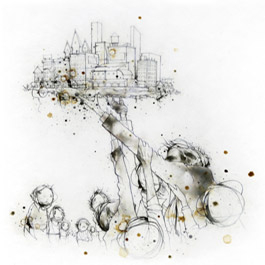
Go Forth and Gentrify?

So are "transitional" homebuyers guilty of class warfare? It's easy to talk about the downside of gentrification—high housing prices, evictions, and a creeping NIMBY-ism that elbows out social services.

—Illustration by: Andres Zbihlyj
Sun July 1, 2007 12:00 AM PST

eighteen years ago my husband and I bought our first house in what real estate agents termed an "up and coming" neighborhood in Oakland, California. We didn't think of ourselves as gentrifiers. We were paying more than we could afford, hoping that someday our neighborhood would have more cafés and fewer car thefts. We eventually bailed, but today the pawnshops and porn theater have indeed been replaced by boutiques and bakeries, and the house we sold at a loss has tripled in value.

So are "transitional" homebuyers guilty of class warfare? It's easy to talk about the downside of gentrification—high housing prices, evictions, and a creeping nimby-ism that elbows out social services. But there are benefits, too. When the white middle class left America's cities in the 1950s and '60s, they took the tax base with them, leaving behind concentrated pockets of poverty and powerlessness. Upscale newcomers bring investment, jobs, and tax revenue to neighborhoods that desperately need them, as well as intangibles like the political know-how required to extract money and services from urban bureaucracies.


story continues below
story continued from above

There's also the environmental benefit. Renovating a house in the urban core is far more sustainable than commuting to a newly built subdivision. A University of Toronto study found that residents of low-density suburbs consumed twice as much energy and produced twice as much greenhouse gases as those living in the city centers.

Whether the costs outweigh the benefits is a tough call, partly because some of what we think we know about gentrification isn't exactly right. Take displacement. A 2005 study by Lance Freeman, a professor of urban planning at Columbia University, found the chances that a poor resident of a gentrifying neighborhood would be forced to move were only 1.5 percent—compared to a 1 percent chance of that same resident being displaced in a nongentrifying neighborhood. This is partly because poor people tend to be transient anyway, and partly because poor neighborhoods tend to have high vacancy rates. Maureen Kennedy, a Clinton administration housing official who coauthored a study of gentrification for the Brookings Institu­tion, found that in one Cleveland neighborhood, city residents believed there had been an enormous dis­placement of blacks by whites, although census data revealed that there had been only a "modest inflow" of white residents. But, she adds, "perception be­comes reality."

That's in part because blacks are moving to the suburbs at twice the rate of whites, an exodus driven as much by high crime as it is by high housing prices. "At least 50 percent have left because of poor education and poor public safety," says housing activist Charlene Overshown, who two years ago moved back into the West Oakland neighborhood where she grew up and has been astonished by the rise in rents and the increase in white residents.

It's true, though, that gentrifiers often exist in a kind of parallel universe. They live behind locked gates, send their kids to private schools, shop outside the neighborhood, and avoid the parks. As Freeman observes, their only interaction with the neighbors may come when they call the cops because the music's too loud.

The problem, says John A. Powell, a leading scholar of race at Ohio State University, stems from making choices based solely on your own costs and benefits. For example, should you send your kid to the local public school? "If I decide to send my kid to a school that's dysfunctional, I feel bad. If I decide not to send my kid to a school that's dysfunctional, I also feel bad. Regardless of my choice, the school remains the same. The question is, how can I transform the system not just for me but for the people who don't have the choices?"

Get involved, suggests Nancy Gapasin Gnass, a high school history teacher who bought into San Francisco's Mission district during the final days of the dot-com boom. She sends her daughter to a local school where 79 percent of the students receive free or subsidized lunches and 80 percent are Latino or black; she volunteers at the school, sits on the pta and the school site council, and has organized a group that revitalized the local park. When Gnass' daughter turned six this year, she invited the entire class. Eighteen out of twenty children came to the party and brought their families. "We all walk to school together," says Gnass, who is Filipina. "My Spanish is horrible, but I try."

Newcomers elsewhere have helped their neighbors fight evictions, taught at the local school, and started businesses that hired locals. Make sure to patronize local businesses and help the owners figure out how to "ride the wave" of new customers, adds Kennedy. Most important, urges Overshown, "Help us fight for more affordable housing. If you say this is the only place you can afford to live, well, let's all fight so that at least some of the folks, the folks who want to stay, can stay here."

Get Mother Jones by Email - Free. Like what you're reading? Get the best of MoJo three times a week.
Comments
no profile pic for comment author

Yeah, it's a complex issue. I live on the front lines of it in Portland, OR. I am a white middle class college student and the whole time I've lived in Portland I've lived in traditionally black areas that are now being gentrified. There was an article analyzing the issue in a similar way recently in the Wilamette Week (our local free paper) that made me reflect on it. As a renter and a low-income person myself, I don't feel like I'm a gentrifier, but because I'm white and not a local, people may read me that way. I think that there are several levels to the problem, and there is a genuine problem with housing prices and rents becoming unaffordable. There is a neighborhood here (the subject of the WWeek article), the Boise-Eliot neighborhood, where a house may have cost $8000 in the eighties and now is $500,000. And I guess the neighborhood is safer than it used to be. I don't believe that racial/class segregation is a good thing, so I think in some ways these neighborhoods that are a mix of poor and rich and different ethnic groups are perhaps some of the most sociologically healthy in the country. At least they can be, if we all make an effort to be a community. The problem I see is when white homeowners and business owners come in with a "conqueror" mentality, like the neighborhood was the frontier before they created it. Reminds me of the old story about how America was this empty wilderness just waiting for the white man to come and "civilize" it (inconveniently, the Native Americans got in the way). I personally feel that if you feel you need to live behind a gate, you don't belong in the neighborhood. But Portland has a ridiculously low crime rate, so I might not apply that elsewhere. But whites need to be sensitive to their new-comer status and not act as if the possibly unfamiliar culture they are entering into is just an annoyance. Instead of expecting the neighbors to adjust to their values (a desire for privacy and quiet, perhaps?), they need to accomodate the values of the existing neighborhood (a more casual approach to noise? Saying "hi" to your new neighbors?) Especially that last part, because I've heard this a couple times now: White people don't say "hi" back when blacks say "hi" to them. Is it because we are generally stand-offish and wouldn't say hi to our white neighbors, either? Or is it worse than that? Either way, I think that saying "hi" is a bare-minimum standard of being in a community with other human beings.

no profile pic for comment author

In my neighborhood we call it gaytrification. I'm not gay, but we love what they are doing for the appearance of the neighborhood and what it does for our property values. It also, i think, encourages others to start caring about how their own houses look. Most of my neighbors have been living here for a long time. I think that's an important thing to take into consideration. Our houses are nest eggs, if you will. They've spent lots of time and money making it a good place to live. It's only right that when the time comes to move on/retire that they be rewarded for it.

no profile pic for comment author

The Atlanta westside neighborhood I moved into seventeen years ago, a neglected area between two interstate ramps, has now been discovered by returning suburbanites who got tired of their commutes. Now the "transients" -- as the new home-owners refer to anyone from renters to anyone dependent on public transportation -- are targets of NIMBY emails on the neighborhood association newsletter. I am increasingly engaged in website exchanges with my newer neighbors. (The most recent discussion has centered around removing all the bus-stops from homeowners' front lawns.) Change is inevitable in neighborhoods like this, but the message is clear: as the home prices go up and the latte cafes appear, new arrivals still do not want to interact with the intown, pedestrian population. They continue to use their cars to drive to the cute corner restaurant and re-create the traffic congestion they moved here to avoid. The inevitable victory of "car culture" in most gentrified neighborhoods destroys whatever charm -- or here in Berkeley Park, the urban walking scale -- they once had. Yes, my home has tripled in value, but I may face the prospect of walking a mile to the nearest bus stop (instead of the nearest corner) so my new neighbors don't have to see me on my way to work.

no profile pic for comment author

My neighborhood has been gentrifying for the 30 years I've lived here. I've watched our property values go up as well. My neighborhood has a mix of types in it, so that makes it more enjoyable.

I have to smile at Mark B's comment about having to walk a mile to the nearest bus stop. I've been walking a mile daily to my job out of choice. I can either catch a bus or drive but I enjoy my walk, and it's good for me, just as walking a mile daily is good for Mark. I do however admit to sometimes taking the bus up the rather steep hill my house is on in the evening when I'm tired.

no profile pic for comment author

Euro-style gentrification has created a ring of poverty surrounding the rich people in many of the city centres. While no-one likes a low-income housing project in their inner-city neighbourhood, it's one of the few ways to keep the low-income workers near their jobs in an era of getrification.

no profile pic for comment author

This is a great article and holds so
much merit. It is my hope, anticipation, that next Spring; I will
be moving into the downtown area of Denver. Old apartments and condos are being remodeled and, thus far, the price for the "old stuff" is still relatively moderate. It's great to visit the parks where so many people of varying races and cultures mingle with one another, without hesitancy. This article is a wonderful reminder of how we can curb energy spending; protect our environment; utilize what is already present; and discover our humanity once again....one to another.

no profile pic for comment author

Sounds great, especially as a retired PUBLIC school teacher--after 38 years--with experience in very racially/culturally mixed [with very little violence], as well as schools where the parents were very educationally-minded--not terribly affluent, but very intereted in education for their and all children. There is no substitute for living REAL life in a public school. Too many people run away, unlike Ms. Gnass. Our entire country was supposed to have been built on the idea of free educcation for EVERYONE, be he/she brilliant, disadvantaged, disabled, rich, poor. Unfortunately for the last 25 years, there has been a war declared on public education [ie. the middle class, that is the backbone of any POLITICALLY STABLE country]. Costa Rica, for example, thinks that it is a "3rd world country." However, their literacy rate puts ours to shame, as does their Universal Health Care!!

no profile pic for comment author

Boy, this is a tough issue. I grew up in the first project ever, in jacob riis or queensbridge projects., and we never locked our dooors and it was heaven on earth. The buildings never really changed but the people did and the city stopped controlling it (to our benefit) and it became the wild west but worse. So, where bad folks live will be a slum or become one and where careful, serious folks live will be nice whether rich or poor. Its in the spirit first.

no profile pic for comment author

There will be alot of affordable housing in the next two years...alot.

no profile pic for comment author

about this comment:

"A 2005 study by Lance Freeman, a professor of urban planning at Columbia University, found the chances that a poor resident of a gentrifying neighborhood would be forced to move were only 1.5 percent—compared to a 1 percent chance of that same resident being displaced in a nongentrifying neighborhood. This is partly because poor people tend to be transient anyway, and partly because poor neighborhoods tend to have high vacancy rates."

another reason is that non-gentrifying neighborhoods are usully worse than the ones you guys want to gentrify, because the gentrifiers pick communities in which people have worked hard to make it relatively safe and family friendly. Non-gentrifying neighborhoods have more SRO's and less fmilies. I think if you looked at the same neighborhood for two years before and two years after the time gentrifiction began, you would see larger difference. I know where I live, in SF, the few years before a neighborhood was genttrified there was little relocating. What hppens is that poor, usully colored people work hard to improve their neighborhood, until it looks like it might be safe for some lower-middle class white people, then its all over. So then we have to move to cheaper crappier neighborhood and work our asses off again. Rationalise gentrifiction all you want, I know you dont like the guilt....

Ever heard of "instrumental rationlisation?"

no profile pic for comment author

You got your rich people, and you got everybody else. The wealthy, regardless of ethnic or regional stripe, have enough to move off and be separate from the rest of the herd, the 1%ers.
But, in recent times, 'rich' has come to mean 'not being buried in debt', not necessarily how big your house is, and chances are, the 'rich people' might not be all that, once you get past the painted outer layer.
We all play the money game, because we've got no choice in the matter. Only problem is, increasingly this country runs on red ink. How do we get 'back in black'? By refraining from spending. But, if everyone does that, then the economy can fold up like a cheap kite.
So we all belly up to the roulette table, for another round, badmouthing the Joneses, and trying to keep up.

Here we go again, may the larceny and the mud slinging begin...

no profile pic for comment author

شات

شات سعودي

منتديات

مكياج

صور

خزعبلات أقلامنا

قضية الاسبوع

اناشيد اسلامية

عبارات ترحيبية

الاهداءت وتهنيئة بين الاعضاء

شعر

أشعار صوتية

خواطر

قصص

برامج

برامج فوتوشوب

أنمي صور

برامج جوال

ثيمات

مسجات

ثيمات

توبيكات

يوتيوب

ايقونات ماسنجر

ثيمات ماسنجر

مكياج

وصفات طبخ

الحياه الزوجيه

اكسسوارت

ديكورات

الطب النبوي

عالم ادم

نكت

مقاطع فيديو

صور

الالعاب

اسئله مسابقات

اسئله كرسي الاعتراف

صور لاعبين

صور سيارات

الشكاوي والاقتراحات

مواضيع مكرره

صور ماسنجر |
مكياج |
توبيكات جديده |
منتديات |
توبيكات ملونه
| شات بنات |
تحميل الصور |
دليل مواقع
| مواقع توبيكات
 | رموز
ماسنجر
| مدونه |
شات كتابي |
شات صوتي

صور بنات للماسنجر 2010 -
صور بنات للمسن 2010 -
صور جديده 2010 -
صور بنات حلوه للماسنجر 2010 
| صور ماسنجر
2010
  | مسجات حب 2010
| مسجات غرام 2010
مسجات عتاب 2010 |
مسجات حزن 2010 |  ازياء
2010
| فساتين 2010 |
فساتين سهره 2010 |
صور فساتين سهره 2010 |
صور مكياج 2010 -
مكياج 2010 -
مكياج عيون 2010
|
تسريحات شعر 2010 ,
تسريحات 2010  |
توبيكات حب 2010
| توبيكات رومنسيه 2010 |
صور للماسنجر 2010 -
صور مسنجر 2010 -
صور مسن 2010
| صور شباب للماسنجر 2010
 | توبيكات
ملونه 2010
| توبيكات ملونه
للماسنجر 2010
| حلقات مسلسل ام
البنات
  |حلقات مسلسل قلوب للايجار|

حلقات مسلسل طاش 16


حلقات مسلسل باب الحارة 4
  |

حلقات مسلسل عوانس سيتي
|حلقات
مسلسل بيني وبينك 3
   |

حلقات مسلسل شر النفوس 2
  |

نكت 2010
|صور
بنات للتصاميم 2010
|

توبكات رومنسيه روعه 2010
|فساتين
سهره 2010 فساتين ناعمه 2010 فساتين روعه 2010
|غرف
نوم اطفال 2010 صور غرف نوم اطفال 2010
|دورات
مياه 2010 صور دورت مياه 2010
|

مطابخ 2010 صور مطابخ 2010
|غرف
نوم 2010 ديكورات غرف نوم 2010
  |

صور ديكورات 2010 ديكورات منزل 2010
|صور
انمي 2010 انمي كيوت 2010
|

موسوعه ثيمات 2010 اسلاميه 2010
|موسوعه
ثيمات 2010 رومنسيه 2010
|فساتين
ناعمه وانيقه 2010
|رسائل
وسائط 2010 حب مسجات 2010 غرام
  |صور
ماسنجر حب 2010صور ماسنجر رومنسيه 2010
|مسجات
mms عتاب وحزن 2010
  |صور
اطفال للماسنجر جديده 2010


صور مسن للبنات 2010
| صور
للبنات ماسنجر 2010
 |

توبيكات ماسنجر بلس 2010

Post a comment
Alternately, you may login to or register an account
The content of this field is kept private and will not be shown publicly.
  • Web page addresses and e-mail addresses turn into links automatically.
  • Allowed HTML tags: <a> <ul> <ol> <li> <blockquote> <img>
  • Lines and paragraphs break automatically.

More information about formatting options


Jail.org - Inmate Search
Criminal records, instant public records & people search & current court records. www.jail.org

U.S. Public Records Search
Search County & State Court Records, Criminal records, Vital and Adoption Records www.PublicRecordsInfo.com

Records.com - People Search
Public Records and Background Checks. Instantly Search Criminal Records, Addresses and Court Records www.Records.com

Court Records & County Records
Find Instant Public Records, Criminal Records as Well as County Property Records Search. www.PublicRecordsIndex.com

Mother Jones Podcast
Get in on the conversation! We talk about culture, politics, the environment, the economy and more. Listen now!

TalkBackTees.com
A treasure trove of liberal wit, wisdom and quotations, from ancient to modern, on colorful, cotton tees.

Support Independent Artists
Amazing art, crafts, apparel, paper-goods and more. A carefully curated selection of sundries since 1999.

FREE CONNECTIONS FOR GREEN SINGLES
Meet progressive singles in the environmental, vegetarian & animal rights community who share your values

