Barbarians at the Capitol: Private Equity, Public Enemy
With the subprime mortgage crisis touching off broad fears about cheap credit, private equity finds itself in the crosshairs of financial analysts and politicians alike.
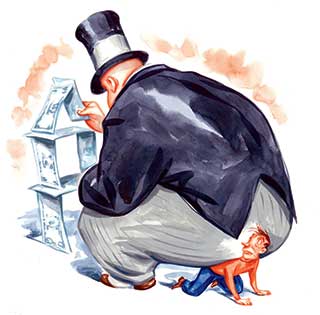
History is pretty clear on this one: Whenever the finance industry discovers a path to quick investment riches for a select few—S&Ls, junk bonds, Long-Term Capital Management, Enron, the list goes on—a massive reckoning can't be far behind. Today's implosion in the making? Private equity, an investment category that is quietly reshaping the entire economic landscape thanks to tax giveaways and an aggressive strategy to escape regulatory oversight.
Private equity isn't new—it's been around in various forms for almost 25 years, including the Barbarians at the Gate-style hostile takeover of rjr Nabisco by Kohlberg Kravis Roberts (kkr) in 1989. But it's never operated on the scale it does today. Cerberus Capital Management, a 15-year-old private equity firm, bought 80 percent of Chrysler this year; the companies in its portfolio have more than $60 billion a year in revenue. Lou Gerstner, former ceo of ibm, now heads the Carlyle Group, a Washington-based global private equity firm whose 2006 revenues of $87 billion were just a few billion below ibm's. Carlyle has boasted George H.W. Bush, George W. Bush, and former Secretary of State James Baker III on its employee roster; not to be outdone, Cerberus' payroll includes former Vice President Dan Quayle and former Treasury Secretary John Snow. And in a nice bit of political irony, kkr recently hired former Republican National Committee chairman Ken Mehlman to provide "political intelligence" on where to invest in case of a Democratic sweep in 2008.
During their salad days in the 1990s, private equity firms were consummate treasure seekers. Spawned from the family of hedge funds (the difference is that private equity goes after brick-and-mortar companies, while hedge funds trade liquid assets like stocks, commodities, and derivatives), these firms focused on picking up private companies with "upside" potential; after reworking finances and replacing management, they'd flip them at a profit.
Then came the stock market dip of 2001 and 2002, which prompted the Fed to lower interest rates dramatically. Suddenly private equity discovered a less labor-intensive way to turn a profit: With credit suddenly cheap, they would leverage debt to buy large, public companies, take them private, chop them up, and resell the pieces. Then they used the interest to offset taxes; better yet, because they were structured as private partnerships, they (and their individual executives) could classify their profits as capital gains (taxed at 15 percent) rather than as corporate income (35 percent). Presto! An almost 60 percent tax differential. Plus, when they took a public company private, its profits could get the same treatment. Thus, doing zero restructuring or resale work, and adding no value, the firms were making money—and that was before they collected their broker fees. As an added bonus, as private companies they didn't have to file with the Securities and Exchange Commission, worry about the transparency rules of the 2002 Sarbanes-Oxley Act, or bother with pesky shareholder activists.
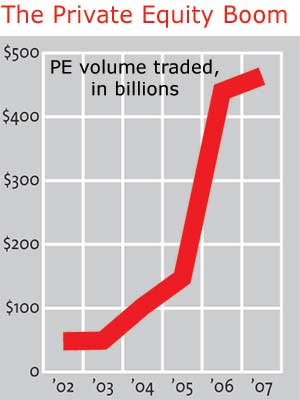
In addition to creating a bull market in Manhattan triplexes, Greenwich estates, and Gulfstream jets, the private equity boom has brought about a major shift in America's corporate landscape. In 2006, private equity firms did nearly one-third of the record $1.5 trillion in U.S. mergers and acquisitions—triple the share from 2005—and this year's percentage could be even higher. The trend also further reduces the already-meager income taxes corporations pay. (As it stands, corporate America contributes 7 percent of the nation's total tax burden, compared with 50 percent after World War II.)
This might seem like a logical area for a Democratic Congress to step in. Or perhaps not: On July 31, 2007, the Senate Finance Committee hosted a contingent of private equity and hedge fund execs, among them the managing director of the Carlyle Group, Bruce Rosenblum, who also chairs an industry trade group. If senators went along with a House measure to eliminate the industry's sweetheart tax status, Rosenblum warned, "there will be deals that don't get done, entrepreneurs that won't get funded, and turnarounds that won't get undertaken."
Members agreed. Christopher Dodd (D-Conn.), who is not on the committee but whose presidential campaign has received $41,200 in contributions this election cycle from private equity giant Blackstone (only Senator John McCain did better), fretted that a tax increase would have "adverse effects" on the financial markets. Chuck Schumer (D-N.Y.) noted that the proposed hike would raise just $4 billion to $6 billion—hardly worth bothering. The Democratic Senatorial Campaign Committee, which Schumer chairs, raised $2 million from the private equity community in the first half of 2007. During that same period, Blackstone, Bain, and the Carlyle Group alone forked over $822,000 to both Democrats and Republicans. And the industry has been spreading cash on K Street as well. Lobbying firm Ogilvy Government Relations got $3.7 million from Blackstone this year, up 15-fold from 2006.
Still, with the subprime mortgage crisis touching off broader fears about cheap credit, private equity is in the crosshairs of financial analysts and politicians alike. Already, some $60 billion in deals (including the Chrysler takeover) have been delayed and others have plummeted in value. By September Rosenblum was back on Capitol Hill trying to beat back a tax increase—and arguing that such a step would hurt retirees, because any increased costs would be passed on to pension funds and other investors.
Indeed, pension funds have a lot riding on the debate. Before I quit Goldman Sachs, back in 2002, the unit I ran started pitching "alternative investments"—a catchall category for esoteric financial products, hedge funds, and private equity. At the time, this was a tough sell. But today, pension funds allocate a remarkable 7 to 8 percent to private equity alone.
They may have gotten in at just the wrong moment. Blackstone took itself public on June 22; its ipo, the largest since 2002, raised $4.13 billion and inflated ceo Steve Schwarzman's on-paper value to a stunning $7.7 billion. But over the following two months, Blackstone's share price fell 40 percent. A California state pension fund, Calstrs, is a limited partner in Blackstone; it saw its $2 billion investment shrink to $1.2 billion. The lesson? Never put your nest egg in something that isn't transparent.
With Democrats like Schumer, Lieberman, Feinstein, et al., gnawing away, termite-like, at the foudations of our democracy, do we even need Republicans anymore?
Oh, now I see the correlation between "The poor get poorer and the rich get richer" and "A fool and his money are soon parted". Thanks.
Why is it that Republicans and now the Jake the Fake Democrats better known as insideout Republicans, always develop some scam to rap the nation with?
Tea Pot Dome, Star Wars, Savings & Loan Scam, and now the current scam, Private Equity---------seems scum need to be purged from the gene pool!
Jefferson said he was more afraid of bankers than he was of standing armies. Will there ever come a time when politicians represent the people and not big money interests? How do we as ordinary citizens fight this crap? I say through grass roots, community oriented initiatives guided by such people as Catherine Austin Fitts at Solari and Michael H. Shuman author of Going Local and Small-Mart. Anyone interested in what we're doing is welcome to contact me at drgeorge@safe-mail.net. George
http://www.totalhealthcircle.com/
Yes, both Republicans and Democrats are tainted by private equity money. Thanks to Mother Jones for running this piece. Now if the media could find the time and energy to highlight The Carlyle Group's kid gloves treatment by Fran Townsend in the White House "Lessons Learned" report on Hurricane Katrina. Fran omitted Carlyle affiliate LifeCare's 24 patient deaths post landfall. Did LifeCare and Tenet Health Care's nearly $1.9 million in lobbying in 2005-06, ensure Fran's selective exclusion of key facts?
Fran announced her retirement last week. Will she too end up on Carlyle's payroll? Time will tell.
As pointed out above, the people have continuously paid the price for the excesses and greed of the wealthy. There has never been time period in US history when the American aristocracy did not rule the US. History has shown that the only time when rights are secured, the condition of the common man has increased is when the common man has forced the hand of the aristocracy. All other times in US history the condition of the common man decreases. The past 40 years are a good example.
Is it even pertinent that like Citi, Carlyle sold a large portion of itself to Abu Dhabi? How many of these giant equity groups will be held by foreign pools before it's over? Is there anyone dumb enough to believe that is stable for our or the world's economy? It's amazing that a few million (or hundred million) a year in salaries is enough to sell off the welfare of the nation to groups whose interest lies perpendicular to our own...to me it's terrifying.
First of all, money is an imaginary social construct, currently amounting to (mostly) zeros on computer. So why do we allow something imaginary have such a destructive effect on real living beings? There is something very wrong with capitalism. Unlimited income is greedy and destructive. The planet cannot sustain such greed. Human relations cannot sustain such greed. I wonder when the perverse money game will end? I wonder how?
The credit crisis was caused by the stupidity and greed of the American public. As they are paying their taxes and consuming everything in sight, they need more and more money to help them cope with their own brainless existences. Let them then go to their churches and worship some imaginary being to make them feel better. They drive around with their little yellow ribbons that say "support the troops" which makes them accessories to murder. Americans are destroying America. They are the terrorists!
No diffence between the core values of the Dems or Republicans. The presidential race reflects gender & racial bias...All are handmaidens for the the FIRE sector
It's time to secede from the union and become independent states again. Texas has a one year renewable contract that allows them to secede at any time (the only state to have this). The federal government was formed to protect the states from invasion from other countries and to provide for the welfare of the people. When they fail to do the above (9/11 & corporate corruption at the expense of the individual) it is time to cancel out our "contract" with Washington. The original jurisdiction of the federal government was the 10 mile radius around the capital. We have allowed them to control us and we must stand up for our rights before we no longer have any. Lobbying by big business must be stopped as the only ones benefiting are the greedy corporate executives. And the only way for the "people" to get their way is to stand up and DEMAND IT!
NO TERM LIMITS and LOBBYISTS--- these are at the core of the egregious treatment of the American people. Until we have term limits and do away with lobbying will we be able to take our Country back from the Congress and the Administrations (it looks like Democrats are no better than Republicans at serving us fairly0
Why don't we just decentralize the [deleted] out of this nation and all of the other bodies that are attempting to put is in a stranglehold?
Appealing to entities who have access to land and resources that are in no tied into such orders may be due.
Or if there are federal, state, and municpal lands sittin' on land and resources that already belong to entities that may have opened the door to these [deleted]in' maggots and vile regimes who have polluted this continent then perhaps it is due to just start the decentralization process, before the federal, state, and municipal lands just fall into the hands of the next wave of maggots attempting to put us in their stranglehold.
Entities that have a passionate hatred for who they opened their front door to have the right to tell them to get the [deleted] out if they think they are going to use what's left in the house to pursue more of their chokehold version of capitalism.
If these federal, state, and municpal lands are not in the legitimate overcontrol of authorities who have a passionate hatred for the maggots who think we should be their cheap monkeys then their should be land and resources designated for those who seek to exchance and compete for resources through peaceful means.
There is no justification for peaceseekers to live in a land under control by such vile creatures unless these peaceseekers (and i ain't talkin' some [deleted]in' lord god of israel) have legitimate authority to pull the plug.