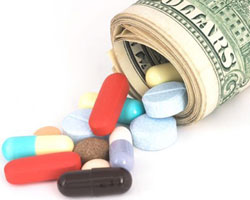
When it comes to showing contempt for the public good, it’s hard to top the pharmaceutical industry. In the last two decades, Big Pharma has raked in profits that dwarf those of most other industries—19.6 percent of revenue in 2006, compared with an average of 6.3 percent for all Fortune 500 companies—while the amount spent on prescription drugs has increased fivefold, far outstripping inflation or even the jump in general health care costs. Rising medical expenses have burdened taxpayers, strained the resources of states, unions, and businesses, and forced some poor and elderly Americans to choose between medications and food.
The industry says it needs high revenues and scant regulation in order to develop life-saving new treatments; but according to Families USA, Pfizer, Johnson & Johnson, Merck, and the rest of the top drug manufacturers spend more than twice as much on marketing, advertising, and administration than they do on research and development. Most of their latest offerings are just new versions of old drugs, designed to extend patents and preserve profits. Others are rushed to market, sometimes with deadly consequences—as was the case with Vioxx, which caused as many as 140,000 heart attacks and strokes.
While the pharmaceutical companies’ rapacious conduct has proceeded apace for decades, they’ve enjoyed special privileges under George W. Bush, who appointed industry insiders to key regulatory positions and worked hard to protect business interests abroad and at home. Big Pharma’s greatest triumph came with the 2003 passage of the Medicare prescription drug plan, or Part D, a bonanza for the drug companies that was backed by the president and rammed through Congress by Billy Tauzin, an influential Republican committee chair who left a year later to head the largest drug industry trade group.
Americans who’ve been grinding their teeth about all of this may feel soothed by the idea that if a Democrat wins the White House in 2008, they will finally see Big Pharma smacked down—or at least gently restrained. And they may well be encouraged by the campaign rhetoric they’ve heard from the leading Democratic contenders, as well as some of the details in their written health care plans. But of course, there’s more to this story than meets the ear.
Any candidate who genuinely plans to confront Big Pharma must be prepared to give up a boatload of cash. According to the Center for Responsive Politics, the pharmaceutical industry ranked first in lobbying expenditures from 1998 to 2007, spending $1.3 billion over that period, and $191 million in 2006 alone. The Center for Public Integrity reports that there are more than 3,000 drug lobbyists in Washington, and over 1,000 of them are former public officials, including some 75 former members of Congress. Their ranks have included not only erectile dysfunction poster boy Bob Dole, but also such high-profile Democrats as Birch Bayh, Lloyd Bentsen, and Dennis Deconcini. Federal campaign contributions from drug manufacturers from 1990 through October 2007 totaled $149 million.
It’s Republicans, however, who generally have been viewed as friends of the drug industry. (They’ve received 66 percent of campaign contributions since 1990.) So some people nursed hopes for change when the Democrats took Congress in 2006. The New York Times reported that the “Drug Industry Is on the Defensive as Power Shifts,” with anxious companies meeting in Washington to plot strategy. But Tufts University political scientist Jeffrey Berry predicted that drug companies would simply begin providing more funding to Democratic campaigns. “Companies are not ideologues; they’re pragmatists,” he told Fortune magazine. “Democrats will shout loudly, and carry a small stick.” Fortune‘s John Simons also pointed out that “the locales where Big Pharma and Big Biotech employ the most voters [are] California, Illinois, Massachusetts, New Jersey, New York, and Pennsylvania, all traditional Democratic strongholds—something elected officials and those running for higher office aren’t likely to forget.”
The drug industry’s biggest fear was that new House Speaker Nancy Pelosi would make good on her campaign promise to revisit the Medicare prescription-drug law and reverse a provision that bans the government from negotiating lower drug prices or setting a list of preferred drugs. The federal government has negotiating power when it buys drugs for Medicaid and Veterans Affairs, and receives discounts of 25 to 50 percent. But in the Medicare prescription program, which is run through an assortment of private insurance companies, the average discount from drug manufacturers is just 8.1 percent. By one estimate, this ban raises the cost of the program by $30 billion a year—a huge rip-off of taxpayers, and of the old folks who pay part of their own drug expenses.
Pelosi made this change part of her agenda for the first 100 hours of Democratic control. She introduced the necessary bill and shepherded it quickly through the House—but the party lacked the votes it needed to bring the legislation to the Senate floor. And even Pelosi’s proposal was weaker than it should have been, since it didn’t give the government power to remove a drug from the preferred list, a vital negotiation tool.
More evidence of how far the Democratic Congress will—or won’t—go to rein in Big Pharma came in May 2007, when the Senate debated a Food and Drug Administration reform bill. In the wake of the Vioxx scandal, the bill included some expanded safety measures; but it also expanded the Prescription Drug User Fee program, a system in which drug manufacturers actually pay the FDA to review their new pills. Still more significant was an amendment that killed the effort led by South Dakota Democrat Byron Dorgan to allow the importation of cheaper drugs from Canada and other countries. Thirteen Democrats joined Republicans in voting to hold off this threat to Big Pharma’s monopoly; according to an analysis by USA Today, they included some of the top recipients of campaign donations from the drug industry, among them John Kerry, Max Baucus, Ted Kennedy, and Joe Lieberman.
The current pending legislation viewed as most threatening to drug-industry profits is one that seeks to ban settlements in which a brand-name drug company pays a generic manufacturer to delay the introduction of a generic drug. In the House, it is stalled in committee; in the Senate, its sponsors can’t get it to a floor vote.
So much for the Democrats being bad news for Big Pharma. Certainly, there have been some tough congressional investigations of the industry since the midterm elections, most notably by the House Committee on Oversight and Government Reform under California’s Henry Waxman. But Democrats in Congress haven’t had the political will—or the vote margins—to translate the committee’s findings into new legislation. The bottom line is that so far, George Bush has not once had to use the veto in order to protect the interests of drug companies.
So, would the missing political will emerge with the election of a Democratic president? The voting records of the three leading contenders only go so far in answering that question. Hillary Clinton and John Edwards voted against the flawed Medicare prescription-drug bill (as did Dennis Kucinich; Joe Biden and Chris Dodd voted for it). Barack Obama and Clinton voted to allow the government to negotiate lower Medicare drug prices. Clinton and Edwards voted yes on an earlier bill to permit the importation of drugs from Canada. All three have earned 100 percent ratings from the American Public Health Association. But none of the three has showed real leadership in Congress when it comes to challenging the overall dominance of Big Pharma.
The Clinton, Obama, and Edwards websites and written health care plans offer more detail than has been found in most presidential campaigns, but make scant reference to needed regulation of the pharmaceutical industry. None of the plans is, as the candidates would like to claim, a map for universal health care; instead, they are plans for universal (or nearly universal) health insurance, which preserves the role—and the profits—of private corporations. Nonetheless, there are a few differences in their plans that could impact the drug companies, perhaps influenced by the varying amounts of money the campaigns have received from the industry—with Edwards standing somewhat apart from the two leaders of the pack.
HILLARY CLINTON calls her health care proposal “American Health Choices Plan.” On her website, a section called “Promote Shared Responsibility” spells out the responsibilities of individuals, providers, employers, and the government. Regarding the medical industry, it says, “insurance companies will end discrimination based on pre-existing conditions or expectations of illness and ensure high value for every premium dollar; while drug companies will offer fair prices and accurate information.” What “fair prices” are is, of course, an open question, and no answers can be found at hillaryclinton.com.
In a May 2007 speech at D.C.’s George Washington University, Clinton offered some statistics: “If we want to get health care costs under control,” she said, “we need to get prescription-drug costs under control. We know that Americans pay the highest prices in the world for prescription drugs that we have already in most instances funded the research on…Studies have shown that brand drug prices are 35 to 55 percent higher in the U.S., and top-selling medications a full 2.3 times more expensive compared to other industrialized countries.” The solutions she proposed were nothing new, and quite tame: Negotiate for lower Medicare drug prices, allow drug importation, and remove “barriers to generic competition.”
Clinton’s strongest statements regarding the drug industry have come during the debates. In June at New Hampshire’s Saint Anselm College, she said, “We have to lower costs, improve quality, and cover everybody.” Referring to her failed 1993-94 attempt at health care reform, she added, “You’ve got to have the political will—a broad coalition of business and labor, doctors, nurses, hospitals, everybody—standing firm when the inevitable attacks come from the insurance companies and the pharmaceutical companies that don’t want to change the system because they make so much money out of it.”
It looks like Big Pharma may be counting on the fact that Hillary has learned her lesson. As of October 2007, according to the Center for Responsive Politics, she led the field among both Democrats and Republicans for campaign contributions from the pharmaceutical industry, with $274,436. Among her supporters is Jeff Kindler, CEO of Pfizer, who donated $2,300. Kindler is unusual among Big Pharma executives in that 67 percent of his political contributions have gone to Democrats and only 4 percent to Republicans (the rest were to PACs). But the mere fact that the head of America’s leading drug manufacturer—U.S. sales in 2006 totaled a cool $26.7 billion—supports the party tells us that there’s something wrong with it.
BARACK OBAMA has engaged in some strong rhetoric denouncing lobbyists and corporate interests in general, and the drug and health-insurance industries in particular. At the New Hampshire debate in June, he said: “My emphasis is on driving down the costs, taking on the insurance companies, making sure that they are limited in the ability to extract profits and deny coverage…The drug companies have to do what’s right by their patients instead of simply hoarding their profits.” And during the September Univision debate he went a step further, saying of the insurance and drug lobbyists, “As president, I am going to take them on.”
That sounds well and good until you follow the money. Obama ranks just behind Clinton as a recipient of Big Pharma campaign contributions, second among both Democrats and Republicans with $266,384. His backing from corporate interests is generally comparable to Clinton’s. And so is his health plan.
As part of his written plan for “Modernizing the U.S. Health Care System to Lower Costs and Improve Quality,” Obama promises to “prevent [insurance] companies from abusing their monopoly power through unjustified price increases.” The site goes on to point out the disparity in drug prices between the United States and markets in Europe and Canada. The solution? “Obama will allow Americans to buy cheaper medicines from other developed countries if the drugs are safe…repeal the ban that prevents the government from negotiating with drug companies for the Medicare prescription drug benefit, [and] work to increase the use of generic drugs in federal benefits programs and prohibit drug companies from keeping generics out of markets.”
These are steps in the right direction, but small ones that all of his rivals, along with virtually every Democrat in the country, support. The only difference between the Clinton and Obama plans is that Obama doesn’t mandate health-insurance coverage for everyone—and his program of subsidies to help poor people get insurance is weaker as well.
JOHN EDWARDS has sought to position himself as the populist candidate who will stand up to corporate interests, including the insurance and drug companies. He came out swinging on this issue in his speech at last February’s meeting of the Democratic National Committee: “We have to stop letting the health insurance companies and the big pharmaceutical concerns decide our nation’s health care policy. We have to give the silent victims&8212;who stand in line at free clinics and use the expired medicines of friends and neighbors—the dignity of universal health care.”
He’s maintained this line in subsequent speeches and debates. During the Huffington Post online debate in September, he declared: “Without taking drug companies, insurance companies, and their lobbyists on head on, we will never have universal health care…Some [candidates] argue that you should give them a seat at the table, you should negotiate with them, compromise with them. I fundamentally disagree with that…The reason we don’t have universal health care is these people have absolutely no intention of giving away their power voluntarily. We have to take their power away from them.”
Yet Edwards’ written health care plan, the first to emerge from the candidates, barely mentions the pharmaceutical industry, and when it does, the emphasis is on safety rather than cost or profits. The plan, called “Universal Health Care Through Shared Responsibility,” includes a promise to protect patients against dangerous medicines: “Recent drug recalls such as Vioxx have raised concerns about drug safety. Edwards will restrict direct-to-consumer advertising for new drugs to ensure that consumers are not misled about the potential dangers of newly marketed drugs and strengthen the Food and Drug Administration’s ability to monitor new drugs after they reach the marketplace. He will also ensure that researchers evaluating medical devices and drugs are truly independent.”
The significant difference between Edwards and the other Democratic candidates is his emphasis on a public option for health-insurance coverage. This strategy has its own shortcomings: As Dennis Kucinich pointed out in one debate, if you have both public and private insurance plans, “what happens is that the private companies start cherry picking the people in the best health, and then you end up with what’s called adverse selection… The most medically compromised end up on programs that the government is paying for, and then the government program starts to go down” while insurance industry profits go up. However, Edwards presents the public option as an experiment of sorts, a trial run for government-run, single-payer health care. This, of course, is the ultimate evil in the eyes of Big Pharma, because it would give the government the negotiating power it needs to force down drug prices. While his rivals treat single-payer as the policy that they dare not speak its name, Edwards said this in the Huffington debate: “There is a very good and legitimate argument that we should go straight to single-payer health care as other countries have…There are huge advantages to single-payer…much lower administrative costs… I thought it was something that we should let Americans decide. Get everybody covered, get rid of the holes in the system.”
Another factor that separates Edwards from the other candidates is the level of campaign contributions he has received from Big Pharma. While Clinton’s and Obama’s numbers are well over $200,000, Edwards’ total is just $15,000. He’s not even in the top 10, lagging behind Ron Paul and Tommy Thompson, who quit the race more than a year ago. As a trial lawyer, Edwards won huge settlements from health care corporations. You can imagine how the drug companies feel about that, especially at a time when they’re seeing a dent in their profits, after they contributed to the deaths of thousands of people with Vioxx.
Every one of the Democrats’ health care plans is vastly superior to anything offered by Republican candidates. John McCain, the least noxious of the bunch, is your average private-enterprise Republican; from that position, he voted against the Medicare drug bill and for drug importation from Canada. Mitt Romney spends most of his time explaining why his own Massachusetts health care plan is nothing like what the leading Democrats are offering (though it kind of is). Mike Huckabee, when not explaining that he didn’t really say in 1992 that AIDS patients should be quarantined, talks a lot about how he lost 120 pounds (and how we could roll back the health care crisis if everyone would just stop eating corn dogs). Ron Paul wants to eliminate medical-malpractice suits by having patients buy special “negative outcomes” insurance before going in for surgery. Rudy Giuliani, whose wife once was a pharmaceutical sales rep, talks of privatizing Medicare and Medicaid and wants individuals, rather than employers, to purchase health insurance.
A Republican in the White House would be very good for pharmaceutical companies and a Democrat might make them squirm just a little bit. Still, Dennis Kucinich is right when he says “the presidential debate on health care has been largely fake, with phony claims from candidates that they are providing ‘universal health care’ when, in fact, they are preserving the for-profit system of private insurance companies who make money not providing health care.” When it comes to Big Pharma, he’s also right that the only way to limit profits is through the kind of comprehensive price controls practiced by the rest of the industrialized world. “America is a captive market” to the drug industry, he said back in 2002. “Our government should place limits on the price which any manufacturer can charge for prescription drugs. We need a new…regulatory structure which puts a ceiling on drug-company profits the same way credit laws establish what constitutes usury… As with utility rates, our government should be empowered to lower prices and impose windfall-profits taxes to correct excess pricing.”
We, of course, won’t see anything like this anytime soon—not until money stops buying votes and policy decisions in Washington. The final word on the matter comes from another plain-speaking Democratic candidate who is not considered a “viable” choice, Mike Gravel. In a September interview with Slate, he said, “When the industry that profits from health care calls the shots on the way health care is going to be delivered, then you are going to see the anomalous situation that you have in this country where they can’t even deliver it to everybody fairly.” Asked how he’d go about curbing that sort of influence, Gravel responded, “Well, you can’t. This is representative government. They put up all the money.”