When Chick Flicks Get Knocked Up
Is the new fertility-movie genre feminist or conservative?
But are the new fertility film stars actually feminists? The heroines of this year's conception flicks (Smart People, Baby Mama, and Then She Found Me, as well as recent hits Juno, Knocked Up, and the brilliant-but-forgotten Happy Endings) mostly procreated with someone of questionable character: Their stunted inseminators include a childlike ex-husband, a curmudgeonly near stranger, and the trashy boyfriend of a wacky gestational mother. Every one of these embryo pics presents itself as a comedy, but their real themes are dark as pitch. For female viewers of late—or, as they say in the medical profession, "senile"—fertility age, the dilemma of conception is often the first true sign of mortality, decrepitude, and gender inequity. Funny? Not so much.
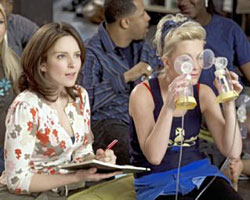
Fertility films' inbuilt conflicts are considerably more pungent than their younger chick flick selves. In each film, there are bawling infants born into inconvenient, unhappy unions or to women alone, recovering from awful relationships. In Baby Mama, Tina Fey hires a low-rent surrogate to beget for her. In Smart People, Sarah Jessica Parker plays an accomplished "high strung" doctor who despite being in her early 30s is so eager for offspring that she keeps the baby of her socially inept, older erstwhile boyfriend. The deliriously amusing, not-yet-released Hamlet 2 is a pleasurable anomaly in the midst, as it alone doesn't feature a woman who for her ambition was cursed with solitude or barrenness, but rather comedian Steven Coogan at a fertility center for "shooting blanks."
But here's the thing. I go to see films at the multiplex because they are not good films and so I don't have to think about things like death, social oppression, or yes, my fertility, while I watch them. The prenatal pics dont mean to irk their viewers, of course: they are simply a corny replacement for the serrated romantic comedies of the 1940s, in which sparkling, independent female protagonists, sporting sharply tailored suits and sharper repartee, wound up getting their comeuppance in the form of a rake who could finally domesticate them. In fertility movies, the rake taming all female powerhouses is an infant. Worse, embryo pics have inverted another film theme. Women who once chose an unusual life path picked child-free independence—liberated Klutes or unmarried women. Now, conceiving of an infant without marriage or even love is the filmic symbol of independence. In this way, these films recast the "pro-choice" narrative of feminists' personal and political past as a different, less politically dangerous sort of pro-choice story—a woman's right to choose from a smorgasbord of late fertility options. Once, in the recent age of "Murphy Brown" having a baby as a single woman was the most rebellious and politically radical thing our heroine could ever do. Now becoming a single mom onscreen makes a film heroine more conventional.
Does that make the storyline less, or more, feminist? After all, the women in the new fertility films are presented as having children not so as to please a social norm. Rather, they do so out of what one social critic has dubbed "maternal desire."
But the truth is that these films are rather conservative at heart; their entanglements all end far more neatly than their real life counterparts. Teen Juno's existence fractures into ironic shards with her surrogacy, true, but then Juno gives her infant to an elegant single mom for adoption and all is well. In her fertility film, Helen Hunt's later life motherhood may have led to uncomfortable issues about biological kinship, but these disruptions are then corrected by motherhood. Same goes for Parker in hers, where her strange romance is relieved of its indie-film angst by the birth of twins. Unlike life, not one female character is disappointed when the new fertility regimen doesn't work for them, or unhappily trapped in a bizarre family situation when it does. And don't even think about the bummer that is a legal contract with commercial surrogates.
But fertility films are a popular choice this year as they offer a sunset-and-rainbows kind of Hollywood schmaltz that other films cannot. All of these films end with a love object, a baby that is superior in the eyes of many women than a man would be. In these films, the baby represents eternity and the possibility of absolute devotion. It's a relationship that, unlike romantic love or marriage, female viewers are thought to believe in without sarcasm.
If only the real life confusion endemic to later pregnancy could be "solved" through upbeat singer-songwriter soundtracks. These films' endings can't help but make me wonder: Where are the images of exceptional thirty- and fortysomething women without bassinets?
There's way too much thinking going on here. My brain hurts.
Hey, how about a wacky pro-choice comedy about a black president who finds out his daughters are pregnant and is determined to kill their unborn babies.
"...if they make a mistake, I don't want them punished with a baby." - Barack Obama
Actually, when I think about it, it sounds like a very sad movie.
In reality no Presidents daughter or her child would be as "punished" due to money and having a support system in place.The reality is a poor or middle class Mother and her child may very well be punished due to poverty or a lack of a support system including services that the Republicans are in favor of cutting. And infant surrender to the adoption brokers does not remove the 'punishment' it only adds to their pain.Maybe the real problem is that Motherhood in this country may very well be full of punishment .Instead of trying to deny that a Mother and her child may very well be punished we need to look at this. Since when has the Republicans been "let's see how we can help a Young Mother and her child?"If anything they are the first to want to remove services for Mothers and their children.Let's see both parties put their money where their indignation
is.How about first we work harder to prevent pregnancy and if there is a child we don't punish the child or his/her Mother by withholding the help they will need!Can Motherhood be Punitive? OH Ya! Should it be? NO!
I find it disturbing that so many "chick flicks" are based on a Mother and child losing each other and that others can somehow find this humorous.It seems that todays' feminist is supposed to have it all ,even if that means another Woman can not only not have it all ,she also is supposed to provide her infant to another Woman,Seems an awful lot like Women have become more like the ruthless Men that so many of us reqect.Ok, since when has it become "uncool" to help one of our sisters in need instead of taking advantage of her situation so that we can fulfil our wants?So many of these Movies basically thumb their noses at the very women who babies they have no trouble feeling entitled to.Maybe a big part of the problem is that the abused has become the abuser and we are now doing it to each other. I disagree with the lack of importance given to the messages these movies are sending.They are very important and they need to be seen as such.I do not find any of this funny,It is just sad.
Just FYI: the reference "liberated Klutes [sic]" would have been correctly made as "liberated Bree Daniels." "John Klute" was the detective.
Thank you for this posting. I have been disturbed as of late with the unwanted preganancy movies such as Juno (teenage), Knocked up (unmarried), and Waitress (married). In all three cases, the endings are happy. It is like the Right to Life people scripted them- abortion is never considered for one second to be an option, the women all have these loving support systems and resources. Juno particularly is a charming film but with a subtext that struck me as dangerous- encouraging teens to have babies and adopt them out-is they are white of course there is a big demand out there but what if they are not? We all know that unwanted pregancy for a woman is a scary prospect and single motherhood is hard so why glamorize them Hollywood style? Is this a return to "family values"?
Linda, I'm adopted but I've never once felt "pained" or "punished".
I'm neither a woman nor militantly pro-life; I realize that lots of women will always want to be allowed choice. At the same time, I'm glad that my mother had a CHOICE, but I'm more glad still that she CHOSE to give me up to competent "adoption brokers" so that I'd have half a chance at making it in this world, a chance to make a difference, no matter how small. My adoptive parents were thirtysomethings whose reproductive clocks had, in one form or another, failed them. They were wonderful parents in every sense, and for them, I express my gratitude as a son.
And yet - yesterday (Mother's Day), as on all earlier ones past, I sent up a silent prayer of thanks to my birth mother wherever she may be, for giving me that opportunity.
If this movie whitewashes some of the grungier aspects of the "pro-choice" issue by glamorizing "a woman's right to choose from a smorgasbord of late fertility options," it can't be put to fault for the reality that some of those options actually _DO_ turn out all right in the end.
The fact is for most Womem the choice of adoption is not one that they have made ,it is made for them ,so to thank Women like myself for losing our children due to a lack of a support system is just ,well wrong.We didn't want an abortion even if they had been more available to us,we wanted our babies.The government knows they can not just tell a woman she can not keep her own child. However,what they can do is remove services leaving them with no choice but to either live on the street with her baby or surrender them to the over 2 billion dollar industry .I suggest you read ';The girls who went away by Ann Fessler (an adoptee). I have held many adoptees in my arms while they sobbed about the loss of their Natural Mother.I am glad that you had a good adopted life,but for many adoptees and natural Mothers adoption is filled with pain.It isn't about what you gained ,it can be about what you lost.The Republicans are attempting to bring back those "good ole days" when all a young Woman needed to lose her baby was to be young, scared,and without support.It is no accident this is happening now and unfortunately the Democrats have allowed it to happen.It is called "The Infant adoption awareness Act". I have reunited with my daughter and she said we are so much alike.I stated that I hope she likes herself and she replied" I am starting to now.I hear this often from other adoptees.Also as sad at is is that many Women are having fetility problems , it is not the responsibility of a single Mom to fix this for them. My gripe is with the "chick flicks" that suggest they are.Family values appear to be what society at the present deems worthy to be a family and it doesn't appear that a single, poor or middle class woman meets the criteria.Have a truth filled day.
So, MJ now runs ads for the Pacific Research Institute?
"How about first we work harder to prevent pregnancy and if there is a child we don't punish the child or his/her Mother by withholding the help they will need!"
Careful. That sounds dangerously like "lets force women the women we deem 'unsuitable mothers' to use birth control" and then "let's reward sexual irresponsibility with money!"
Where does personal choice, and more importantly personal responsibility, fit in here?
Breeders and their public schools exploit childfree taxpayers while they destroy the planet!! NO ZONING!!
http://groups.yahoo.com/group/childfreetown/
And if you think I hate breeders of both sexes then try this movement.
http://groups.google.com/group/alt.support.childfree?hl=en
So motherhood is automatically too conventional and therefore anti-feminist? I couldn't disagree more. It's not the fact of breederdom that is conventional or feminist/anti-feminist but rather the way in which a woman accommodates motherhood into her life. To push together all recent movies about getting pregnant is to paint with far too broad a brush.
For instance, in "Knocked Up," her pregnancy is inconvenient, her partner an uncommitted, unhelpful man-child, her job initially unsupportive (and only later supportive because it suits a commercial purpose, one that takes a physical toll on her has she is made to stand for quite a while interview movie stars during her third trimester and obviously uncomfortable). The wink to the corporation is about the only conservative aspect. To paint her decision, as a fully-formed, economically independent adult, to keep a pregnancy is a strange thing, one I think the pro-choice side (of which I am a proud, committed member) does at its peril. I haven't seen all of the other movies portrayed (in part because I was evidently too conventional, anti-feminist and conservative and actually went and had a baby -- by choice!), so I can't comment on their political ramifications, but they seem rather different in their tones from each other and from "Knocked Up," so evaluating them together seems weird.
Most importantly, a woman choosing to continue an unwanted pregnancy isn't automatically conservative (and it's still very much not conventional), especially when it's a clear plot contrivance, one without which there would be no movie. To take it seriously as a message film because of that contrivance requires that we do so with other similar contrivances, giving them ridiculous thematic credibility. Are we to now consider the liberalism or conservatism of the intrusion of the state into the marital contract because of the movie "What Happens in Vegas"? Sometimes it's as simple as moviemakers wanting to cover new ground in a familiar genre (i.e., not wanting to remake "Nine Months" or "She's Having a Baby" but still making a movie about wacky babymaking adventures). The personal may be political, but the personal as depicted in movies about babies is as unrealistic as the personal as depicted in all other ways -- economically overadvantaged, filled with leisure time not possessed by the people who are supposedly depicted at that economic level (which I suspect is supposed to approximate upper-middle class but is unattainable even for people whose income is in the hundreds of thousands of dollars per year), and with property out of the league of almost everyone in the U.S. To look for political messages in them (beyond rampant consumerism, of course) is kind of silly.
Seems to me that if Juno or Knocked Up had an abortion in the plot, the movies would be a lot shorter.
Really, I think there are better things to worry about than silly movies.
Like a criminal president? Just a thought.
I really do not see how it can be a problem to depict women having babies as opposed to childless women. What I do see a problem with is the way most expectant mothers are portrayed as superficial, not educating themselves and just going along with things. When are we going to see empowered, knowledgeable women choosing to have, keep or even put up for adoption (not in an inconsequential Juno way) a baby? When are we going to see motherhood as something other than sleepless hell or upper class trendy accessory? What is anti-feminist in these movies is not the fact that women are pursuing motherhood, it is the way it is depicted that is downright demeaning.
I think you are over-reacting to movies created by a stripper (Juno) and a man who thinks fart jokes are funny (Knocked Up). Of course, for the record, all men think fart jokes are funny.
These are silly movies, made for a laugh. The End.
To attach too much consequence to a silly Hollywood movie is like the right wing crazies using gay marriage as a wedge issue.
These movies are a reflection of our culture. Haven't you noticed that American society is captivated by babies? Pick up any popular schlock, such as People, US Weekly, Newsweek, Time, et al, and you'll find pages of pictures and accompanying text extolling the virtues of babydom. What had been a natural part of life - child birth - has been appropriated into a consumer industry. The spokespeople? Well-known celebs and their 'baby bumps'. The purveyors? Mass media in all its forms. The profiteers? Mass media, the clothing industry, baby food industry. The chumps? The American public, namely the males and females being urged to 'get preggers' so they can be just like everyone else. Mindless. Duped. And completely asleep to any of what I just wrote. Wow. Perhaps I ought to jump on the bandwagon and figure out a way to profit from inducing anxiety, fear and frustration on behalf of millions of people.
Amen. More movies bringing women to reckon with their one true function in this life. HA! Reproduction is done without much thought most of the time, as is obvious from these fertility flicks. It is a fact of the biological life on this planet. One is sadly mistaken if one pins ones hopes and dreams for a happily ever after life on an infant. Poor baby.
What I find truly interesting is all the women who are waiting to have children and then doing wacky things when they are forty-years-old in order to conceive.
What is especially interesting is that generally, they are women who are successful in careers and very intelligent. Before this century, women didn't have very effective birth control (or careers), so most fertile women had children. They also married younger, increasing the chance of getting pregnant when they were younger and more fertile.
The question here, I think, is if our human gene pool is eliminating the 'career-minded' women from the gene pool. Maybe if they are so focused on their careers, they wouldn't be good parents anyway.
I'm not a social darwinist, but I think it is important to remember that Darwin said that it was neither the smartest nor strongest that survived, but those most able to adapt. Women who think they can wait until they are forty aren't adapting.
Educating children helps everyone in society, even the 'child-less.'
Please stop calling films that have female leads "chick flicks"
it's a disservice.
heheh gd olthourgh i didnae raed hahah lol
I, too, would like to see the "images of exceptional thirty- and fortysomething women without bassinets" in films and books. Then again, I grew up at the tail end of Second Wave feminism. From what my culture, including movies, taught me back then, I got the impression that motherhood was tantamount to indentured servitude while the bassinet-free, new feminist woman might be able to have a real career, become a great writer or artist, or, like, drink and hunt down archaeological finds with Indiana Jones.
Later in life, I experienced the horrific shock of the "maternal desire" mentioned in your essay (you are referring to Daphne DeMarneffe, yes?). Had I known how painful and traumatic the grief of childlessness and the biological clock would be -- and had I gotten the impression that I could be a mom *and* a cool chick-flick career gal -- maybe I wouldn't have been so insistent on remaining childfree. Maybe I would have brought some awesome child into the world and (selfishly, perhaps) spared myself years of emotional, hormonal torture. I was naive, and I've paid a price for that naivete.
As much as I am personally upset by how our society now idolizes motherhood and (as a commenter mentioned here) promotes baby culture like it's a commodity, at least these movies acknowledge maternal desire. Perhaps younger women will grow up with a fuller selection of feminist images, heroes, and examples, from moms to bassinet-free, "exceptional" women. Babies don't promise a happy ending to one's life any more than weddings promise a happy marriage, but movies are all about unrealistic promises...