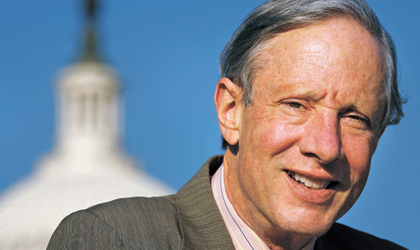
Photo courtesy of Lucien Perkins.
It’s not clear if longtime Washington Post reporter Robert Kaiser holds a lower opinion of lobbyists or lawmakers. Based on a 27-part series that ran in the Post, his new book, So Damn Much Money, covers the 35-year history of the modern lobbying industry. But at the heart of Kaiser’s book is not K Street. It’s money—and the way that American governance has been subverted by it. While many lobbyists unabashedly pursue the goals of their corporate clients at the expense of the public interest, it’s members of Congress—and their voracious appetites for perks and campaign cash—that keep the lobbyists in business. Because of the way the US political system has evolved, Kaiser’s book reveals, elected representatives now spend less time actually making law and ensuring oversight than ever before—and more time raising funds, campaigning, and angling for post-Congress lobbying jobs. Earlier this week, Kaiser spoke to Mother Jones about how lawmakers and lobbyists have polluted politics.
Mother Jones: You structure the book around the career of one immensely successful lobbyist, Gerald Cassidy of Cassidy and Associates. Why did you make that decision?
Robert Kaiser: I’m a storyteller and it’s always seemed to me that a good story has a good lead character. When I decided to do this project, I began looking around and I discovered the S-1 that Cassidy had filed with the Securities and Exchange Commission when he proposed to take [Cassidy and Associates] public in 1998. An S-1 is a very revealing document, when done properly, which is meant to explain to would-be investors in a company why they should want to invest in it, and why it has any value. For a reporter it was a gold mine. It was a road map.
MJ: Perhaps the most important thing about Cassidy, other than the fact that he managed to make $100 million as a lobbyist over three decades, is that he invented earmarks.
RK: Yes, and that was not clear to me initially. I found out from his original partner. What they realized was that a good earmark was something that made everybody happy. I should define an earmark, the way I use the term. It is a direct appropriation from Congress to a particular project sponsored by a particular institution, and it’s most often suggested by that institution. It is not part of a government program, and it’s not something that an executive branch agency has recommended.
In the very first instance, it was just something that Tufts University wanted to do—have a nutritional center. But what they realized was that the congressman that represented Tufts, and the other congresspeople from the state, the lobbyist who is pushing the idea, and of course Tufts, the beneficiary, all have the same wonderful sense that if this thing goes through, they are helping themselves. The congressman was bringing home the bacon, the university had hit on a great new scheme for making money, and the lobbyist had found a new way to make money.
MJ: Was it the case back then, and is it still the case today, that when a lobbyist and a member of Congress work in conjunction to slip an earmark into a much larger bill, the other lawmakers who eventually vote on that bill don’t know that it is even in there?
RK: More than that, in fact, particularly in the early years. Back then, there was only some general statement [in the bill] and then there was report language, as it’s called. There was some paragraph in the report of the conference committee that wrote the final version of the bill that says, “The research laboratory in section 8, paragraph 7 is one that can only be built at Podunk University, and we expect the money to go to Podunk.” For a long time, that was all you needed.
Later, this became more complicated and controversial, and you had to have a line item [mandating spending in the bill, instead of in report language]. But even when you had the line item in the bill, most members of Congress had no idea what was in these big appropriations bills. Nobody pays attention to earmarks that aren’t their own. Except John McCain.
MJ: Earmark reform has occurred through the years, as has lobbying reform. But you make it clear in your book that at every step, Cassidy and his colleagues in the industry have found new ways to stay ahead of the game.
RK: Yes. Interestingly, one of the most relevant recent reforms is that the sponsors of all earmarks have to be identified. Any line item that is in one of these bills now, you can see who sponsored it and so on. But as Cassidy would tell you, this is rarely a deterrent, because the member who sponsors the thing usually wants to be known. It’s bacon that he’s going to bring home and brag about.
So it is a reform, in that we can now write stories about how Congressman X received a lot of money from such and such an interest, and then that interest got an earmark sponsored by that same Congressman X. But he’s not embarrassed by that, and it’s not really a deterrent.
But I do think we can invent reforms that would have a big impact. One of the things I’ve talked about is having every official or every lobbyist, or both, report at the end of the day every day who they talked to and about what. In other words, if the administrative assistant to Congressman Jones had to say, “Here are the lobbyists I met with today and here’s what we discussed,” I think that would clean things up fairly dramatically.
MJ: One way lobbyists have adapted is that they have started raising money for politicians in huge amounts. They can’t take politicians on trips or give them gifts, but politicians know who organizes their fundraisers. And that buys access down the road.
RK: It does. As the campaigns have become more and more expensive, finding that money becomes more and more important. The fact that you can’t take Congressman X to a baseball game or a golf tournament may make life less easy for both the lobbyist and Congressman X, but what he really cares about is having the funds to fend off the next challenger. That’s an area where lobbyists’ role is untouched so far by any reform.
MJ: You write about the way in which the increasing need to raise money has changed the day-to-day activities of congressmen. Talk a little about that.
RK: This is one of the things I simply did not know about before doing the reporting for this book. The members now routinely spend a day, sometimes two days a week—all the time, all year around, election year or no election year—on the telephone calling potential donors, pleading for money. It’s a demeaning enterprise, and I think it has an impact on weaning out a lot of people who might consider running for Congress [but don’t] once they find out they have to do this every week for the rest of their lives.
MJ: Former Congressman Bob Livingston points out how because of fundraising demands and because of how Congress goes home on the weekends now, Congress simply does less work than before.
RK: One of the reasons why governance in this country got so bad over the last eight or ten years was the total absence of any oversight of the executive branch by Congress. And one reason for that was that Congress wasn’t here. Really, since 1995, since Republicans got the control of both the House and the Senate, both bodies have been working three- or three-and-a-half-day weeks. And oversight is a hard job; it takes a lot of time and energy. And they just didn’t want to devote themselves to it.
MJ: The pollster Peter Hart says in your book that today’s political system creates “smaller people.” Explain that.
RK: For me personally, this is perhaps the most important conclusion in my book. Congress no longer attracts independent-minded, big people who think for themselves, have their own personal worldview, fully informed and animated by their own intellects and their own reading. Instead you have a new class of people who want to go on television, who look good, who are willing to put up with that demeaning fundraising experience, and who really seem to be drawn to politics for the combative, gladiatorial aspects of the game, more than for any appetite to improve the governance of the United States.
From Jimmy Carter in 1976 through George W. Bush, we had candidates for president, the successful ones, all expressing somewhere between skepticism and outright negativity about government. And while Ronald Reagan was the archetype here—who said government isn’t the solution, government is the problem—even Bill Clinton declared the end of big government and in other ways tried to signal that he wasn’t an enthusiast for government. I think after 30 years of that, these guys have managed to put government into ill repute. They’ve given it a really bad name. Not surprisingly, government itself began to fail—I think because we got the government we deserved.
MJ: Can you talk about how the perception of the revolving door has changed, starting with Jim O’Hara?
RK: This is an important theme in my book. We had a taboo structure in Washington when I was young. There were things you just didn’t do, not because they were illegal, but just because they looked bad. And that whole category seems to have eroded in the last 20 years, eroded to the point of disappearance. For example, Tom Daschle came to town as a warrior liberal fighting for little guys and ends up humiliated by the discovery that he was being a fat-cat lobbyist without even registering as a lobbyist, exploiting a loophole in the reporting law. And taking big, big money from all kinds of special interests, including some from the realm he would be overseeing if he was secretary of Health and Human Services.
The Jim O’Hara story you mention is one that is fascinating to me. I remember it vividly because I was covering Congress when this happened. Jim O’Hara was a popular and serious liberal Democratic congressman from Michigan who ran for a Senate seat in 1976. O’Hara lost and had to come back to town with five or six kids and no job. He had to find a paycheck. And he went to work for Tom Boggs, one of the biggest lobbyists in town. This was seen in 1977 as something that was scandalous. “Jim O’Hara became a lobbyist? Gee, that doesn’t look right.” I talked to Leon Panetta, now our CIA director, about this. He was in the House at that time. And he said, “Oh yes, I remember when O’Hara came up to the House, exploiting the privilege to visit the floor”—which all former members have forever—”and he came on the floor as a lobbyist, and I wouldn’t talk to him. A lot of my colleagues wouldn’t talk to him. Because it just didn’t seem right.”
And now we have 185—I think that’s the latest number—former members of Congress registered to lobby. Absolutely taken for granted.
MJ: On the subject of Cassidy, this is a man who once helped pharmaceutical companies fight health care reform in the ’90s. And yet, despite the fact that he repeatedly served corporate interests, he’s a liberal Democrat.
RK: In his own mind.
MJ: You’d think he’d be less aligned with corporate America and more aligned with the little guy. How do you explain his motivations, and the way that he’s made peace with himself?
RK: In the case of the pharmaceutical companies that Cassidy organized in 1993 when the Clintons were first trying to orchestrate health care reform, he saw, pure and simple, a business opportunity. Unlike you and many other professional political observers, Cassidy’s first interest is not policy. It’s money. And I think that is the instinct of most of these guys.
But despite all that, Cassidy can say, “I gave lots of money to liberal Democrats running for Congress, I’m still a liberal Democrat myself; I’m a good guy; I understand who the bad guys are.” It’s a coping mechanism for people who are in a position that others often don’t think of as honorable or pure. And Cassidy himself gives a lot to charitable causes, always has, and looks at himself in the mirror and sees a good guy. He goes to mass every day. People are complicated.