Did America Forget How to Make the H-Bomb?
Inside an institutional memory lapse of nuclear proportions.
For decades nonproliferation experts have argued that, once unleashed, the nuclear genie cannot be stuffed back in the bottle. But they probably didn't consider the possibility that a country with nuclear bomb-making know-how might forget how to manufacture a key atomic ingredient. Yet that's precisely what happened to the US recently, and national security experts say this institutional memory lapse raises serious questions about the federal government's nuclear weapons management.
In 2007, as the government began overhauling the nation's stockpile of W76 warheads—the variety often carried by Ohio-class submarines—officials at the National Nuclear Security Administration realized they couldn't produce an essential material known as "Fogbank." What purpose this substance actually serves is classified, but outside experts have suggested that it's a sort of exploding foam that sits between the fission and fusion portions of hydrogen bombs. The Government Accountability Office reported in March that NNSA's effort to recover its Fogbank-making ability had resulted in a yearlong, $69 million delay in the refurbishment project. And a government official with knowledge of the situation tells Mother Jones that further Fogbank-related delays are imminent.
The US government's Fogbank snafu has stunned nuclear policy experts. "What the story ought to tell people is that the institutions that we've built to oversee development and maintenance of our nuclear weapons are incompetent," says Jeffrey Lewis, the director of the nuclear strategy and nonproliferation initiative at the New America Foundation, who has written about the episode.
So how did America's three nuclear weapons design laboratories and four nuclear weapons manufacturing plants—the institutions collectively known as the nuclear weapons complex—simply forget how to make a crucial component of one of the military's most important warheads? "It seems like it was a case of ten-year-itis," says Phil Coyle, a former assistant secretary of defense who worked in the nuclear weapons complex for 33 years. "Ten years go by and people forget things that they used to know how to do."
"You have to keep people who know how to do these things and when people get too old or they retire you have to train new people to take their place," adds Coyle, now a senior adviser to the Center for Defense Information, a Washington think tank. But NNSA failed to do so, according to the GAO. The agency "kept few records of the process when [Fogbank] was made in the 1980s and almost all staff with expertise on production had retired or left the agency" by the 2000s.
In March 2007, the NNSA mounted an all-out effort, dubbed "Code Blue," to remanufacture Fogbank before a September deadline to finish refurbishing the first W76 warhead. According to the GAO, that effort failed, and it took another year before the NNSA could finally produce its first refurbished warhead. Fogbank-related delays led to significant logistical problems for the Navy, the GAO reports, causing it to put off replacing old W76 warheads with refurbished ones until April—a year after its original goal.
And the Navy may have to wait even longer until its W76 arsenal is shipshape. According to the GAO, the NNSA, after falling behind schedule, adopted an ambitious production plan that required it to produce more weapons per year than it had originally planned. But it now appears that the agency may not be able to keep its deadline, the government official says.
An NNSA spokesman disputed the GAO's characterization of the situation. "The GAO statement is technically incorrect," Damien LaVera, the NNSA's director of public affairs, writes in an email. "We did not commit to an aggressive production schedule to make up for delays in Fogbank." (Gene Aloise, the director of the GAO's national resources and environment division, says his office stands by the report.) At the same time, though, LaVera acknowledged that the NNSA is still facing problems with the W76 refurbishment program: "There have been some technical issues that we are working through, but they are not atypical for a production ramp up and would not alone not prevent us from meeting the [Navy's needs]," he says.
Loren Dealy, a spokeswoman for the House armed services committee, which has investigated the Fogbank matter, said the committee "continues to monitor" the issue.
Coyle, the former Pentagon official, says more vigilance is needed to ensure the nuclear weapons complex avoids other Fogbank-like fiascos. "It takes more oversight on the part of the Department of Energy and NNSA, it takes more oversight on the part of Congress, it means the lab management has to do a better job, and the management at the production plants has to do a better job. It takes real management. And apparently that broke down in this case."
No Nukes is Good Nukes
-
tagged as:
- solution
This is a prime example of the fact that you CANNOT MANAGE NUCLEAR WEAPONS!
No one can. No one should. No one ever will... whether it is the U.S., the Russians, the North Koreans, the Iranians, the Israelis, or the Pakistanis. Nuclear weapons need to be destroyed, and the U.S. as the largest holder and only user, must take the first step toward GLOBAL DISARMAMENT.
This is a success story, not a failure
Part of the whole logic behind the test-ban treaty is to dismantle the institutions that have built up around nuclear weapons. We *want* people to forget these things so that the nuclear arsenal is not considered 100% reliable. This makes the superpowers more, not less, likely to support global nuclear disarmament.
Did America Forget How to Make the H-Bomb?
In a way, this is amusing.
Maybe we should draw up a list of other things to be forgotten.
cash
This means the "Top Secret" process was never officially written down in some encrypted or other safeguarded form? It was just carried around in the heads of people who could go everywhere and be kidnapped by any one of a dozen countries? Seems ridiculous.
What a Tragedy
These dangerous devices don't really protect us, they are dreadfully expensive to build, manage and protect and somehow we have forgotten how to build them. What a tragedy.
it's like jumping into a
it's like jumping into a freezing pool... "you first!"
NNSA: I Love You
Fogbank! Enough nuclear destructive power to kill all of mankind many times over and they forget how to make a component. I guess they did not bother to write it down. After all written language only goes back 4-6000 years. Oral history goes back much futher. They could even have inscribed it on a mud tablet and baked it in the sun. It takes a serious bureauracy to achieve this level of incompetence. Imagine how many forms they must have designed so that this information could not be recovered.
These are the morons who we depend upon and they perform just like the Congress.
Look ahead fellows don't look back.
I am a technical
I am a technical writer.
Your comment is on the mark.
To the acronyms RTM and RTFM I propose we add WRM and WTFM. W = write.
Although technical types often simply don't want to document, there are some who do and do it well, and I tip my hat to you.
Ultimately, it is management's fault. No manufacuring or quality control methodology in place today allows for any activity to be certified as complete without proper documentation.
Having said that, I note that is the theory. Most often it is not the practice. Including where I work.
Forgot How to make the H-bomb
Not to worry. There's a small village in China that can do it.
In fact there's are a number of small villages in China that can and do make lots of things we forgot how to make.
Shoes
Clothing
Hand tools
TVs
Telephones
Computers
Radios
When (not if, but when) the US finally has to go to war with China, at an early date, we will have to insist on an armistice, so the US military can resupply critical electronics, made only in China. Also the US Army's berets.
Hey, USA, welcome to the Third World.
good point but
Not to worry... we're still the big guys since we have the biggest weapons... even if we can't get them to work!
ng how to make Fogbank . . .
this debacle makes me wonder if these fusion bombs have shelf-life, like bread in the grocery store or the vitamins in my pantry shelf . . . .
Forgot fogbank!
Fogbank is fart air anyone knows that! the retired experts need retirement funds to travel the world giving training lectures to interested governments it's the only way they can make retirement benefits after our government cut their retirement accounts, man's got to make a living right!, but fear not China will help us remember how to build a bomb or TV.
Did America Forget How to Make the H-Bomb?
Mother Jones should be ashamed of its censorship practices.
Posts are there and a few minutes later they are removed ?????
Competance
-
tagged as:
- solution
Funny, I draw an opposite lesson from this episode then most of the commentators here. This episode tells me that we need to keep nukes on a more regular production schedule, so that people stay in practice in how to make them. We certainly need to get rid of the test ban treaty, so that we can consume enough nukes to need a steady replacement system.
Why shouldn't they write it down?
I suppose the reason why they didn't write it down was as a way to protect the secrecy of the whole thing. It's impossible to steal a secret if there are not written records. However, nobody could have expected for the geniuses to forget the magic recipe. How exquisitely ironic!
Sounds like Asimov's 'Foundation' trilogy
Isaac Asimov's trilogy of "Foundation" novels describe a time when essential technologies are forgotten by most of the galaxy in a new 'dark ages'. Similarly, the 'Battletech' wargaming universe draws on the idea that the ability to maintain and create certain high technology machines is lost, and warring factions gradually lose what remains.
Someone once proposed that a long-term ban on new nuclear weapons development and maintenance could result in disarmament, as aging stockpiles become less reliable and more dangerous to their owners. I would personally welcome having 'fogbank' join Greek Fire in the pantheon of lost technology.
Put the blame where it belongs
The failure is one of policy and not technology or NNSA management. This nation is unwilling to give up a nuclear deterrent, but it doesn't want to modernize the decrepit Cold War weapons it has. Either we decide to get rid of them all together or we commit to building more maintainable weapons than the expensive 60's and 70's relics we currently have. Dithering and neglect is not policy; it is reckless irresponsiblity. It would be better not to have nuclear weapons than to be careless with the ones we have. If we want them, let's be responsible with them. If we don't want them, let's get rid of them. It is kind of childish to think neglecting them will make them go away.
BTW, when we've forgotten how to make nuclear weapons, we will also have forgotten some pretty basic physics. Any physics undergraduate knows enough to ruin someone's day. The hope isn't that we'll forget how to make them, but that we'll forget why we wanted to make them in the first place.
I have read variously that
I have read variously that 'polystyrene' or 'polystyrene foam' surrounding the secondary provided a low density of protons (hydrogen nucleii) to convert outgoing photons (gamma?) to inwards x-rays to heat the outer lining of the secondary.
I recall being surprise that polystyrene was around in the early 50s. I recall my first sighting of polystyrene foam, in an ad (early 60s?) of a child sitting on a white block floating on water. Seemed marvelous then, now is a tedious waste, although blocks can be reused as house insulation (not very fire-safe).
It likely this is formed pre-construction, not at 'explosively' at point of ignition.
Just order nookilurz from China from now on
-
tagged as:
- solution
If our own overpaid government bloaties can't keep their tinfoil hats on straight for long enough to build our defense stuff anymore, or they're too busy processing stress claims or participating in empowerment therapy or some other complete waste of tax revenue, then just put in an order with China, and they'll build em for us faster, better, and cheaper and have em delivered in 2 to 6 weeks. Now, whether or not imported nookilurz would fly, which direction they'd fly in, or whether they'd even launch to begin with without some sort of UN authorization code or something, well, that's another story, but hey, outsourcing and globalization is where it's at these days...
Klaatu marachas necktie
If I were in the business of
If I were in the business of making nuclear arms, I would make sure they didn't work.
Typical...Graphic is not a Hydrogen Bomb
Dear readership,
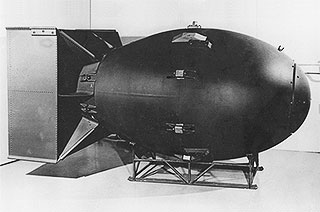
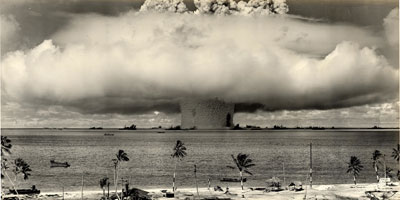
As is typical of stories which discuss nuclear weapons, the image used is very pretty, but also not a hydrogen bomb. The image is from the Baker underwater test of Operation Crossroads (1946). With a yield of a small 21kt, the largest hydrogen weapon was 2,380 times larger.
If you want to demonize these weapons, use graphics that support your claim. This bomb succeeded in sinking (not even destroying) a ghost fleet, including the USS Saratoga. A hydrogen bomb (take Castle Bravo, for instance), looks as if the very substance of a supernatural hell has rained fury down upon ye mortals. This looks like a very pretty splash.
Sounds like this 'fogbank'
-
tagged as:
- solution
Sounds like this 'fogbank' material is a nickel-beryllium foam impregnated with deuterium.
SSSHHH! That's top secret!
Luckily your forgot the Unobtanium, Peruvian flake and Pixie dust which increases the yield by 4 to 6 percent.
It stinks something fierce which is why it is nicknamed dragon fart.
Something Stinks!
Something similar happened
Something similar happened in Japan centuries ago. After the first contact with European explorers, the Japanese learned to make guns and became quite good at it. But when their government embarked on a centuries-long policy of isolation, the government pursued a policy of restrictions on gunmakers, to the point where knowledge of this technology was essentially lost until, ironically, Admiral Perry showed up in the 19th century -- with guns and cannons -- and forced Japan to open up to international trade.
Clearly the source is what is forgotten
They think they've forgotten how to make it.
What they've really forgotten, what was studiously kept out of any written document that might serve as future proof and evidence of further coverup, is the source of the original Fogbank material.
They never did know how it was made. They were never even quite sure from whence it came. All they knew was that the visitors in the strange ship provided a limited supply and warned them it could be used for good or evil and that they would only receive more if that initial supply was used responsibly. Ignoring the threat, they used it in weapons, and the visitors never returned.
unghhh...just find the peeps
unghhh...just find the peeps who used to work there and retired...kidnap them...and torture them till they remember...
OMG!
Let's hope we never forget how to torture people!
Something Stinks!
This is institutional evolution at work
Just as organisms evolve to become better able to adapt and exploit their environment, the "nuclear-weapons-complex" has shown a remarkable genetic adaptation to ensure that it survives: make nukes impossible to build, and no nukes will destroy the planet, and ergo sum, the "nuclear-weapons-complex" will survive forever, along with the rest of us. Kudos, "nuclear-weapons-complex"! WE LOVE YOU!
cheap replica handbags cheap
cheap replica handbags
cheap Louis Vuitton handbags
Cheap designer Louis Vuitton
cheap gucci replica handbags
Discounted Louis Vuitton Luggage Discounted lv wallet
cheap discounted Chanel cheap discounted Gucci
cheap discounted Hermes
cheap discounted YSL
cheap discounted Prada
i-replicahandbags-Louis Vuitton Handbags,Gucci Handbags,Chanel Handbags,Hermes Birkin handbagson sale.
The high quality Replica Handbags,replica Louis Vuitton Handbags,
designer handbags replica,Hermes Birkin Handbags
http://www.mycooldesigner.co.uk
Thank you for your sharing,I like this.ed hardy shop Links of London
Chains ed Hardy Men Long T-
Shirts