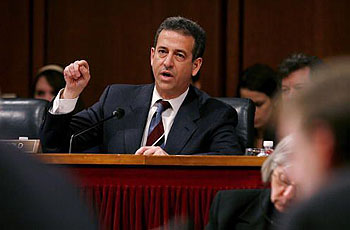
 In the wake of a historic economic collapse caused largely by a financial industry allowed to run rampant, Sen. Russ Feingold (D–Wisc.) has decided to vote in favor of doing nothing at all to address this:
As I have indicated for some time now, my test for the financial regulatory reform bill is whether it will prevent another crisis. The conference committee’s proposal fails that test and for that reason I will not vote to advance it. During debate on the bill, I supported several efforts to break up ‘too big to fail’ Wall Street banks and restore the proven safeguards established after the Great Depression separating Main Street banks from big Wall Street firms, among other issues. Unfortunately, these crucial reforms were rejected. While there are some positive provisions in the final measure, the lack of strong reforms is clear confirmation that Wall Street lobbyists and their allies in Washington continue to wield significant influence on the process.
Can I vent for a minute? I know Feingold is proud of his inconoclastic reputation. I know this bill doesn’t do as much as he (or I) would like. I know the financial industry, as he says, continues to have way too much clout on Capitol Hill.
But seriously: WTF? This is the final report of a conference committee. There’s no more negotiation. It’s an up-or-down vote and there isn’t going to be a second chance at this. You either vote for this bill, which has plenty of good provisions even if doesn’t break up all the big banks, or else you vote for the status quo. That’s it. That’s the choice. It’s not a game. It’s not a time for Feingold to worry about his reputation for independence. It’s a time to make a decision between actively supporting something good and actively supporting something bad. And Feingold has decided to actively support something bad.
What’s more, his reasons for doing this don’t even make sense. This bill won’t prevent another crisis? No it won’t, but voting for the status quo does even less. It doesn’t break up the big banks? The status quo does even less. It suffers from too much lobbyist influence? Well, Wall Street lobbyists are far more enthusiastic about the status quo than they are about this bill. There are only two choices available here, and on virtually every level Feingold is voting in favor of the alternative that does less of what he says he wants.
But who knows? Maybe this won’t make any difference. Maybe Harry Reid will be able to round up three or four Republicans to vote in favor of proceeding. But maybe not. With Robert Byrd’s death, Feingold’s vote could end up being the one that dooms financial reform for another decade. I sure wouldn’t want that to be my legacy.