In The Blogs

From the Man Who Brought You the Segway: The Next Electric Car?

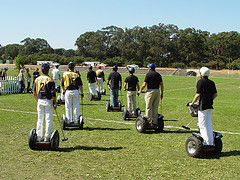
segway.jpgRemember the Segway? Back in 2000, the self-balancing scooter was hyped as the Second Coming of wheeled transport. Unfortunately for its inventor, eccentric New Yorker Dean Kamen, it hasn't really caught on outside a narrow circle of enthusiasts. But Kamen doesn't care. He's got something better:

Conceived in Scotland almost 200 years ago, the Stirling is a marvel of thermodynamics that could help to replace the internal combustion engine—in theory it can turn any source of heat into electricity, in silence and with 100 percent efficiency. But corporations including Phillips, Ford and Nasa have devoted decades of research, and millions of dollars, to developing the engine, and all retired defeated, having failed to find a way of turning the theoretical principles of the engine into a workable everyday application.

After ten years and a $40 million investment, Kamen and his engineers think they've succeeded where NASA failed. Though the Stirlings aren't ready for commercial use, Kamen says he's test-driven engines burning everything from jet fuel to cow manure. They don't work in cars yet, he says. But they will.

image
image

Kamen isn't your typical eco-warrior. On the one hand, he makes his seven-mile daily commute via personal helicopter; on the other, when New York authorities told him he couldn't put a wind turbine on his private island, he evaded them by declaring it an independent nation (North Dumpling) of which he was sole sovereign (Lord Dumpling).

But Kamen is a tinkerer, and he has plenty of resources to devote to solving the Stirling engine. There's no guarantee he can do it. But oil doesn't grow on trees, and a lot of people would like to keep using cars as their primary transportation (just look at all the ways we're trying to keep them on the road). Whoever invents the first truly green, cost-effective car is going to become a gazillionaire, at least in this country. And if it's Dean Kamen, don't be surprised if you and all your friends are driving Dumplings to work.

Photo used under a Creative Commons license from Franco Folini.

Get Mother Jones by Email - Free. Like what you're reading? Get the best of MoJo three times a week.
Comments
no profile pic for comment author

It transforms heat into electricity with 100% efficiency? Someone needs to study the laws of thermodynamics.

no profile pic for comment author

Wow, who thought it would be so hard to get to the bottom of this entry :(

Turns out the original article in the Telegraph is talking about his new Electric Car that uses a stirling engine as a range extender to give an Electric Stirling hybrid.

The stirling engine is theoretically 100% efficient at converting heat into movement, but thats no where near the same thing as 100% efficient at converting chemical energy ( the fuel) into electricity for the electric car to use.

While the sterling engine may be close to 100% efficient, the generator its hooked up to may get 60-80% efficiency at best, then there are further losses when that electricity has to charge up the Lithium battery pack, and further losses again when the electricity in the battery pack gets converted into forward motion by the electric motor.

no profile pic for comment author

Gene Roddenberry depicted a vegetarian future in Star Trek: The Next Generation. Electric vehicles and alternative fuels are as real a possibility as is a vegetarian future.

The following quotes, facts, figures, and statistics are excerpted from Please Don't Eat the Animals (2007) by Jennifer Horsman and Jaime Flowers:

"A reduction in beef and other meat consumption is the most potent single act you can take to halt the destruction of our environment and preserve our natural resources. Our choices do matter: What's healthiest for each of us personally is also healthiest for the life support system of our precious, but wounded planet."

---John Robbins, author, Diet for a New America, and President, EarthSave Foundation

One study puts animal waste in the United States to between 2.4 trillion to 3.9 trillion pounds per year. The United states produces 15,000 pounds of manure per person. This is 130 times the amount of waste produced by the entire human population of the United States.

A 1,000-cow dairy can produce approximately 120,000 pounds of waste per day. This is the functional equivalent of the amount of sanitary waste produced by a city of 20,000 people.

A 20,000-chicken factory produces about 2.4 million pounds of manure a year. Poultry factories are one of the fastest growing industries throughout Asia.

One pig excretes nearly three gallons of waste per day, or 2.5 times the average human's daily total. One hog farm with 50,000 pigs in France produces more waste than the entire city of Los Angeles, and some pig farms are much larger.

Factory farm pollution is the primary source of damage to coastal waters in North and South America, Europe, and Asia. Scientists report that over sixty percent of the coastal waters in the United States are moderately to severely degraded from factory farm nutrient pollution. This pollution creates oxygen-depleted dead zones, which are huge areas of ocean devoid of aquatic life.

Meat production causes deforestation, which then contributes to global warming. Trees convert carbon dioxide into oxygen, and the destruction of forests around the globe to make room for grazing cattle furthers the greenhouse effect. The Food and Agricultural Organization of the United Nations reports that the annual rate of tropical deforestation has increased from 9 million hectares in 1980 to 16.8 million hectares in 1990, and unfortunately, this destruction has accelerated since then. By 1994, a staggering 200 million hectares of rainforest had been destroyed in South America just for cattle.

"The impact of countless hooves and mouths over the years has done more to alter the type of vegetation and land forms of the West than all the water projects, strip mines, power plants, freeways, and sub-division developments combined."

---Philip Fradkin, in Audubon, National Audubon Society, New York

Agricultural meat production generates air pollution. As manure decomposes, it releases over 400 volatile organic compounds, many of which are extremely harmful to human health. Nitrogen, a major by-product of animal wastes, changes to ammonia as it escapes into the air, and this is a major source of acid rain. Worldwide, livestock produce over 30 million tons of ammonia. Hydrogen sulfide, another chemical released from animal waste, can cause irreversible neurological damage, even at low levels.

The world Conservation Union lists over 1,000 different fish species that are threatened or endangered. According to the United Nations Food and Agriculture Organization (FAO) estimate, over 60 percent of the world's fish species are either fully exploited or depleted. Commercial fish populations of cod, hake, haddock, and flounder have fallen by as much as 95 percent in the north Atlantic.

The United States and Europe lose several billion tons of topsoil each year from cropland and grazing land, and 84 percent of this erosion is caused by livestock agriculture. While this soil is theoretically a renewable resource, we are losing soil at a much faster rate than we are able to replace it. It takes 100 to 500 years to produce one inch of topsoil, but due to livestock grazing and feeding, farming areas can lose up to six inches of topsoil a year.

Livestock production affects a startling 70 to 85 percent of the land area of the United States, United Kingdom, and the European Union. That includes the public and private rangeland used for grazing, as well as the land used to produce the crops that feed the animals. By comparison, urbanization only affects 3 percent of the United States land area, slightly larger for the European Union and the United Kingdom. Meat production consumes the world's land resources.

Half of all fresh water worldwide is used for thirsty livestock. Producing eight ounces of beef requires an unimaginable 25,000 liters of water, or the water necessary for one pound of steak equals the water consumption of the average household for a year.

The United States government spends $10 million each year to kill an estimated 100,000 wild animals, including coyotes, foxes, bobcats, badgers, bears, and mountain lions just to placate ranchers who don't want these animals killing their livestock. The cost far outweighs the damage to livestock that these predators cause.

The Worldwatch Institute estimates one pound of steak from a steer raised in a feedlot costs: five pounds of grain, a whopping 2,500 gallons of water, the energy equivalent of a gallon of gasoline, and about 34 pounds of topsoil.

33 percent of our nation's raw materials and fossil fuels go into livestock destined for slaughter. In a vegan economy, only 2 percent of our resources will go to the production of food.

"It seems disingenuous for the intellectual elite of the first world to dwell on the subject of too many babies being born in the second- and third-world nations while virtually ignoring the overpopulation of cattle and the realities of a food chain that robs the poor of sustenance to feed the rich a steady diet of grain-fed meat."

---Jeremy Rifkin, author, Beyond Beef: The Rise and Fall of the Cattle Culture, and president of the Greenhouse Crisis Foundation

Lester Brown of the Overseas Development Council calculates that if Americans reduced their meat consumption by only 10 percent per year, it would free at least 12 million tons of grain for human consumption--or enough to feed 60 million people.

no profile pic for comment author

A vegitarian future?

So "vegitarian future" what do you propose to do with domesticated species? If we don't eat beef then beef cattle will become extinct for they will have no purpose and thusly no future. In point of fact a beef cow is an ideal method of converting stuff we can't eat (grass, etc.) into things we can (Milk and meat) with the useful byproduct of material easily converted into useful biogas. Your "vegitarian future" shoots humanity in the foot! There is not enough arable land to feed us all on solely vegitarian diets and supply the biomass neccesary for fueling our penchant for travel without drasticly reducing human population (by billions). Areable land is being destroyed by saltation, erosion, pollution and desertification at a hideous rate. What do you propose we do? plow the Amazon?
Human beings are a species that have achieved an incredible ability to foster conscious symbiosis with other species, through domestication of species ranging from elephants to yeast. Yes we eat beef, but the beef needs us, and is dependant on us as we are on the cattle. What is needful is to foster responsible and ethical animal husbandry that raises animals humanely on feedstocks the animals evolved to eat. For cattle that means grass. We can't eat grass, cows can. Grass grows well in many places where men can't grow vegitables and growing wheat would destroy the topsoil. Grass and cattle build topsoil, plows give it up to the wind.
and there be the rub...Topsoil is a treasure as precious as clean water and air and we are loosing it to industrial farming and so many other factors. Without topsoil your vegitarian future is stillborn, or atre you going to keep the cattle just for manure?
So but eating animals is cruel! someone wails...I can never comprehend why some smug individuals go on about cruelty to animals when the quantity of human suffering is so vast! As if human beings were ever noted for being anything but rapacious sea apes. Yes, we have the capability to be kind, compassionate and thoughtful but seldom is it so! One takes life with every breath (sorry Jaina) and our bodies are filled with bacteria alien to our genome, how far can your Ahimsa go? Remember we are made of meat just like the cows, any grizzly bear will happily chow down on. Life eats life and always has and always will. Our symbiosis with other life forms is our salvation, if only we do it wisely and learn to waste nothing, the way our ancestors did. The Masai say the cow is sacred, yet they drink the blood of their living animals. Do you care more about cows than a Masai? I don't think you ever could...

no profile pic for comment author

Well said, Vasu. Researchers at the U of Chicago have determined that just going vegetarian is more effective in reducing global waming than driving a hybrid car. The FAO concludes:"the livestock sector...generates 65% of human related nitrous oxide which has 296 times the Global Warming Potential of CO2.

no profile pic for comment author

so, by those statements i can conclude that my 16 years of vegetarianism, including 12 years of veganism, allows me the privilege of driving without having any feelings of guilt?

hmmm. i'll stick to mass transit and my bike for now, as we all should. increase demand and put more money into these systems. US mass transit sucks, with very few exceptions. sure, electric cars are great, but are they really the answer?

no profile pic for comment author

tammy, the real answer is being a vegetarian. Vegetarian women look thin and pretty. Go vegetarian.

Post a comment
Alternately, you may login to or register an account
The content of this field is kept private and will not be shown publicly.
  • Web page addresses and e-mail addresses turn into links automatically.
  • Allowed HTML tags: <a> <ul> <ol> <li> <blockquote> <img>
  • Lines and paragraphs break automatically.

More information about formatting options


Jail.org - Inmate Search
Criminal records, instant public records & people search & current court records. www.jail.org

U.S. Public Records Search
Search County & State Court Records, Criminal records, Vital and Adoption Records www.PublicRecordsInfo.com

Records.com - People Search
Public Records and Background Checks. Instantly Search Criminal Records, Addresses and Court Records www.Records.com

Court Records & County Records
Find Instant Public Records, Criminal Records as Well as County Property Records Search. www.PublicRecordsIndex.com

Mother Jones Podcast
Get in on the conversation! We talk about culture, politics, the environment, the economy and more. Listen now!

TalkBackTees.com
A treasure trove of liberal wit, wisdom and quotations, from ancient to modern, on colorful, cotton tees.

Support Independent Artists
Amazing art, crafts, apparel, paper-goods and more. A carefully curated selection of sundries since 1999.

FREE CONNECTIONS FOR GREEN SINGLES
Meet progressive singles in the environmental, vegetarian & animal rights community who share your values