Photo: Lisa Church
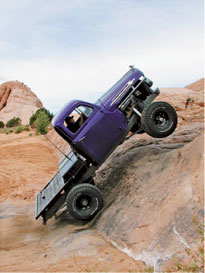
For Kiley Miller and John Rzeczycki, owners of 160 acres of wild desert outside Moab, Utah, Easter brings jeeps. Hummers, too, and modified pickups, and stripped-down rock crawlers—by the tens of thousands they descend on Moab for the annual Easter Jeep Safari, one of the nation’s largest off-road-vehicle events. The jeeps whine through gears on a windswept uplift named Black Ridge near the couple’s property, leaving a spoor of beer cans and brake fluid. Once, a group of jeepers left a message on one of the Private Property signs Miller and Rzeczyckihad put up—a noose, as carefully knotted as a girl’s braid.
Carpenters by trade and rock climbers by choice, Miller, 36, and Rzeczycki, 37, came to Black Ridge in 2003 to live in a solar-powered, wood-heated cabin. This was their land; they expected that the local government would protect their right to it. So, Miller was quick to call the sheriff’s department on the morning of Good Friday, 2004, when Rzeczycki tried to block a jeep traveling on a closed trail adjacent to the property. The vehicle kept moving, pinning Rzeczycki under its 40-inch tire; the sheriff’s deputy found him lying in the dirt, nursing a torn ligament and a damaged meniscus. He promptly threatened to write a ticket for disorderly conduct—to Rzeczycki, for “getting in the way of the jeeps.” As the deputy drove away, Miller noticed that his car bore one of the ubiquitous urinating-Calvin stickers, the insult in this case directed at the logo of the conservation group Southern Utah Wilderness Alliance (suwa).
As Miller and Rzeczycki would soon learn, they had walked into an epic national land-use debate, with conservationists and property owners pitted against state and county officials, deregulation advocates in Washington, and a slew of industry lawyers and lobbyists. At the heart of the dispute is an ancient federal law known as Revised Statute 2477, passed in 1866 to encourage development in the West by granting rights of way over public land. In a sweeping new interpretation embraced by the Bush administration, counties across the West have argued that RS 2477 allows them to claim as “highways” thousands of paths, trails, and wagon tracks, even on private property and inside national parks and wilderness areas. If the counties succeed in establishing their reading of the statute as legal precedent, warns suwa executive director Scott Groene, it could “open the door to motorized use of nearly all of America’s public lands.”
At stake is not just whether jeepers can drive across public land, or cut new trails in the boulder-studded washes on Miller and Rzeczycki’s property. Roads mean access for oil, gas, and timber companies, for uranium prospectors and hard-rock miners and utility lines. Indeed, the outcome of the RS 2477 cases now cycling through the courts could determine the future of wilderness designation in the United States. For where there are roads, Congress has made clear, there can be no wilderness.
If by history, culture, and predilection any one state in the West was destined to start this fight, it was Utah. Isolated, persecuted, and rebellious, the Mormons arrived here in the 1840s to carve out a new nation; when they begrudgingly joined the union 50 years later, Utah’s vast “unsettled lands,” 42 percent of the state’s territory, fell to federal control. But Utahans who had learned to farm amid the rock and raise cattle in the canyons spurned the land-use laws emerging from distant Washington. They paid little heed in 1934, when the Taylor Grazing Act sought to curb overgrazing in the West, or in 1946, when the toothless Grazing Service became the U.S. Bureau of Land Management (blm), also toothless but now charged with overseeing 258 million acres across 11 Western states and Alaska—land that was wild but not officially designated as national forest, park, or wilderness. Some 23 million acres of that blm land are in Utah.
A generation later, in 1976, Congress finally provided the blm (long mocked as the “Bureau of Livestock and Mining”) a measure of enforcement power over its vast domain by enacting the Federal Land Policy Management Act. The law called on the agency to limit grazing and motor vehicle use, to hand out mining and drilling leases only after an environmental review, and to examine which of its parcels might be protected as wilderness. Though the act was rife with loopholes, many rural officials and business interests saw the introduction of environmental and other rules as a declaration of war; the ensuing antiregulatory backlash, known as the Sagebrush Rebellion, spread across the West for a decade.
Among the rebels’ more obscure concerns was RS 2477. As a concession to local governments, the 1976 blm reform act had grandfathered in rights of way on public land, as long as they were shown to have a proven use at or before the act’s passage. The process for identifying those roads and bringing them under state and county jurisdiction was never clarified, though, and for the next 30 years the RS 2477 question hung in the air, unresolved.
Fast-forward to September 1996, when Bill Clinton employed another moldy law, the American Antiquities Act of 1906, to create out of blm lands the Grand Staircase-Escalante National Monument, a 1.9 million-acre protected wilderness showcasing 260 million years of geologic history in the form of vast cliff staircases running across southern Utah toward the rim of the Grand Canyon. Local governments saw it as yet another Washington land grab, and the commissioners of Kane, Garfield, and San Juan counties—whose slot canyons and piñon plateaus comprise some of the most pristine roadless landscapes in America—decided to avenge the injury. Just weeks after the monument was created, in September and October 1996, road crews dispatched by the three counties drove onto blm land, including portions of the Staircase, to turn 16 rugged trails into fully graded dirt roads that they claimed as county property under RS 2477.
The counties’ stratagem quickly widened to include private lands as well. On an October day in 1997, a pair of longtime ranchers in Kane County, Ron and Jana Smith, came home from vacation to find their 2,000-acre property near the Staircase monument broken into, the chains on their gates clipped, six Private Property signs torn down, and four RS 2477 claims laid across their land. Kane County officials had made no attempt to give the Smiths prior notice. “They just showed up with bolt cutters,” says Jana Smith, 53, who with her husband has owned the ranch since 1976. “Just went ahead and did it.”
The Smiths tried to reason with Kane County. They asked for a map of the RS 2477 roads the county had identified on their land, and for proof that the roads were covered by the statute. Their requests were ignored, they say, and the sheriff called to warn them that the fences they’d put back up across the alleged roads would be cut down. Jeepers ran right over the fences in any case, and Ron spent a lot of time chasing off trespassers who had been told by Kane County that the trails were open and legal.
In the end, the Smiths sued the county, forcing officials to identify “highways” that, according to Jana, “began nowhere, went nowhere, ended nowhere, provided access to nothing.” In court the couple presented the county attorney with the limited access deed they had received when they purchased the property (and had shown the county years before), which clearly stipulated that the land was immune from RS 2477 claims. Within 30 minutes the county attorney dropped the matter, but it took another year to get the three-man county commission to vote to abandon the claim on the couple’s property.
“Kane County cried out that the Staircase was an abuse of power, a land grab, done without due process—the county and citizens weren’t allowed to participate,” says Jana Smith. “What we found so mind-boggling is that they turned around and did the same thing to us.”
San Juan County commissioner Lynn Stevens, a 70-year-old, cool-eyed retired Army general, told me he works 80 hours a week in public service, so finding time for an interview was tricky. We finally met at 10 p.m. at the counter of a Shell station diner in the county seat of Monticello, one of a handful of habitations in the stone expanses of southeastern Utah. I wanted to ask Stevens about the county’s RS 2477 claim in nearby Salt Creek Canyon, a stretch of Canyonlands National Park known for its rugged, remote beauty.
Twisting and high-walled, Salt Creek Canyon is the route to a view of Angel Arch, a sandstone formation that soars 150 feet over the canyon. It is an eight-mile hike through a garden of yucca and desert evening primrose, often with no other human in sight, no sound except one’s breath, one’s feet sinking in the sand. The sand and flowerbeds are really a “highway,” according to San Juan County, which sued the National Park Service in the summer of 2004 for closing the canyon to vehicles because of documented damage jeeps have caused to the canyon’s ecology.
The creek-bed “road” in Salt Creek Canyon existed long before the establishment of the national park in 1968, Stevens told me. He said local cattlemen and others can testify to having driven up Salt Creek as early as the 1940s, while wagons traveled the creek bed for 100 years before that. “Angel Arch is a place where families had get-togethers,” he said, “where grandparents came with children.” Overhearing our conversation, a woman mopping the floor of the diner chimed in bitterly: “Not anymore!”
The San Juan County lawsuit is a fight over perhaps the most contentious application of RS 2477—the claim that the statute provides vehicle access to wildlands even in national parks. According to an internal Park Service memo, if the courts agree, at least 17 million acres in 68 national parks and monuments nationwide could be affected, including every hiking path in Zion National Park. Several environmental groups, including suwa, the Wilderness Society, the Grand Canyon Trust, and Earthjustice, are seeking to intervene in the case on behalf of the public interest.
Stevens—whose many positions include an appointment as the Utah governor’s coordinator for public lands policy—says the issue is simply one of fairness. The motoring public, the “non-hiking people,” should not be deprived of the opportunity to see Angel Arch. “These are cherished, beloved places among the residents of San Juan County,” says Stevens. “It’s elitist to say if you can’t hike, you’re not entitled to have that beauty.”
Although it is technically the defendant in the Salt Creek case, the Bush administration has looked favorably on San Juan County’s efforts. As she was leaving office in March 2006, then-Secretary of the Interior Gale Norton issued a sweeping policy directive specifying that national parks are not exempt from RS 2477. The Department of the Interior has also repeatedly exempted RS 2477 claims from public comment and environmental review, and it has sought to make it easier for counties to claim new roads via a variety of rule changes, at least one of which was illegal, according to a 2004 Government Accountability Office report. Meanwhile, the blm has for years failed to complete the required environmental impact reviews and even basic mapping of trails for off-road vehicles on public lands, and it has also neglected Congress’ mandate to inventory blm lands for potential wilderness designation.
That foot-dragging has turned out to be a godsend for RS 2477 advocates: If San Juan County’s claims are upheld, for example, suwa estimates that 86 percent of public lands in the county would sit within one mile of a “highway,” which would almost certainly render these lands ineligible for wilderness protection, since by statute a wilderness must be roadless and “untrammeled by man.”
Congress could, of course, block that endgame. Congressman Mark Udall (D-Colo.) has proposed legislation, the RS 2477 Rights of Way Act, to force counties making highway claims to prove the existence of a road and its continuous usage to the present, though the bill has so far gone nowhere. suwa‘s own legislation, which would turn about half of Utah’s wild blm lands into federally protected wilderness (where, the group points out, people could do almost anything they do on the land now, including fish, hunt, ride horses, and run cattle, but not mine for minerals or drive vehicles) has languished on the Hill for 18 years.
Off-roading is big business. Sales of everything from three-wheelers and snowmobiles to rock-crawling trucks quadrupled during the 1990s, with 36 million users fueling a $4.8 billion industry. Between 1979 and 2006, the number of registered off-road vehicles (orvs) in Utah alone went from about 9,000 to more than 500,000 (and many more go unregistered). Crowds at Moab’s Easter Jeep Safari have been growing each year, with the motels on Main Street filling to capacity, restaurants overflowing, and mechanics working nonstop. The rodeo arena outside town turns into a trade show with booths offering outsize tires, gas-tank skid plates, superpowered winches, shock mounts, and the latest lines from Suzuki, Honda, Ford, and Chrysler.
Last year, Easter Safari attendants opened the event’s 72-page newsprint brochure to find a full-page ad featuring a trio of cigar-chomping gangsters aiming Tommy guns and wearing slouch hats labeled “Sierra Club” and “Wilderness Society.” The headline read, “These guys wanna rub you out! Their racket is to lock you out of YOUR public lands.” The ad was paid for by the nation’s largest orv group, the Idaho-based Blue Ribbon Coalition, whose sponsors include branches of the Honda, Harley Davidson, and Yamaha corporations, as well as major mining, timber, gas, and oil companies (see “Blue Ribbon Bedfellows,” opposite page). The coalition, along with other off-road enthusiasts’ associations, is a co-plaintiff in San Juan County’s push to reopen Salt Creek Canyon via RS 2477.
For lobby groups like the Blue Ribbon Coalition, jeepers function as an informal army of RS 2477 missionaries. They blaze new trails or rediscover the old, hurtling along the abandoned mining paths and seismic-exploration lines that web southern Utah. And, in a perfect feedback loop, the jeepers also justify the counties’ road claims: Here, after all, is public use.
I rented a Jeep Wrangler Rubicon on a sunny day not long ago, traveling a jagged trail that edged Arches National Park. The truck slammed and sloshed, leaped over boulders, and cracked its shanks against the limbs of piñons. There was thrill in the power of the vehicle, its acquisition of each hard mile. For eminently practical reasons alone, jeeps have a place on federal lands, as of course do roads. The question boils down to where, and how many. As far back as 1977, a National Science Foundation study noted that “orvs have now invaded an enormous variety of natural settings, from deserts and coastal dunes to forested mountains, and from fertile habitats for wildlife to unique refuges for relict flora and fauna…. Damage by orvs in even the least vulnerable areas will require periods for recovery measured in centuries or millennia…. Archaeological and historical features, relict landforms, primitive soils, and other legacies of irreplaceable cultural, aesthetic, and scientific value have also been permanently lost.”
During Easter Jeep Safari last year, I stood in the crowd at Potato Salad Hill, a stretch of oil-stained red rock a half-mile outside Moab. A thousand people had formed a human amphitheater, watching the jeeps go up against the stone. A roaring creature resembling a prehistoric bug, stripped to roll cage and wheels and engine, crawled up the face; it hovered, shivered, lost footing, and finally it tipped end over end, thudding down the incline. Cheers and beers went up, and the driver walked away unhurt. Nearby was a derelict, pillbox-shaped gauging station for a stream flowing from the mountains east of Moab, a spot where women gathered to watch the machines. On its wall, someone had spray-painted Dr. Seuss’ Lorax, mustache resplendent, arms upstretched.