Out of Mind, Out of Sight
A photo essay of the psychiatric hospitals the world forgot.
See Eugene Richards' related photo essay here.
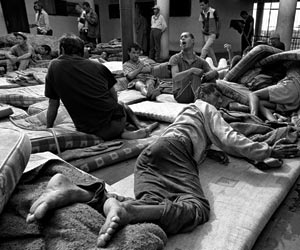
hidalgo, mexico, 1999. Though the sun is beginning to filter in through the barred windows, it's damp and cold in the men's ward at Fernando Ocaranza Psychiatric Hospital—no more than 50 degrees. Around the edges of the common room are tangled nests of men lying together in heaps, trying to stay warm. Others shuffle busily back and forth, as if they have a destination in mind. In the middle of the floor, running half the length of the ward, is a pool of urine.
Attendants prod a group of 15 or 20 naked men down a hallway into a shower room. The patients moan and shiver as a worker bathes them. Then they are herded back along the drafty hall, still dripping wet, and forced to compete with one another for items of clothing: shirts that cover only their shoulders, pants so large they have to be held up. A few pull on dresses, since women's clothing has been mixed in with the men's during washing.
At the other end of the hospital, in the female ward, frail, heavily medicated women shudder beneath fluorescent fixtures. An elderly lady who I think might have Alzheimer's is tied to a wheelchair, her arms wrapped around herself. When I ask who she is, the attendant answers that she doesn't know "the old one's" name, only that she's been here a very long time.
This was the first of many trips. Over the last decade, I've crossed the globe as a volunteer photographer for Mental Disability Rights International, an advocacy group dedicated to improving conditions in psychiatric hospitals worldwide. The kinds of cruelty I witnessed in Hidalgo, I've since seen in Kosovo, Hungary, Argentina, Armenia, and Paraguay. Overcrowded, cash-strapped mental health facilities in the United States are bad enough, but the conditions in the Third World are truly nightmarish. Patients are bathed in ice water; some are kept in rooms with no lights, while others are wrapped in straitjackets 20 hours a day. Rapes go unpunished. As of 2005, 25 percent of countries—including China, Thailand, El Salvador, Turkey, and Vietnam—had no laws protecting psychiatric patients, while as of 2002, laws in 15 percent of countries hadn't changed for at least 40 years. It's as if there's a kind of worldwide agreement that once people are classified as mentally disabled or mentally ill, you can do things to them that you'd otherwise never do.
Before arriving at the Neuro-Psychiatric Hospital in Asunción, Paraguay, in 2003, I had heard rumors of an autistic teenage boy named Jorge locked in a tiny cell somewhere inside the facility. I follow one of the workers along a dark corridor to a six-by-nine-foot isolation area with a hole in the floor for a toilet, a piece of foam for a bed, and bars through which food is passed. Jorge, naked, crouches in the front part of the enclosure. When we move closer, he reaches for our hands, throats, and faces, laughing and making loud, guttural noises. Said to have been abandoned by his family, Jorge has been held for four years in this dank cell.
For two hours every other day, Jorge is let out, barefoot, into an outside enclosure where the ground is covered with broken glass. The attendants don't speak to him; instead, they look the other way. I see a similar situation at a private group home a mile from the hospital, where a 13-year-old boy lives in a cage barely big enough for a dog. An epileptic since birth, he's on so many sedatives that he drools constantly. Socks on his hands prevent him from sucking on fingers that were burned in a fire.
In so many photographs of the disenfranchised, subjects are shot to look wise and dignified, as if there is something ennobling about suffering. We like these images for their optimism—all that serenity makes the squalor more palatable. But all too often, when people are locked up, they lose their dignity. Psychiatric patients rarely look transcendent—mostly, they seem frightened, vacant, miserable. But shooting honest, brutal images presents another problem: That can be too much to bear. We peer in at the patients behind the iron bars and wonder if it might actually be safer with them in there. Once you meet the patients, they're not so easy to push out of your mind. If you go into the children's ward, you'll hear kids screaming, banging their heads against the wall. Those could be your children. That's the part I can't show you.
(Richards photographed this project with the generous help of Mental Disability Rights International.)

Example
The best thing we can do is provide an example of full rights and good care for psychiatric patients. We have not been so great at this so far: http://www.psychosurgery.org
Psychiatric hospitals
This artcles is horrifing and reveals such dedication by the reporter, Eugene Richards. How can I and others help. Is there someone in the Obama Administration conerned with this?
How To Help
-
tagged as:
- result
Dear Caroline:
If you want to help, probably the first place to look is the group that Eugene volunteered for, Mental Disability Rights International (www.mdri.org). You can donate or volunteer. You can also find them on Facebook and MySpace. Best, Clara Jeffery, Editor, Mother Jones
the heart aches
-
tagged as:
- solution
Whenever we think we have seen the last of these horrific conditions all we need to do is look a little harder. These conditions once existed in mental hospitals in America. Some still look like this! It is not just foreign countries where this exists. Reform efforts have slowed and with the increasingly moribund economic conditions, I fear we may return to the days of 'economies of scale' thinking that argued that by placing people back into "hospitals" that are really not hospital at all, we could save money. But all we will get is this: hell holes!
This is so sad. To think
This is so sad. To think that people who need help more than most of us do are treated so poorly just breaks my heart.
Very Sad.
I fear that this paradigm for handling the mental and physical problems in 3rd world countries will become the paradigm here, because "we can't afford proper health care". Many suffer here in the U.S. I believe it will get worse here because those who can afford to help others won't do so. We live in an every-man-for-himself country. For the same reason, those in other countries will not be helped either.
Mental Disabled
I seen a video how our system works with the cronical or mentally ill or cronic ill.The justice system has a hand full and they are happy once they are able to give them the meds they need then they sit out their punishment some cannot be handled soft they will need arrest teams to transfer them inside institute.It looks bad but they are helping them the best they can,I do hope in the future they have diferrent meds so they can at least live outside bars.
Americans struggled to get
Americans struggled to get some good rights and good programs for mental patients, good people around the world deserve the same protection - not to permit rapes or mistreatment by the scum of the Earth go un-answered by a good, decent, human rights respecting legal system.
This is sad and still a
This is sad and still a reality due to the fact that politicians do not care about the disabled: They can create institutions but it is just another strategy to get votes.
On the other hand, people who take care of the mentally disabled have a very short range of action: We all depend on the head that is sitting in a chair starting to feel so powerful. There are some days that you just feel like giving up. Sad story, bad story the daily life of the disabled in my poor Mexico.
Finding the answers
-
tagged as:
- solution
The sad thing is we are about to get there here in the US. In my home state of Tennessee mental health services have been cut 22%. The cuts are harsh and fast, leaving many with no place to go besides jail or living on the streets. I'm afraid to see the numbers of an already skyrocketing suicide rate in the upcoming years. We need to find the answers needed to solve this puzzle. Have true diagnostics and develop treatment for the individual. Maybe down the road we will see treatment for the illness rather than just trying to control the symptoms with a hit or miss, take this and that for years before we figure out the right "cocktail" for you method. So many people just give up hope after they are broken financially, physically and psychologically. While others are afraid to even seek treatment. Right now I'm a one man show after my backer lost big in the market but any support you could give by just signing your name to my online declaration and spreading the word would be greatly appreciated.
Michael Corbin
everyminute.org
everyminute a suicide is attempted
Out of Mind, Out of Sight
Eugene Richards is doing an admirable job exposing the inhuman conditions in mental hospitals--an issue that few legislators, lawyers and politicians are loathe to address. I became a citizen activist for mental health reform years ago, after being appointed to administer my father's estate, who was a famous American artist, railroaded to a New York mental hospital, without a hearing or due process. Although sane, and despite years of pleas for his release, he died after 16 years as a political prisoner of Wall Street parties that reaped a fortune from his estate and concealed their fraud. Because I refused to remain silent to warnings to back off, I was repeatedly sued after launching a web site story exposing corruption and serious constitutional violations.
Although the legal battle brought national publicity and public outrage, I can only say that, in the spirit of Mother Jones, whose words, "Give them Hell!", did have an effect, the only way to obtain help for a vulnerable group, labelled mentally ill, is to publish stories like that of Eugene Richards, and to demand attention by the oligarchs so that mental inmates are not treated as worthless animals. Some mental hospitals have been useful prisons for getting rid of a troublesome child, relative, or one who dissents against powerful political forces. They become persona non grata, stripped of their legal rights and prisoners of the corporate state that will continue to flourish if noone speaks out.
Psychiatrists, lawyers and politicians as a group can be hard to impact as a collective conscience, but when there is publicity or public comment like this article shows, it can help to melt the silence that ensues too often from the words, "mentally ill", or "handicapped".
Out of Mind, Out of Sight
We paper over our stealth care system quite well:
http://blogdredd.blogspot.com/2009/01/why-do-we-call-it-health-care.html
One wonders if we are headed in the direction toward the destination this excellent article forwards us to?
This story is so horrible
This story is so horrible and eye opening. We have to find a better way to care for the mentally ill, rather than treating them in this terrible manner.
Makes us Angry!
This story defies the imagination. How can we still let this happen - civilization seems to still be a far out of reach luxury for people throughout the world.
Not only 3rd world
I have had the unfortunate experience of dealing with mental health professionals and facilities here in the US. Not one whit of difference if one cannot afford the care of doctors, private institutions, and of course, pills, pills, and more pills. The 'normal' people are not any better, if one has cancer or diabetes then that garners sympathy and is part of most conversations, not mental illness or what has been decided by arrogant doctors as mental illness causes these 'normal' people to freak out when they find out one's diagnosis, forgetting they did not see any of that in your behavior Until they find out your diagnosis then these normal people turn into persecutors jumping on anything to prove how erratic that mentally ill person is. Hell yes, I would commit suicide before going into a state run mental facility or being forced to live on the streets...who wouldn't?
tiffany jewelry
of tiffany jewelry on ebay are cheaper than tiffany jewellery outlet store, why is that?
You will find the newest tiffany jewelry on sale fashion release on their official website.
I am planning to give my wife a big surprise with tiffany and co as a birthday gift, but I don’t know which one to choose, any ideas?
Nevertheless, everybody can
Nevertheless, everybody can not stop learning and attempting. His work also gave a big surprise to Marc Jacobs who greatly admires his passion toward
Galliera GM.It announces that all handbags are made individually at its secret workshop- it balks at the term factory- in Aseni?res-sur-SeineLouis Vuitton Galliera GM, northwestParis. This is also where its laboratory does its testing Multiple Wallet. A mechanical arm lifts a handbag loaded with a3.5 kgweight then drops it on the floor Louis Vuitton Multiple Wallet to test its durability.
We are providing all kinds
-
tagged as:
- result
We are providing all kinds of louis vuitton handbags, wallets and purses in ourgucci Online Store, all items of which have the most popular styles and are the newest and at discounted prices.
We also provide helpful shopping guide tips for you to choose and compare our bags and other accessories. Get your sale of replica handbags today and you will never be disappointed with it.