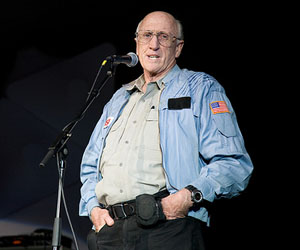
Power Q&A: Stewart Brand
NEWS: The Long Now futurist and founder of the Whole Earth Catalog talks about why it's time to rebrand nukes.
|
|
|
|
Mother Jones: What's the most promising new energy source?
Stewart Brand: Might well be space solar. Because the main problem with solar on the Earth's surface is that it is so intermittent, and we don't have decent storage yet. The advantage of having something out at synchronous distance is that it's in the sun all the time. You can beam down, via microwave, significant juice, about nine times greater than you'd get on the Earth's surface.
MJ: Wouldn't that cost a lot?
SB: Yeah, that's a big one, probably on the order of a large dam or something. The main cost, as usual, is getting stuff out of the gravity well of the planet. But one advantage of a solar collector in space: It would be some kind of origami thing that would unfold and be relatively light because it doesn't have gravity to deal with. All you'd have to do is be able to steer it or have it be self-steering, so it points at the sun and sends the energy down to a big receiver on the ground. Like all the energy stuff, it's basically infrastructure.
MJ: What do you think is the most overhyped new energy source?
SB: That's a good question. It changes from month to month. Ethanol was hot for about two weeks, and then it became everybody's favorite bad idea. In a way it still is. It needs to be subjected to more of the full-footprint-type analysis, because there is a fair amount of it going on and it's driving up food prices and taking down forests and doing all the things you don't want. Palm oil looks like it may be in the same category, depending on basically execution. If you tear up a swamp in Indonesia that was fixing carbon and turn it into a palm plantation, people should not get tax credits for that.
MJ: If you had a million dollars to invest in energy, where would you invest it?
SB: Well the easy one is nuclear, because it's so proven and the companies that are doing pretty good work are already well known, so that's just an easy investment. Not a big gain, but probably would do okay. The genetically engineered stuff, especially the microbial stuff, there are a whole lot of people working on making some stuff that will basically grab CO2 right there where it is generated in the coal plant and turn it into something you can use, like hydrogen. Whether this will be done with larger plants, I don't know. There is some good tinkering that could be done with switchgrass and whatnot, to make it more energy productive, but knowing which company to invest in at this point, as an ordinary guy I wouldn't know where to put a million dollars.
MJ: What's it gonna take for renewable energy to go mainstream?
SB: It already is: Wind is mainstream, hydro is mainstream—16 percent of world electricity production in 2004. By the way the rest of the numbers, coal is 40 percent worldwide, oil is 7 percent and gas is 20 percent, so there's your fossil fuels. Renewables are 2 percent, and if you include hydro as renewable then it's a total of 18 percent. That's more than nuclear and almost as much as gas. Here in California, there's 16 percent nuclear, quite a lot of hydro, quite a lot of gas. Anyway, hydro is huge and is the great unnoticed because it has been there so quietly for so long.
MJ: But dams cause a lot of environmental degradation.
SB: Right at the start, yes. Then you've pretty much done your degrading.
MJ: But, I mean, what's happening in China now with dams—
SB: Thirty-two dams being built as we speak, plus the Three Gorges.
MJ: That's not sustainable.
SB: Well, it's a whole lot better than two new coal plants every week.
MJ: Would you rather live next to a nuclear plant or a coal plant?
SB: Boy, is that a softball! Obviously a nuclear plant, because they are fabulously clean and tremendously safe, and coal-fired plants are pretty gnarly. Most of the nuclear plants in the U.S. are in the South, and people there love them, mainly in terms of employment. Everyone works there. They have a really good feeling about the place.
MJ: But there's also the potential for something to go drastically wrong.
SB: Of the four major, legitimate complaints about nuclear—high capital costs, safety issues, storage, and weapons proliferation—the safety one has pretty much been dealt with. It's nothing compared to the safety issues with natural gas. And when eventually we start sequestering carbon dioxide, that's a poisonous gas. Basically all of the infrastructure stuff is dangerous. Bridges are dangerous. If you build a tall building in New York, it is dangerous if somebody runs an airliner into it. This is pretty much the infrastructural stuff that comes along with large quantities of energy. Whichever technology we are looking at has serious hazardous issues.
MJ: And proliferation?
SB: It's too late. We've got [nuclear weapons]. And China has got them, India has got them, France's got them so in those places, which are the main energy users where you would want a lot more efficiency and a lot less carbon, it is not an issue. In the developing countries that people are worried about in terms of weapons, you could have a deal where you completely monitor them. Sell them fuel and buy back the spent fuel, process it, and sell them a fresh load of fuel. They get to do the whole thing, but they don't get to reprocess it in their borders until they've satisfied the UN or whoever that they're going to be responsible about it. That's no different than selling and buying any other energy source.
MJ: What do you think is the one policy change that would go the furthest toward cutting fuel consumption in the United States?
SB: Carbon tax, cap and trade, either or both.
MJ: That's interesting. A lot of people have said that cap and trade isn't as good of a solution as a tax would be.
SB: Either one of them would have to be constantly fine-tuned and adjusted. Cap and trade has worked pretty well in cutting the sulfur emissions that led to acid rain. And Europe just had a pretty good experience with cap and trade. Carbon tax has the advantage of basically being able to subsidize one set of activities that you want with another set of activities that you don't want. It's like a cigarette tax. Take the cigarette money and put it in education; everybody feels good about that. When the government tries to run innovation, sometimes it does it well and sometimes it doesn't. So setting up a situation where the market runs innovation, which is a cap-and-trade idea, may well have more flexibility.
MJ: What energy policies do you think the next president should enact in his or her first 100 days in office?
SB: An easy, conspicuous thing to do—that may or may not have that much real effect —is to do what Australia did when it had a change of government, and that is to sign the damn Kyoto Accord. We're the last holdout, and it's ugly and looks stupid. Kyoto by itself can't do nearly as much as we want, but to be a holdout at this point is just an insult to everybody.
MJ: What kind of car do you drive?
SB: I'm about to renew a lease—or not—on a Land Rover. Which is a pig. But so far I haven't found a decent hybrid off-road vehicle.
MJ: What is your favorite personal energy-saving trick?
SB: I live in a tugboat with 450 square feet. And living in a city is bloody brilliant, especially in Manhattan, which has good public transit and punishes you for driving.
MJ: That's surprising, since the Whole Earth Catalog was so much about—
SB: Right! Back-to-the-land. I did the catalog so I could help [communes] without actually having to live on one. Partly that's due to the boredom of the remote countryside. You wind up in a very repetitive soap opera, and that's why everybody in the world is running to town as fast as they can.
Kiera Butler is associate editor at Mother Jones.


greetings from TMI! wish you were here!
dave
This revealed that no-one is concerned about nuclear safety when it's his or her own skin that needs to be near either a nuclear power source or another kind; their concern is to keep others, not themselves, in the vicinity of other, much deadlier power source such as natural gas. Natural gas is 25 times more expensive than uranium.
--- G.R.L. Cowan
http://www.eagle.ca/~gcowan/boron_blast.html --
let the baby light matches in the fuel storage room!
Let’s deal with facts.
Fact - “More people have died in Ted Kennedy’s car than from commercial nuclear power.” This oft seen bumper sticker is true (except for Chernobyl which was a known inherently unsafe design that only the Soviets used). Even at TMI, with over 90% of the core melting (and being contained vs. heading to China as some had proposed), no members of the staff or public were harmed. In fact, over 400 nuclear power reactors operate world-wide. In those fifty years of operating experience, Chernobyl is the only case of nuclear related fatalities – 26 immediate deaths. Hydroelectric dams have collapsed and killed thousands.
Another fact, reinforced by responses to this article, is that there is no solution to the nuclear waste issue. That is totally false. What is true is that proven technical solutions are available (ask the French and Japanese how they do it) but those solutions are being held up due to political wranglings. Two quick examples: A used fuel reprocessing facility was built in the 1970s but Jimmy Carter stopped it from going operational to appease the left wing of his party. Ronald Reagan and Congress developed and passed a plan in 1982 for the Federal Government to take the ownership of all high level nuclear waste and begin taking shipments within then years. However, interveners have successfully delayed the opening of the facility out to 2020.
Another fact – nuclear power plants cannot blow up like a bomb - the fuel enrichment is too low. When is the last time you had a loaf of bread blow up? Yet in a different form, or “enrichment,” the same material that makes yummy whole-wheat bread is very explosive and has killed over 300 U.S citizens in the last 20 years. Wheat, when in the form of fine dust is very explosive. Does that make you stop eating bread?
Another fact – natural radiation exists everywhere, including coal. More radioactivity is given off by a coal-fired generating plant than an operating nuclear power plant.
I may be accused of bias as I derive my living from nuclear power. Granted. But my bias comes from methodical research, clear independent thinking, and a real concern for the environment. In all things, weigh the facts, not opinions to drive your conclusions. It’s great to “feel” one way or the other about something, but until you complete your due diligence, it may be best to keep your mouth shut and thought a fool than to open it and remove all doubt.
Kevin Lay is ignorant; or so one would hope. In any case, the above is total petrodollar crap.
"We need you to remind us that nuclear energy is most dangerous to generations of all species in the distant future."
Depending who "we" is, that need may indeed be felt, but if Brand is competent and unpurchasable, he will not help to meet it.
The ideal is to bury it far enough down that the natural radioactivity in the same land, at equal or lesser depths, is more. Then you have a similar reassurance to that which you have with respect to saltshakers in the Titanic's pantries: it doesn't matter whether they leak or not, they are not going to make the sea salt.
In the buried spent fuel rods' case, it doesn't matter what happens to them down there, it doesn't matter what they do; they are not going to make the land radioactive.
The Titanic depth criterion is easily enough met. Finland's plans to meet it are reported at http://news.bbc.co.uk/2/hi/science/nature/4948378.stm
What about "Energy Descent"!? People need to think outside the 'substitution solution' in our energy crisis!! Check out David Holmgren's "Principles and Pathways Beyond Sustainability".
Instead of repeating the common anti-nuclear speaking points, check out the facts as determined by real scientists who publish their findings for peer-review vs. general statements without any backing.
http://www.iaea.org/Publications/Ma gazines/Bulletin/Bull422/article4.pdf
The above research compares the amount of Green House Gases (CHG) generated for various means of electricity generation for their entire life-cycle on a per unit basis, i.e., how much GHG is produced per kilowatt-hour. You will find that nuclear power, because of its ability to produce such a very large amount of power from a relatively small amount of material, both fuel and facility-wise, is actually the cleanest means to produce electricity.
This is why Stewart Brand, Patrick Moore (co-founder of Greenpeace), and others who think versus parrot 30 year old anti-nuclear speaking points realize nuclear power is a necessary option for limiting CHG.
Regarding nuclear fuel and wastes…the residual fuel is very radioactive, but it is also contained and controlled. In addition, nuclear fuel can be recycled, reducing the wastes by 90%. France and other countries are successfully doing this. How to deal with waste is not a technical issue, it is a political issue. On the other hand, fossil-fueled plants free-release CHG and metals, such as mercury, into the atmosphere for all to breathe.
Lastly, comparing U.S. commercial power reactors to Chernobyl is another worn out “red herring.” Chernobyl was a 1950’s design unique to the Soviet Union – no U.S. commercial reactor is like Chernobyl and no U.S. reactor can blow up like Chernobyl did because of basic design differences. Regarding Chernobyl’s health effects, these too have been exaggerated. I offer the analysis of a multi-national United Nations study for your review… again, read, think, and then draw your own conclusions.
http://www.iaea.org/Publications/Booklets/Chernobyl/chernobyl.pdf
I look forward to your respectful feedback and/or questions.
I assume you are asking me and the unqualified answer is "yes."
We in the U.S. have been operating commercial nuclear power plants and storing used reactor fuel for 50 years without one fatality or even a radiological injury to a worker or member of the public.
Let that soak in a minute. Then think about that safety record and compare it to any other major industrial undertaking.
I currently live between two large nuclear power plants...one 10 miles south and the other 15 miles north. Each has over 30 years worth of used fuel stored in "spent fuel pools" that are 40 feet deep and flooded with cool water. Around this country there are approximately 70 such facilities. Depending on where you live, Patsy, you too may live near one of these storage pools.
If that bothers you, why not support the long term storage solution approved by the Federal government who by law is responsible for the ultimate disposal of this fuel. Would it not be better to reduce the storage sites from 70 to one remote, easily guarded and hardened structure?
Patsy, et al: Do you eat granola, muffins, or whole wheat toast? If so, I am surprised you would support such a lethal product. In just this country alone, hundreds of people have died in grain elevator explosions. Yes... that benign bran muffin of yours came from a product that can be very explosive and kill humans without concern. See the following link for the lethal truth.
http://www.fike.com/pub/epdocs/stspr99.pdf
Now...I expect all you anti-nukes to stop eating anything made from wheat immediately! teehee... that would be silly wouldn't it?
A similar logic applies to the proliferation argument offered by many anti-nukes proffer – it goes something like this:
Building nuke plants in this country and god-forbid, reprocessing the used fuel (re-cycling sound better?) will somehow encourage rogue nations to build nuke power plants and pull the PU239 out of the fuel to build bombs! So let's not build nuke power plants in this country and be a good example. That will stop those people. (better tell the North Koreans and Iranians what good examples we are)
Let's apply this same logic to something you can relate with. Have you read about the terrorists in the Middle East loading up cars/trucks with explosives, driving them into the midst of a crowded market, and blowing themselves and innocents to smitherings? Terrible thing and damn every one of them that do so.
Now apply the anti-nuke's logic regarding proliferation. I suggest we stop producing cars and trucks in this country - immediately put a "stop work order" in place at all Ford, GM, and Chrysler production facilities. We would not want to encourage the unsafe use of a vehicle by building and owning cars and trucks!!
Again...teehee. I just wish people could break away from the activists, who in a self-serving manner spread exaggerated lies and logic straight out of Alice in Wonderland.
You live in the city and drive an off road vehicle and you don't want to be in the country? I don't get it. I think you've sort of blown the rationality thing.
The whole thing runs so strongly counter to the ideas of economic & political democracy this country is founded on that I'm surprised to see the debate so fervently focused on how clean nuclear power is. Sure, it massively reduces GHG pollution compared to any fossil fuel technology. So do all renewable technologies, to greater or lesser extents than fission.
Technologies like solar and wind may also need significant government subsidies. But ask yourself if you'd rather your tax dollar pay off institutional investors, or average people like yourself? Anyone with real estate can be the proud owner of a small scale solar or wind power plant. These dispersed, small scale, community owned power sources would strengthen our communities, improve personal wealth, and make our economy far more healthy than investing in relatively few large institutional power sources.
In summary, free market good, monopoly bad.
I like your free market philosophy. I assume you vote Republican since that philosphy is so anit-big government.
All kidding asside, you need to catch up on the history of regulated monopolies and the advantages they provide, as well as the current economics of utilities undergoing deregulation.
In a nutshell, a U of Wisconsin professor first recommended the structure of state regulated utilities back in the 1920s. The huge capital investment required to build generating plants, string up transmission and distribution lines, and operate the above required either very large corporations or government bodies...of which both occured.
The deal was this…a large utility was given a service territory or “franchise” with the guarantee of no competition. In exchange, the rates charged customers were regulated by the state so the utility got a decent return on their investment and customers were not overcharged. This model worked very well, providing the United States with abundant, reliable power. Utilities became very popular investments for people adverse to financial risk, including our parents and grandparents. As a result, these IOUs (investor owned utilities) became very much “community owned” and accountable to their shareholders.
The government did get in the business where the customer base could not support a large utility company. So in the 1930s the Bonneville Power Administration (Northwest), Tennessee Valley Authority (Southeast), and Rural Electrification Administration (Midwest) were created and supported by the government to bring electricity to rural areas.
In the 1990s, many people wanted states to abandon this model and deregulate the IOUs. The thought was Big Company Bad, forgetting these big companies hired thousands, paid well, offered safe investment risks for retirees, and provided a great service at a fair price. But tinker we will. So California went full speed ahead and deregulated, that is, they encouraged independent power producers to sell wholesale electricity to the state regulated monopolies. The IPPs could charge whatever they could to the utility who could then only charge the customer the state regulated rates. So in 2002 when a couple of markets changed, the IPPs were charging $1.20 kilowatt-hour and the utility could only sell it for 12 cents per kw-hr. How fair was that? As a result, most other states quickly backed off their dereg plans to rethink their plans. Also…the California governor who pushed for this plan was soundly defeated in the next election and replaced by ‘The Governator.’
As far as subsidies…I hear this often but no one has ever shown me where. I work for a utility and other than the normal tax breaks any business can get, we get nothing more. As far as subsidies for the nuclear power plant I work at…I have asked our bean counters and they know of no subsidies. We pay for everything we get…including our Regulator. We pay several million dollars a year to the NRC. Then for every inspection they do, we pay about $240/hour per person they bring onsite to inspect us. Hunter, if you can explain to me your statement regarding all these subsidies, I would appreciate it.
I am not against solar and wind generation. But many think that these can somehow supplant fossil and nuclear power. As a result, this distracts and delays our country from pursuing a rational and sensible energy policy.
1) one 165 MW Pebble Bed Modular nuclear reactor = 80 full time jobs + 1400 construction jobs of one year; or
2) 1700 MW of wind power = 850 full-time jobs + 3000 construction jobs which can be supplied locally; or
3) 5700 MW of solar Photo Voltaic = 680 full-time jobs + 8800 construction jobs which can be supplied locally; or
4) 795 MW of generating power saved by providing solar water heating for 1.2 million houses, thereby improving the quality of life of about six million people.
The fact is that the root causes that distract and delay long-term solutions to our accelerating atmospheric carbon dioxide problems still dominate.
For example, what does it tell you when National Geographic and The Aspen Institute just held their Aspen Environment Forum cosponsored by Shell Oil and General Motors (as in we still do not have a mass marketed electric vehicle GM).
And Berkeley scientists still perpetuate a half-century of scientific research dedicated to humanity destroying hydrogen bomb production for the M-I Complex that prevented the achievement of Teller’s dream of controlled fusion, and most recently sold $500 Million in University of California research to BP Oil!
1. As a former submarine engineer officer, I have lived within 200 feet of an operating reactor for months at a time. I was in charge of all operations and maintenance of a power plant and training of the operators. I fully understand the safety issues and am comfortable enough with the mitigations that I would happily host a small plant in my own back yard.
2. What is now called "nuclear waste" by some people who wish to constipate the industry is actually valuable raw material. Fully 95-97% of the initial potential energy remains in the fuel material that is removed from reactors today.
3. Even with our rather wasteful "once through" fuel cycle, the volume of used nuclear fuel is very small - all of the left over fuel in the US would only make a tiny 15-30 foot tall hill on a football field sized piece of land.
4. Supplying 1,000,000 homes with electricity requires about 1,000 MW of electricity. If that power is supplied by coal, it requires 100 train car loads of coal every day and produces about 40,000 tons of CO2 plus a whole bunch of other air pollution components like SOx, NOx and mercury. If it is produced by a nuclear power plant, it requires about three truck loads of fuel every 18 months. The used fuel that is removed can fit into 3 licensed storage containers that together would fill about 2 parking spaces on the dry storage lot. (After a period of cooling in the used fuel pool.)
5. Going back to small reactors - it is very possible to produce small fission power plants that could be owned by a small community. Toshiba is working with Galena, Alaska to supply them with one of their 10 MWe 4S power plants. NuScale is developing a 25 MWe natural circulation light water reactor for small community applications. Hyperion has a plan for "hot tub" sized reactors. More than 30 years ago, the US Navy built a nuclear powered submarine called NR-1 that was only 400 tons in total weight - less than 1/3 of that was the power plant. NASA has built even smaller plants. My own company would like to start with 10 MWe plants but we believe there is the potential to build even smaller ones economically. Sure, they probably will not be owned by average individuals, but then neither are your neighborhood supermarkets. The idea that the only kind of nuclear plant is a large one is an idea whose time has passed - and it was originally the idea of some very large companies anyway.
6. Unlike some of my fellow supporters of nuclear power, I think Yucca Mountain is a silly idea. I have no issue with the safety, but I think that the cost is an outrageous waste of money. I have been searching for years for a documented case of an accidental injury or death associated with used nuclear fuel. I have not found one yet. IMHO, the stuff is pretty easy to handle using very simple concepts of time, distance and shielding. Control your exposure time, control your distance from the source, and use adequate shielding. We know how much radiation is required before there is any danger, and we have very well devised and proven ways to remain well away from those danger levels.
7. I advocate fission as a replacement for existing uses of coal, oil and natural gas. Other fossil fuel alternatives cannot do the jobs that I think need to be done like powering factories, pushing ships on the ocean, supplying electricity for locomotives, providing heat for industrial processes, and supplying concentrated populations of people with heat, fresh water, sewage systems, trash removal, and electricity.
Stop parroting what you have heard about nuclear power and really try to learn and question. One of the most important questions that you need to ask yourself is "who profits the most from restrictions on the use of nuclear power?"
When you realize that fission is a direct competitor to burning coal, oil and natural gas and you know how important and powerful the purveyors of those commodities are, you will understand that fission threatens the profitability of the fossil fuel industry. That is ONE of the reasons that you have been carefully taught to be afraid of the natural process of fission. (If you do not think that the process is natural, you need to do a search for "Oklo uranium". If you are really curious, try searching on "georeactor".
Disclosure - I have significant (to me) financial investments in companies that stand to benefit from a growth in nuclear power. I am not employed by the industry; my full time job is as an analyst in the US Navy.
Is that really an argument against the use of nuclear fission as an energy source - or are you just arguing against "The Man" and large corporate structures?
Wouldn't your same concerns apply equally to large, centralised solar thermal, wind, or whatever other kind of generation?
As Rod Adams points out above, it's entirely plausible to consider that nuclear fission power generators can be built on a scale that will fit in a large backyard - delivering the kind of decentralised, grid-free community-scale generation you're talking about.
“A few weeks ago, NASA's chief climatologist, James Hansen, submitted a paper to Science magazine with several coauthors. The abstract attached to it argued -- and I have never read stronger language in a scientific paper -- that "if humanity wishes to preserve a planet similar to that on which civilization developed and to which life on Earth is adapted, paleoclimate evidence and ongoing climate change suggest that CO2 will need to be reduced from its current 385 ppm to at most 350 ppm."
Hansen cites six irreversible tipping points -- massive sea level rise and huge changes in rainfall patterns, among them -- that we'll pass if we don't get back down to 350 soon; and the first of them, judging by last summer's insane melt of Arctic ice, may already be behind us.”
For those of you who admire the thought of "small decentralized" power, consider the 60 MW(th) thermal with 23 MW(e) described below. I was Googling for a different design that I had seen, but this covers the premise.
"Other markets, like heat and power cogeneration or distributed electricity generation in developing countries are still waiting to be penetrated by the uranium based energy source.
For these applications, the power level required per location will be much smaller than for the existing nuclear plants. ACACIA-Indirect (AdvanCed Atomic Cogenerator for Industrial Applications), a 60 MWth, 23 MWe (max.) nuclear plant design with indirect Brayton cycle is proposed.
http://www.ecolo.org/documents/docu ments_in_english/HTR-Aliki-Baytron.pdf
The other design I saw was designed for small cities or neighborhoods to minimize distribution losses.
On a different note, IMHO the greatest threat to world peace these days are food to fuel policies that just add to greenhouse problems.
eric
In the meantime the energy issues are so much closer. Nuclear advocacy merely promotes the fantasy of the quick technology fix over real political issues: taxation and regulation.
Insofar as nuclear, has he heard of the near disaster at the Browns-Ferry plant in 1975 in Alabama, when a fire broke out because a worker dropped a candle (yes, a candle, which was used to check for air leaks, because they had no anemometers, and this was in a brand new, "modern" GE nuclear plant . . . )?
Or what about the Japanese accident at Tokaimura? See: http://www.isis-online.org/publications/tokai.html
There are many "small" accidents that do not get the press coverage as did 3-mile island and Chernobyl.
Personally, I find it telling that Brand isn't asked about -- well, the very things that Judith Lewis mentions in her recent MJ article . . . like:
"n March 2002, during a scheduled refueling outage at the Davis-Besse Nuclear Power Station in Ohio, workers discovered that boric acid deposits had gnawed a "pineapple-sized" hole into the six-inch-thick steel cap bolted to the top of the reactor. Had the corrosion gone just a third of an inch deeper, radioactive steam would have flooded the containment dome, and Davis-Besse might have been the next Three Mile Island."
Or:
"The Union of Concerned Scientists (UCS) has counted 47 incidents since 1979 in which the NRC failed to adequately address issues at nuclear power plants—until the troubles got so bad the plants had to be shut down for repairs. In some cases, "the NRC allowed reactors with known safety problems to continue operating for months, sometimes years, without requiring owners to fix the problems."
Or:
"Every year Areva, the French conglomerate that handles reprocessing, dumps so much radioactive liquid into the Channel that, says Lochbaum of the Union of Concerned Scientists, "there are certain beaches where the effluent pipe is where you can get a suntan at night."
http://www.motherjones.com/mojoblog /archives/2008/05/8208_chinas_outlaws.html