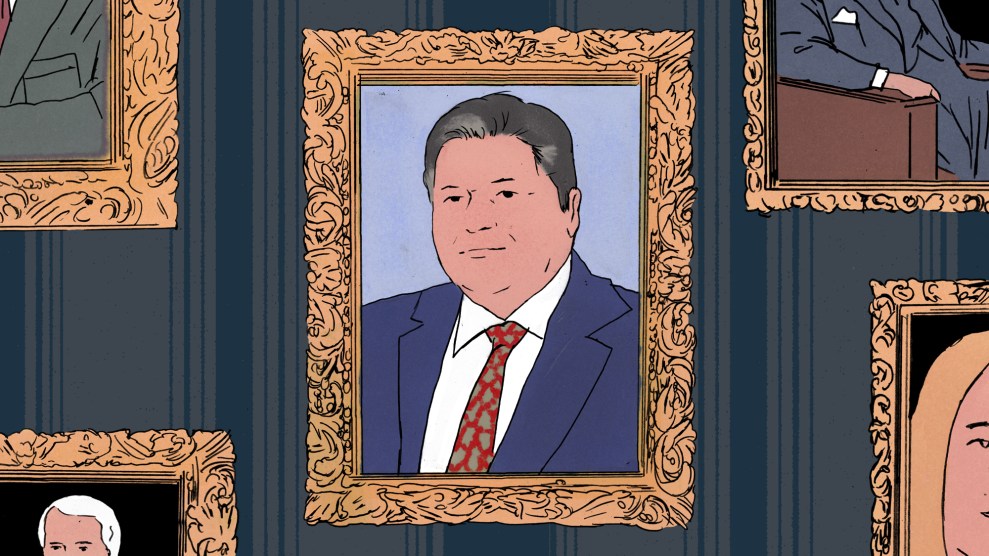
Andrew Bacevich, a retired Army colonel turned professor of history and international relations at Boston University, wasn’t prepared for all the attention his latest book has received. Published in August, The Limits of Power: The End of American Exceptionalism has clearly struck a chord, its title name-dropped by foreign policy enthusiasts as a must-read analysis of how America has strayed from greatness. Metropolitan Books, a Holt imprint, was prepared for modest sales with an initial press run of around 13,000. But the book’s eye-opening qualities promptly landed it on the New York Times best-seller list, where it remains six weeks later, and the publisher has been reupping ever since. “I can’t imagine how these politicians do it,” the author told me, referring to the physical demands of media interviews. “I wouldn’t have the endurance.”
Bacevich did have the endurance to lead a platoon in Vietnam and serve 23 years in the military, but wasn’t until much later that he began to reflect on his experience. “I have come to an appreciation of the difficulty of making war politically useful,” he explains. “I’m not a pacifist; I support having a strong and effective military. But I’m very wary of when that military ought to be used.” In The Limits of Power, Bacevich goes beyond mere Bush-bashing; he traces the long-term erosion of America’s economic, political, and military might to the peculiar delusion that history’s direction is preordained, and that the United States is destined to play the lead role. He mines our past to explain the disconnect between civilian and military leaders and the rise of a self-perpetuating national security establishment that serves to undermine national security. Bacevich also lays bare a foreign policy whose primary purpose, he argues, is to ensure Americans’ freedom to consume more than their fair share, and a dysfunctional Congress whose top priority is to keep incumbents in power.
I caught up with Bacevich the morning after the vice presidential debate . So naturally, we began with the election.
Mother Jones: In terms of foreign policy, do you think it matters who wins next month?
Andrew Bacevich: It matters, but not nearly as much as the candidates would have us believe. And this is a disappointment to me. I had hoped that an Obama candidacy would help to create conditions in which we would have a debate over the fundamentals of foreign policy and national security policy. I think what we’re ending up with is a debate over operational priorities: McCain is arguing, “Elect me president and I will deliver victory in Iraq, which is the central front in the global war on terror.” Obama says, “Elect me; I will send more troops to Afghanistan because that’s a central front on the global war on terror.” That difference is based on a consensus that the global war on terror provides the correct framework in which to think about US national security policy.
MJ: Do you think Obama could initiate the alternative debate and still win the election?
AB: Certainly his political advisers have calculated that he cannot have that debate. But I would insist that it would have been tremendously useful for the country. I guess I hold out a little bit of hope that if he wins, and if his victory is read as a repudiation of the Bush approach to national security policy, then maybe that opens up some space for a debate over fundamentals, posing the question, “What is our approach to the rest of the world?”
MJ: During the first debate, Obama noted that China is active in Latin America, Asia, and Africa. He said, “The conspicuousness of their presence is only matched by our absence, because we’ve been focused on Iraq. We have weakened our capacity to project power around the world because we have viewed everything through this single lens.” That struck me as an affirmation of our militaristic foreign policy.
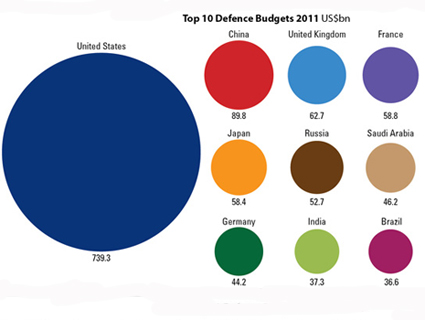
AB: I think that you’re correct. It’s signaling his deference to a conception of America’s role in the world. “Global power projection” is one of those cornerstone concepts that implies a big military establishment, high military spending, and a network of bases scattered around to support and sustain the projection of power.
MJ: Obama is right that the cost of these operations has weakened our military stance elsewhere. So at what level of debt might the global pursuit of US power stall?
AB: I think it’s gonna take some rather large catastrophe for us to directly address the implications of our profligacy—to recognize that we cannot simply spend and spend and borrow and borrow as if the line of credit has no limit. We’re all quite nervous about where this financial crisis is headed. If it heads us into some kind of serious economic slump, that might promote a greater awareness of the extent to which we have become militarily and economically overextended.
MJ: McCain, Palin, and others are going around saying the surge has worked, and they’re not really being challenged on it. Does that worry you?
AB: Yeah, it does. We don’t know exactly which events during the period called the surge actually made a difference. And while violence is down, it doesn’t seem to me there’s a lot of persuasive evidence that the so-called political reconciliation is going to happen anytime soon. We should acknowledge the positive developments, but on balance it seems we’re likely to be years away from Iraq being able to manage its own affairs in any meaningful sense. We’ve already spent somewhere between 800 billion and a trillion dollars on that war, and even if we achieve the victory that proponents of the surge say is just around the corner, what will we have won? My answer is, not much. I say that because I understand the war to have been undertaken within the context of the Bush administration’s attempt to transform the Islamic world. Iraq was supposed to be a demonstration project, and five and a half years later we can see that it is an enormously difficult and costly long-term proposition. The notion that, having succeeded, we’re now going to apply comparable means to bring about transformation elsewhere—Pakistan, Saudi Arabia, Syria—is clearly absurd. Even if the Iraq War ends in what some call victory, strategically it has been an abject failure.
MJ: You’ve written that America is taking the wrong lessons from our failures in Iraq and Afghanistan. What are the right lessons?
AB: The lessons we’re taking—gosh, we need to get smart in counterinsurgency; we need to give more authority to the generals and keep the politicians like Rumsfeld from screwing things up; we need to consider conscription as a means to close the gap between the military and society and make greater numbers of soldiers available…I think those are the wrong lessons. The preoccupation with counterinsurgency overlooks the fact that these so-called small wars are almost necessarily imperial wars; they are efforts to impose the will of an outside power on a population. Rather than becoming better at waging imperial wars, we need to move to a nonimperial foreign policy. That argument is not a moral argument—although you could make a moral argument—but a pragmatic one, that the prospect of more such wars is gonna bankrupt us.
MJ: You could argue that it already has.
AB: Yeah. [Laughs.] We’re starting to talk real money here. So lesson number one: Change your foreign policy so that you only fight wars that you need to fight.
MJ: So now we’re talking about putting more troops in Afghanistan. Where might that lead us?
AB: I’m pretty pessimistic based on my modest understanding of Afghan history, and my understanding is that Afghanistan has never been a nation state—maybe with the exception of the Taliban period—in which effective governance has been exercised outside of Kabul. So the notion that we’re going to overturn that history is just a mighty tall proposition. I don’t think we can afford it, and I don’t think it’s necessary. So although I did support the invasion, and do believe it was necessary to make the Taliban pay a heavy price, it doesn’t follow that we need to stay there forever. I think we need to find a new course, and disengage militarily.
MJ: Are you saying it’s acceptable to pull out and let the Taliban take over again?
AB: I don’t think that has to be the consequence. One telling lesson from Iraq is that if you set aside moral considerations, people can be bought. It seems clear that we’ve bought out the Sunni insurgents, not because they liked Americans, but because they saw it as in their interest. And I think we can buy warlords in Afghanistan in ways that will incentivize them to sustain control over whatever territory they claim. We can provide money and wherewithal; they’ll police their own country. The result is not going to be a liberal democracy. It’s not going to be a place where the rights of women are going to be respected in the way that we would want to see in our country. But I think that’s probably about the best that we can do. And I think that would prevent the Taliban from simply taking it over and making Afghanistan once again into a base of Islamic radical activity.
MJ: Just out of curiosity, how would you describe your own politics?
AB: I always describe myself as a conservative and then hastily emphasize that I don’t believe that President Bush and his administration are conservative in any principled sense. To me, in the context of foreign policy, to be conservative means to be realistic in your understanding of the way the world works; realistic in appreciating the limits of one’s own power; realistic in understanding that the use of force almost always ends up producing unintended consequences.
MJ: But you don’t entirely blame the Bush administration for our current predicament. How come?
AB: The premise of the Bush Doctrine is that we can use force to nip problems in the bud before the bud even forms, and that we can do it with a high level of confidence that we’ll be successful and that the costs will be relatively minimal. That kind of thinking in many respects really emerged from the post-Cold War decade. Going back to Operation Desert Storm—which was widely interpreted, and I believe misinterpreted, as a victory of historic proportions—it seemed to demonstrate that the United States had evolved this new way of war unlike anything the world had ever seen. Compounding that perception were the actions of President Clinton, who made the use of force a routine thing. His interventions were not large, but they became so frequent that we began to take it for granted that the United States could exercise this prerogative of using force around the world. So I think the conditions that made the Bush Doctrine possible came into existence before Bush ever became president.
MJ: You quote Bush as saying, “The survival of liberty in our land increasingly depends on the success of liberty in other lands.” Clinton, Obama—they all use variations on this. What’s the origin of this notion?
AB: Many people trace it to the famous speech by John Winthrop in 1630 speaking to members of his community as they’re about to establish Massachusetts Bay Colony, when he said, “We shall be as a city upon a hill.” But this theme of American exceptionalism, of America possessing a special mission, is really a thread that runs throughout our history. It has come to be part of our mainstream foreign policy consensus that we are called upon to spread freedom and eliminate tyranny. When Sarah Palin endorsed this idea [during the VP debate], I imagine it was part of the script she has been coached to recite. I imagine that the advisers who prepared that script calculated that this claim of specialness is something that plays well with the Joe Six-Packs and the hockey moms she referred to.
MJ: During past wars, as you note in the book, Americans were asked to sacrifice, to ration food and fuel, pay higher taxes, and cut nonessential items. Why has no US president since Carter asked this of American citizens? Is it political suicide?
AB: It’s politically difficult. I think Bush could have done it immediately after 9/11, and of course he chose not to. Not to blame everything on the ’60s, but I think fault does lie, in part, on the cultural revolution we’ve experienced over the past 40 years or so. We have become spectator citizens—patriotism means cheering for the home team, but it doesn’t mean actually suiting up and getting out on the field. In World War II, when FDR said we were going to have to curb consumption, for the most part people understood that, accepted that. Even before Pearl Harbor, when Congress enacted the first peacetime draft, people were willing to concede that the federal government should have that authority. Well, after Vietnam that authority has gone away, I think irrevocably.
MJ: You write that protecting our freedom to overconsume is ultimately the basis for our foreign policy. Assuming that’s so, can anything be done about it?
AB: To the extent that self gratification has come to be the primary definition of what it means to exercise and enjoy freedom, then there really has to be another cultural revolution to see if freedom is anchored to some conception of truth, something that’s more permanent then the acquisition of material goods. I don’t have any expectations that such a transformation will occur. And that’s really one of the reasons that I’m relatively pessimistic going forward.
Photo from flickr user Army.mil used under a Creative Commons license.