MoJo Interview: The Cove's Louie Psihoyos and Ric O'Barry
A filmmaker and marine mammal activist expose Japan's secret dolphin slaughter.
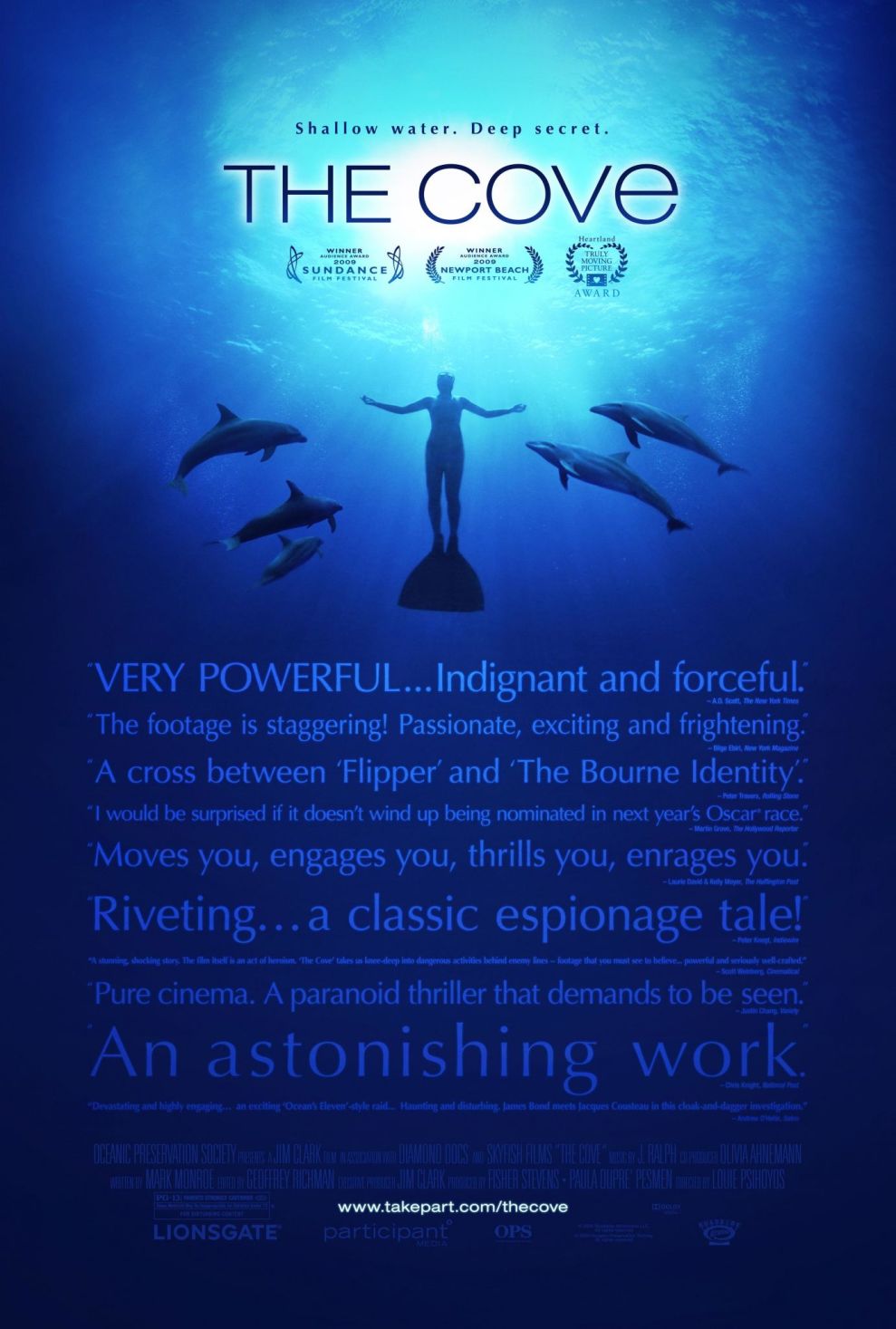
There's something fishy about the coastal town of Taiji, Japan: Statues and murals of dolphins line the streets, yet every year, the town's fishermen kill thousands of dolphins and sell their meat. That’s a whole lot of dead dolphins—you'd think some enterprising activist journalist would have blown Taiji's cover long ago. They tried, but no one could penetrate the heavily guarded cove where the killing takes place. Until now. When photographer Louie Psihoyos heard about Taiji, he teamed up with marine mammal activist (and former Flipper TV dolphin trainer) Ric O'Barry. Together, the two launched a high-tech espionage mission to infiltrate the cove and expose the slaughter. We spoke with O'Barry and Psihoyos about making The Cove, assembling an Ocean's Eleven-style team, and why a little paranoia can be a good thing.
Mother Jones: Louie, you're a photographer by training. How did you get involved with making a documentary?
Louie Psihoyos: Jim Clark—the guy who financed the movie—he and I have been dive buddies for years. He's a serial entrepreneur—he started Netscape. We'd been diving around the world and watching the degradation of the oceans. During a trip to the Galápagos in October 2005, Jim said, We should do something about this. So he had the idea of starting the Oceanic Preservation Society. Two months later I met Ric at a marine mammals conference. He was banned from talking. I called him, and he started telling me about the dolphin slaughter in Taiji. He said, "I'm going next week. Want to come?" I took a three-day crash course on how to make a film. And I went to Taiji.
MJ: What were your first impressions of Taiji?
LP: It was like walking into a Stephen King novel. Everywhere you go there are statues of whales and dolphins. There are signs that say, "We love dolphins." But in the center of town is this horror show. Right between the whaling museum and City Hall. It's in a national park! If you were to write this as a novel, people would say it was too over the top. My journalistic instincts turned on. I thought, this is a great story. But here's the problem: All the dirty business happens in this secret cove, but you can't see it. People have been coming for decades to try to document it. At that point, I realized I was no longer just a journalist covering a story. By trying to get into the cove, I was becoming an activist.
MJ: Louie, in the film, you say you were feeling like you had gone halfway around the world to end up in a car with this paranoid guy (meaning O’Barry). Ric, how did you convince Louie that you weren't just some wacko?
Ric O’Barry: [Laughs.] Well I never did!
LP: First of all, the cops were behind us. The paranoia was well founded.
RO: If you're a Westerner and you're in Taiji and you're not paranoid, you're not paying attention. It really is dangerous there. The police aren't our enemy. Neither are the fishermen, though they are very angry, and there's always a chance one of them will get drunk and do something stupid. But the real danger is the Yakuza, the Japanese mafia. They're always lurking around. Some of the fishermen are connected. The Yakuza is very involved in the fishing and whaling industry, so they know what’s going on. They normally don't bother with Westerners, but this is a special situation. So being on high alert all the time is the safe thing to do.
MJ: The Yakuza didn't really make it into the movie. Why not?
LP: They were following us around for a bit. After a while we had identified the cars, determined who was in which car. The Yakuza really stood out in that community. Slicked-back hair, wraparound glasses; they looked like they came out of central casting. A Japanese version of The Sopranos. But the police were the ones that were following us around 24-7. We had five hotel rooms; the police had five hotel rooms. We would go out; they would go out. Even in the middle of the night, they'd follow us. They would stay four or five blocks behind. We would set up decoys to throw them off. We had a car that was rented by a Japanese assistant, in his name. We'd park it outside of town; we'd go around a corner and all hop out of the van and hide behind it. The police would follow this other car, and we'd just take them on a wild goose chase for a few hours outside of town while some members of our team were at the cove.
MJ: But in the movie, you never have a real run-in with the police.
LP: But we did have run-ins. They were really curious about what we were doing late at night. After a few weeks of that the chief of police asked us what we were doing. I said, "We're looking for a place to live." He said, "What are you here for?" I said, "That's kind of a rude question to ask of a foreigner. Why do you want to know?" He said, "I need to get some sleep." The 24-hour surveillance was really cramping his style. We got run out of the prefecture once. The chief of police said, "You have to go right now or I'm going to arrest you." He was obviously under a lot of pressure to find out what we were doing there. He couldn’t figure it out. Two months later I was back again.
MJ: They couldn't figure out why you were there? They must have known it had something to do with the dolphin slaughter.
LP: A lot of times, our high-tech cameras, hidden in rocks, were rolling while we were back at the hotel. So they couldn't figure it out. We tried never to be seen at the cove.
MJ: What was the hardest part of the whole operation?
LP: Just getting it all together was the hardest part. There were so many moving parts. It was like an Ocean's Eleven team. We had 60 cases of high-tech surveillance gear that we had to get through customs, and a lot of this stuff wasn't off the shelf; we actually had to make it. And we had to bring all these people together. The joke of the movie was that we're all professionals, just not at this. We had a world champion free diver who could go down to 300 feet, and now she's setting up microphones and underwater cameras for us. Implementing it was hard, too. A lot of it was done in the middle of the night: You're awake, you're afraid, you've been up for days getting all this gear together, and now it's go time. You know the cops are out there. If the cops had searched our car that probably would have been enough to put us in jail for several months. We had runners whose only job was to get the footage off the camera, back it up, then get it out of the country. We didn't want to be caught with more than one day's footage. It's a lot of stress. I stopped drinking for fourteen months. It would have been too easy to have a glass of wine at the hotel every night. But I wanted to be completely aware of what was going on.
MJ: Were there scenes that got edited that you wish had stayed in?
LP: There was one scene I fought for so hard: We had this rock camera in front of a campfire scene. These fishermen were sitting around on the beach and talking about how you used to be able to kill the large whales, just like the dolphins. These guys are responsible for killing blue whales, which still haven't recovered from the '70s. Now they’re about to do the same thing with dolphins. Another great scene that didn’t make the cut: One of those same fishermen said, "I was trying to watch TV last night but I couldn't hear it. I turned up the sound all the way. My wife and son said, 'Why do you even bother watching TV? You can't hear it anyway.'" We're thinking, he has mercury poisoning.
MJ: What do you think are the chances that once this film is released in Japan, dolphin slaughter will end?
RO: I think that's going to happen. If the film does well, that kind of external pressure will be hard for the Japanese government to deal with.
MJ: Have you had any reaction from the Japanese government to the film?
LP: Last year I was going down to Santiago, Chile. Sitting next to me on the plane was the head of the Japanese fisheries. I showed him a preview of the movie. So he had the information, but a year has gone by and he hasn't done anything about it. So it seems like he is complicit.
MJ: The fishermen at the cove say that killing dolphins is the Japanese way of life, something they've been doing for generations. Is there any cultural or economic legitimacy to that claim?
RO: How can it be the culture if the Japanese people don't even know about it? We interviewed a hundred people on the streets of Kyoto. They simply don't know. The reason they don't know is that there's a media blackout on all whale and dolphin stories. But for a moment, let's assume they're right and I'm wrong, that it is their culture. It doesn't mean it's okay.
LP: And it's not just an animal rights issue. These animals are so toxic that it becomes a health issue. Their mercury levels are through the roof. Some of the meat tested had 5,000 times more mercury than is allowed by Japanese law. One of the great ironies of this movie is that dolphins are one of the only animals that will come to the aid of human beings. What's going to save the dolphins is that humans have made them toxic. That's the one thing that's going to save them from being eaten.
Read the Mother Jones review of The Cove here.
Hunting of marine mammals
Hunting of marine mammals exemplifies the defective core-nature of the human culture. It shows that we lack even the slightest molecule of discipline.
Another example of gross excess.
"a country where vegetarianism prevailed"
Misturu Kakimoto of the Japanese Vegetarian Society writes: “A survey that I conducted of 80 Westerners, including Americans, Englishmen and Canadians, revealed that approximately half of them believed that vegetarianism originated in India. Some respondents assumed that vegetarianism had its origin in China or Japan. It seems to me that the reason Westerners associate vegetarianism with China or Japan is Buddhism. It is no wonder, and in fact we could say that Japan used to be a country where vegetarianism prevailed.”
Gishi-wajin-denn, a history book on Japan written in China around the third century BC, says, “Thre are no cattle, no horses, no tigers, no leopards, no goats and no magpies in that land. The climate is mild and people over there eat fresh vegetables both in summer and in winter.” It also says that “people catch fish and shellfish in the water.” Apparently, the Japanese ate fresh vegetables as well as rice and other cereals as staple foods. They also took some fish and shellfish, but hardly any meat.
Shinto, the prevailing religion at the time, is essentially pantheistic, based upon the worship of the forces of nature. According to writer Steven Rosen, in the early days of Shinto, no animal food was offered in sacrifice because of the injunction against shedding blood in the sacred area of the shrine.
Several hundred years later, Buddhism came to Japan and the prohibition of hunting and fishing permeated the Japanese people. In 7th century Japan, the Empress Jito encouraged “hojo,” or the releasing of captive animals, and established wildlife preserves, where animals could not be hunted.
There are many similarities between the Hindu literature and the Buddhist religions of the Far East. For example, the word Cha’an of the Cha’an school of Chinese Buddhism is Chinese for the Sanskrit word “dhyana”, which means meditation, as does the word “Zen” in Japanese. In 676 AD, then Japanese emperor Tenmu proclaimed an ordinance prohibiting the eating of fish and shellfish as well as animal flesh and fowl. Subsequently, in the year 737 of the Nara period, the emperor Seimu approved the eating of fish and shellfish.
During the twelve hundred years from the Nara period to the Meiji restoration in the second half of the 19th century, Japanese people enjoyed vegetarian style meals. They usually ate rice as staple food and beans and vegetables. It was only on special occasions or celebrations that fish was served. Under these circumstances the Japanese people developed a vegetarian cuisine, Shojin Ryori (ryori means cooking or cuisine), which was native to Japan.
The word “shojin” is a Japanese translation of “vyria” in Sanskrit, meaning “to have the goodness and keep away evils.” Buddhist priests of the Tendai-shu and Shingon-shu sects, whose founders studied in China in the ninth century before they founded their respective sects, have handed down vegetarian cooking practices from Chinese temples strictly in accordance with the teachings of the Buddha.
In the 13th century, Dogen, the founder of the Soto sect of Zen, formally established Shojin Ryori or Japanese vegetarian cuisine. Dogen studied and learned the Zen teachings abroad in China, during the Sung Dynasty. He fixed rules aiming to establish the pure vegetarian life as a means of training the mind.
One of the other influences Zen exerted on the Japanese people manifested itself in Sado, the Japanese tea ceremony. It is believed that Esai, founder of the Rinazi-shu sect, introduced tea to Japan and it is the custom for Zen followers to drink tea. The customs preserved in the teaching of Zen lead to a systematic rule called Sado…a Cha-shitsu or tea ceremony room is so constructed as to resemble the Shojin, where the chief priest is at a Buddhist temple.
Food served at a tea ceremony is called Kaiseki in Japanese, which literally means a stone in the breast. Monks practicing asceticism used to press heated stones to their bosom to suppress hunger. Then the word Kaiseki itself came to mean a light meal served at Shojin, and Kaiseki meals had great influence on the Japanese.
The “Temple of the Butchered Cow” can be found in Shimoda, Japan. It was erected shortly after Japan opened its doors to the West in the 1850s. It was erected in honor of the first cow slaughtered in Japan, marking the first violation of the Buddhist tenet against the eating of meat.
An example of a Buddhist vegetarian in the modern age: Kenji Miyazawa, a Japanese writer and poet of the early 20th century, who wrote a novel entitled Vegetarian-Taisai, in which he depicted a fictitious vegetarian congress…His works played an important role in the advocacy of modern vegetarianism. Today, no animal flesh is ever eaten in a Zen Buddhist monastery, and such Buddhist denominations as the Cao Dai sect (which originated in South Vietnam), now boasts some two million followers, all of whom are vegetarian.
The Buddhist teachings are not the only source contributing to the growth of vegetarianism in Japan. in the late 19th century, Dr. Gensai Ishizuka published an academic book in which he advocated vegetarian cooking with an emphasis on brown rice and vegetables. His method is called Seisyoku (Macrobiotics) and is based upon ancient Chinese philosophy such as the principles of Yin and Yang and Taoism. Now some people support his method of preventative medicine. Japanese macrobiotics suggest taking brown rice as half of the whole intake, with vegetables, beans, seaweeds, and a small amount of fish.
In his 1923 book, The Natural Diet of Man, Dr. John Harvey Kellogg writes: “According to Mori, the Japanese peasant of the interior is almost an exclusive vegetarian. He eats fish once or twice a month and meat once or twice a year.” Dr. Kellogg writes that in 1899, the Emperor of Japan appointed a commission to determine whether it was necessary to add meat to the nation’s diet to improve the people’s strength and stature. The commission concluded that as far as meat was concerned, “the Japanese had always managed to do without it, and that their powers of endurance and their athletic prowess exceeded that of any of the Caucasian races. Japan’s diet stands on a foundation of rice.”
According to Dr. Kellogg: “the rice diet of the Japanese is supplemented by the free use of peanuts, soy beans and greens, which… constitute a wholly sufficient bill of fare. Throughout the Island Empire, rice is largely used, together with buckwheat, barley, wheat and millet. Turnips and radishes, yams and sweet potatoes are frequently used, also cucumbers, pumpkins and squashes. The soy bean is held in high esteem and used largely in the form of miso, a puree prepared from the bean and fermented; also tofu, a sort of cheese; and cho-yu, which is prepared by mixing the pulverized beans with wheat flour, salt, and water and fermenting from one and a half to five years.
“The Chinese peasant lives on essentially the same diet, as do also the Siamese, the Koreans, and most other Oriental peoples. Three-fourths of the world’s population eats so little meat that it cannot be regarded as anything more than an incidental factor in their bill of fare. The countless millions of China,” writes Dr. Kellogg, “are for the most part flesh-abstainers. In fact at least two-thirds of the inhabitants of the world make so little use of flesh that it can hardly be considered an essential part of their dietary…”
Misturu Kakimoto concludes: “Japanese people started eating meat some 150 years ago and now suffer the crippling diseases caused by the excess intake of fat in flesh and the possible hazards from the use of agricultural chemicals and additives. This is persuading them to seek natural and safe food and to adopt once again the traditional Japanese cuisine.”
I definately see the irony
I definately see the irony in your statements. Also consider that only a small part of the Hindu religion maintains a veggie diet anymore, and all the Muslims in Pakistan used to be Hindus (not that long ago). Likewise, entire Buddhist sects have turned away from Vegetarianism. The Dali Lama (for example) was the first Tibetan leader to abrogate vegetariansim. Blood-foods are just too aluring.
As far as history. No one knows who invented vegetarianism as an institution. Could have been the Atlantans 14,000 years ago. Or the indians of Peru. There is a serious case that the Zadokites where very, very early. Possibly before Moses in Egypt. The Essenes of circa 250-BC made it the core of their religious observance.
The "powers that be" will soon become the powers that were.
The strange computer For a
The strange computer
For a computer programming class, I sat directly across from someone, and our computers were facing away from each other. A few minutes into the class, she got up to leave the room. I reached between our computers and switched the inputs for the keyboards.
She came back and started typing and immediately got a distressed look on her face. She called the teacher over and explained that no matter what she typed, nothing would happen. The teacher tried everything. By this time I was hiding behind my monitor and quaking red-faced. I started to type, "Leave me alone!" They both jumped back, silenced. "What the..." the teacher said.
I typed, "I said leave me alone!"
The kid got real upset. "I didn't do anything to it, I swear!" It was all I could do to keep from laughing out loud. The conversation between them and the PC went on for an amazing five minutes.
Me: "Don't touch me!"
Her: "I'm sorry, I didn't mean to hit your keys that hard."
Me: "Who do you think you are anyway?!" Etc.
Finally, I couldn't contain myself any longer and fell out of my chair laughing. After they had realized what I had done, they both turned beet red. Funny, I never got more than a C- in that class.
folder gluer
the message of menu
It is funny, but freely I admit that my closest association with religion is during reflections about such things, when my cerebral inquiries ask (must be Buddhist winds blowing, since it is also the most intellectual of all religions, excluding, of course, those created by scifi writers and blissninny cult con artists) as to what the God I have been spoonfed would think about animal slaughter. My heart cannot countenance cruelty to much of anything at all, though I have observed that often people engaged in routine slaughter seem to adopt cruelty as a defense against the emotional inward chew, so I cannot blow it out of the debate.
In the end, though, when I am tired of entertaining visions of God wreaking havocal justice on those before Him for being cruel to animals to suit the lust of my revenge, I move into storming reminder that two things prevail: 1) life as it is designed cannot survive the moon phase cycle unless it can run down some other life form to murder and devour, plant or animal. 2) the whole of the wheel of animal life in the seas, also designed by Himself, is a small fish about to be devoured by a larger fish, who is about to be devoured by a yet larger fish, etc. etc. etc. Land or sea, it is one big lunch of life.
Wonder if that means that when I stand before the creator, he will order me to be hurt, and hurt bad (let's face it, if the general gist of all the scriptures is right, justice above is a mother-fucker compared to ours)? Furthur, since my heart made be a believer in the first place and placed me at odds with his design, will I be--to borrow a phrase from Heinlein--'put on a pain amplifer for eternity?
It's a hard one all right.
Blar, blar, blubber, blar
People gotta eat SOMETHING, and if they get hungry enough, they'll even eat each other. Dolphins, whales, bugs, dogs, cats, cattle, horses, birds, whatever it is, if it doesn't move fast enough, or you can spear it, net it shoot it, grow it, or breed it, somebody's going to roast it, sprinkle salt on it, and wash it down with Chablis. Why? People are omnivores. People also have to eat pretty regularly. Maybe not as regularly as they DO(we here in the United States are attributed to be among some of the fattest people in the world...believe it...or NOT), but without a good food supply, next thing you know it's riots and famine and it starts looking like Ireland not that long ago, with people trying to grow their tubers and then the tubers rotting in the soil and then having to get on a boat and go seek their fortunes in the New World, and you can read the book for yourself from that point.
Should people eat dolphin meat? Well, wasn't that long ago, people realized that their canned tuna had dolphin mixed in, and countless legions of unsuspecting schoolchildren marched off to their daily lessons with a DOLPHIN sandwich in the lunch bag. O dear, o dearie dearie me. Now, though, we've got 'dolphin-safe' tuna.(Which makes you wonder what the tuna fish in question might have to say about the whole situation. At least when the final product was part dolphin, Joey and his friends had SOME kind of chance. Now, they're just being hunted down. Cruelly. Mercilessly. Without remorse. With robotic efficiency. By some evil, heartless fish harvesting company, all so people can have jobs, and some kid can have a halfway nutritious lunch that his mom took 15 minutes out of her busy morning to make for him, when she might end up being late because of it, and get fired and then have to apply for welfare benefits, and the kid will probably end throwing the sandwich in the trash anyway, and eating Doritos and drinking soda pop and smoking dope with his friends after school instead and get busted for loitering or assault or shoplifting or something, and spend 2 weeks in jail where he'll learn how to be a REAL criminal, and go to prison for grand theft auto or cybercrime or something, and probably end up working off his parole years on some fishing boat, processing tuna, and throwing the dead dolphins back in the ocean. Oh, the blastards! That was Joey, man! Well, I'll show THEM! Hey, Flipper! Hey buddy! Wanna race? See that big boat? Yeah! You like boats, right? I hear they give out free fish off the back, and I'm gettin's some, think you can beat me? Let's go! Heh heh heh). But, I digress. But, it was FUN digression, don'cha think? (Note: If you're still reading, and have something important to do, NOW would be a good time to go and do it)
Aaaaanyway, back to the plight of the dolphin. It's utterly horrible that we harvest these noble, fun-loving sea creatures and turn them into a variety of products. Oh, wait, this was Japan we were talking about. Ok. It's utterly horrible AND heartbreaking that THEY harvest these noble, fun-loving sea creatures and turn them into a variety of products for the market. But, if you really want to get upset and all frothy-mouthed and roll around on the floor about commercial food production practices in the 21st century, start reading about where your McChicken sandwich comes from. Cluck, cluck.
Klaatu marachas necktie
Anonymous, dude: You would
Anonymous, dude:
You would make the only question if it tastes good. Maybe it does. But so might human meat (to some), then perhaps human "veal". When that gets boring, then try some fetus fondue. Only a few other animals kill indiscrimonately. Sharks and polar bears. Problems is that they have an excuse. They're dumb animals, with nothing better to do. Is that the excuse you would like to apply to humans?
It may not be time for us to wake up and evolve. But it should be.
Go Veggie. (Then, when you are done with the shakes and night sweats from toxic withdrawal, go vegan.)
Do Something
-
tagged as:
- solution
To take action and help stop the slaughter, you can sign the official Cove petition here: http://www.thecovepetition.com
Its all very well signing a
Its all very well signing a petition (which I have done) but unfortunately it doesn't make you feel any less helpless.
@randy - its a big call tagging your post as a solution, maybe for the short term but it's most definitely not a long term solution - call me skeptical but I can't see a petition no matter how many people sign it changing anything.
Having said that I guess it's better than sitting on our hands - I think it's time though the government stepped up to the plate.
It's time to stop the slaughter. If you haven't signed the petition here's the URL again: http://www.thecovepetition.com
thank you for making this
thank you for making this film, youre very brave
Phins
It's telling there has been a media blackout on the Taiji slaughter. This collusion between government and news outlets has less to do with PR and more to do with Japan's leaders' traditional hierarchical if-the nail's-up-hammer-it down mindset. While the dolphinocide appears wanton and egregiously excessive to Westerns, Japan, its fisheries arm and the fishermen maintain a ban would be an affront to an ages-old custom, one that must be preserved as part of its cultural heritage. To be fair, this position is arguable in light of our own native Americans' right to hunt cetaceans. The aberration in Taiji, however, is quantity. As a sidebar regarding Japan's endemic insularity, a hospital, recently razed, revealed a mass grave containing the bodies alleged to be captive Manchurians used in Japan's biological warfare experiments that had been conducted at the WW2 facility. People in the area were astounded: they were shocked, disbelieving, completely (pragmatically?) unaware that their country ever committed such atrocities. The bodies were removed by the prefecture and the site paved over. Only the western press carried the story. An apartment complex was built on the property.
DOLPHINS
DOLPHINS ARE ADORABLE.
THE SLAUGHTER OF DOLPHINS IS UNFORGIVABLE.
DOLPHINS HAVE A RIGHT TO EXIST.
_____________________
SCANDALS! SCANDALS! SCANDALS!
DANGER! DANGER! DANGER!
GEORGE W. BUSH IS AN EXTREMELY DANGEROUS CRIMINAL STALKER AND SERIAL KILLER!
“In her suit, Margie Schoedinger states that George W. Bush committed sexual crimes against her, organized harassment and moral pressure on her, her family members and close relatives and friends. As Schoedinger said, she was strongly recommended to keep her mouth shut. . . . Furthermore, she alleges that George Bush ordered to show pressure on her to the point, when she commits suicide” (go to Google, type “blog of drizzten Margie Schoedinger,” and hit “Enter”).
“George [Bush is personally complicit] in the death (murder to be precise) of my friend Margie Schoedinger in September of 2003. Determining the exact whereabouts and contacts of . . . George Bush on September 21 thru 22, 2003, should be entirely lacking in difficulty” (Leola McConnell—Nevada Progressive Democratic Candidate for U.S. Senate in 2010).
McConnell is correct: Bush applying pressure (continuously criminally stalking Margie Schoedinger) purposefully to force Schoedinger to commit suicide does in fact constitute murder where it culminated in her death.
Bush’s method of murdering Schoedinger cannot exist in a vacuum: he must have murdered other people in the same way.
During Bush’s presidency, of course Bush would have desired to kill people whom he hated or get them out of his way. Insofar as Bush was clearly capable of murdering Schoedinger—even in “broad daylight”—and is clearly capable of getting away with it, in consideration of common sense and the laws of human nature, Bush of course murdered numerous people in the disgusting way he murdered Schoedinger. One can examine public information; in various situations where people who sought to oppose or disadvantage Bush ever so frighteningly ended up “committing suicide”—specifically—Bush murdered them just like he murdered Schoedinger. For example, Bush murdered James Howard Hatfield by continuously criminally stalking Hatfield to the point that Hatfield could not get away from it—purposefully to force Hatfield to commit suicide—and Hatfield committed suicide in desperation to escape. However, the vast majority of such scandalous cases will never come out (the grisly details are typically hard to substantiate). A prosecutor really can lawfully charge a former president with murdering one or more people in the disgusting way Bush murdered Schoedinger. The American people unfortunately live in a world where evil presidents can murder any number of people—figuratively—with a wave of a magic wand and get away with it.
(There are thousands of copies of the information above on the Internet. Please feel free to go to any major search engine, type “GEORGE W. BUSH IS AN EXTREMELY DANGEROUS CRIMINAL STALKER AND SERIAL KILLER” or “George W. Bush continuously criminally stalked Margie Schoedinger to the point that she could not get away from it, and she committed suicide in desperation to escape: he murdered her” or “George W. Bush applying pressure (continuously criminally stalking Margie Schoedinger) purposefully to force Schoedinger to commit suicide does in fact constitute murder where it culminated in her death” or “George W. Bush murdered James Howard Hatfield by continuously criminally stalking Hatfield to the point that Hatfield could not get away from it—purposefully to force Hatfield to commit suicide—and Hatfield committed suicide in desperation to escape,” hit “Enter,” and readily find hundreds of copies.)
(Please feel free to go to Google, type “GEORGE W. BUSH IS THE WORST PRESIDENT IN U.S. HISTORY blog of Andrew Wang,” and hit “Enter.”)
_____________________
Andrew Wang
(a.k.a. “THE DISSEMINATING MACHINE”)
B.S., Summa Cum Laude, 1996
Messiah College, Grantham, PA
Lower Merion High School, Ardmore, PA, 1993
runescape accounts
I've been desperately searching for
The film is due for release
The film is due for release in UK cinemas on the 23rd so will go and watch the movie in support of the fight against the needless slaughter of dolphins at the cove. The film makers are very brave to have made the documentary considering the pressure that was placed on them by the Japanese Police, hopefully their efforts will pay off with a worldwide support and calling for the ban of the slaughter.
stop the killing
i dont know why you would slaughter dolphins, i mean other than religious signifiance there is really no reason. and even that is not justification.
i will see it
i will go and see this film. it looks like it will be impactful
As a sophomore, I am feeling
As a sophomore, I am feeling the time flies. Recalling about the past one year, so many thoughts are flooding in my mind. At this time, I just can’t tell my real idea.
I said to myself, “ you
I said to myself, “ you have no others who can help you here, just depend on yourself”And then I came to my dormitory 303. I considered that I would spend four years here (in fact I moved to another one year later) and my dorm mates are all there.
Dolphins?
I know the Chinese eat weird stuff but Dolphins? I think that's taking it a little to far. Dolphins are beautiful creatures and I don't think they're meant to be eaten. That has to stop before dolphins become even more endangered.
test
Great Conversation! I can't
Great Conversation!
I can't explain that how much i am excited to watch this kind of brilliant interviews. Louie Psihoyos is great straight forward guy, given brief information about the movie. I really enjoy your article. Thank you much for sharing it here.