
- ‹ previous
- 2360 of 2823
- next ›
More on Prop 1A
MORE ON PROP 1A....You will be unsurprised to learn that I took a ton of flak in comments yesterday over my opposition to California's Proposition 1A, a bond measure that would fund a high-speed train between LA and San Francisco. My position was primarily based on a generic opposition to bond measures, but since that isn't enough for most people, how about if we discuss the project on its merits too? That will give you all a second chance to yell at me.
(I also took some flak for supporting Prop 11, a redistricting initiative, because it might dilute the power of the Democratic Party slightly. Actually, based on how redistricting was done the last time around, I'm not sure it would, and I'm OK with forcing both parties to fight harder for their seats anyway. Still, the issues there are more obvious, so I'll leave it alone for now.)
So here's the thing about Prop 1A: yes, it's a high-speed rail initiative. And we all love high-speed rail.
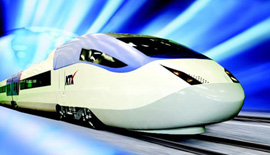
But if we're going to continue living in the reality-based world, we have to accept that there are both good rail projects and bad ones. And I have some very serious doubts that this is a good one.
In order to be competitive, it relies heavily on a projection that the train will make the LA-SF run in about 2.5 hours. This is almost certainly a fantasy given terrain, trackage, and existing technology. It will probably be closer to 3.5 or even four hours, which would make it almost completely noncompetitive with air travel. It also relies heavily on a projection of 100 million users by 2030. This is fantasy squared. And it further relies on funding assumptions that are practically laughable. Even if Prop 1 is passed, there's a good chance this train won't even be built by 2030, let alone carrying 100 million people per year.
There are plenty of promising short-haul rail projects that we should be considering, but long-haul rail is just really problematic. The numbers don't work out most of the time without heroic assumptions, and the money could almost certainly be better used on other things. So even if California were in good shape fiscally, I doubt very much that Prop 1A would be a good dea.
For more, click the link to read an email on the subject from an extremely dedicated rail proponent. I find it pretty persuasive.
Hi friends,
I'd like to suggest you vote "No" on Proposition 1A, the "Safe Reliable High-Speed Passenger Train Bond Act," on the basis of the following insider, expert information: my dad says it's a bad idea.
My father, James Mills, spent his entire career in the California state legislature (1961-1983) working to promote public transportation in the state. He was President pro Tem of the Senate for a decade. He was chairman of the Amtrak board under president Carter. Since retiring he has worked as a consultant on transit issues, and in the 1990's he served on the High Speed Rail Commission for the State of California. My dad is hard-core in favor of rail. If he says a proposal to fund a rail project is no good, then that proposal has to be a real turkey.
Specifically:
1) Prop 1A raises about ten billion dollars in a bond issue. This is a down-payment on a project which was estimated in 2006 to cost 45 billion dollars but will probably cost more if it is ever built. Remaining funding will be sought from the federal government (10-15 billion) and private investors (15-20 billion).
2) The federal government has never invested any amount even close to $10 billlion in a transit project.
3) If private investment were found, the bill says that investors would make money NOT from a the profit of the transit system, but from a percentage of ticket sales. In other words, the profit of investors is guaranteed, regardless of the operating costs of the system. The Legislative Analyst estimates that the OPERATING AND MAINTENANCE COSTS of the system will be one billion per year the State of California will cover any deficit not covered by ticket sales. It is rare for a public transit system to run in the black: normally, not all costs of the system will be covered from the fare box.
4) Premises on projected ridership are false. The only high-speed rail system in the US is Amtrak's "Acela" service between NY-Washington and NY-Boston. This system is well established and serves large population centers with excellent public transportation tie-ins to feed it such as subways, and they carry 3 million riders a year. The French have the best high-speed rail system in the world, and their busiest line is Paris to Lyon, again large cities with major subway systems, and it carries perhaps 15 million riders a year. In contrast, proponents of Prop 1A rely on a projection of 100 million riders per year between Los Angeles and San Francisco, a figure provided by a paid consultant that happened to be Lehman Brothers. This projection of patronage is a fantasy.
5) Promises of future extension to Sacramento, Orange County and San Diego are empty in that no concrete plan of any kind is offered other than the unrealistic plan for a Los Angeles-San Francisco line.
Arguments against are signed by Richard Tolmach, President of the California Rail Foundation, of whom my father said "there's probably nobody in California who is a bigger advocate for rail or better informed."
Finally, my dad suggests that the best idea is to spend public money improving existing passenger rail service in California (already provided by Amtrak), with track upgrades and more frequent trains.

















It's surprising to see so many internet users who can't be bothered to learn anything about Prop 1 before they comment or ask questions in comments. However, maybe I shouldn't be so surprised, seeing as KDrum is setting the bad example here.
This is not some sudden mad whim that has just popped up. It has been studied for years, the environmental impact studies have been done, the initial route has been chosen and vetted, and if Prop 1 passes the completion date for the first segment is 8-11 years.
"After the completion of the Authority's June 2000 Business Plan, the Authority hired the consulting arm of national railroads from three countries to peer review the Business Plan and supporting technical studies. SNCF (French), DE Consult (German), and JARTS (Japan), representing the three countries with the most experience operating high-speed trains, each submitted and presented reports confirming the Authority's assumptions, and conclusions ? including high-speed train design criteria, capital and operational costs, travel times, ridership and revenue forecasts and alignment assumptions."
the above quote, and quite a bit more information about the planning and vetting that has been done, can be found here.
Frankly, this is all just silly. If Kevin wanted to learn any more about Prop 1 it certainly would not have been hard for him to do so- and the same goes for a number of commenters above also offering fact-free opinions they are apparently reading off the side of the cracker-barrel.
Please, learn to google and read the faqs before you start thinking you're really something on the internet.
It's surprising to see so many internet users who can't be bothered to learn anything about Prop 1 before they comment or ask questions in comments. However, maybe I shouldn't be so surprised, seeing as KDrum is setting the bad example here.
This is not some sudden mad whim that has just popped up. It has been studied for years, the environmental impact studies have been done, the initial route has been chosen and vetted, and if Prop 1 passes the completion date for the first segment is 8-11 years.
"After the completion of the Authority's June 2000 Business Plan, the Authority hired the consulting arm of national railroads from three countries to peer review the Business Plan and supporting technical studies. SNCF (French), DE Consult (German), and JARTS (Japan), representing the three countries with the most experience operating high-speed trains, each submitted and presented reports confirming the Authority's assumptions, and conclusions ? including high-speed train design criteria, capital and operational costs, travel times, ridership and revenue forecasts and alignment assumptions."
the above quote, and quite a bit more information about the planning and vetting that has been done, can be found here.
Frankly, this is all just silly. If Kevin wanted to learn any more about Prop 1 it certainly would not have been hard for him to do so- and the same goes for a number of commenters above also offering fact-free opinions they are apparently reading off the side of the cracker-barrel.
Please, learn to google and read the faqs before you start thinking you're really something on the internet.
The problem with the redistricting initiative is that it amounts to unilateral disarmament. A federal system must have all of its localities have the same type of electoral rules; otherwise you may end up with one gerrymanded state and not another- the net effect is that doing the "right" thing amounts to diluting your power. Federal changes should be pursued at a federal level. This also applies to changing electoral college rules. Incredibly, the U.S. has a system in place that would allow for proportional electoral college representation in some states and not in others (I dare to suggest the NE and ME laws maybe unconstitutional). If all forward thinking states adopted such a system and all blue states did not one would create a permanent presidential Republican lock even if its candidates lose by over 10 points. So let me be clear, one must seek these types of changes at a national level.
Well, you convinced me, Kevin. Or rather Jim Mills did. If he says the project sux, it sux.
Kevin, this is an incredibly ignorant comment. You falsely claim that we don't have the technology to build a train that can go from San Francisco to LA in 2.5 hours. Such technology is widely deployed today in France, Germany, and Japan. You also claim that the economic projections are fantasies, but in Europe it is the long-distance trains that are the profit centers, and the short-haul routes that you champion tend to need subsidies.
The busiest Shinkansen lines in Japan are well over 100M passengers
I think at this point our limited resources would be better spent on less ambitious, more localized projects to improve commuter transit (and I'm not talking about adding lanes to the 405). After all, a line connecting SF and LA doesn't do much to address the daily needs of the sprawling population of SoCal.
I guess I should have commenetd on the rail initiative; Mr. Mills sounds persuasive, though the fact the U.S. has never invested (insert amount) of money is not a logical point; by inflation and growth, every new project will always have that boomerang. My question, being from the East Coast- is there any rail between both cities? If so, can it be improved? If not, what about a regular line and not a superline?
I'll admit, I'd rather see better transportation in the Bay Area, like a MUNI Metro extension from the Caltrain station in SF to Market Street. Or BART to San Jose. Or better VTA service in Santa Clara County.
I just know that a SF-LA high speed rail route is going to have to hit every podunk Central Valley city, thereby fucking over the "high speed" aspect of it. Add in connections to Sac and further out in So Cal, and "2.5 hours from SF to LA" seems like a pipe dream. Also, how is the train supposed to share Caltrain trackage from SJ to SF? Has anyone factored that into the equation?
There is NO train now between LA and SF. You have to take a bus between LA and Bakersfield.
Even 4 hours by train would be competitive with flying. The flight time is 1.5 hours, you have to be there 1.5 hours ahead and at least another hour getting in and out of the airport.
Also, trains are going to be the future of medium distance travel. The airlines are in the toilet and flying is really inefficient in these kinds of distances.
How is the HSR supposed to share right of way with Caltrain going up the Peninsula? Are the tracks compatible? If Caltrain is electrified, will they still be compatible? How will it effect daily Caltrain runs? Will the station at 4th Street in SF need to be rebuilt?
It will probably be closer 3.5 or even four hours, which would make it almost completely noncompetitive with air travel.
With respect, Kevin, Amtrak vs the DC and Boston Shuttles between those cities and NYC contradict that presumption. It's about an hour in the air and 3.5 to 4 via train, but the amount of time you have to arrive in advance for the air shuttle and the gyrations you have to endure for security effectively eliminate that difference.
You depart from your "no on everything" policy in order to endorse Prop 11?
Please read what Jon Fleishman has to say about 11.
http://www.flashreport.org/blog.php?postID=2008102220490281
The optimal competitive distance for HSR is not necessarily LA to SFO. It's on the high side of the range. As far as time goes, what makes HSR competitive is the reduced time from your doorstep to the train or plane's entrance.
Speed depends on whether you have separate dedicated tracks (costs more, right of ways harder to get) or share tracks with other trains (which is done in some systems). Obviously the sharing and the number of stops slows you down.
There is presently no serious Federal commitment to HSR. It would be foolish to commit funds without an agreement that secures Federal and private financing.
I haven't read the bill, so I don't know what the commitment is re: private sector participation. The latter can be secured, and some risk can be included. For instance, it's possible for a private outfit to agree to take on some or maybe a lot of risk of insufficient ridership, maybe with some per-rider subsidy. Depends on what they think ridership will be relative to their own costs. That's a bargaining issue.
Acela is not a good comparison. It is slow as mollasses because the tracks have not been upgraded, because Congress wouldn't pony up. Even so, with the gas price spike its ridership went through the roof.
Few passenger rail systems run without subsidies for riders. And the prospect of a system getting built without the Gov(s) paying for most of the infrastructure is very dim. A significant, maybe ongoing public subsidy is inevitable. Depends on how much it is worth to you to reduce highway & airport congestion, pollution, and greenhouse gases.
Plans for the California HSR line are in fact extremely detailed. Just go their web site for the voluminous detail.
Items 4 and 5 in the letter are sufficiently wrong as to cast doubt on the whole.
Tim Bassett: So a country with ~2.5x CA's projected 2030 population (50% larger) reaches 100M riders/yr. And this is somehow convincing of such large ridership projections?
I have yet to see on any pro-HSR website any details about how its supposed to run up the Peninsula. I can't stand the yuppie boomer NIMBYs who live there, and at the very least someone needs to realise that those towns are gonna tie all the eminent domain takings up in court forever.
Kevin,
Can I put in another plea for you to get this kind of information out sooner? I already voted in favor of 1A, but I likely would have changed my vote if I'd seen your posts first. A lot of people who read this blog probably vote early.
I think the only way a SF-LA trip would be 2.5 hours is if the only stops are SF, SJ and LA.
Agree with all of those above who say that even 3.5 or 4 hours on the train would make it competitive with the airlines. If it's less hassle to board a train, it could even beat the amount of time you spend in airports and in the air. Even if it doesn't, it could well beat the airlines in terms of cost (Southwest = $200+ roundtrip from Oakland to Burbank) or hours spent in the car driving up the I-5.
LA to SF is 342 miles
Tokyo to Osaka is 251 miles.
The fastest Japanese bullet trains now make the trip in 2 hours 25 minutes. The 'normal' bullet trains take longer.
It is absurd to think that the California train would go 35% faster than the Japanese train. If the trains reached the speed of the fastest Japanese trains then the trip would be about 3 hours and 25 minutes.
Maybe if they cut a straigter line between LA and SF they could reduce the time. Maybe if they reduced the number of stops they could reduce the time.
Realistically, there is virtually zero chance of getting the train there in under 3 hours.
A lot of the analysis here makes the assumption that the current modes of transportation between LA and SF will remain viable in the future.
Petroleum based methods will get worse and worse as time continnues.
For the immediate future at least, the TSA will make aircraft based mechanisms slower and more expensive.
The clean, green, viable approach will be fleets of e- based autos/buses/trains.
(Amanda, my guess is that it goes up the peninsula using the Caltrain right of way.)
California has: land, sun, sprawl. All of that seems to favor trains in the long run.
On the other hand, I am all for enormous algae based biofuel farms to keep our aircraft flying.
There was a question about being able to run Caltrain and a high speed rail train on the same track. In general HSR equipment is built differently and lighter than standard heavy rail cars and engines, so you can't run them on the same track at the same time. That and the complexity of routing what would amount to an express on the same track as slower trains means that HSR is almost always on it's own right of way.
You can also read the S.F. Chronicle article by James R. Mills and Richard F. Tolmach" on this same topic. It gives some different points.
The argument is not against HSR in general, but about this specific ballot measure. The funding proposals are unlikely to succeed. The aligment through Tehachapi that is proposed is out of direction and would make this run much longer than the highway distance between SF and LA.
I am very pleased to see that the internet brought this bit of family political action to Kevin's attention.
Bill Mills
Interesting discussion. I'm mostly swayed by the budget issues, but I've also wondered WHO would be riding this train? Would it appeal to airplane commuters? Would this really keep cars off I-5? I'm not so sure... what does the potential population look like?
Neil,
the shinkansen was built in 1964. Tokyo-Osaka must stop in a few cities anyway (Kyoto and Nagoya, and a few more I believe).
Anyway, a train built now would for sure go faster than one that is almost 50 yo!
Commercial speed for train in France is currently at 300km/h, that is over 180mph. 340 miles at 180mph is less than 2 hours. 2.5 hours is not that far-fetched a goal.
If high-speed rail makes no sense in California, then it's hard to see that it would make any sense anywhere in North America, and would only be viable in very few places in the entire world. I think there's some really small-bore thinking going on here.
You can't even begin to address climate change without some effort to cut back on short-haul flights and inter-city vehicle traffic. This rail could be powered by much cleaner energy sources than any plane.
And Kevin, if the rail line isn't going to be ready until 2030, then there probably isn't sufficient fiscal need to neglect the project due to short-run budgetary issues. Long-run deficits are just bad management, and if those are present taxes need to be raised or budgets slashed, with or without this project.
There are some problems in that column.
"Voters are being asked to approve nearly $10 billion in bonds (costing taxpayers about $20 billion when debt service is included)"
In light of the time value of money, it is double counting to add principal to interest in calculating a cost. The present value of the interest, assuming it is paid forever w/no repayment of principal, is simply the initial borrowing.
" . . . Lehman Bros., the rail authority's financial adviser, is apparently out of business and unavailable to write the business plan. How can taxpayers trust the rail authority with $20 billion, given this record?"
You can't very well blame the rail project for the failure of Lehman Bros.
" . . . the rail authority made wild claims about ridership, energy and pollution benefits. It based its claims on a prediction that 117 million passengers will use this service annually, dwarfing the 29 million using Amtrak nationwide today. Amtrak's high-speed train, Acela, carries only 3 million annually."
The 117 mill is for the year 2030. To compare it to today's Acela ridership is a crock. Moreover, Acela is not high-speed.
" . . . 12 million of those passengers used trains before high-speed service started. "
Yeah TGV riders used to ride other trains . . . because France had a lot of passenger rail. Rail in the U.S. would take riders from air, conventional rail, and highways.
Train travel is just not that economical over long distances. Air travel is surprisingly fuel efficient.
For example, the Boeing 737-800 burns about 4.88 gallons of fuel per passenger per hour at a cruising speed of 515 miles per hour. This works out to 105 miles per gallon per person. This is almost 3 times the gas mileage of a Prius. Unless you always carry four people in your Prius, you would use less fuel flying from SF to LA, and save half a day.
http://www.amtrak.com/servlet/ContentServer?pagename=Amtrak/am2Copy/Titl...
On the Northeast Corridor, where the Acela is one of several trains, annual ridership is 10 million. Not 3 million. The Acela makes it from D.C. to NYC in 2 hrs, 46 min. Other trains get there in 3 hrs, 15 min. I'll leave it to others to decide whether this time difference merits the designation "high-speed" to the Acela.
OK, so LA/SF by air is about 1 hour 25 min, give or take. I have to be there at least 1 hour in advance to navigate all the lines. I have to either find satellite parking or take the subway, adding a good half hour to my travel time. (All right, maybe I'd have to do that for the train too, but in Boston at least it's a lot easier to get to either train station than to the airport.) On the plane I can't use my cell phone and my laptop use is restricted. On the other end I have to wait for my luggage, if I checked any, which I probably had to if I'm going for more than a couple of days.
And I haven't even gotten to taking my shoes off or having my drinking water confiscated. Or the simple fact that I feel happier on terra firma.
All of that said, "we don't have any money" is sufficient reason to vote no all by itself. But the time argument doesn't wash as far as I'm concerned, even if the train takes an hour or two longer.
Miracle Max:
Acela can't go faster because of speed limits for safety as it goes through a lot of developed areas. Sort of like CA's HSR would everywhere except the central valley.
And 117M still comes across as laughably high. Someone claimed Japan achieves that, but they have 2.5x CA's projected population in 2030.
Cedichou: Why would a newer train necessarily go faster? I mean, perhaps a bit, but train technology is only part of the limiting factor. Geography and safety have a lot to do with it, too.
And since there's little desire to tunnel under the entire Grapevine, the route currently goes around it. That throws the time estimate off quite a bit -- it's longer and speeds are reduced on non-straight segments.
I am an avowed train nut and big transit proponent, but I think this thing is a lousy idea for many reasons, including those already cited (ridership projections are BS, cost estimates are BS, etc):
1. Environmental Impacts: nobody has talked about the impact of a rail right of way plowing through both urban and rural communities, either below grade, at grade or elevated. It will go through densely populated cities and sensitive agricultural and natural areas---just wait til the specific routes are proposed and watch the field day for environmental lawyers suing the rail authority on behalf of impacted neighbors. At least with air travel, the environmental impacts, as bad as they are, are limited to the areas where the planes land and take off. The air quality impacts of jet planes is relatively small compared to the overall carbon footprint.
2. The success of any rail system is critically based on connectivity. Unless there are extensive rail systems in place in the destinations, where this funding should be better spent frankly, they better have car rental counters on both ends.
3. The placement of stations in cities like Bakersfield, Fresno and Modesto opens the Central Valley to increased urban sprawl, and there is absolutely nothing in this program to address the perils that may bring. Imagine this: Modesto could become a bedroom community of Silicon Valley because it would only be an hour away using this train. That may be OK, but has anybody asked the good people of Modesto how they will feel about a skyrocketing population? Has anybody evaluated the environmental, social and economic impacts of that? Has anybody examined the alternative approach of fixing the jobs housing balance in Silicon Valley? And most importantly, has anybody thought about the potential negative impact of the paving over of the Central Valley on our agricultural resources? Might the Valley go from being a national breadbasket to a regional uber-suburb in one generation? Imagine visiting a supermarket in 25 years and wondering why all the produce says "product of Mexico/Chile/Argentina" on it. Will we be importing all our food from foreign countries, along with oil?
4. Finally, we need to think about building upon an infrastructure already in place: improving local transit, and improving the air transport system (addressing such things as airport accessibility and capacity, as well as quieter, less polluting and more fuel efficient planes).
5. Finally, the argument that rail will be more pleasant than air travel because there is no heavy security and screening for rail---that is an ephemeral condition. The day may well come when airplane security loosens or becomes more efficient, and the day may well come when train travel is afflicted by invasive security measures. It is an irrelevant argument.
Lucia: I don't think it's easier to get to the train station than the airport in LA at the moment :)
I imagine that, even with other time included, HSR would still be slower if you use more realistic HSR time estimates. That may well be worth it to avoid some of the other hassles to many people (but don't be surprised if TSA tries security checks on HSR lines if any are built).
It'd be really nice to have -- my wife and I are looking to move to the bay area after I finish grad school, and my parents outside LA would love being able to take a train rather than flying or driving. But CA's budget problems really make it hard for me to see this as a good idea right now. Sometimes short-term reality really does need to dominate, however unfortunate it may be.
I voted against 1A as well, but for different reasons. 1. It seems that a bond measure was already out there for the project, and the project already begun.
2. The small print says that the already begun leg from SF to LA will be completed first and whatever other money is left over will be used for other legs (like Sacramento-SF). Given the type of project managers the government tends to hire, I am assuming that there will be no money left over. That, to me, is a problem.
I'm busy so I can't go into detail, but:
#4: I think you are (Bill is) mismatching "total" riders by 2030 vs. riders "per year" by 2030. France's HSR just surpassed their 1 billionth rider on a system less than 30 years old; Japan's has surpassed their five billionth passenger.
Your arguments are really, really weak. Let's dispense with them in order.
1. I'm not even sure what your point is. Scary numbers? Compare with expanding airports and freeways. Compare with being dependent on ever more expensive fossil fuels.
2. This isn't a transit project. It's either this or another interstate highway network for California. And big policy changes like these are coming, whether you like it or not. The idea in effect is to get federal funding for this rather than another interstate highway system in California.
3. How do you suppose every rail system in Europe does it? That's right, a profit for the train operating company. And subsidies provided where needed by the infrastructure operator, which is the state (although guess what, Eurostar, Thalys, and TGV-Sud Est cover their access fees as well as their operating costs).
4. Paris has fewer people than LA, Lyon has many fewer than the Bay Area, and there are no intermediate stops on the route. The proposed California system serves twice as many people as TGV Sud-Est, with major intermediate stops. And both LA and the Bay Area have, guess what, major rail transit systems.
5. No extensions set in stone? You've got to start somewhere. TGV Est (Strasbourg) and TGV Nord (Chunnel) weren't set in stone either back in the early 1970s when Sud Est was approved.
6. The existing network is so short of capacity and so slow as it is that upgrading for passenger would likely be comparably expensive to building an all-new line.
If this is how you argue against high speed rail, I can only assume that you're opposed to the principle of passenger rail in general and holding out for fuel cells and plugin vehicles.
1. Kevin's passenger number of 15m per year for the Paris-Lyon line must be wrong. The Lyon-Marseille extension carried 19m in 2002. I admit it's hard to find passenger numbers amid the techie fan stuff.
2. The standard operating speed for the latest French TGV line (Paris-Metz) is 320 km/hr, or 200 mph. On high-speed lines, the top speed is held for long stretches. A complete high-speed line from LA to SF could easily deliver a 2-hour service.
3. The French rule of thumb, based on a lot of experience, is that passengers abandon air travel if you can get under 3 hours city centre to city centre. For example, Paris-Bordeaux, where half the distance is on upgraded old track. Since there are no major population centres between LA and SF, a Californian HSL would have to be 200 km to make a difference. Incremental improvements won't do it.
4. France is unusual in the quality of its old network: most main lines were electrified and ran trains at up to 140km/hr before the TGVs and LGVs came in. California's starting point is more like Spain's, which has a poor and cheaply built Victorian network, so the new lines (Madrid-Seville/Malaga, Madrid-Barcelona) have to go all the way.
Pleased to see my e-mail wind up on your site, regarding my father's evaluation of Prop 1A. Here is a link to his San Francisco Chronicle editorial on Oct 8: http://www.sfgate.com/cgi-bin/article.cgi?f=/c/a/2008/10/08/EDB913D4MU.D...
You would find it persuasive, Kevin, since you don't understand the key details and you haven't done any research on this. You haven't bothered to look at the case from the Yes on 1A folks.
That email was posted as a diary at Daily Kos yesterday. It is full of false and misleading information. Here is my takedown of it.
Let's take this point by point.
RE: Point #1: Can you give a specific reason as you "probably cost more"? Or is that blind speculation? Can you give a specific figure that we will go over budget? If not then your claim lacks credibility. Rail projects around the country, including LA's Metro Gold Line extension, have been delivered on time and on budget in recent years.
Further, and this is ironic, that $45 billion is the figure for the ENTIRE system - which in point #5 you claim is unplanned.
RE: Point #2 - The federal government had never spent $700 billion on a bank bailout either.
But we have better evidence. John Kerry and Johnny Isakson are working on a bill to provide about $10 billion for HSR projects around the nation. Both Barack Obama and Joe Biden are strong supporters of HSR and want to fund it.
RE: Point #3 - First, you are misleading Kossacks on the Legislative Analyst's estimate - she has said the $1 billion figure is a worst-case scenario.
Second, it is not rare for high speed rail systems to run in the black. In fact, they ALL run in the black. Every last one. In France the TGVs are so profitable they subsidize other slower rail services. SNCF had so much money they actually gave some to the French treasury earlier this year.
Third, the HSR legislation *requires* profitability of the system, otherwise private operators forfeit a bond they must put up, and are still held liable for what's known as a "franchise fee." That means any losses will be absorbed by a private operator. The public and the state of California are essentially indemnified from any loss.
RE: Point #4 - This is a complete and total lie.
First, Acela is not true HSR and is much slower than our system will be because they must share tracks with freight. CAHSR runs on its own dedicated tracks.
Second, nice work on parroting the Reason Foundation! Nice to see right-wing libertarian lies being passed off as fact at Mother Jones. Do your editors know about that, Kevin? Those ridership claims - specifically about Paris-Lyon - are complete nonsense. We thoroughly debunked the "not enough riders" claim at my California HSR Blog.
RE: Point #5 - Now you're just showing off your ignorance. Prop 1A would fund a line from SF to Anaheim - which, last time I checked, was still in Orange County. SD and Sacramento plans are in existence in full detail and can be found at the California High Speed Rail Authority website.
So Kevin, I think you owe your readers an apology and a correction for posting an email which you did not do any due diligence on, which you are passing off as "pretty persuasive" when it is severely factually challenged.
If you don't understand a project, Kevin, you should either learn the details or not write about it.
Just because it works in France and Japan doesn't mean it will work in California. Aside from the different population density issue, it's also a cultural issue. Los Angeles is a city in which people will drive 3 blocks to go grocery shopping, where sensitive white liberals have no problem publicly proclaiming that "only poor people ride the bus", where driving separate cars to the same location, from the same location, is more often than not seen as completely logical. I'm not saying this as some outsider who's watched "LA Story", I see it every day. It's not impossible, but there needs to be a massive cultural shift in Southern California away from dismissive attitudes toward public transit before the projected ridership numbers are reached. Merely building the high-speed train isn't gonna do it. Nor will simplistic arguments about economic rationality. People in France and Japan ride trains precisely because they're used to riding trains as a part of life (yes, it's a tautology). There is no stigma attached to trains, there are extensive networks of subways, regional trains, and long distance trains, all of which more or less serve their intended purposes, and have for a long time. When you're not used to riding a train, desire to hop on one won't just automagically emerge, especially in a place like LA where there's cultural hostility to the concept in everyday life.
Intra-state train ridership will actually work in CA if train ridership at all levels -- local, regional, and long distance -- is rethought comprehensively, and viable projects at all levels are sensibly funded. Otherwise, we're shoveling smoke.
"And both LA and the Bay Area have, guess what, major rail transit systems."
Which does nothing to address the specifics of how people are going to efficiently get to the stations. Every rely on taking public trans in the Bay Area?
"And both LA and the Bay Area have, guess what, major rail transit systems."
LA's is major in the sense that it was really expensive to construct. When a friend of mine from Sweden was visiting and he saw the Metro system map outside the Hollywood/Highland Red Line station, he couldn't stop laughing and took a bunch of pictures. Apparently, our local subway/light rail system is slightly more anemic than those in Europe -- all the while "serving" the second largest city in the country.
It's surprising to see so many internet users who can't be bothered to learn anything about Prop 1 before they comment or ask questions in comments. However, maybe I shouldn't be so surprised, seeing as KDrum is setting the bad example here.
This is not some sudden mad whim that has just popped up. It has been studied for years, the environmental impact studies have been done, the initial route has been chosen and vetted, and if Prop 1 passes the completion date for the first segment is 8-11 years.
"After the completion of the Authority's June 2000 Business Plan, the Authority hired the consulting arm of national railroads from three countries to peer review the Business Plan and supporting technical studies. SNCF (French), DE Consult (German), and JARTS (Japan), representing the three countries with the most experience operating high-speed trains, each submitted and presented reports confirming the Authority's assumptions, and conclusions including high-speed train design criteria, capital and operational costs, travel times, ridership and revenue forecasts and alignment assumptions."
the above quote, and quite a bit more information about the planning and vetting that has been done, can be found here.
Frankly, this is all just silly. If Kevin wanted to learn any more about Prop 1 it certainly would not have been hard for him to do so- and the same goes for a number of commenters above also offering fact-free opinions they are apparently reading off the side of the cracker-barrel.
Please, learn to google and read the faqs before you start thinking you're really something on the internet.
Given the resistance to mass transit in this country does anyone think initial proposals for something this different are going to be perfect in the eyes of any majority? And what alternatives do people propose who seem to be saying that mass transit via rail will simply never be accepted in the US? Flawed or not we have to start somewhere. The proposal can certainly be altered if it's passed, and you can bet it will be (both for better and worse). I don't care if does end up taking 4 or 5 hours to get to LA. It's time that can be spent doing something productive or entertaining rather than driving. And dear god, anything but air travel. It's such a hostile experience these last seven years. Last, who here thinks that fuel costs will continue to fall and stay low over the long term so that airfare will be "cheap" again and remain so?
If Acela had a improved infrastructure it would run fine.
The problem is that the TGV model is expensive, and Americans have no expertise with it. And having something like the TGV when you aren't able of building good commuter rail systems is unrealistic.
It's actually remarkable that Peak Oil Kevin (Peak Oil Drum) is mired in the tar pit of an obsolete petroleum based transportation system.
First time posting on Kevin's blog since his move from the other blog site...
If this were a country that routinely builds rail systems in its major cities I'd agree with your stance. But given how difficult it is to get any mass transit project passed in CA that doesn't involve adding more lanes to superhighways, I'd be willing to support a flawed but well-meaning prop for HSR.
Yes I'd be willing to spend 3.5 hours on a train to LA versus 1.5 hours on a plane + parking + getting to the airport.
Heck, even the Bay Area with its BART and Caltrain stations could use some improvement. SF has a slow but extensive bus system. It's rail system is OK. Of course there's no rail line from it's most residential district to Downtown. Instead there's the "most trafficked bus line west of the Mississippi" that makes stops every other block - so it takes 45 minutes to travel six miles. Much "easier" to drive if you have a car in that case.
Okay, done with the drunken ramble.
Couldn't we just take all the Federal tax dollars of ours that are being sent to undeserving Alaska and build something akin to this? I think so.
I submitted a comment with a link to the California High Speed Rail agency website- perhaps it was the inclusion of the link that resulted in the comment being embargoed, or perhaps it was my assertion that people should learn something about the project before expressing opinions (I know, strictly optional).
So, instead of linking, and having already spent (wasted?) time on this, I'll just say-
The environmental studies have been done. The route will not serve dozens of small communities or encourage sprawl. The technical and business plans have been vetted by French and German rail experts. Reports have been published, hearings have been held.
The plan was developed to meet Californian transportation needs of the future without exceeding emissions limits, or, for that matter, reasonable costs. It has been approved by the state DOT and even the airport association, which realizes the need to take short flights off the runways.
Kevin's post, and this comment thread, are a sobering reminder to me that we will not put it in first gear and pull the country out of the mudhole if Obama is elected. Half the people commenting here have never given the future a serious thought and are apparently totally unaware of the efforts of those who are thinking about it.
How did we get so dumb? Well, just compare what you spend on prisons in California with what you spend on schools. We're almost as bad where I live.
I guess actions have consequences.
We want alternative fuel, so we're offered ethanol made from corn which increases food costs and isn't so effective on energy either.
Now we want mass transit and we're offered long-distance trains which can't compete with faster more efficient airplanes.
Seems to me the oil industry is still fighting strongly.
Are there really many people who want to commute from SF to LA or vice versa? How about using commuter trains which would get huge numbers of travelers every day?
How about renewable non-food-product alternative fuels so we can finally get the oil monkey off our backs?