- ‹ previous
- 2038 of 2745
- next ›
*Chart of the Day - 11.27.2008
CHART OF THE DAY....Via Overcoming Bias, three French researchers surveyed 1,540 people and offered them the opportunity to play a game in which a coin is tossed ten times and they'll win ten euros each time it comes up heads.
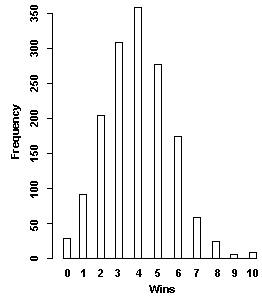
"The participant is then asked for his/her own estimation, according to his/her experience and his/her luck, of the number of times heads will occur, i.e. how many times (out of ten) he/she thinks he/she is going to win (and get 10 euros)." What do you think is the most terrifying aspect of this survey?
The mean answer was 3.9.
About ten people thought they would win every single toss.
The authors managed to produce a 21-page paper out of this.
The full survey is here. The authors also note that women are more pessimistic than men; old people are more pessimistic than young; and that nearly everyone answers "five" if monetary gain is removed from the question. In other words, people seem to know the odds, they just think the universe is stacked against them. (Or that the researchers are going to cheat. Take your pick.)
The exception, of course, is those ten respondents who think they'll win every time. Here in America, we call those people "investment bankers."


good one kevin. you seem to getting your mojo back.
Maybe for investment bankers, but hedge fund managers will also say that and will also bet that they will lose all ten.
By far (3) is the scarriest. It is easy to imagine that participants would expect some combination of cheating/bad-luck would cause them to get a lower than expected payoff.
LOL!
Coins obey newtonian physics so the answer really depends on the experiment. 3.9 sounds about right if you are spinning pennies. On the other hand if I stand them all on their side and bump the table from a few feet away I'm pretty sure I could get all heads. Catching a flipped coin takes away a significant bias.
I remember getting detention from our 4th grade math teacher for confidently telling her that tails was more frequent when tossing pennies on the ground. She kept us quite a while but gave up when we were at about 600 tails and 400 heads.
It may not be pessimism. Most people would perceive the game to be whether you exceed or under-perform w.r.t. the stated expectations in a public contest. By saying "3" they lower the expectations and increase the probability that they win this (implicit) game. Getting fewer wins than you predicted would carry some embarassment cost in any public situation.
And sure enough the last sentence of the paper is:
The elicited pessimism could be interpreted as defensive pessimism, an
anticipatory strategy that involves setting defensively low expectations prior to entering
a situation so as to defend against loss of self esteem in the event of failure.
So a different experiment should have been set up -- one in which points (or euros) were lost as the actual score deviated from the stated expectation.
Was this financed by the casino industry? It explains craps.
What about those 25 who think they are going to lose every time? That's not exactly encouraging. Dare to hope, people...
It could be these folks know more about euros and how they are minted than you do.
And there are those who probably suspected it was a trick question.
Euro coins have no heads.
I skimmed through the paper and didn't find any mention of the sample being cross-cultural. Is there any possibility that the sample was all French? After all the French are notoriously pessimistic. I wouldn't be surprised to find different nations having different scores.
If they'd been business news pundits, they'd have sold tickets to their upcoming seminar on how to win 11 times out of 10 - with no money down!!!
-- Euro coins have no heads.
not true, some do, like the euros from monarchies like spain or the netherlands
HAhaha! Perfect!
In real life for each toss of the coin these guys were getting an exorbitant fee and betting other people's money. If there was a risk on each toss they sold that risk to someone else and told that person the toss was a sure thing. What a system!!
I think this is a bad experiment. They're not measuring what they think they're measuring.
Say a stranger comes up to you and tells you he will give you a good deal of money every time a coin comes up heads. The social situation is overwhelming your rational estimation. You want to get-along, tell the person they won't have to give you too much money. You want to show a little humility, a little self-deprecation about your luck. It's telling that women, who are more socially aware than men, would be more prone to this effect.
They should recreate this experiment and conduct it through a computer terminal. I would predict that the effect would disappear entirely.
I haven't read the paper, but another aspect may be financial risk-aversion, since the answers differed when money was involved.
This implicitly assumes that people were assuming they would be asked to pay to play the game based on their answers, i.e., "you say 5, so give me 50 Euros and we'll do it." In that case, 3.9 is just about right for a sample of people of average wealth.
What would YOU pay -- pay in cash right now -- to play that game?
Kevin Drum: The exception, of course, is those ten respondents who think they'll win every time. Here in America, we call those people "investment bankers."
Enough demagoguery. Investment bankers are the best and brightest, educated at our country's finest universities. They know that the expected value is 5.0. Using sophisticated mathematical modeling, they will improve the odds of this primitive game by dividing the tosses into tranches and selling them to other sophisticated investors. Expected returns will be increased to 500 euros by appropriate leverage. To hedge against the unlikely they then become a counterparty to as many as ten other counterparties for each toss (nine of whom aren't even otherwise involved in the transaction).
And I haven't even gotten to the sophisticated part! The key step is to then convince the US government that what is technically known as "male bovine manure" is equivalent to "unforeseeable consequences" (this step explains why a narrow technical education is inappropriate, and must be rounded out by subjects such as the theater arts). Lastly, it's essential that the audience be convinced that "panhandling" and "welfare" are not appropriate synonyms for "saving the economy".
Ok, given the supine US government and the ready assistance of the MSM and certain serious bloggers, that last step is surprisingly easy. Nevertheless, taken as a whole, it's quite a trick.
Did they ask the same respondents what they thought would happen if the rules were changed and the game paid off on tails? Could one believe that the modal outcome is .4 for heads and .4 for tails both, and still get through a normal day crossing streets and stuff?
#3 is scary because many economists assume that economic decisions are rational and informed. It should be common knowledge that they are not, and if this were common knowledge then the results of this simple study would not be worth publishing.
As a matter of fact, it is well known to some scientists (not economists, who are not scientists anyway) that the degree of rationality of decisions is highly sensitive to social context.
Yeah, people's handling of probability is weird, there's a lot of psychology in it. Sometimes the experts are wrong, however: anyone remember the big whoop over Marilyn Vos Savant and "the three door problem"?
BTW there is a weird variant of the "St Petersburg Paradox". My slant is: suppose you are playing a game with say 1/4 - 1/8 or so chance of winning. Your winnings are set to be much less than long-term break even. (Say, 1/4 chance to win but payout is only 2:1.)
What you do: Bet in a sequence such that the sum of the preceding numbers is always substantially less than the given number. Hence, I would bet e.g.:
1, 3, 9, 27 , ...
So let's say I win with bet of $81. Well, first of all the sum of losses 1 + 3 + 9 + 27 is only 40, and furthermore I win $162. Note that I will end up long-term (total net of plays) ahead no matter when the winning event occurs. I can then "quit and start all over again." Ironically, the smaller your chance of winning the better, since it's more likely that a win won't happen until you've bet a large sum!
But according to probability concepts of net expectation value etc. I should have to lose in the long term. It's a weird paradox and there really isn't a way out, except that you have to have "unlimited funds" in case you get a run of bad luck that just might exhaust any finite betting kitty.
An argument I started about this raged in a Brad DeLong thread for a long time. They picked up on the "how much to bet using" issue but never really resolved the challenge to probability theory.
BTW, the investment bankers aren't thinking in terms of luck, but in:
1. Their ability to manipulate regulations through lobbying and customers through deceit and psychology.
2. That the government will bail them out since "they're too big to [be allowed] to fail" or maybe yet more lobbying, etc.
some do, like the euros from monarchies like spain or the netherlands
Very true -- but still, many do not, so if you take "heads" literally you might be skeptical about which coin they would choose in this particular study.
By the way, the heads on the 1-euro coins are not all monarchs -- they include Mozart, the Pope, and various national heroes.
The exception, of course, is those ten respondents who think they'll win every time. Here in America, we call those people "investment bankers."
Man, talk about taking a cab....
Richard Feynman (the Nobel-winning physicist) once spent some time in Vegas, hung out at the craps table, and met a guy who was a professional gambler. Feynman asked the man how he could make money gambling, since the odds were in favor of the house. He explained:
"I'm standing around a table, when some guy says, 'It's comin' out nine! It's gotta be a nine!' The guy's excited; he thinks it's going to be a nine, and he wants to bet. Now I know the odds for all the numbers inside out, so I say to him, 'I'll bet you four to three it's not a nine,' and I win in the long run."
شات
tagged as:- solution
شات سعودي
منتديات
مكياج
صور
خزعبلات أقلامنا
قضية الاسبوع
اناشيد اسلامية
عبارات ترحيبية
الاهداءت وتهنيئة بين الاعضاء
شعر
أشعار صوتية
خواطر
قصص
برامج
برامج فوتوشوب
أنمي صور
برامج جوال
ثيمات
مسجات
ثيمات
توبيكات
يوتيوب
ايقونات ماسنجر
ثيمات ماسنجر
مكياج
وصفات طبخ
الحياه الزوجيه
اكسسوارت
ديكورات
الطب النبوي
عالم ادم
نكت
مقاطع فيديو
صور
الالعاب
اسئله مسابقات
اسئله كرسي الاعتراف
صور لاعبين
صور سيارات
الشكاوي والاقتراحات
مواضيع مكرره
صور ماسنجر |
مكياج |
توبيكات جديده |
منتديات |
توبيكات ملونه | شات بنات |
تحميل الصور |
دليل مواقع | مواقع توبيكات
| رموز
ماسنجر | مدونه |
شات كتابي |
شات صوتي
صور بنات للماسنجر 2010 -
صور بنات للمسن 2010 -
صور جديده 2010 -
صور بنات حلوه للماسنجر 2010
| صور ماسنجر
2010 | مسجات حب 2010
| مسجات غرام 2010 |
مسجات عتاب 2010 |
مسجات حزن 2010 | ازياء
2010 | فساتين 2010 |
فساتين سهره 2010 |
صور فساتين سهره 2010 |
صور مكياج 2010 -
مكياج 2010 -
مكياج عيون 2010
|
تسريحات شعر 2010 ,
تسريحات 2010 |
توبيكات حب 2010
| توبيكات رومنسيه 2010 |
صور للماسنجر 2010 -
صور مسنجر 2010 -
صور مسن 2010
| صور شباب للماسنجر 2010
| توبيكات
ملونه 2010 | توبيكات ملونه
للماسنجر 2010 | حلقات مسلسل ام
البنات |حلقات مسلسل قلوب للايجار|
حلقات مسلسل طاش 16
حلقات مسلسل باب الحارة 4 |
حلقات مسلسل عوانس سيتي |حلقات
مسلسل بيني وبينك 3 |
حلقات مسلسل شر النفوس 2 |
نكت 2010 |صور
بنات للتصاميم 2010 |
توبكات رومنسيه روعه 2010 |فساتين
سهره 2010 فساتين ناعمه 2010 فساتين روعه 2010 |غرف
نوم اطفال 2010 صور غرف نوم اطفال 2010 |دورات
مياه 2010 صور دورت مياه 2010 |
مطابخ 2010 صور مطابخ 2010 |غرف
نوم 2010 ديكورات غرف نوم 2010 |
صور ديكورات 2010 ديكورات منزل 2010 |صور
انمي 2010 انمي كيوت 2010 |
موسوعه ثيمات 2010 اسلاميه 2010 |موسوعه
ثيمات 2010 رومنسيه 2010 |فساتين
ناعمه وانيقه 2010 |رسائل
وسائط 2010 حب مسجات 2010 غرام |صور
ماسنجر حب 2010صور ماسنجر رومنسيه 2010 |مسجات
mms عتاب وحزن 2010 |صور
اطفال للماسنجر جديده 2010 |
صور مسن للبنات 2010 | صور
للبنات ماسنجر 2010 |
توبيكات ماسنجر بلس 2010