- ‹ previous
- 931 of 2720
- next ›
The Banking Crisis Revisited
In an interview with Peter Baker, Bill Clinton says that although he regrets not regulating derivatives more strictly, he doesn't think that repealing the Glass-Steagall Act and allowing commercial banks to merge with investment banks was a big cause of our financial meltdown:
On the Glass-Steagall, I’ve really thought about that because No. 1, nonbank banking was already a major part of American life at that time. Letting banks take investment positions I don’t think had much to do with this meltdown. And the more diversified institutions in general were better able to handle what happened....I believe if you look at the blurring of the lines which already existed before that bill was signed — the bill arguably gave us a framework, at least, for which this process, which was happening anyway, could be regulated. So I don’t think that’s such a good criticism.
I think actually, if you want to make a criticism on that, it would be an indirect one; you could say that the signing of that legislation sped up what was happening anyway and maybe led some of these institutions to be bigger than they otherwise would have been and the very bigness of some of these groups caused some of this problem because the bigger something is and the newer it is the harder it is to manage.
I think this is roughly right. And frankly, even the "indirect" criticism that repeal of Glass-Steagall produced a glut of banks too big to fail seems a little hard to swallow. After all, even if Citi and Bank of America had remained purely commercial banks they still would have been too big to fail. Hell, Bear Stearns, a modest sized investment bank, was too big to fail. In the event, I doubt very much that Glass-Steagall had much if anything to do with our banking disaster.
On the other hand, I've also been thinking a lot about the financial meltdown of the past two years and wondering how much of what we think we know is really true anyway. Structured finance, for example, has gotten a lot of blame for the crisis, but Dean Baker argues persuasively
that derivatives and financial engineering didn't really have much to do with it. It was purely and simply the result of a housing bubble, and the size of the collapse and the ensuing recession are pretty much what years of academic research predicts given the size of the price runup. You just don't need anything more to explain it.
In a similar vein, Jim Hamilton has suggested that if you model the 2007-08 runup in oil prices you get pretty much the recession that we got. And James Surowiecki points out that the IMF's estimate of capital shortages in the American banking system isn't actually as large as a lot of us have been thinking — and the market seems to agree. Bank stocks have been rising since early March, and after the stress test results were announced banks started raising startling amounts of private capital almost immediately.
What else? John Hempton has argued that the FDIC's takeover of Washington Mutual, which was responsible for at least part of the flight of private capital from the banking sector, was an act of unwarranted panic. Recent events suggest he was right. Likewise, it turns out in retrospect that the collapse of Lehman Brothers wasn't quite the catastrophe we thought it was at the time. Rather, it was panic in the wholesale funding markets caused by Reserve Prime breaking the buck — an event related to the Lehman collapse but by no means the same thing.
None of this is to downplay what happened. Fannie and Freddie and Bear and Lehman and AIG really did all collapse. The Fed really was forced to intervene in financial markets in unprecedented ways. The banking system really did require a lot of recapitalization. Exports really have dropped like a stone. The global economy really is shrinking for the first time since the Depression and trade imbalances remain stubbornly high.
But here's the weird thing. We're at a point where one of two things will happen. Either we're close to bottoming out, as many people seem to think, which will mean that the pessimists weren't really right. The biggest asset bubble in the past half century will have caused a bad recession but nothing worse. Alternatively, the pessimists are right and this is just a short breather. The worst is yet to come as home loans continue to reset, trade balances stay out of whack, consumption remains sluggish, and the world economy remains sensitive to further disasters — disasters that are almost certain to come sooner or later.
So what's my point? I'm rambling and I might not even have one. Except for this: I'm not sure that even the people who have been right about all this stuff have been right. I'm not sure that anyone has been right. Something doesn't add up, and I can't quite figure out what it is. But who knows? Maybe I'm just doing the equivalent of adding in decimal when I should be adding in octal. Or something. All I can say is, things haven't unfolded the way I've expected — or the way a lot of other people have expected — and I'm not sure what that means. Either the worst has been averted or the worst is yet to come. You can vote in comments.


I think it's an artificial
I think it's an artificial floor.
But also we will not be getting the regulations and reductions in the size of firms to make them not too big to fail and to exert total control of the political system. If this opportunity is wasted and you damn well know it is, it's over.
The country is owned by the financial tycoons and there NOTHING any of us can do about it ever again.
the root of the problem...
... was the deliberate and willful obfuscation of risk -- by pretty much all parties. They didn't care about the risk because (a) their models showed that it couldn't happen and (b) even if it did, there was some other arcane financial instrument that would be hit with the pain.
The root of the problem was obsfucation of risk
but i don't think it was because of the models or the hedging instruments. It was mostly as you said, "willful obsfucation" by folks who had financial incentives to ignore long term risk to get short term gain. The people who did this, at many levels, knew it was unsustainable. But when you get millions in pay and bonuses, who cares if you bankrupt you company and your country. Sure, there were many people who did believe the models and math that said it was all gonna be fine but I think that the root was perverse financial incentives.
So, the cause of the
So, the cause of the economic recession can be attributed to a housing bubble. Still, how can the enormous size of the bubble be separated from the fancy derivatives created on Wall St. and blessed by AIG with magic dust?
In that sense, the financial meltdown involves a vicious circle in which the bubble brought down the banks... but the financial innovations contributed to the bubble. Would old-fashioned banks without investment arms have had any incentive to issue more and more speculative subprime loans?
Unless I'm missing something, it's not clear that the repeal of Glass-Steagall didn't play a significant role in this feedback loop.
The housing bubble didn't just happen, it was created
But what drove the housing bubble? It was the insatiable demand for securitized mortgage based investments, which were made to appear safe by the extravagant use of credit default swaps. With less unregulated greed and more transparency it would not have happened.
Pessimists Were Really Right
That should be clear. Retirement savings (401k's) have been trashed. Unemployment is skyrocketing. People are trapped in houses they can't sell.
And it's clear that there will be no quick recovery. I don't know of any serious economists who think that. So the possibility that we're "bottoming out", and will soon return to normal, isn't at all likely. At best, we're stuck in a much worse spot than we've been since the 70s - early 80s. I think we know this as much as we ever know anything about the state of the economy.
Most of all we know that there was too much household consumption in relation to household income, financed by unrealistic levels of debt. Who doesn't know this?
So we're in a "bad recession" with no end in site. Markets have broken down and have been on government life support for some time. As mentioned by a commenter above, the housing bubble can't be separated from a host of related issues including globalization, supply side economics, and ineffective monetary and regulatory policies.
I do think the needed adjustments are underway, but these adjustments have made us poorer and less secure, as many predicted...
What's wrong?
I think that there are so many moving parts, to use the cliche, that no one has any idea where we've been and, more importantly, where we're headed. The Saudis want oil at $80 per barrel and they'll get it if it doesn't overshoot on the upside again to, let's say, $110. The 2s/10s treasury spread just went over the record. Mortgages follow the 10s. Is this the beginning of the next leg down? Who knows, but it ain't good news. Carvelle wanted to come back as the bond market...and oil prices are blamed by some as the ignition for this recession/depression (I'm keeping my definitional options open.). Oh, my! All we need to finish the entire recovery off is a Denver/Orlando NBA finals.
You are an idiot. This is
You are an idiot. This is the last time I'm reading this blog
So, it just kinda happened?
That's great. No need to learn any lessons or do anything differently in the future. Everybody meant well, after all. James Bond, aka The Lounsbury, will soon be here to tell you that you finally got it right, the titans of finance were entirely blameless. In fact, they were just doing us all a favor, giving us all that credit. Kevin, you should have reread this post before you hit the save button. It meanders to no point.
So I'm studying economics . . .
and I'm to about 1950 or so. Talk about a bummer. Economics was called the dismal science for about a century and for good reason.
Apparently this 'capitalism,' this 'flawed but the best invented so far' system we are using is well known for creating booms and busts, and also for inevitably leading to the ultimate state of a few rich and everyone else poor.
As I said, I'm only up to 1950, but my guess is that what has created the middle class since 1950, and what has gotten us to where we are now, has been the constant expansion of the global economy which has allowed, for a time, the creation of a middle class in the western countries.
Assuming that this constant global economic expansion was made possible by the use of cheap energy and not technology in general, that means when the cheap energy runs out we devolve back to the steady, sustainable economic state of a relatively few rich and as many poor as we can feed.
Am I crazed? Am I missing something else, perhaps a deus ex machina that will save the day and give us a happy ending?
Seriously, am I a befuddled poseur who is wrong to be pessimistic? Because I'd love to be told I'm wrong and the future looks bright and rosy.
Tripp
dismal fer sure fer sure
"cheap" energy? Compare all the military, war fighting and the price we've paid for oil, coal, gas & nuclear to the cost we'll pay for solar, tidal, geothermal, conservation and that kind once we get it underway. We've been paying far too much.
Switching over time to even cheaper energy sources and using our technologies more will give us a long time to continue developing and "growing".
Just think of the change in computer technology and it's impact on the world since 1980 -- it's huge and continuing. Yet, small computers use LESS energy. This ain't your grandad's model T.
Also, I think there has truly been an improvement in understanding of the economy and that's how they ran it from about 1980 with most people not getting any improvement in wealth, but with a handful getting filthy rich. That didn't happen by accident. If they hadn't been quite so greedy they wouldn't have let the poor drop that one or two percent in recent years and they could have continued the Clinton era forever. As it is we've been awakened to the big LIE of our economy's tremendous growth -- most people aren't getting any more than in 1980.
Now we're gonna have some change to enable everybody to grow a bit wealthier and that should help us through recessions better. Call it Clinton-Plus or something like that.
Besides, the world economy hasn't really been fully integrated yet. There's still time for China to bombard us with even more stuff and for the rest of the world to grow wealthier and happier.
irresponsibility is a big part of his personality
The people who explained the housing bubble before it happened, the people who said the bankers schemes were sleight off hand and the people who pointed out the LTCM failure indicated greater oversight and regulation of hedge funds were needed to prevent more too big to fail scenarios were all correct in their analyses of the economy and the consequences of finance market deregulation. The president just does not want to take any responsibility for his role in reducing regulatory roadblocks for Wall St. Irresponsibility is a big part of his personality.
Myself when young did
Myself when young did eagerly frequent
Economist and business guru, and heard great argument
About it and about: but evermore
Came out by the same door where in I went.
Can't figure out what happened?
We gave the bankstes two trillion dollars with no accountability and no transparency, without so much as a Congressional hearing, and we still don't know where it went.
The largest transfer of wealth in history -- that's what happened. As always, follow the money
Not an idiot - just a sensibly sensible centrist
> You are an idiot. This is the last time I'm reading this blog
Been reading Mr. Drum since the CalPundit days. I doubt very much he is an idiot. He is, however, a sensibly sensible suburban centrist who seems to think that nothing is ever really bad, that no one/no group ever works in concert to do bad things, and that there is no real intensity to anything. The truth, to Mr. Drum, always lies somewhere in the middle, and never requires any significant challenges to our society's rulers or any change to the social order.
Cranky
Leverage
I think the common thread underlying all of these disperate events is the extremely high levels of leverage maintained by all the various players. Homeowners had too much debt, banks had too much debt, builders had too much debt, consumers had too much debt. The series of shocks - any one of which would have been bad but not necessarily disasterous - knocked the props out from underneath the economy.
Baker is sort of right, but
What enabled the housing bubble, if not a peculiar "structure" of finance? Lenders simply assumed their borrowers would never actually repay, and "structured" the financing to conceal this fact from investors.
What could've possibly gone wrong?
bad
maybe this is the worst thing in my lifetime! 5555
MN Pundit
Nailed it. A shorter version of what Simon Johnson and Kenneth Rogoff have been saying. The financial industry owns the Obama administration and won't tolerate any regulation beyond window dressing, so that's what we'll get.
Bush's war against down payment requirements
"Structured finance, for example, has gotten a lot of blame for the crisis, but Dean Baker argues persuasively that derivatives and financial engineering didn't really have much to do with it. It was purely and simply the result of a housing bubble, and the size of the collapse and the ensuing recession are pretty much what years of academic research predicts given the size of the price runup"
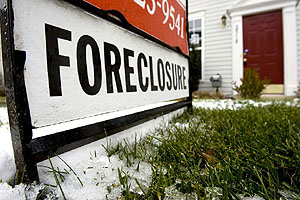
Right. l think the most overlooked element is the disaster is George W. Bush's 2002-2004 campaign against down payment requirements for obtaining mortgages, which signaled to his federal regulators not to take the punch bowl away when the party gets interesting. In California, where something like 5/8ths of the defaulted mortgage dollars are found, the % of first time home buyers putting no money down increased from under 7% under Clinton to 41% in 2006, the worst year of bad lending.
I'm struck by how few liberals have mentioned Bush's anti-down payment jihad. For example, on June 18, 2002, Bush orated:
"Well, probably the single barrier to first-time homeownership is high down payments. People take a look at the down payment, they say that's too high, I'm not buying. They may have the desire to buy, but they don't have the wherewithal to handle the down payment. We can deal with that."
http://www.hud.gov/news/speeches/presremarks.cfm
Subprime Fraud
Had regulators merely clamped down on mortgage fraud, this all never would have happened. That was Alan Greenspan's responsibility, and he was warned about it.
The crisis
Kevin is absolutely right that we don't now have a good understanding of just how the crisis was set off and propagated. That includes Rogoff, Krugman, Roubini, Johnson, Buiter, Ackman, Roach and myself--people who were worried about the housing and credit bubbles before they popped, and the financial instability that would result when they did. If you actually read what these people wrote in advance of, say, July 2007, it's clear that each got only elements of the story right; the actual crisis has unfolded rather differently. (For one, a run on the dollar was a key element of almost all crisis predictions; just the opposite occurred.) More generally, the popular "greed and willfull blindness" story has considerable merit--there are plenty of obvious villians--but it's also too easy, and at bottom intellectually lazy. There's always greed and willfull blindness when there's money to be made; the systemtic fragility the system demonstrated required a whole chain of things to go wrong. The narrow populist thrust of the "greed and willfull blindness" story also ignores the very broad political constituency behind the bubble. Millions and millions of people rode it: your local real estate agent, local home builder, local mortgage banker, local plumber and carpenter, your friends flipping houses, you and your friends refinancing and extracting equity and then doing it again. The broad social basis of a bubble of this sort is why, historically, government intervention is essentially never preemptive. Everyone's making money and nothing has gone wrong yet. Even deeply nervous regulators knew that stepping in front of that would simply mean having their heads handed to them.
Matt: Kevin is absolutely
Matt: Kevin is absolutely right that we don't now have a good understanding of just how the crisis was set off and propagated.
Nor do we need to. More important is in what way the system was fragile. If you build a house of cards and it falls down, does it matter whether the collapse was triggered by a breeze from the window or someone jumping on the floor? No. Does it matter whether the cards fell on the table or whether they slid down onto the floor? No. What's important is that you know a house of cards is fragile and almost any little thing can bring it down.
In that the system was fragile, and known to be fragile ahead of time by economists who weren't willfully blind, is well established. There is also pretty broad agreement on how it was fragile. Mostly they differ in terms of emphasis and presentation. For example, Dean Baker talks about the housing bubble (which he was pointing out in 2002) as being something you could see by comparing long term and short term trends in housing prices. Despite what Kevin Drum said, I've never heard Baker dismiss derivatives as an enabler, it's just that his emphasis is on the effect rather than one of the causes.
>> You are an idiot. This is
>> You are an idiot. This is the last time I'm reading this blog
>Been reading Mr. Drum since the CalPundit days. I doubt very much he is an idiot.
>He is, however, a sensibly sensible suburban centrist who seems to think that
>nothing is ever really bad
I've been reading him that long, too. And I think you are mistaking tone for substance. Kevin is optimisitic, it's true. And he's committed to a bunch of things. Universal healthcare, CO2 regulation, credit card regulation, gay marriage, and no more torture, to name a few.
However, he writes not as a fiery partisan, but as your friendly neighbor. Which is perhaps why he has so many readers.
...
... don't forget the kitties!
My reading of the situation
My reading of the situation is that we're bottoming out, but that the economy will just drift along the bottom for a long while. Things aren't going to get much worse, but unemployment isn't going to improve for a long time, people aren't going to spend again like they were a few years ago. Home prices are going to stay at 2001/2002 levels for at least five years or so, particularly if long term interest rates start heading up again, which, given the amount of debt the Treasury is taking on to get us out of this mess, is highly likely.
And if you live in California, it's going to be twice as shitty for twice as long.
Unemployment
Unemployment is the real kicker. Globalization has ensured that we will never have the jobs in the US again that built a middle class unless we enact severe a protectionism agenda. So, we lose or we lose.
Long term picture is that manufacturing will likely never return to our shores, which means severe wage deflation. We can survive this as long as prices of everything else, especially housing, come down to meet a lowered wage standard. What we can't have is high living costs/standards of living and low wages coupled with high unemployment.
it is disconcerting
Although some economists and a few others attempted to point out the problems of the finance industry and the economy as a whole prior to the crash, there were thousands of business persons and their associates who were reaping huge rewards in the market place. The money these business persons were 'earning' and the concomitant political power such money provides were able to bury any rational analysis of what was actually happening to the economy, and politically block any attempt to regulate the markets. One reason it is so difficult to make determinations about what occurred is because of the political machines theses 'business persons' were able to finance in order to prevent public discussion about economic fundamentals and the consequences of capital misallocation.
What is disconcerting, however, is that people who supposedly want to understand the economy are unable to recognize how the power of wealth distorts discourse about it. The competition between those who advocated for a rational economy that benefited everyone were drowned out by those receiving the misallocated wealth. Wealth in America refers respect and wisdom to those who accumulate it, even if the wealth was not earned by adding value to goods and services, and many people cannot recognize it as illegitimate.
China
It's the trade deficit.
Why did homeowners keep inflating the bubble? Low interest rates on cheap savings-glut cash.
Why did banks and hedge funds and pensions need to get absurdly over-leveraged? It was the only way to get good returns in a savings-glut world.
Why did all the toxic crap get sold faster than it could be printed? Because the risk premiums on everything normal had fallen through the floor when the sovereign funds flooded into the market looking for dollar assets.
This is the result of the global financial imbalances that Setser, Roubini, and others have been warning of for the last five years or more. The specifics of our meltdown are different than the predicted scenarios, but the fundamental causes are the same.
Alternatives cheaper than oil?!
MarkH,
Throw in the Iraq war and any other war and oil has been, by far, the cheapest source of energy the world has ever seen. Solar is at least eight times as expensive. Wind is pretty good, but limited. Geothermal is great - but we've tapped all the good locations. Tidal energy - maybe, but I wonder about the maintenance required for all the zillions of generators. Things clog up fairly quickly under seas. I just don't see any alternatives that will be as cheap as oil has been.
And I don't think it is fair to compare computer technology with energy. That is really apples and oranges. Computing power won't feed your kids. It takes energy and potable water to do that, two things that are nearing their peak.
Tripp
tpx, wealth is power,
and wealth accumulates, and those with power don't give it up. That is why the stable state for capitalistic societies is for the rich to get richer and the poor to get poorer.
Inequity in wealth has been given just a small amount of attention since at least the 70's. I think part of that is because as long as the non-wealthy standard of living was rising, at least a little, no one really cared. If that rise is over people should start to care, but my guess is that it will take a serious threat of a violent change before anything much will be done about it. Look at how strongly and furiously the weathiest have rebuffed and attempt at increased taxes so far.
Tripp
the result of income inequality
The mass murders of Rwandan Tutsis by Rwandan Hutus was a result of income inequality. Economics was the source of the conflict, not race.