
- ‹ previous
- 1051 of 2798
- next ›
Financial Innovation
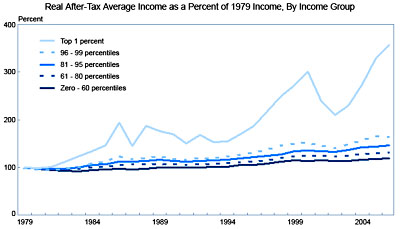
Niall Ferguson thinks that if deregulation is to blame for our recent financial collapse, then financial deregulation should also get the credit for the preceding 27 years of economic growth. Matt Yglesias takes a look at income growth over that period and isn't so sure:
For the top one percent, that’s a pretty impressive period. For the next 19 percent, there’s something happening. But for the bottom 80 percent, there’s just very little going on in terms of real income growth. There was, however, pretty robust consumption growth fueled by the credit boom and declining savings rates. The current downturn is now threatening that and calling into question the sustainability and worth of the overall growth throughout the period.
This is a kissing cousin to the question everyone is raising these days about financial innovation. It goes like this: the basic benefit of all the financial innovation we've seen over the past few decades has been to make credit more easily available, and that clearly had something to do with the credit boom and subsequent bust. This in turn begs the obvious question: was it really a good idea to make credit so easily available? If the answer is no — if the only result was to mask stagnant wages and produce a fake consumption boom — then maybe all that innovation wasn't such a hot idea in the first place.
This is rapidly becoming conventional wisdom, and Matt's point deserves more attention as part of it. For good or ill, the modern economy is driven by middle-class consumption. If middle class wages are rising, everything is fine. They'll consume more, debt will stay tolerable, and rich people will benefit from the growing economy. But if middle class wages are stagnant, then vast pools of money are increasingly directed toward the rich, who have a limited ability to spend it. So they end up loaning it back to the middle class, collecting economic rents along the way, and the middle class laps it up, figuring that their wage stagnation is just temporary and they'll eventually pay all the money back.
But they don't, of course, because today's rich have no intention of ever allowing wage growth among the middle class. The result, eventually, is disaster.
I realize that most economists will never believe this until someone says the same thing accompanied by several dozen pages of equations with lots of Greek characters. So can someone please get cracking on that?














"Begs the question..."
Must you promulgate the contemporary (mis)use of the expression "begs the question"? I tend toward language descriptivism and not prescriptivism; yet in the case of "begs the question" there is a perfectly useful (and far more unambiguous) expression, "raises the question"...while the older, technical meaning of "begs the question" is being erased.
Besides which, preferring "raises the question" would avoid provoke nags like myself.
must you be such a huge nerd?
Marx lives
Sounds like a Marxist posting. And while Marx was a lousy prophet, he was a insightful critic of capitalism.
I think the problem was more an agency problem, the people who were charged with investing wealth by lending it to an increasingly impoverished middle class were looking after their own personal gain, rather than determining whether the investments could ever be repaid. Financial innovation merely served as a fig leaf for self-aggrandizement by the people managing the wealth.
I agree, macroeconomics has a lot of work to do concerning class and its impact.
I hope Adam Davidson of NPR
I hope Adam Davidson of NPR Planet Money doesn't read this post since he will undoubtedly phone you and browbeat you like he did Elizabeth Warren.
The rich love beggars and
The rich love beggars and monopoly rents.
supply-side gardeners
Applying more fertilizer is the sole tenet of supply-side gardeners.
The notion of balance never enters their minds.
Ack, my eyes! Kevin with
Ack, my eyes! Kevin with "begs the question" again!
Regulation is not binary
I agree about excessive credit fueling the bust, but not about "regulation/deregulation" -- it's not a binary. Banks have lots of regulations, and page for page, probably have more now than they did 20 years ago (think Basel 2).
Instead of "regulation" vs. "deregulation", lets talk productive vs. unproductive vs. counterproductive regulation. If we end up with only 10% as much regulation as we have now, but it's all productive, surely we'll be better off; if we end up with 200% as much regulation, and it's mostly counterproductive, I'm not looking forward to the next bust.
From David Macary in today's
From David Macary in today's Counterpunch:
" What happened next was hideous. Loyal employees woke up one morning to find that not only had their standard of living been hollowed-out, but that they had been stripped of their dignity as workers. Instead of being proud union warriors, they were now palace eunuchs."
The castration had been a three-step process. Initially put in motion by the Taft-Hartley Act, way back in 1947, it was followed, sequentially, by policies of the Reagan and Clinton administrations, and culminated in the “team-building” philosophy of corporate HR. Since then, of course, everything has gotten worse."
Bingo. This should have been
Bingo.
This should have been blindingly obvious to everyone once political conservatives started printing huge pieces in the NY Times about how we didn't actually have an income inequality problem in the US because poor and working class people could still buy whatever they wanted.
Just because you want to believe something like this could be true...it isn't.
Damn Liberal press!
tagged as:- solution
One of the earlier posters mentioned that the Rich were using monopoly rent and another said the Rich love beggars and another suggested the Rich weren't being as careful with their lending to the working class as they should've been.
I agree and add (something obvious) that they've been holding the working class in a slow decline for decades with credit cards and health care costs and education costs slowly driving everyone into bankrtupcy.
But more than that, they've been shifting chairs on the Titanic and claiming they're building Value. Hooey. If we had gone into the Green Revolution in 1981 instead of this garbage we could have invented new useful technologies and built real Value.
Now all they want is to get free of America (and use over burdensome regulations or a Socialist president as their arguments I suppose) so they can go to Russia and China where there is little competition (something they claim to like, but avoid with every breath of their "bodies") and little regulation. I hope they enjoy the scenery and the militaristic governments which might treat them to some jail time.
Yes, we've 'saved' the world for Capitalism and perhaps democracy, but the Rich prefer fascism and those which can are likely to embrace it even moreso in the next several decades. I hope they're successful and I hope Americans own shares in those companies, so they can benefit too. Just please, save us from all this nonsense of trashing America before venturing abroad.
Now government needs to get a handle on the worst of our problems and talk about that awful "R" word 'Regulation'. But, not so much as to stifle real growth.
Along with that I hope they do something a little less obvious and not so easy: discuss the built-in incentives of our system which have driven us into this corner where trashing another company is an easier way to gain market share than to do something new and risky. We can't tolerate 'destructive capitalism'. It's simply unacceptable.
Let the good times roll
... but it sure was fun while it lasted. (BTW, the banking part was well regulated, and still is. So far, nobody's lost money in their checking accounts.)
Your description sounds like
Your description sounds like underconsumptionism to me - underconsumptionism plus easy credit.
They certainly have.
"I realize that most economists will never believe this until someone says the same thing accompanied by several dozen pages of equations with lots of Greek characters. So can someone please get cracking on that?"
Oh, they certainly have. You can find dozens of papers on this in Google Scholar. The problem is, the field is non-vertical. That is, economists write papers, present model X or Y, and people read them and go, that's interesting. And they they write their own paper, modeling Z or A, and on it goes. Since there are no criteria for empirical validation, the modeling effort is driven almost entirely by novelty. The result is a field with very little established wisdom -- and the orthodoxies that do exist are mainly about foundational assumptions that are rarely questioned, let alone tested.
Your description sounds like
Your description sounds like underconsumptionism to me - that plus easy credit.
They're aliiive!
Health care costs are unrestrained.
Oil costs drain the domestic economy.
Wall St. has been sucking in far too much (unbeknownst to most of us).
Unnecessary wars are immoral and wasteful.
Education costs are ridiculous.
Fixing these real world events (slow disasters really) is crucial and the Obama administration has tackled them. It's a ridiculously huge agenda, but it wouldn't have been if government had taken them on earlier.
The wealth divide is related.
The savings rate is related.
The state budget problems are related.
The drug problem and iillegal immigration are related.
The Israeli-Palestinian-Al Qaeda-Pakistani nukes problems are related.
If an entire generation grows up wondering what their parents were doing while the world rotted under their feet I won't be surprised.
Subprime credit
The final bit of irony, as I see it, is that all those rich people with more money on their hands than they knew what to do with ended up investing a whole large chunk of it in mortgages, because housing has always been a safe investment, not quite getting that all the corporate policies they had supported to keep wages low might make it less and less likely that Americans would actually be able to afford the mortgages on their property.
regulations
"Banks have lots of regulations, and page for page, probably have more now than they did 20 years ago (think Basel 2)."
Apparently you are unaware that one of the main ways the Bush administration pursued it radical deregulation policies was to leave the regulations on the books unenforced.