- ‹ previous
- 1035 of 2825
- next ›
Regulatory Reform
The Washington Post reports on the Obama administration's plans for regulatory reform of the financial industry:
Senior administration officials are considering the creation of a single agency to regulate the banking industry,
replacing a patchwork of agencies that failed to prevent banks from falling into the worst financial crisis since the Great Depression, sources said.
....Senior officials [also] favor vesting the Federal Reserve with new powers as a systemic risk regulator, with broad responsibility for detecting threats to the financial system. The powers would include oversight of previously unregulated markets, such as the derivatives trade, and of market participants such as hedge funds.
....The new [bank] regulator would assume responsibility for the safety and soundness of banks, currently divided among the Fed and three other agencies: the Office of the Comptroller of the Currency, the Office of Thrift Supervision and the Federal Deposit Insurance Corp. The OCC and the OTS would probably disappear, while the Fed and the FDIC would retain other responsibilities.
For what it's worth, I'd say that having a single bank regulator is long overdue. The current structure not only doesn't make sense, but allows banks to shop around for the most lenient regulator they can find, prompting a race to the regulatory bottom. It's also a problem for big banks, which end up under the regulatory authority of multiple agencies.
The "systemic risk regulator" I'm less enthused about. It's not necessarily a bad thing, but it's not clear to me that it would have done much to prevent the asset bubble of the past decade. After all, the problem there wasn't the lack of a central regulator, but the simple fact that no one felt like there was a lot of risk in the system in the first place. Regulating derivative markets may be a good idea, but the real issue isn't giving the Fed additional powers, it's getting it to take systemic risk seriously in the first place.
In any case, I'll repeat something I said earlier: specific regulations are all well and good, but I'd sure like to hear first what general principles are guiding these decisions. My picks are (1) stronger limits on leverage, wherever and however it occurs, (2) a stronger commitment to countercyclical policies, and (3) a little more sand in the gears. These might be the wrong principles to choose, but if they are, I'd like to hear which ones are right before a tidal wave of regulations comes heading down the pike.






replacing a patchwork of agencies that failed to prevent banks from falling into the worst financial crisis since the Great Depression, sources said.


Accountable
Charging the Fed with systemic oversight is fine, but giving it more authority is a bad idea. I don't subscribe to the often hysterical conspiracy theories about the Fed, but there is no denying it is a quasi-independent quasi-private .... thing of some sort, with somewhat conflicted goals. If it is charged with systemic oversight, it should be given to right to extract whatever information it needs from any and all financial entities. But the actual enforcment should be lodged in the executive branch, which is (eventually) accountable to the public. (The currently independent SEC is clearly broken and should be reconstituted in the executive branch.)
Come on, the Fed is
Come on, the Fed is appointed by the banks! Talk about your fox watching your hen house....it seems to me the Fed has designed a system to reward banks (and others) for their predation of retirees, students, and other "have not's" in our top heavy class system. We need deep reform and we are getting window dressing.
not be subvertable
I think a key principal should be that new regulations continue to work even when a boom physiology takes hold and rationality goes out the window.
A key thing to keep in mind is that the banking system will figure out how to get around relations that get in the way when things are good.
This is my problem with principals like "limits on leverage". There always has been limits on leverage. Banks avoided the limits with tricks like using off balance sheet vehicles. There are always ways to hide leverage.
As an example of the kind of regulation I would like: banks should be required to have all debt they issue be convertible to equity in the event of certain regulatory events.
This would in effectively reduce leverage but when a boom comes no one will feel the need to get around the rules because they will feel the regulatory event will never happen.
Greenspan tried the
Greenspan tried the countercyclical stuff in a economic/political sense. He pumped up the bubble whenever the GOP was up for reelection. The normal tendency would have been kick the buffoons out of office so he did a remarkable job of damping fluctuations in political power.
Former Bank Examiner
The idea of a single bank regulator has been around since at least the early 80's.
The idea then was that the FDIC, OCC and Federal Reserve would all kind of merge. The problem came when the top people at the FDIC and the OCC realized that they were going to give up almost all their power.
It was a good idea then and it is a good idea now.
Does anyone reading this really have a clue what the OCC does? Do you even know what the letters "OCC" stands for?
The S&L crisis would have been far smaller if the FDIC had regulated the S&L's just as the FDIC regulated Savings Banks. The FHLBB and FSLIC basically would be out of a job if they shut down all the insolvent S&L's. So, rather than doing the right thing and following the law, the S&L regulators played all sorts of tricks to pretend that the S&L's had adequate capital. While over at the FDIC, we shut down the insolvent Savings Banks. Of course, we had the commercial banks to regulate so it didn't threaten our jobs.
One more question: what is the difference, or what was the difference, between a Savings Bank and a Savings and Loan?
"After all, the problem
"After all, the problem there wasn't the lack of a central regulator, but the simple fact that no one felt like there was a lot of risk in the system in the first place. "
Yes, lots of big, sophisticated players got caught long during this bubble, but maybe they recognized the risk, and just got caught standing when the music stopped, before they could unload their positions on the rubes. I get the impression that plenty of people knew they were playing with fire, using other people's money.
About Time
I, too, like the single regulator idea. I'm underwhelmed with more power being given to the Fed. If the Fed wants that level of power then the taxpayer backstop should be removed from the tool box. Taxpayer money should only be on the line from a fully transparent, government controlled agency.
Further, there has to be a way for the SEC to be independent enough to tell the President of the United States to go pound sand when said President tells the agency to loosen regulatory standards to as to "not create an environment hostile to risk taking." Either the SEC is there to make sure business is conducted in a honest and ethic manner or it isn't. There is no middle ground.
I like Kevin's ideas, but I
I like Kevin's ideas, but I think he is comparing apples and oranges.
One issue with regulation is that it should be efficient--banks should know who they have to answer to, and nobody should be able to skirt regulations because certain types of institutions fall between the cracks. It looks like the Obama Administration is working with Congress on this issue and will eventually make significant progress.
The other issue is the type of limits that should be placed on financial institutions, which is what Kevin refers to as general principles. Once we make the regulators efficient, the question arises as to what they should be doing efficiently. It would be entirely possible to address this issue with separate legislation than what will pass in regards to the first issue. However, while dealing with the first issue is helpful to banks, dealing with the second issue (though it probably is helpful in the long term) is constraining to banks. Thus, this second issue is a tough fight, and there may not be any interest in it from Obama or Congress.
Nice to see him finally catching up, but yes he is mixing apples
and oranges. And Melons.
First, confusing Bank Supervision with Financial Sector oversight is inappropriate - under most best practice models international, regulation is by three major cones, Capital Markets, Credit and Insurance. Universal banks usually end up with multiple regulators, however they have only ONE for a particular business line (e.g. lending / credit). That reduces the gaming of system opportunities. Some systems have the Deposit Insurer as a separate entity, others don't - but I do think the US is fairly unique in having the deposit insurer as an effective Supervisor. In any case, FDIC and US Fed overseas have decent reputations. The others.... well it just puzzles the observer as to why anyone would think a byzantine, balkanised regulatory structure is a good idea.
(PS for the American bank regulator supra, OCC is Office of the Comptroller of the Currency, and it has over the years entirely escaped me as to why it exists in any manner for banking).
I would agree as well on the complete separation of the Regulatory Principles (there are already bodies doing standard setting: Bale Committee notably) from dealing with the inefficient and clearly broken Regulatory Structure. It is not evident to me as a financial sector actor that the best Regulatory Principles as on the books in the US per se failed, rather than the Structure failing due to ineffective implementation of the same. The "better" US regulators actually made very cogent arguments in the international arena on areas that have proved weak in Basel II, notably the models approached favoured by the European regulators more heavily. In any event, tweaking Leverage rules (and for what entities, Drum continues to lump very different beasts together willy nilly) is something a strong unified Credit Regulator can do - in particular if it is insulated from political interference. The Greenspan example merely indicates, I would note, that if one appoints an ideologue to a good structure, he can still do damage. It does not indicate the model is broken - a multi central bank comparison rather indicates the contrary. So just get your appointments right.
Have You Read the Post Below ? I know You wrote it.
Dear Kevin Drum
There is a certain tension, almost cognitive dissonance, between this post and the post below. In the post below, you agree with Bill Clinton that the repeal of Glass-Steagal was no biggie. Here you argue that it is terrible to have competing regulators who are financed by fees paid by regulated firms inevitably causing a race to the bottom.
How did we ever get such an absurd regulatory system which seems to have been conciously designed to prevent actual regulation ? That would be by the repeal of Glass Steagal. The problem isn't that the barriers between say financial services companies and insurance companies were removed. The problem is that the barriers between the regulators weren't removed.
Firms could switch from sector to sector and their regulator couldn't follow them. Back under Glass Steagal a firm couldn't choose its regulator because it wasn't allowed into the business of the desired regulator.
To put it another way, the problem with the bill was not that it allowed AIG to set up AIG-Financial products, but that it allowed AIG-FP to find a way to be regulated by the office of thrift supervision.
Oh and I don't doubt that the regulatory system left by the repeal of Glass Steagal wasn't deliberately designed to allow a race to the bottom and prevent regulation insofar as that was possible. The chief architect was Phil Gramm who has made it very very clear that he thinks the main problem with regulation is that it exists.
Kevin, please, never do this again ...
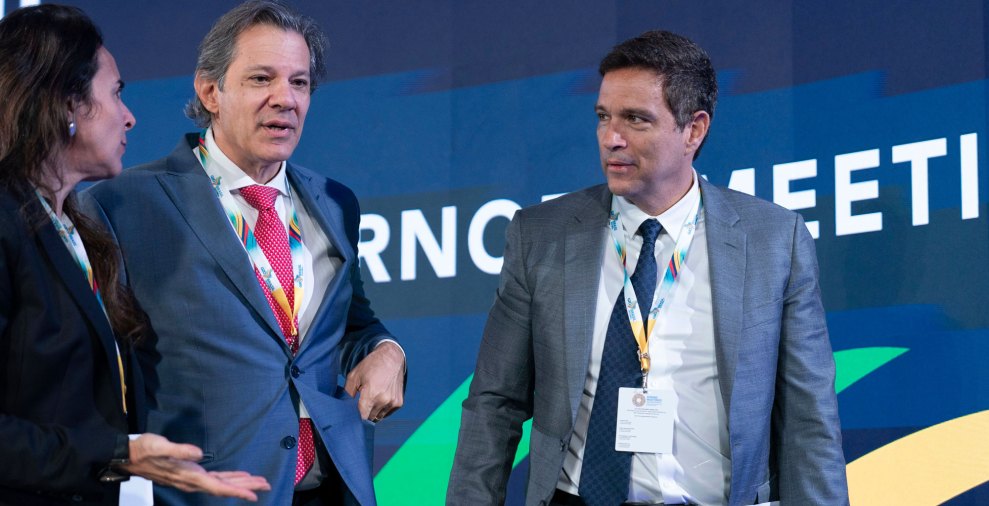
Am I the only one who really, really hates the type of "graphic" accompanying this post?
Over the last few years, this "stylized people with broad shoulders in business suits" clip art dreck has been infecting everything from business magazines to powerpoint slides to the stupid handouts you get from your bank or insurance. They make my eyes bleed. Please, can we keep them out of my favorite blog?
And who came up with that stuff, and where do they live?