- ‹ previous
- 580 of 2836
- next ›
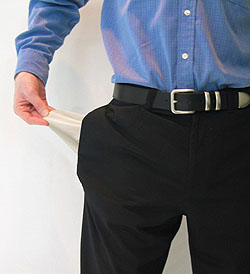
Empty Pockets
The New York Times reports that Asian stock markets are down and the rest of the world is following:
“It’s almost an Asian flu that the markets caught today,” said Art Hogan, the chief markets analyst at Jeffries & Co. “Creeping into the conversation now is, when do we see top-line revenue growth? When is the consumer going to take over from government stimulus? But the answer is consumer data has been less than spectacular.”
Well, yeah. That's always been the problem.
Eventually, recovery has to be fueled by consumer demand, and it's just not clear where that's going to come from. Rising middle class wages? Nope. More credit card borrowing? Obviously not. Drawing down savings? Just the opposite is happening. Tapping into home equity? Forget it. Neil Irwin sums things up in the Washington Post today:
"Credit fuels housing. It fuels consumer durable goods. It fuels business investment. It's in every part of the economy," said [Carmen] Reinhart, an economist at the University of Maryland. "Credit makes recessions after a financial crisis longer, and all the signs are that [it] is happening this time as well."
A related head wind comes from American consumers. The financial crisis and recession are reversing a 30-year trend carrying Americans toward a high point in debt. The ratio of consumer debt to the nation's total economic output rose to 97 percent in the first quarter of this year from 45 percent in 1975.
Currently, Americans are saving more and paying down debt; the savings rate was 1.2 percent of disposable income in early 2008. By the second quarter of this year, that rose to 5.2 percent.
"The household sector has never been so stressed," said RGE Monitor Chairman Nouriel Roubini, who predicted the crisis and recession. "Savings has to go much higher, and that is going to slow growth of consumption even once incomes start growing."
Every dollar that Americans save is one fewer dollar for consumption, which means less economic output. When the savings rate goes up by a percentage point, spending decreases by more than $100 billion, according to the McKinsey Global Institute.
My Netroots Nation panelists might have all broken my heart by not opposing the reappointment of Ben Bernanke, but they were also unanimous in calling for a second stimulus. Politically, that's not in the cards right now, and I think it's defensible to suggest that we wait for the current stimulus to really kick in before considering a new one anyway. Still, even if the worst is over, no one has been able to point to a mechanism that will cause consumer demand to grow significantly over the next few years, and without that we have a very long, very swampy slog ahead of us. Until the debt overhang goes away and middle class incomes start to rise, the U.S. economy is going to stay fragile and vulnerable to shocks. It's hard to see much of a silver lining here.


Worst Not Over
The recent run-up in stock prices is bad for everybody, but especially bad for the Obama Administration. I predict the debate on whether to reappoint Bernanke will get more interesting as it becomes clear that the worst is not over.
As you note, just about everybody who studies these things agrees that U.S. consumers will not be able to resume their freespending ways. Yet the mainstream narrative has rushed ahead to recovery mode. Expectations need to be adjusted...
Debt/Income Table
http://www.monthlyreview.org/docs/0506tbl1.pdf
To spend money on
To spend money on entertainment, vacations, cars and other durable goods, consumers have to feel confident that they'll be able to handle the costs involved into the future as they finance these things. Right now, the only thing most people can think about is: 1. how they're throwing huge sums of money at upside down mortgages that the idiot banks won't modify and 2. there's little or no prospect of either getting a raise or moving to a better job because there are no jobs and even if you found one, you couldn't sell your house and still have enough left over to buy a new one. The Obama administration and the Fed are going to have to stick a much bigger fire under the assess of the banks and mortgage servicers to get people out from under these mortgages so they feel that they have some breathing room to spend again. And to those who say this is "rewarding" people who made "bad decisions," well, yes, in some cases it is. But you would rather we spend a lost decade like Japan, or reward a few foolish people and get this economy moving again?
I Would Prefer the Lost Decade Like Japan
Is that unreasonable? Couldn't we just slow down for 10 years, while increasing the safety net and making strategic investments for the future? I'm all for getting people employed productively, but don't want to prop up private industry (banks, autos, homeowners & builders) to do so. Let the prices fall so that we can afford things again. Let imported prices rise so we don't buy things we can't afford...
Basically it is unreasonable
Basically it is unreasonable when you have a nearly $12 trillion Federal debt and a fiscal deficit in excess of $500 billion- projected to go to nearly a trillion.
Unreasonable
Again, why is it unreasonable to reduce spending and the fiscal deficit? The Federal debt is going to be defaulted on long term, no other way around that. You can only goose the economy for just so long on credit to mask stagnant wages until the piper comes home to be paid. Everyone rode this gravy train for as long as possible, but it is over and not coming back. We are shedding low-skill jobs at an astronomical rate and those simply will not be coming back. Sure, we are adding high-skill jobs -- but take a look at the average American...not high-skill.
Kevin is right, expecting a recovery based on middle class consumption is vaporware. I don't know a single person who isn't ratcheting way back on spending and saving more. Many are pulling their money out of the TBTF banks like BofA and heading to credit unions.
Zero Hedge had a post up over the weekend showing just how much of a mess the finances of the average consumer are:
http://www.zerohedge.com/article/detailed-look-stratified-us-consumer
This is a tempting, if
This is a tempting, if somewhat cynical, solution. But massive deflation is not pretty and throwing more people out of work by driving down consumption is a blueprint for sliding into a greater depression, or at the very least, a much lower standard of living. It's like saying inflation is good because it means that you'll get paid more.
That's ...
exactly the kind of thinking which made Detroit what it is today, Dan.
Wrong consumers have the cash
Giving all the money to the very wealthy just did not work out so well. More wealth needs to be funneled down to people who will spend it. The second quarter bump can be attributed in part to the rise in Social Security payments. Maybe it is time to tax stock transactions, hence draining the financial sector a bit and use the money to pay down student loans for unemployed and low income student loan holders. This would be a twofer. First you would lower the debt level, while at the same time freeing up the same amount of cash and putting it in the hands of people who would spend it almost immediately. The wealthy have so much money they would not notice a 5 cent per share tax. Heck it may even be enough of a tax to stop the Goldman Sachs HFT programs. A tax to stop a problem instead of a regulation that may be cooked seems a better idea.
Guns into Art
Stop being a tool.
Actually what worked out really well was giving people the ability to get rich, that's how this country grew GDP to $14 trillion from, well what was it in 1776? It's why we have, among many other benefits, the highest standard of living in the world.
Of course if you think the 'rich', as you call them, as some homogenous monolithic group ,well then you will never understand just what the 'land of the opportunity' means.
Liberals complained for years that the 'rich were getting richer' all the while the standard of living went up in this country. Well now the rich have gotten poorer much to the detriment of the entire country. So no, I don't think we need any more disincentive to invest, so nix-ay to your stock tax.
One final point. It's not just the 'greedy' bankers who caused this problem, it was the politicians from both sides of the aisle so stop being a tool of the media and point your finger and anger at the folks who laid the seeds to this mess.
the rich
Kevin Philips has documented very well that most of the rich come from money. Yes people work hard and get rich, but most come from money. Also, if you are rich you are rich. You can afford more taxes. I have a friend who is very wealthy. He has a Modigliani hanging behind a lamp. He spends $50,000 a weekend for race car driving lessons and he keeps getting much richer. I think he can afford to pay a bit more in taxes.
One of the the problems,
One of the the problems, well it really isn't a problem because they know the fallacy of it, is that Progressives use 'static economic model'. The shocking truth is that people move up and down the economic scale. And saying that the rich come from money doesn't mean that they are rich.
As for your friend, God bless him that he can spend his money as he sees fit. But with top tax rate approaching 58% in three states- California being one of them- I don't think confiscatory tax rates are good for anyone.
How much income is actually taxed at 58%
If you think that the top rate in CA is actually anywhere near 58% of actual income, or even that the marginal rate (which is all you can be talking about) is paid on something like every dollar brought in over the threshold then you are seriously demented.
Also, one of the problems is that anti-progressives ignore the stickiness of the economic scale. They use anecdotes to pretend that "anyone can be rich." It's a nice fairy tale, but it doesn't reflect reality.
Who got rich?
There is very little social mobility. Most people stay in the same social class in which they were born.
Tax protesters often claim that the US has the highest standard of living. It may be true that suburban Caucasians live to the highest standards, but much of Europe ranks higher than the US in Human Development Index measurement. The US is 15th. The high-tax Scandinavian countries and France are ranked higher.
The silver lining
This patient has suffered extreme financial distress, but is now under the care of grownups. THAT is the silver lining. It doesn't mean the patient is now fine and can stand well on his own two legs, but it means things are getting better.
The painful thing to see is there are still greedy bankers who really don't seem to give a damn who suffers so long as they make their huge unearned bonuses and there are insurance companies who continue funding lyin' politicians to stop health insurance reform.
Being flat on your back in a hospital bed where you'll likely be for a while and hearing the bankers and insurance company execs fighting over who gets your money is not easy.
Credit
Jon Carroll had some pithy comments in his column this morning from the banking industry spokespersons regarding their thoughts on the 'profitibility' of extending credit to small business.
http://www.sfgate.com/columnists/carroll/
How do these people live with themselves?
Yes, that's quite an article
Yes, that's quite an article by ol' Jon. Most of the article is about Dear Abby's advice of letting a 7 year old boy use a public bathroom. He does manage to get a few words in about wanting to rip the larynx out of bankers who won't lend money to small businesses. He makes no mention of the fact that the Banking regulators are scrutinizing every loan banks make these day , especially to small business. Even line of credit renewals- which use to be a breeze are bogged down in loan committees. Not exactly your 'greedy banker stereotype.
You might want to get your uh economic news from some place else. Might try the WSJ or Bloomberg or something.
fearmongering
The health care reform "debate" is also playing a role in consumer confidence. People are afraid. When you propose doing a study to see what treatments work, and that is categorized as "rationing", and intelligent people I know are afraid they'll lose the care they have as a result of this plan...they're not going to spend their money. The town hall meetings, at least the ones that make cable news, show people expressing totally irrational fears--with audience support. The astroturfing is working--and it is scaremongering (health care reform=destroying our constitution???). Talk about fearing fear itself...
MarkH is right, the silver lining is that adults are now in charge of the Whitehouse. And the Republicans I know are tired of the nonsense and lack of positive goals shown by their party--but the underlying fear is still their... Anyone an expert on group dynamics???
So to sum up: stimulus we
So to sum up: stimulus we need, not so much, health care reform that's on the wrong track, that we can do.
Woohoo! Next time I'm going to vote for the Democrat.
The paradox of thrift
Am I alone in noting that what we have here is something of a rebirth in the mainstream press of Keynes's argument, referred to in shorthand as "the paradox of thrift"? Wikipedia phrases it (correctly) thus: "The paradox is, narrowly speaking, that total savings may fall even when individual savings attempt to rise, and, broadly speaking, that increases in savings may be harmful to an economy."
In today's context, it's seemingly apparent that a higher sersonal savings rate is almost a necessity. From aroung 1960 to around 1985, saving as a percentage of disposable personal income averaged about 8%. Beginning around 1985, it declined steadily until, by 1999, saving was negative. It averaged around 3% from 2000 to 2005 and around 1.5% from 2005 to 2008.
My best guess is that we will see a (long-run) return to something more like the 1960 to 1085 average, which means nearly a doubling of current (in June) 4.6% rate.
But to move to that high a savings rate immediately would clearly make recovery from the current recession much more difficult.
Why is it a problem that. . .
. . . we're not buying more environment-destroying crap?
Just askin'.
No economy can grow when too
No economy can grow when too many of its participants no longer have discretionary incomes.
Yes, it's that simple
Yes, that's correct and indisputable, the middle class doesn't have enough after-tax income to sustain the consumption necessary to keep the economy moving in this country without resorting to unsustainable borrowing.
Meanwhile, huge amounts of wealth are accumulated by the upper class. Usually that would be used for investment, but why invest when not enough consumers can afford to buy? The problem is not that there is insuffcient investment, it's that there is not sufficient consumption to drive that investment.
The solution is easly to see: much steeper marginal tax rates, scrapping the cap on social security contributions, a tax code that is neutral between labor and investment income.
But none of this will be done, of course. So we're fucked.
Nutroot!
Nutroot!
Paradox of Thrift Resolved
It's not really a paradox that the economy is in trouble because people borrowed and spent beyond their means. It's straightforward that household balance sheets need to be repaired.
One way to repair household balance sheets is to tax the rich and give to the poor. Another way is for the government to print money and help households get out of debt. Another way is to beef up the safety net. There are lots of ways to help households without encouraging them to rack up more debt...
It doesn't help that health
It doesn't help that health care costs are a growing cancer on American industry and society. America's biggest generation just saw their 401ks turned into 201Ks and until we get health care reform we're not spending squat.
Mass, not middle-class, consumption
Not "middle-class" consumption but *mass* consumption has made this economy what it was. Okay, so everybody's "middle class" when you ask them, but still-- this is something so few in business and winger punditry seem to understand. New Deal programs got money in peoples' hands and they spent it; WWII saw the greatest downward distribution of income in our national history, and Sears and the Big Three profited from that as people with incomes bought cars and moved into new homes in the 'burbs. The Cold War economy sustained that until it began to falter in about 1973. Millions lived better.
Deliberate decisions were made that spread income around so the masses of ordinary people in America could be consumers. That came to drive 2/3 to 3/4 of the economy, for the first time in recorded history. Yet those who were getting rich off it, providing what these masses wanted, somehow convinced themselves that income is generated by some kind of magic-- at least the income of ordinary people; for themselves, the important thing was to change the laws so they could take in more. But ordinary people can't use laws for the same purpose. Instead, they have to close their eyes and rely on what others are willing to pay them.
Those same others, most of them, never understood, and can't understand, the wisdom of that effing socialist Henry Ford, who paid his line workers the outrageous sum of 5 dollars a day so they could afford to buy what they built-- what they mass-produced.
Maybe that specific consumption model isn't sustainable over the long term. But the current problem is much more due to those who can't understand their *own* interests enough to leave something on the table for other people so they can spend it and create profits for the willfully obtuse.
This of course leaves aside the obvious morality question, because those guys would never understand it anyway.
That's always been the
When you're maxed out on dept, then you have to make some money to pay off debt. How can we do that?
Trade surplus? No, wrong track.
Manufacturing? No, wrong track.
Natural resources? No, we have doubled the population since the 50's, so wealth as per capita natural resources has been halved, or worse in the case of non-renewables.
Fortunately, there are some good solutions.
1. Stiff the Chinese and other creditors.
2. Attack Canada and steal their oil to revitalize the US big car business.
3. I have long advocated selling the "M" states": Mexifornia, Mexizona, Mexas, etc., to bring in some bucks.
consumer demand to grow
consumer demand to grow significantly over the next few years,may be is good way to save economy.if the big company like nike publich new series: nike dunks high or Tiffany & Co. report one new Tiffany 1837 may be can force fans buy them in a short time.well,is not save,but obviously,can advance economy of the world.
invest
Growth in demand does not need to come from US consumers: consumer spending as a percent of gdp has gotten too high.
In the long run it needs to come from increased net exports. In places like China consumer spending as a percent of gdp is too low.
In the short to medium term it should come from investments that increase the capacity of the economy. Most importantly this should be based on investments in energy, both capacity and distribution. This will insure that increasing oil prices do not choke off the next boom.
Agreed that the U.S. has to
Agreed that the U.S. has to become a net exporter, but insufficient consumption is a global phenomena. If China is to take up the slack, it too will have to redistribute resources to ordinary workers in order to increase consumption. Currently, workers there are paid too little and have an insufficient saftey net. Meanwhile, Chinese corporations build up hoards of cash. The economic well-being of the U.S. depends upon this changing.
tax the rich like Eisenhower and grow the middle class
The income tax rates during the Eisenhower administration were very high for the top income earners, approaching 90%. This is the same era that created America's huge middle class. While the richest paid very high marginal taxes, almost everyone else was employed, able to afford one of those ticky tack houses and raise a family on a single wage earner's income. That elevated Americans' living standards to the highest in the world. With the reduction of marginal tax rates for the rich, living standards have fallen and Americans probably no longer have the highest living standards, especially when public goods like health care are considered. The history is clear, transferring wealth is what creates a middle class and sustains modern, consumer economies. Reaganism has destroyed America's middle class.
"The more you tighten your
"The more you tighten your grip, Tarkin, the more star systems will slip through your fingers."
―Princess Leia to Grand Moff Tarkin
You can kiss Obama goodbye in 2012. We're in for a jobless recovery, and the progressive compulsive obsessive lust for redistribution will result in policies which day by day just make things worse. Cap-and-trade, health care reform, ammnesty for illegals, increased taxes, reform of health care reform, whoo hooo!
I guess you believe a Star
I guess you believe a Star Wars quote indicates you are a serious thinker. Though I'm sure in a conservative circles that would make you an intellect.
Ha!
Let's hope that this doesn't catch on. I would probably die of laughter upon seeing Sarah Palin with a Princess Leia hairdo.
"You can kiss Obama goodbye
"You can kiss Obama goodbye in 2012."
Depends on the competition. The GOP has lost everyone in the field with a real shot except Romney. That's a might big roll of the dice.
Are you planning to find
Are you planning to find Cheap UGGS online?UGG has created a new series of UGG Classic Tall Boots which are approximate to the mid-calf.These boots are made of the first-hand sheepskin which touches comfortable but also feels warm.UGG Classic Mini Sale collection is available in limited colors,such as metallic gold and metallic pewter.