In The Blogs

Reading and the Whale

Should schoolkids be allowed to read whatever they want?  Or should teachers assign them specific books?  Here's the brief for the defense:

What child is going to pick up ‘Moby-Dick’?” said Diane Ravitch, a professor of education at New York University who was assistant education secretary under President George H. W. Bush. “Kids will pick things that are trendy and popular. But that’s what you should do in your free time.”

This whole debate seems odd to me because it conflates two different things.  In earlier grades, say 1-8 or so, we're teaching reading.  Within reason, letting kids pick books they're personally attracted to seems like a good approach since it's more likely to keep them interested in reading for its own sake.

But in later grades we're introducing them to the literary canon, and that's where it becomes more appropriate for teachers to pick the books.  American Literature is a subject, just like history or chemistry, and an expert in the subject ought to choose the reading list.

On the subject of Moby Dick in particular, though, I take issue with Matt Yglesias:

All that said, I love Moby Dick. Every American should read Moby Dick, it’s our great national epic and you can’t understand the country without it.

I read Moby Dick a couple of months ago.  I didn't care for it.  I'll spare you the details since I'd just be opening myself up to quite justified charges of philistinism, and who needs that?  But I will say this: I don't feel like I understand our country any better for having read it.  And "you can’t understand the country without it" is an even stronger claim that requires an equally strong defense.  I'm eager to hear it.

image
image
Get Mother Jones by Email - Free. Like what you're reading? Get the best of MoJo three times a week.
Comments
LarryB

Our national epic?

Yglesias is clearly mistaken. I'd put a few books ahead of Moby Dick in tems of understanding our country:

* The Adventures of Huckleberry Finn
* The Scarlet Letter
* O Pioneers!

It's worth saying that I never would have read any of these but for Huckleberry Finn if it weren't for mandatory reading lists.

g. powell

Lost at sea

I'm reading Moby Dick right now. I gave it up 10 years ago and I still felt guilty about it, so it became my summer literary project. I'm about a third the way through and want to keep going.

It's a strange book, and not just because of its age.

I really enjoy certain chapters, which are short and easily digestible, but then a chapter pops up, where the narrative takes a weird turn, and I'm lost. Not clear to me yet why this is considered the great American novel.

no profile pic for comment author

non-fiction

I would suggest America's great national epic would be non-fiction,

something like Eleanor and Franklin.

no profile pic for comment author

The only book that truly

The only book that truly deserves the "you can't understand the country without it" bit is Valley of the Dolls.

no profile pic for comment author

Moby you're joking

Darn, and I thought The Great Gatsby was the essential book that explained America.

Truthfully, I'm with you - I read it as a kid, and again more recently, and it not only didnt help understanding America, it hardly helped make itself understood. Such an odd mixture of clarity and confusion - if you told me it was written by 2 authors, I'd believe you.

no profile pic for comment author

Moby Dick

I love Moby Dick, but the only way Yglesias's claim that "you can’t understand the country without it" is defensible is if you add the corollary that you can't understand the country with it either.

peep

J. Frank Parnell

Call me Ishmael

The first mate Starbuck is a basically good man who lacks the strength of character to resist Ahab. As a result he finds himself drug along in the chase of the white whale even though he senses it is evil. Even with Ahab dead he can not break free; trapped by his duty as a “whaleman” all he knows is to keep chasing the great white whale. I think about Starbuck and the crew of the Peaquod every time I read about some atrocity or war crime. Typically the leader is clearly evil, but the followers include indifferent or even good men who allowed themselves be pulled under.

anandine

Great book

Moby Dick is a great book, but not every great book appeals to every discerning reader. In an essay on poetry and poets, TS Eliot said that everybody had some great writer, whose greatness he would acknowledge but whom he couldn't stand to read. For Eliot, that was Milton. He couldn't stand Paradise Lost.

Likewise, everybody has some poets whom he will acknowledge are not great but who just click with his psyche. For Eliot, it was Light of Asia and the poetry of Kiplilng. He particularly liked the line, "The colonel's son has taken a horse, and a raw, rough dun was he, with the mouth of a bell, and the heart of hell, and the head of a gallows tree."

As long as you don't tell me you don't like Catch-22.

no profile pic for comment author

This is quite true. I used

This is quite true.

I used to feel guilty about not liking certain "great authors"; I have come to realize that, as you say, certain writers speak to us (or don't) independent of their greatness (or lack thereof).

Thackeray is a not-quite-great (and presently unfashionable) writer whose combination of cynicism and sentimentality greatly appeals to me. I have read many of his less-than-stellar efforts, for pure enjoyment. (I may be the only person alive who has actually read "The Great Hoggary Diamond." :) )

Then there are the greats whose books I find it a terrible chore to read, among them Dickens, Hemingway and Tolstoy. Dickens' fevered whimsy leaves me cold; the other two repel me for what you might call philosophical reasons.

(When I dislike a writer, I often find that I like best of his/her works that which is most autobiographical. Thus I like "David Copperfield," "A Moveable Feast" and a long short story by Tolstoy, reportedly a fictional treatment of his own marriage, (ironically) called "Happy Ever After.")

no profile pic for comment author

I read Moby Dick the easy

I read Moby Dick the easy way, by listening to the unabridged audio version.

Like g.powerll, I found certain chapters are terrific, and others less so.

Teach literary canon though? Does that include a bunch of patriarchal bitter white guys? We tossed them out years ago.

I say we teach Buffy.

no profile pic for comment author

I apologize for the typo in

I apologize for the typo in your name, g.powell.

no profile pic for comment author

Prodigious

Yglesias goes too far, but MOBY DICK is indisputably a great novel. Like America itself, it's very much a melting pot of different styles, themes, attitudes, and elements. Melville really grapples with the microcosm he creates, coming at it from all angles--poetic, prosaic, spiritual, nuts-and-bolts literal, abstract, satiric, modernist, melodramatic. You name a style and he incorporates it. Yet I do think he holds it all together in the grip of his prodigious imaginative sympathy for all the characters (including the whale). And he has a great subject to wrestle with--whaling as a metaphor for the American experiment. I guess if you don't buy that metaphor the book probably won't work for you.

no profile pic for comment author

I read Moby Dick for the

I read Moby Dick for the first time in 7th grade. I don't think I really appreciated the subtext, but I thought the stuff about the whaling was fascinating. For what that's worth.

I disagree with Matt about it being required, but don't disagree that it's a classic.

I'd vote for Gatsby and Huck Finn. Maybe it's because those speak directly to the genesis of our modern culture, more than Moby Dick or The Scarlett Letter?

no profile pic for comment author

Moby Dick

Kevin,

Where can I send you a copy of Charles Olson's "Call Me Ishmael"? I'm serious. I used to teach "Moby Dick" to college kids, and this SMALL book helped the better students see the truly vast picture behind that *sea story*. It may not teach you a lot about America today, but it will teach you a hell of a lot about how we got here. Olson's section on capitalism and the whaling industry is well worth your time. He worked for the DNC when FDR ran the show, so he wasn't merely a poet and literary critic.

no profile pic for comment author

RE: Moby Dick

twelve chapters of story, 148 chapters of the whaling industry....

BTW: Love the chapter on pitch polling!

no profile pic for comment author

on reading whatever you want

I never liked Moby Dick. But I'm glad I was forced to read it. And I'm glad I was forced to read Gatsby--which I loved and which led me to devour everything Fitzgerald ever wrote. The purpose of being forced to read good books is not just that you might love them all--because you won't--but that you will learn to be a better writer, a better thinker, and will have a broader understand of our country, world, etc.

You don't really get any of those things from, say, the Twilight series, I would guess. Especially having seen how crappily written those books are.

no profile pic for comment author

Weekends lost.

These books, remind me of myself as a teenager. Wanting to spend the weekend playing outside, but having to read a required book.... Moby Dick may have been a classic, but it was a tough read, but at least it wasn't Dickens (who I found massively depressing), or Fitzgerald -I hated that Gatsby book.

But, when you talk about needing them to explain America? Maybe if you want to understand 19th century America, but the culture depicted by Melville, or Twain, has got to seem almost alien to today's kids. There's just not much connection other than history, the world has changed so much.

no profile pic for comment author

I can't get past the first

I can't get past the first chapter of Moby Dick. It's clunky and self-indulgent. The first paragraph is strong--though also self-indulgent--and after that it just reads amateurish to me.

no profile pic for comment author

Leave Moby Dick for the moment

What about the original question: should teachers let kids pick their own books?

I say yes, even when studying American Literature. The teacher should vet the selection to make sure the students don't pick overly easy books. Otherwise, as this thread proves, who's to say Moby Dick is more or less important than Huckleberry Finn? Not even two university professors would agree on that; why should anyone be a final authority on it?

g. powell

No, I think the original

No, I think the original question was about Moby Dick.

no profile pic for comment author

Pollitt on Why We Read

One of the best essays I've ever read on the literary canon, and one my favorite essays full stop, is Katha Pollitt's Why We Read originally published in The Nation in 1991. Nearly twenty years later and it's still spot on.

no profile pic for comment author

Moby Dick: good novel, great metaphor

I'll quote from my last blog entry, which happened to deal with Moby Dick (among a lot of other stuff):

When you ask people what the "Great American Novel" is, two candidates tend to be mentioned above all others: Huckleberry Finn by Mark Twain, and Moby Dick by Herman Melville. Huck Finn probably best represents the American condition: two people, one white, one black, floating together down the great American river. Moby Dick, on the other hand, represents in Captain Ahab the American character: the utter refusal to accept failure, the relentless rush towards greatness, regardless of the cost.

It's interesting to look at the 2008 Presidential election as a choice between the two Great American Novels, America's two metaphorical visions of itself. The Moby Dick version presents an America with a white whale to conquer. Patton's generation had the Nazis as their white whale, while Ronald Reagan's generation had the Communists. Those were Moby Dick kind of fights, where the mission is clear and unambiguous, where a single-minded obsession with victory was exactly what was required of us. John McCain, like Captain Ahab, is a salty old wounded and battle-tested captain, who clearly views the War Against Terrorism as another such white whale, where a clear victory over the Bad Guys is the only acceptable outcome.

But America had another choice, the Huckleberry Finn model. In Huck Finn, the enemy is more Ourselves than the Other Guy. Winning does not result in the defeat of the opponent, but in merging with them. Barack Obama is a Black-White-Christian-Muslim-African-Asian-Minority-Elitist-Pragmatic-Liberal-American, the ultimate merger of opposites, a one-man Huck & Jim.

After seven years of fighting terrorism as a Moby Dick battle, America decided to change models, to test if merging with the enemy is more effective than defeating them. America decided to float off on a newly constructed, untested raft, with racially ambiguous leadership, heading whereever the currents take them, with our objectives messy and undefined, into directions unknown.

no profile pic for comment author

Moby Dick

Kevin, I recommend the philosophy podcasts of Hubert Dreyfus (of the University of California at Berkeley). He discusses Moby Dick at great length in his course "Man, God and Society in Western Literature." Dreyfus is very original, unpretentious, often funny, and insightful. On the other hand, these are recordings of lectures he gives to undergraduates, so there is a certain amount of class business, questions from the audience that are hard to hear, in addition to Dreyfus sometimes hemming and hawing and going in circles. It is worth suffering through this all, though.

Here and (another semester) here.

no profile pic for comment author

Moby Dick sucked. Not as

Moby Dick sucked. Not as much as The Brothers Karamazov sucked, but it sucked. Gimme the movie version with Gregory Peck any day.

no profile pic for comment author

The key to reading Moby Dick

I had to read Moby Dick in high school - a class called "Comparative Literary Analysis". All about comparing Moby Dick and King Lear. It was slow going but I quickly figured out you could skip all the whale biology chapters and not miss a beat in class discussion. They were easily spotted within the first paragraph.

My bottom line - Shakespeare said a lot more with far fewer words.

no profile pic for comment author

The prosaic and the literal

The prosaic and the literal are a huge part of American culture and tradition (hey, look at this blog). It was part of Melville's genius to realize this and incorporate it in the form of the nuts-and-bolts whaling chapters--alongside the grandiose and spiritual ones--in his novel.

no profile pic for comment author

Matt Yglesias is a tard who

Matt Yglesias is a tard who can't even spell basic words correctly. Who cares what he thinks?

no profile pic for comment author

To the question of whether

To the question of whether you should choose your childrens' books. Contrary to Kevin, in grades 1-8 they are NOT "just" learning to read, they are learning to write. The best way is by example. You're just not going to get that example from "Diary of a Wimpy Kid" or a Lego Star Wars magazine. (Any of you with a 3rd or 4th grade boy knows what I mean!)

Which isn't to say you completely disallow such books -- they are the bait for the better books. One step up are books like the Magic Treehouse series which can bring in an interest in history. And any children's book that you remember that is still in print probably has something to reccomend it. (Think, The Call of the Wild or even Harriet the Spy.) Harry Potter is close to being literature despite its trendyness. (But any kid who can read the later Harry Potters can also read The Hobbit independently.) Then there are the Newberry Award books (and the caldecotts for younger kids). What I found is that once I made my kids read a first chapter, they actually got more engrossed in those than in the trendy "lite" books they would read by default. (Examples across many genres -- From the Mixed up Files of Mrs. Basil E Frankweiler, Rabbitt Hill, A Wrinkle in Time, Mrs. Frisby and the Rats of NIMH, My Side of the Mountain, Charlotte's Web, The Westing Game, Hoot, etc.)

And if a book is above their heads (or even if it isn't), you can read it to them. Tom Sawyer, Huck Finn, any C S Lewis, The Hobbit, Treasure Island, Alice in Wonderland, the Oz books ... it's some of the best bonding I ever did with my kids. And books on disc of any of these make a great alternate to Disney DVDs in the car on long road trips.

In other words, even kids can appreciate quality -- if you expose them to it.

g. powell

Nicely said.

Nicely said.

no profile pic for comment author

It's a novel about work and

It's a novel about work and how work shapes you. In that it may be the first novel of its kind; amid the titanic moral struggle of Ahab vs. fate/God, there are men working at a trade.
Give yourself up to it--quit demanding that it accomodate itself to your frame of reference, and you'll find it's a time machine.

no profile pic for comment author

Moby Dick is the greatest

Moby Dick is the greatest philosophical novel ever written but is rarely appreciated by anyone without some grounding in 19th century German Idealism and the linguistic problems involved in the pursuit of Truth (which is why the novel was never fully appreciated until the 1920s post-Wittgenstein). While the narrative can be reduced to the disabled captain seeking revenge on the white whale that devoured his leg, this sort of reading misses all the prescient multiculturalism, the dark intellectual humor, its rich metaphorical expansiveness, and the sheer deviousness of the author's descriptions. The "boring" chapters are not included by accident, or because the author needed filler. And it is not a book for high schoolers, nor even college undergraduates. The first word in Moby Dick is not "call" as in "call me Ishmael," but etymology. Students should start with something shorter, like "Bartleby the Scrivener," if they are curious at all about Melville's linguistic concerns. Melville was inspired by conversations he had with Hawthorne whose "The Scarlet Letter" obsesses over the same issues. That Yglesias thinks you can't understand American culture without grasping Moby Dick is ridiculous hyperbole. As someone mentioned upthread, "The Great Gatsby" is a much sharper and still relevant commentary on American values.

no profile pic for comment author

Proficiency in reading is

Proficiency in reading is really a parental responsibility. You can get the basics technique in school, but parents have to take kids to the library if they want their kids to be proficient. I'm amused at the current malarky that schools and teachers are responsible for performance of students. Teachers can only present material.

elmo

I must confess...

I got busted by my 70 sum-odd year old 9th grade English teacher for putting a bookcover on Stephen King's "Eyes of the Dragon" and pretended it was the required reading. She tried to use me as an example of what happens to students who cross her(I really should not have laughed while she scolded me)...but it made me a hero...

no profile pic for comment author

I love Moby Dick, but . . .

I love Moby Dick and Huckleberry Finn, but as an engineer working for a third tier vendor on the 787, I can’t get through a day without thinking of Sergeant Scheisskopf in Catch 22. The troops won’t march for Scheisskopf because they don’t like him and consider him incompetent. “Tell me what the problem is” Scheiskopf tells the troops. “Am I the problem? I want to know.” And my managers wonder why I smile while I sit through interminable meetings with managers from our first and second tier vendor overseers and our ultimate customer, the esteemed Yoyodyne Corporation.

no profile pic for comment author

The Chase - The Third Day

...
But as the last whelmings intermixingly poured themselves over the sunken head of the Indian at the mainmast, leaving a few inches of the erect spar yet visible, together with long streaming yards of the flag, which calmly undulated, with ironical coincidings, over the destroying billows they almost touched; - at that instant, a red arm and a hammer hovered backwardly uplifted in the open air, in the act of nailing the flag faster and yet faster to the subsiding spar. A sky-hawk that tauntingly had followed the main-truck downwards from its natural home among the stars, pecking at the flag, and incommoding Tashtego there; this bird now chanced to intercept its broad fluttering wing between the hammer and the wood; and simultaneously feeling that etherial thrill, the submerged savage beneath, in his death-gasp, kept his hammer frozen there; and so the bird of heaven, with archangelic shrieks, and his imperial beak thrust upwards, and his whole captive form folded in the flag of Ahab, went down with his ship, which, like Satan, would not sink to hell till she had dragged a living part of heaven along with her, and helmeted herself with it.

Now small fowls flew screaming over the yet yawning gulf; a sullen white surf beat against its steep sides; then all collapsed, and the great shroud of the sea rolled on as it rolled five thousand years ago.

no profile pic for comment author

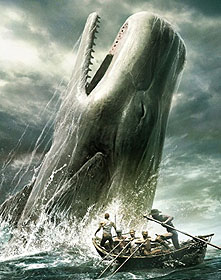
Of the Monstrous Pictures of Whales

...

But it may be fancied, that from the naked skeleton of the stranded whale, accurate hints may be derived touching his true form. Not at all. For it is one of the more curious things about this Leviathan, that his skeleton gives very little idea of his general shape. Though Jeremy Bentham's skeleton, which hangs for candelabra in the library of one of his executors, correctly conveys the idea of a burly- browed utilitarian old gentleman, with all Jeremy's other leading personal characteristics; yet nothing of this kind could be inferred from any leviathan's articulated bones. In fact, as the great Hunter says, the mere skeleton of the whale bears the same relation to the fully invested and padded animal as the insect does to the chrysalis that so roundingly envelopes it. This peculiarity is strikingly evinced in the head, as in some part of this book will be incidentally shown. It is also very curiously displayed in the side fin, the bones of which almost exactly answer to the bones of the human hand, minus only the thumb. This fin has four regular bone-fingers, the index, middle, ring, and little finger. But all these are permanently lodged in their fleshy covering, as the human fingers in an artificial covering. "However recklessly the whale may sometimes serve us," said humorous Stubb one day, "he can never be truly said to handle us without mittens."

For all these reasons, then, any way you may look at it, you must needs conclude that the great Leviathan is that one creature in the world which must remain unpainted to the last. True, one portrait may hit the mark much nearer than another, but none can hit it with any very considerable degree of exactness. So there is no earthly way of finding out precisely what the whale really looks like. And the only mode in which you can derive even a tolerable idea of his living contour, is by going a whaling yourself; but by so doing, you run no small risk of being eternally stove and sunk by him. Wherefore, it seems to me you had best not be too fastidious in your curiosity touching this Leviathan.

no profile pic for comment author

If you're looking for one

If you're looking for one book to illustrate the american character, then the clear choice is Democracy in America by de Tocqueville.

On literature class reading selections, I agree with the general consensus here. You're not only teaching reading, you're also teaching the subject of literature. If the class has the flexibility, then giving students some choice in readings (off a short list) is a good compromise, but it's tough to do too much of that, since it limits the ability to have discussions.

Having said that, high school literature classes have a tendency to over-reach. Moby Dick is a tough read for a mature adult with a broad grounding in history, literature, and philosophy. I think forcing high school students to read it is much more likely to turn them off and make them think all high literature is dull and worthless than it is to enrich their lives and start them on the path of reading. There are centuries worth of literature to choose from--surely you can find works that are both great and more accessible and relevant.

Coincidentally, I happened to pick of Goethe's Faust last night and found the prelude an apt reflection on the ability of great literature to appeal to the general public.

http://www.levity.com/alchemy/faust01.html

"So let us also such a drama give!
Just seize upon the full life people live!
Each lives it though it's known to few,
And grasp it where you will, there's interest for you.
In motley pictures with a little clarity,
Much error and a spark of verity,
Thus can the best of drinks be brewed
To cheer and edify the multitude.
Youth's fairest bloom collects in expectation
Before your play and harks the revelation.
Then from your work each tender soul, intent,
Absorbs a melancholy nourishment.
Then now one thought and now another thought you start;
Each sees what he has carried in his heart.
As yet they are prepared for weeping and for laughter;
They still revere the flight, illusion they adore.
A mind once formed finds naught made right thereafter;
A growing mind will thank you evermore."

ajw_93

nah...

I think you can't understand the country without some combination of
1. The Great Gatsby (money!)
2. The Scarlet Letter and/or The Crucible (sex! puritanism!)
3. Uncle Tom's Cabin
4. something Western. I never read anything that was a Western in school, and didn't out of school either (because I don't like them), but I feel I would have benefited from it

Of course, I never read Moby Dick either. (Billy Budd was bad enough!)

no profile pic for comment author

Nah, nothin to be learned here...

Where lies the final harbor, whence we unmoor no more? In what rapt ether sails the world,
of which the weariest will never weary? Where is the foundling's father hidden? Our souls
are like those orphans whose unwedded mothers die in bearing them: the secret of our
paternity lies in their grave, and we must there to learn it

no profile pic for comment author

You can't understand America without reading . . .

Beloved by Toni Morrison.

no profile pic for comment author

Do not believe everything

Do not believe everything you read in the Times.

no profile pic for comment author

Look at the syllabi for

Look at the syllabi for American literature courses taught abroad.

no profile pic for comment author

Moby Dick is immensely

Moby Dick is immensely sophisticated and erudite novel, which automatically excludes it from being considered "the great American Novel" or some such claptrap. 99.9% of all readers can barely understand it's depths and tend to blame the novel rather than themselves. Read the first paragraph of Moby Dick, and if it's not your cup of tea, then please pass on it! Stupidity is a cherished American trait.

no profile pic for comment author

Moby Dick as National Epic

For most readers, the best way to approach Moby Dick is to roam through it and read single chapters such as "The Monkey Rope" or "The Castaway" or "The Grand Armada" rather than starting at the beginning and trying to read the book straight through. The novel is simply too dense, uneven, and craggy to be an easy read.

That said, it's a superb way to look at our earlier religious traditions (Melville often shapes chapters as if they were 18thc. sermons) and at whaling, one of the 19th century's most important industries. Between final exams and graduation from college, I spent five days on Nantucket island, visiting the whaling museum to read ships' logs and absorb the exotic collection of artifacts, walking around the island and reading Moby Dick. It was an unforgettable swim in the dark, exotic seas of our past and a wonderful look at the range of human nature at work on the high seas.

no profile pic for comment author

nike af1 light up shoes

Yes ,your article is very good, we have the same belief with you,so let me introduce
thearea to you.Now nike ,as the worldwide brand, is beloved by more and more people.Recently,i purchase a pair of Nike Men's AF1 Light-up Shoes in a online srore,they specialized in nike air force one sheos ,the air force one light-up shoes are high in quality.To buy af1 lights up shoes this time,i feel happy. because light up air force one give my feet utmost comfort.I recommend this best online store : http://www.af1star.com .

no profile pic for comment author

Most of our Cheap UGGS for

Most of our Cheap UGGS for Sale are made of the genuine sheepskin from Australia.If you are looking for the tall boots,UGG Classic Mini Boots on Sale and UGG Ultra Tall Boots are your best choice.They are in double-faced sheepskin with the durable yet lightweight outsole.

Post a comment
Alternately, you may login to or register an account
The content of this field is kept private and will not be shown publicly.
  • Web page addresses and e-mail addresses turn into links automatically.
  • Allowed HTML tags: <a> <ul> <ol> <li> <blockquote> <img>
  • Lines and paragraphs break automatically.

More information about formatting options


Jail.org - Inmate Search
Criminal records, instant public records & people search & current court records. www.jail.org

U.S. Public Records Search
Search County & State Court Records, Criminal records, Vital and Adoption Records www.PublicRecordsInfo.com

Records.com - People Search
Public Records and Background Checks. Instantly Search Criminal Records, Addresses and Court Records www.Records.com

Court Records & County Records
Find Instant Public Records, Criminal Records as Well as County Property Records Search. www.PublicRecordsIndex.com

Mother Jones Podcast
Get in on the conversation! We talk about culture, politics, the environment, the economy and more. Listen now!

TalkBackTees.com
A treasure trove of liberal wit, wisdom and quotations, from ancient to modern, on colorful, cotton tees.

Support Independent Artists
Amazing art, crafts, apparel, paper-goods and more. A carefully curated selection of sundries since 1999.

FREE CONNECTIONS FOR GREEN SINGLES
Meet progressive singles in the environmental, vegetarian & animal rights community who share your values