In The Blogs

Why Bipartisanship Matters

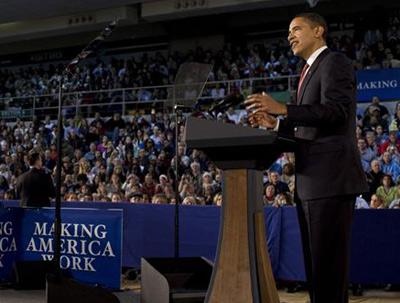
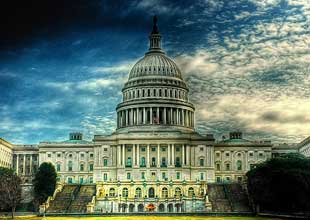
—Photo by flickr user BlankBlankBlank used under a Creative Commons license.

Barack Obama plans to partially pay for his healthcare program by reining in Medicare costs.  Megan McArdle thinks that's a problem:

To my mind perhaps the most worrisome part is that anything Obama does to "pay" for this program is something that cannot be done to "pay" for our growing Medicare problem.  Slashing provider reimbursements, Medicare advantage, etc, if it is done, is something that should be done in order to close the projected 3.4% budget gap in 2019.  Once we've used them for new entitlements, we are less able to pay for the entitlements we've already got.

In other words, if we cut reimbursements as a way of offsetting the cost of Obama's universal healthcare, we can't later cut reimbursements as a way of reducing Medicare costs and reining in the looming Medicare deficit.  The money is already gone.  So what will we do instead?

The answer is obvious: we'll eventually raise taxes.  Or, more accurately, we'll raise taxes more than we otherwise would, since tax increases of some size are now inevitable regardless of what we do.  This is part of the price we're paying for the tactical decision Republicans have made to oppose every Democratic program sight unseen.

Step back for a moment and you'll see why.  Bipartisanship is in bad odor these days because it's associated with a knee-jerk, David Broderish tendency to assume that the answer to any policy dilemma is automatically halfway between the liberal position and the conservative position.  But that sells bipartisanship short.  Where it shines is its ability to allow politicians to make tough decisions.

If all you want to do is hand out goodies — tax cuts, prescription drugs, defense contracts — life is easy.  Everyone loves goodies.  You don't need help from your opposite numbers to get stuff like that through Congress.

But what if you want to pass something tougher?  Something that takes as well as gives?  If you have bipartisan support, you can do it right: you can stand up to special interests and K Street lobbyists and enact real reform.  But you can only do this if you have political cover and plenty of votes.  If, instead, you have to do it in the face of implacable partisan opposition, then you can't afford to make any more enemies.  Every vote is precious, and that means instead of standing up to special interests, you have to buy them off.  All of them.

Take healthcare reform.  Republicans used to be in favor of reining in Medicare costs, which normally means that this would be a fertile area for bipartisan cooperation.  But the Republican Party has decided in recent weeks that its short-term political interests dictate unbending opposition to everything healthcare related.  So suddenly they're Medicare's biggest defender, screaming about euthanasia and death panels and brigades of bureaucrats getting between seniors and their healthcare.  As a result, no Democrat in his right mind will seriously touch Medicare.  Instead, special interests are bribed to cooperate, Medicare is left largely untouched, and the can is kicked down the road.
The same thing has happened with the climate change bill.  Historically, Democrats were the party of command-and-control: if you want to regulate emissions, just pass a law telling everyone how much they're allowed to emit.  Done deal.  It was conservatives who first introduced the idea of cap-and-trade, which uses market mechanisms to reduce emissions more cheaply and efficiently than command-and-control.  Democrats were initially skeptical, but after it turned out to work pretty well on acid rain they decided to throw in their lot with conservatives like John McCain and Newt Gingrich — who until recently were supporters of a cap-and-trade approach to greenhouse gas emissions.

But no longer.  Republicans have decided to unanimously oppose cap-and-trade, and that's left Democrats with no choice but to buy off every special interest on the planet.  The Waxman-Markey climate bill has turned into an orgy of dealmaking and logrolling because that's the only way to get anything done when the loss of even a few votes is enough to sink your whole bill.

When you have bipartisan support, though, you can afford to make tougher decisions.  That's how Social Security got rescued in 1984.  It's how tax reform was passed in 1986.  It's how welfare reform was passed in 1996.

Now, you can decry this all you want.  Maybe Democrats ought to stand up for their principles no matter what the cost.  Death before dishonor.  Etc.  But that's not the way life works, or ever has worked.  If you want healthcare reform that really tackles costs, you need bipartisan support for pissing off the people who are going to lose either money or services from the deal.  If you want a fair and straightforward cap-and-trade bill, you need bipartisan support to keep the special interests at bay.  If you don't get it, then you've got no choice but to watch your flanks like a hawk and ensure that you do nothing that can be used against you at election time.  And the can is kicked down the road.

That's the price we're all paying for the Republican decision to be the Party of No. Instead of difficult decisions on healthcare costs, we get mostly smoke and mirrors.  Instead of serious reductions in greenhouse gases at the least possible cost, we get a porkfest.  It's irresponsible and feckless, but until Republicans are made to pay some kind of price for it, it's not likely to change.

image image

Get Mother Jones by Email - Free. Like what you're reading? Get the best of MoJo three times a week.
Comments
no profile pic for comment author

That's rich, Kevin.

That's rich, Kevin. Democrats invented the Ponzi scheme better known as Medicare. And they've used the scare tactic that Republicans are going to cut Medicare in every election since.

And now you're pissed because Republicans won't provide them cover to rescue its' coming fiscal implosion. Baaaaaaaahaaaaa!

no profile pic for comment author

Cluelesss on Ponzi

I can readily understand why you chose to post anonymously, because everything you assert is so counterfactual.

Medicare has been far less of a drain on the budget than the war in Veitnam, Reagan''s tax cuts, Reagan's defense build up, or Bush's tax cuts. So if facts matter, and obviously they don't to you, it has been the antithesis of a Ponzi scheme.

Of course, according to your warped definition of the word, the defense budget is a Ponzi scheme as well.

Medicare, simply put, is sound policy. The logical extension of your post is that you would have seniors buy health insurance as individuals on the open market, which, as a high risk group, would bankrupt many of them. Sounds like a plan.

Thanks so much for spreading your anti-family values meme. It isn't heard enough from Republican politicians these days. I'm sure you would make your heroes: Palin, Wilson, and Bachman, very proud.

no profile pic for comment author

Ponzi

Hey Clueless; I believe you're the one that way off here on the definitions. First the defense dept. is Constitutionally called for and is to be funded for the protection of the citizens from enemies foreign and "domestic". Next the definition of a Ponzi is taking from new "investors"...us, to pay off previous investors...current recipients. This is exactly what is going on. Next you say it's "Sound Policy". If a bankrupt program is sound policy, then I still have some stock to sell you from Enron. Next, my mother buys Medicare "Supplemental" insurance to cover the gap in current Medicare payments, so the current system does still and will continue to cover only part of the costs. As those cost increase, so will the participates share increase. Now if you continue to raise taxes on everyone, then many more people won't be able to find or afford their healthcare. Raising taxes and restricting options will do more damage to your phony argument for family values than offering more real market competitive options/solutions and take more money out of hard working people's pockets; making personal health decisions impossible for the majority of the citizens. A "Nanny State" is not the answer.

no profile pic for comment author

That's Not A Ponzi Scheme

"the definition of a Ponzi is taking from new "investors"...us, to pay off previous investors...current recipients."

No, that's not the definition of a Ponzi scheme. If it were, then many corporate pension programs would be Ponzi schemes (and therefore illegal). What you wrote is the definition of a pay-as-you-go system, which can continue indefinitely--and is therefore not a Ponzi scheme.

In many pension systems, as with Social Security, present workers pay for benefits for present retirees. As long as revenues equal payments, the system is just fine. When the number of workers grow relative to beneficiaries, the system can actually run a surplus (as Social Security has been doing for some time because of the working baby boomers). When the opposite happens, it can run a deficit (as will happen as the boomers retire). But these are demographic issues and not inherent in the nature of a pay-as-you-go system.

And the demographic imbalance creating deficits can be dealt with in several ways: by increasing the benefits age, or raising contribution requirements, or cutting benefits, or some combination of the three. Even if nothing is done, the Social Security Administration estimates that retirees will still receive 74% of their benefit levels in the 2040s after the "trust fund" (surplus) is exhausted. If that's a "Ponzi" scheme, it's very odd one since it's based on political decisions that we will (or will not) make.

By contrast, a Ponzi scheme must fail by design; its very structure makes it unsustainable because earnings are less than payments and cannot possibly keep up indefinitely. And it's almost always fraudulent. Pay-as-you-go retirement funds are neither inherently unsustainable, nor are they fraudulent. One may think they are good or bad policy, but they're not Ponzi schemes. And neither is Social Security.

no profile pic for comment author

Health Care Reform

Interesting that Common Sensor cites the Constitution, and correctly so, for the armed forces (provide for the common defense). But what about "promote the general welfare?" The Declaration of Independence cites that we have certain unalienable rights, among them being life, liberty, and the pursuit of happiness. What could be more critical to life than health care, so that liberty and happiness can be pursued? Is not health care reform part of promoting general welfare, considering that about 50 million citizens are without it?" Don't say that they have it in the emergency rooms, because everyone pays for that in a hidden tax called higher premiums to private health insurance companies. Promotion of the general welfare of all citizens, in this case health care for all citizens, is not a nanny state. Health care now is more a privilege if you are employed where insurance is offered, or wealthy enough to afford it.

no profile pic for comment author

Another good reality check.

Another good reality check. Given the power allocation developments over the past 30 years, especially the weakening of labor, Democrats have no choice for achieving anything worthwhile but to employ guerrilla tactics. Hence rope-a-dopes, deals with the power structure to concede incremental changes, etc. But we have to do what we can do, and hope that small wins will start to add up. The more passionate progressives are attacking Obama as a sell-out, as they did Clinton, but they don't have much comprehension of the realities. Continuing to argue for single-payer, for example, is ridiculous and childish at this point. It simply is not going to happen. So is railing against corporate power in the Democratic Party. Without that money Democrats have no chance whatsoever, but they do bring different public policies. Anybody who thinks there was no difference in real terms between Clinton and Bush, even with all the compromises Clinton made, is an idiot.

It would be helpful, however, if the Democrats had a clue how to move public opinion in fundamental ways. Never since World War II has the other party and its infantile governance philosophy been more vulnerable to a strong and sustained substantive attack -- one well deserved for the good of the country. So far, however, our leaders -- apparently frightened to death of being criticized by Broder and company for being too partisan -- are only nipping around the edges. Somebody has to take on the national media's anti-Democrat slant, too. Media Matters is doing the spadework religiously, but we need spokespeople to step forward and use it. Where the hell is the strategy?

no profile pic for comment author

Republicans have decided to

Republicans have decided to unanimously oppose cap-and-trade, and that's left Democrats with no choice but to buy off every special interest on the planet.

When the Republicans become unprincipled jerks we have OTHER choices than to become different kinds of unprincipled jerks.

To the extent that we chose to buy off every special interest on the planet, than we ARE wrong and we ARE the bad guys and we should lose.

no profile pic for comment author

"Republicans have decided to

"Republicans have decided to unanimously oppose cap-and-trade, and that's left Democrats with no choice but to buy off every special interest on the planet."

Ah yes, I've heard this argument before. It often goes like this:

"We had to burn the village to save the village."
"Winning isn't everything; it's the only thing."
"The ends justify the means"

Similarly, you may wish to consider this: "When you look into an abyss, the abyss also looks into you."

I am not surprised that your tactics leave use looking like monsters and so easily defeated.

no profile pic for comment author

The point being

I think Kevin's point is that politics is about compromise, particularly in the United States. And the post above mine implies that no compromise should ever be struck.

In this country, we rarely take large absolute leaps and we tend to take them in extraordinary circumstances. We banned slavery only after a Civil War rent 80 years of compromise. We adopted Social Security during the Great Depression. Even Medicare, which we look upon as a great leap, was really a compromise between those who wanted single payer and those who did not.

Kevin's point, I think, is that polticians could align to create an effective bulwark against special interests. I think that's what we all want in politicians - people who put aside the electioneering, roll up their sleeves, work together and get the job done.

Now we have a political party that refuses to do this. So Democrats have to look elsewhere to create a bulwark against their opponents, and the Republican Party has become one of their key opponents, not just in winning elections, but in governing the country.

You might argue that the compromises currently being made on any issue are too great. That's a fair thing to say. I disagree, at least when it comes to health care. I think the situation here is similar to the civil rights votes of the late 50s - once the first legislation passes, it will be easier to grow the benefit. Republicans - stanch opponents of Medicare in the day - had no problem adding prescription drugs to the benefit, with much of the Democratic Party opposing them.

no profile pic for comment author

compromise is good, gift giving bad

As long as compromise earns something, it should be used. The problem is many compromises with Republicans means noting is compromised by them, and the Democrats end up with noting in return. Pelosi's taking W. Bush's impeachment off the table in 2006 was not a compromise; it was a gift without any expectation of a return.

no profile pic for comment author

Compromise

First, Slavery was eliminated when we as a nation refused to compromise. SS and Medicare were both Democratic schemes to buy votes. Neither of these have proven to work over the long run, mostly because of built-in inefficiencies, government restrictions and political corruption. The whole idea of government being a system of compromise is a little simplistic. If the basic policy is flat out bad, then no compromise should be considered. For example if any policy that is not equally distributed amongst ALL citizens, as the Constitution calls for, then it is bad policy and it should be fought against. The Constitution/Bill of Rights does allow for incremental implementation of policies. It's to be done through the States. If the policy works, then it can be improved and will naturally spread from State to State and eventually through the nation...IF IT'S A GOOD POLICY.

no profile pic for comment author

Offtopic but really

Offtopic but really interesting: http://chronicle.com/article/Taking-the-Right-Seriously/48333/

Taking the Right Seriously
Conservatism is a tradition, not a pathology

By Mark Lilla

This month the University of California at Berkeley opened a Center for the Comparative Study of Right-Wing Movements. The center is housed in the Institute for the Study of Social Change, which the university advertises online as an institution placing "issues of race, gender, and class at the center of the agenda," conducting "research with a conscience," and capitalizing on "Berkeley's history as the birthplace of transformative social movements." Needless to say, the center is not promoting conservatism. This is, as the university reminds us, Berkeley.

...

But beggars can't be choosers. The unfortunate fact is that American academics have until recently shown little curiosity about conservative ideas, even though those ideas have utterly transformed American (and British) politics over the past 30 years. A look at the online catalogs of our major universities confirms this: plenty of courses on identity politics and postcolonialism, nary a one on conservative political thought. Professors are expected to understand the subtle differences among gay, lesbian, and transgender studies, but I would wager that few can distinguish between the American Enterprise Institute, the Heritage Foundation, and the Cato Institute, three think tanks that have a greater impact on Washington politics than the entire Ivy League.

Why is that? The former left-wing firebrand David Horowitz, whom the professors do know, has a simple answer: There is a concerted effort to keep conservative Ph.D.'s out of jobs, to deny tenure to those who get through, and to ignore conservative books and ideas. It is an old answer, dating back to the 1970s, when neoconservatives began writing about the "adversary culture" of intellectuals. Horo witz is an annoying man, and what's most annoying about him is that … he has a point. Though we are no longer in the politically correct sauna of the 1980s and 1990s, and experiences vary from college to college, the picture he paints of the faculty and curriculum in American universities remains embarrassingly accurate, and it is foolish to deny what we all see before us.

...

no profile pic for comment author

as an academic

I can tell you that the idea that conservative ideas are discriminated against in academia is b.s. This sentiment is nothing more than the usual conservative whining over "an unfair media." Is global warming data anti-conservative? Is the study of natural selection anti-conservative? Also, last I checked free-market "ideology" reigns in most economic departments and business schools...but that's because in *theory* it should work. It doesn't, always, and this is now being realized... Is this evidence of an anti-conservative leaning? Bah! Yes, there are plenty of identity politics folks in academia, and I find the more strident annoying. But there are also plenty of conservatives.

no profile pic for comment author

You're not an Academic,

You're not an Academic, you're an Anonymous (not verified.)

I however have a 12" peener and am an astronaut and I tell you there are space aliens that follow our spacecrafts and intend to take me for my prowess.

Other academics, like the author of the article, you name themselves, disagree with you.

no profile pic for comment author

"Also, last I checked

"Also, last I checked free-market "ideology" reigns in most economic departments and business schools."

Brad DeLong, et. al., are ultimate free traders, rule the econ departments and make claims to being liberal.

free trade is no longer a left/right thing, it's a heterodox, classic thing.

If you were an academic you would understand that.

Scratch that, that you don't know this does buttress your claim to be an anonymous academic. And an arrogant ignoramus.

Davis X. Machina

It's hard to buy the notion of a generation...

...being habituated by their professors to the notion that property is theft in a world where the single most popular undergraduate major is business/business administration, and there are thirty business schools for every school with a labor institute or labor studies department.

But hey, why ruin a good story arc?

no profile pic for comment author

This is ridiculous

The latest example Kevin mention is 13 years old, and since welfare reform didn't involve the donor class, its hardly a good example. Washington has become far more corrupt since then. The number of lobbyists has doubled, and the price of campaigns has similarly skyrocketed. This alone ensures that bills are porkfests -- whether bipartisan or not. (Remember the Bush energy bill?)

no profile pic for comment author

This is actually an argument

This is actually an argument for strict party discipline, not bipartisanship. If Democrats could be trusted to vote for a Democratic proposal, they could just pass the proposal and then defend it on the merits and on the facts created on the ground.

The two main things standing in the way of "hard decisions" are lack of party discipline and the two-year election cycle for the House. It's unrealistic to expect an opposition party not to make hay from unpopular decisions the governing party feels it has to make.

no profile pic for comment author

Well said

Fantastic post, Kevin!

no profile pic for comment author

Since We Are Not

getting Republican support anyway, I say tax liberally now to get a healthcare reform bill with generous subsidies to the middle class and poor. $1.4 trillion vs. $900 billion could be the difference between a good and a poisonous bill. Years from now nobody will care about the difference if you have a good bill.

no profile pic for comment author

Bi-partisan isn't limited to

Bi-partisan isn't limited to getting votes from the other side's representatives. BHO, I think, understands that what he really needs is to have broad support for his reforms amongst voters of all political stripes. Happily, a by-product of that is to trivialize the leadership that is at odds with its constituency.

The current downward spiral of the Republicans will not last forever. A day will come when the non-insane wing -- which is likely the larger part of the party -- will return to the fore and retake the party's leadership. That will be a good day for America, since the two party system is preferable to a one party/one cult system.

I think if reforms pass without any Republican votes but with the support of Republican voters, that's a good outcome.

no profile pic for comment author

problems with Republicans? or taxpayers?

I'm not sure that Democrats' difficulties are completely explained by machinations of those wily Republicans. To me, it looks like many prominent liberals miss the larger picture: the electorate, the American taxpayers, have no more appetite for increased taxes or increased costs from government-mandated liberal programs. The heyday for liberalism was many decades ago. People have now lived with the consequences of liberal programs for more than a generation, and they have no more stomach for them. Even in the case of health care reform, which is sorely needed.

no profile pic for comment author

I agree. It sucks that the

I agree. It sucks that the success of liberal programs created people who think they are rich enough to be republicans.

We create our own enemies when we succeed, which is the tragedy of liberalism.

no profile pic for comment author

Oh dear lord ...

What reality do you inhabit?

Sorry, but in poll after poll after poll after poll, people support liberal positions on health care, the environment, education, etc.

What people are sick of are GOP "policies" that have created the largest rich-poor gap in American history, favor corporations over actual human beings, and do nothing to move our nation forward. Add in the GOP's crass use of religion and fear, and you have a country in which more people find socialism appealing (30+%) than trust the GOP (24ish%). And the last two elections have proven that.

You all created this mess -- from the $1.5 trillion sucked from the treasury from Bush's tax cuts, to massive defense spending under Reagan, to treating the environment like a trash can, to starving our nation's poor of services they need, to the fact 70% of our nation's debt was rang up under a Reagan or Bush -- then turn around and do all you can to keep anyone from cleaning it up?

Where is the reality-based GOP plan for fixing our health care system? Where is their alternative budget with actual numbers in it? What's their plan to protect our environment?

Face it: The GOP is the party of "NO!" because they have NO ideas, NO policies that haven't been proven spectacular failures, and NO desire to help anyone Not Like Them.

And it's a shame, because our nation needs, at the very least, two functioning political parties.

As of now, all we have is .75 of one party, and a cult.

g. powell

How the GOP wins when it loses

Tom Friedman basically made this point last week when he said that America's one-party democracy was inferior to China's one-party autocracy.

I think the GOP strategy is to let the crazies run amok in order to block meaningful Democratic reform and then allow someone like Mitt Romney to jump in around 2011 as the great sensible moderate who can bring common sense back to Washington.

Progressives can sneer all they want, but its a cynical strategy that will probably work. Most voters don't pay too close attention to what's going on and they have very short memories.

Hell of a way to govern a declining nation.

MacGruber

Rich in NJ is rich indeed

"Medicare has been far less of a drain on the budget than the war in Veitnam, Reagan''s tax cuts, Reagan's defense build up, or Bush's tax cuts. So if facts matter, and obviously they don't to you, it has been the antithesis of a Ponzi scheme."

Seriously? Have you seen the three largest outflows of gov't money?

1. Social Security
2. Defense
3. Medicare

Bush's tax cuts and Reagan's tax cuts and Vietnam (spell it right, at least) are blips on the radar.

Democrats are looking more and more like lemmings: they are just following each other to the edge of the political abyss. How many government programs are you going to enact? How are you going to pay for them? Exactly how high can you tax the rich before you start taxing the middle class?

You don't have answers because you don't care. Just get those gov't bennies out and damn the torpedoes. Just borrow more money and tax all those eeeevil rich people. Only it won't work. Not for long. Heck, even Rockefeller is against Baucus' health care plan that will soak the middle class.

I love Michael Moore's new film. I wonder if he's going to do something about it: you know, like showing his film for free instead of making people pay $11 per ticket. No, that gas bag loves HIS capitalism. It's everone else's that he can't stand.

You guys just don't get it.

no profile pic for comment author

Actually, we do have answers

Soc. Sec. and Medicare can be fixed quite easily: Raise the income limit from $90K to $250K.

POOF! Problem solved!

But you all will fight that because the rich may have to **gasp** start paying more to help their fellow citizens! Heaven frickin' forbid!

And we can't cut defense spending, can we? Nope -- that's some government spending you can get behind!

And where were your complaints when Reagan and the Bushes were piling up 70% of our nation's debt? Oh, that's right -- you all only care about fiscal responsibility when Democrats are in charge. Otherwise, it's all "Let's put two wars on the credit card, all while giving $1.5 trillion away, primarily to the rich!"

Sorry, MacGoober, but your party is the one that doesn't get it. That's why you all have yet to present a single realistic idea to help solve our nation's problems. You just whine and moan and complain, claiming that there's this tide of opposition brewing, despite all scientific polling that proves otherwise.

Now if you'll excuse us, we've got a nation to fix.

no profile pic for comment author

The best counterstrategy

The best counter strategy to the "oppose everything" is this: Win. Get programs through that people like, even if they are flawed. Do stuff that seems to be helping. Make sure your door is open to bipartisan cooperation. Let them see that there's more to be gained by negotiation than by stonewalling. And beat them down in the midterms.

I believe Obama is following this program.

no profile pic for comment author

One thing to keep in mind,

One thing to keep in mind, though, is that in all of the examples of bipartisan success you list, both parties held control of at least one chamber of Congress or the presidency. In 1984 and 1986, the GOP had the White House and the Senate while the Dems had the House; in 1996 the GOP had Congress while the Dems had Bill Clinton in office.

So they all had skin in the game and had to demonstrate that they could deliver. And that was the only incentive people had to cooperate -- during the tax reform negotiations, for instance, powerless House Republicans opposed the whole process.

no profile pic for comment author

I am truly astounded at the

I am truly astounded at the high dudgeon Dems get into when Republicans employ the tactics the Dems invented.

no profile pic for comment author

Compromise

I agree. You need compromise to defeat Special Interests. As Burke said:

"All government, indeed every human benefit and enjoyment, every virtue, and every prudent act, is founded on compromise and barter we give and take; we remit some rights, that we may enjoy others"

Please don't tell me that Burke has anything to do with the GOP today.

I also agree with you about Cap and Trade. That is the compromise. Making exceptions or diluting such a plan makes no sense.

no profile pic for comment author

Kevin, get your head straight.

The Republicans tax us to death for their personal enrichment. The Democrats tax us to death to buy votes. They are two different flavors of the same #$%#, in case you haven't noticed. It's called "Big Government". From a voter standpoint, the more limited the government is, the better, but for lack of a third party option, our country is in a tailspin. Go right, and you've got war, go left, and you've got "social reforms" that don't work and cost as much as the wars. So....anyone for a third option out?

no profile pic for comment author

Thank you Kevin, I know I

Thank you Kevin, I know I read this site for some reason.

I would add - Bipartisan support is important because sometimes partisan ideology and assumptions will blind you from something that will truly work.

As a conservative, there are several things I would like to see enacted, but I know will never happen in the current partisan climate. Liberals must admit that the current President is not at all "post-partisan".

1. I would like to see the monopoly that health insurance companies have over health care broken. I think the commerce clause can be used to separate the business of risk mitigation ( what health insurance once was ) and club purchasing ( what the "health insurance" business has become ). If we could separate these items out it would be more fair.

2. I would love to see insurance not based on where you work. This gives an unfair advantage to the big corporation over the small business.

3. I would love to see catastrophic care enacted for the truly indigent in a program that would be so bare-bones and so income restricted that it would not compete with any private insurance but be a true safety net.

4. I would especially love to see meaningful tort reform to bring down wasted costs on malpractice insurance and defensive medicine no matter how insignificant of problem some on the left think it is.

5. I would love to see the tax advantages taken away on health care benefits so that small businesses don't get screwed over.

6. I would love to find a fair way to help the absolutely uninsurable. e.g. those who did not have coverage, but then got cancer, or liver disease, etc.

7. I would love to get some amount of market forces back into health care. In the current model, the consumer is completely divorced from the payment. No market forces are present to hold down costs.

None of these individual items will see the light of day because progressives feel they must totally revamp the entire health care system into some huge government run monstrosity, and so conservatives must totally oppose everything in the democrats plan.

no profile pic for comment author

Complete overhaul of the

Complete overhaul of the health care system? Are you joking? All that's being proposed now is health insurance reform. If you can't see that, your partisanship is blinding you to reality.

MacGruber

"And we can't cut defense

"And we can't cut defense spending, can we? Nope -- that's some government spending you can get behind!"

We did that under Clinton and we were left with a gutted military that couldn't have fought and won one war, much less two. You do realize the military serves a purpose - a purpose that can't be filled by the private sector, right?

You can always save for your own retirement (rather than waiting for your SS check). You can't raise your own army and attack Afghanistan after Bin Laden kills your family.

"And where were your complaints when Reagan and the Bushes were piling up 70% of our nation's debt?"

Civics 101: Congress spends the money. Most of Congress during the time you complain about was under Democratic control.

Seriously, other than defense spending, is there a government program Democrats haven't enlarged? Is there government spending they've actually cut?

I can't wait for the 2010 midterms. A bloodbath for the lemmings who somehow think the U.S. taxpayer doesn't see what's in store for them if Cap-n-Trade and the Health Care bills get passed.

no profile pic for comment author

Defense spending

Sorry, can't let this one go. One of the big problems this country has is that defense spending is perhaps the only area of bipartisanship in Congress and that all parties agree that said spending should rise.
We spend so much more than the rest of the world on defense, I can't even come up with a good punch line to describe it.
In 2008, the U.S. spent $600 billion on defense, about 40% of the world total. Second was China, with $85 billion.
Look at it this way, if we only spent twice as much as the No. 2 country, we would free up $400 billion a year, or $4 trillion over a decade.
We could create the most generous health care plan imaginable and still have room for a $200 billion a year tax cut.

no profile pic for comment author

Stop using your darned logic!!

We all know that spending to kill people (preferably brown ones) is the very essence of America!

And using that money to help our own citizens is socialism! Or fascism! Or, um ... communism ... or ... well, whatever the hell the right has decided it is this week.

no profile pic for comment author

You dipshit, the military

You dipshit, the military Clinton left Bush performed admirably in Afghanistan and Iraq.

no profile pic for comment author

FAIL

"We did that under Clinton and we were left with a gutted military that couldn't have fought and won one war, much less two."

Meanwhile, in reality, Clinton was following the Bush-Cheney plan. In fact, in just four years, Bush I actually cut the military more in terms of sheer dollars and percentages than Clinton managed to do in eight:

President Bush had already said publicly that the proposed FY 1990 Defense budget of more than $300 billion had to be cut immediately by $6.3 billion, and soon after Cheney began work the president increased the amount to $10 billion. Cheney recognized the necessity of cutting the budget and downsizing the military establishment, but he favored a cautious approach.

[...]

Early in 1991 the secretary unveiled a plan to reduce military strength by the mid-1990s to 1.6 million, compared to 2.2 million when he entered office.

Of course, once Clinton got into office and followed the plan laid out by the previous occupant, Republicans started whining and accusing Clinton, as you did, of "gutting the military," despite the fact he did no such thing.

And once Bush II and Cheney got into the White House, defense spending went up dramatically; including all those billions in no-bid contracts to a company Cheney still had a financial interest in, and to the likes of Blackwater.

You do realize the military serves a purpose - a purpose that can't be filled by the private sector, right?

You realize I never posted otherwise, right? And that it was the GOP who fell in love with private contractors, right? But please, continue arguing with Strawmen, since that seems to be a gift you have.

Civics 101: Congress spends the money. Most of Congress during the time you complain about was under Democratic control.

You should have stuck around for Civics 102, in which it's explained that budget proposals are given to Congress by the White House, and that any president can veto a budget if he wants.

Of course, the GOP doesn't really give a damn about keeping our nation safe (they failed to do that on 9/11, and are more interested in enriching defense contractors) or fiscal responsibility (Bush and a GOP-controlled Congress added more than $5 trillion to our debt, and nary a peep came from the right the whole time).

But that's reality, and we all know how reality has a liberal bias ...

no profile pic for comment author

Re Mark D

All true. In fact it was the attacks on Clinton for carrying out the 'peace dividend' that turned Clinton and his successor Democrats into hawks on defense spending. 9/11 upped the ante. Today defense spending is at insane levels, and I am using 'insane' in a careful, measured way - meaning that the spending level defies logical analysis. A Congressman could support cutting defense spending in half and still be a bigger hawk than any other country in the world.

Davis X. Machina

The military...

...that rolled over Iraq being entirely a creation of the fourteen months between 1/21/2001 and March of 2003.

no profile pic for comment author

Can't fight and win your precious wars?

"Couldn't fight and win one war"? With a defense budget, yes, even when Clinton was in office, as big at the rest of the world combined?

If I could, I would defang you warmongers by reducing the "defense" budget 90%. THEN and only then, would the DoD actually live to its name.

no profile pic for comment author

mass murder has been bipartisan

The occupations of Vietnam, Afghanistan and Iraq were bipartisan, too.

no profile pic for comment author

Policy has consequences

But, of course, this is the David Broder argument. David Broder does NOT argue for split-the-difference; David Broder argues for leaving "partisan ideology" and "partisan bickering" at the door, and having the "adults" just "get together" and "solve problems" like there are no legitimate partisan or ideological differences about policy.

The problem of assembling a governing coalition is always the same: how to enable the rational and sane to cooperate, against the corrupt and crazy.

When the rational and sane, and the corrupt and crazy, were both split between the Parties, bi-partisanship made sense, to the extent that it meant assembling the rational and sane from both Parties, to govern together. That's how Civil Rights got passed: liberal Democrats and moderate Republicans voted together against reactionary southern Democrats: voila!

And, that's how bi-partisanship got a great reputation, in a now lost era, when political polarization between the Parties was minimal, and both Parties had extremist nutcases in approximately equal measure.

The Parties are divided differently today, in case you haven't noticed, but, in the end, the motivation for assembling a governing coalition of the sane and rational remains the same: policy has consequences.

You don't want politicians to "make tough decisions" because it sounds dramatically satisfying. You want them to do so, because the consequences are serious.

The people in Congress, who are genuinely responsible and not hopelessly corrupt or stupid, are all in the Democratic Party. And, outside of the Congress, almost all of the remaining responsible conservatives are allied closely with the Administration.

If you want good policy, the governing coalition has to be assembled, within the Democratic Party. The "bi-partisan" gambit just won't work. The marginal, semi-corrupt or semi-stupid vote has to be afraid of the consequences of policy failure, sufficiently afraid that they will compromise their greed with people they recognize are smart and care about the consequences. Only a handful of such marginal votes will come from nominal Republicans; most Republicans are committed to the politics of the shock doctrine and bringing on Armegeddon, or simply don't believe in reality and policy consequences.

Now, you can argue that governance from within the majority Party simply cannot work, but the problem is not the lack of consensus, or even the lack of party discipline, which would enable those "tough decisions" of which the Village Pain Caucus among the punditocrisy has become so fond. The problem must be that responsible governing by a single Party cannot be successfully "branded" and the brand marketed. FDR managed it with a very unlikely Party, but nevermind.

We've had a remarkable experience over the last 16 years: a responsible, albeit fairly conservative President followed by an irresponsible, conservative President, from different political Parties. Now, we're back to a responsible, conservative President from Party Number 1.

I have my doubts about whether this contrast can be brand-marketed. But, my doubts concern the role of the news Media, as fair and sensible tribunes.

If Glenn Beck and Rush Limbaugh are going to judge what constitutes responsible government, and what consequences are to be blamed on what policy, then we are in a lot of trouble.

no profile pic for comment author

Really astute analysis. Of

Really astute analysis. Of course, it probably also sheds some light on the irresponsible spending of the Bush years, as well. Bush couldn't get much bipartisan support for Medicare Part D, so no costs were imposed on anyone: money was handed out to seniors and to Big Pharma and no revenue offsets were provided. The noxious partisanship in Washington really does make hard decisions impossible. Even if a majority party were truly suicidal in taking the tough votes without regard for the political consequences, it won't be able to muster the votes to pass the Senate doing so. The only way to get the supermajorities needed in a party polarized Congress is to do nothing hard.

no profile pic for comment author

The real purpose of GOP deficits

Let's not forget the real purpose of the GOP deficits. They are trying to "starve the beast." They oppose government in principle so their strategy is to run huge, irresponsible deficits while they are in power. They know that once the Democrats get back into power, they will be forced to deal with the deficits. That hinders the Democrat's ability to spend for social programs. Witness complaints from the right and the center about the cost of health insurance reform.

Since their deficits are generally caused by tax cuts for the wealthy and expansion of the military, deficits have an added benefit. Tax cuts for the rich pay off the key GOP constituency and military expansion both enriches contractors (another GOP constituency) and, since military people and their spouses are usually more conservative than the general population, builds the voting base.

Although their priorities are disastrous for the country and the world, the GOP strategists are not as stupid as their voters are. The strategists are quite shrewd.

We should also understand that to the GOP, compromise is a sign of weakness. Baucus compromised the public option away, compromised the employer mandate away, and compromised adequate subsidies away. He still failed to get a single Republican supporter, including the supposedly moderate Snowe. Attempts at bipartisanship are futile. Republicans must be defeated.

As for those of us on the left, we need to stop being so nice and so civil. Alinsky advised using ridicule as a conflict tactic. Ridicule is difficult to defend against, as Kerry learned in 2004. Many of the GOP positions are ridiculous, why not heap ridicule on them? Power is never given, it must be taken.

no profile pic for comment author

If you are looking for the

If you are looking for the tall boots,you might as well take a look at the UGG Classic Tall Boots. UGG Classic Tall are in double-faced sheepskin with the durable yet lightweight outsole.These boots are lady-like enough.Most of our Cheap UGGS are made of the genuine sheepskin from Australia.Welcome to order.

Post a comment
Alternately, you may login to or register an account
The content of this field is kept private and will not be shown publicly.
  • Web page addresses and e-mail addresses turn into links automatically.
  • Allowed HTML tags: <a> <ul> <ol> <li> <blockquote> <img>
  • Lines and paragraphs break automatically.

More information about formatting options


Jail.org - Inmate Search
Criminal records, instant public records & people search & current court records. www.jail.org

U.S. Public Records Search
Search County & State Court Records, Criminal records, Vital and Adoption Records www.PublicRecordsInfo.com

Records.com - People Search
Public Records and Background Checks. Instantly Search Criminal Records, Addresses and Court Records www.Records.com

Court Records & County Records
Find Instant Public Records, Criminal Records as Well as County Property Records Search. www.PublicRecordsIndex.com

Mother Jones Podcast
Get in on the conversation! We talk about culture, politics, the environment, the economy and more. Listen now!

TalkBackTees.com
A treasure trove of liberal wit, wisdom and quotations, from ancient to modern, on colorful, cotton tees.

Support Independent Artists
Amazing art, crafts, apparel, paper-goods and more. A carefully curated selection of sundries since 1999.

FREE CONNECTIONS FOR GREEN SINGLES
Meet progressive singles in the environmental, vegetarian & animal rights community who share your values