In The Blogs

Focusing the Fed

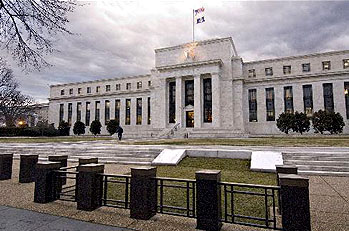
David Ignatius is worried about Chris Dodd's proposal to reduce the Fed's regulatory authority over the banking system.  Fine.  It's an arguable proposition.  After all, the British have a separate agency to regulate banks and it didn't seem to do them any good last year.  So maybe it won't help us either.

But he also seems to have bought into the idea that Dodd wants to politicize the Fed's core mission of conducting monetary policy:

The political challenge to the central bank's authority comes at an especially delicate moment — as the economy begins to rebound and the Fed considers future tightening of monetary policy. It will need public support to combat inflation. But as the New York Times noted in a front-page article last week, the Fed is "under more intense attack than at any time in decades," from both left and right.

Wall Street so far appears unfazed by the criticism of the Fed, perhaps because investors assume that the protests are just political posturing. But this could change. "If Congress even appears to be politicizing the Fed's monetary policy function, rest assured that two market developments are inevitable — a collapsing dollar and higher long-term interest rates," warns David Smick, a Washington financial consultant.

 So what exactly is Dodd proposing?  Let's break it down:

  • Interest rates are set by the Fed's Federal Open Market Committee, which has 12 members.
  • Five of the FOMC's twelve members come from the ranks of the presidents of the Federal Reserve regional banks.
  • These presidents are appointed by the boards of directors of the regional banks, subject to approval of the Fed Board of Governors.
  • Two-thirds of the regional board members are elected by member banks — i.e., ordinary private commercial banks
  • Dodd's bill would give the Fed Board of Governors the power to appoint the entire membership of the boards of the regional banks.

In what way does this politicize monetary policy?  What it does is reduce the power of commercial banks and increase the power of the Fed.  The only way to spin this as politicization is to point out that the Fed Board of Governors is approved by the Senate, which means that under Dodd's plan the regional board presidents would be appointed by people who are appointed by people who are in turn approved by the Senate.

This is pretty tenuous stuff.  If you want to argue that private commercial banks should retain the power to elect two-thirds of the boards that appoint five-twelfths of the FOMC, go ahead.  But they're losing that power to the Fed itself.  That only increases politicization of monetary policy if you think that the current Fed Board of Governors is too politicized in the first place.  But that's a tough argument to make: all modern central banks have boards that are appointed by political authorities.  That's democracy for you.  Their independence is guaranteed by staggered terms, guaranteed tenure, and statutory authority, just like the Fed.

Dodd's stated intention is to keep the Fed focused primarily on monetary policy and leave bank regulation to a separate super-agency.  As near as I can tell, that's exactly what he's done.  Commercial banks might not like losing some of their influence in the process, but it's the Fed that's gaining at their expense, not Congress.
image
image

Get Mother Jones by Email - Free. Like what you're reading? Get the best of MoJo three times a week.
Comments
no profile pic for comment author

Rather simply because it injects US Congress

Rather than having the regional (as in US regions) business oriented reserve boards, which are not at all political.

The argument is clear enough, despite your downplaying it. It may not be correct, although your Congress does not of late cover itself in glory relative to clarity in economic policy thinking (indeed, had it been left to itself, rather than the Fed, you would have likely recreated many of the errors of the 1930s).

no profile pic for comment author

Otherwise, relative to your populist anti Fed Jihad

and returning to an earlier posting you had re financial stability, observations:

(i) The Real Fundamentals of the "case" against your federal reserve devolve down to a case against Greenspan, not the Fed qua Fed. As an operator in emerging markets, I can attest that one can build the best institution possible, staff it well, but if you have a Big Cheese who blocks action (as Greenspan is known to have done), they you will get the same result.
(ii) Financial Stability, and the Fed's weak points in this area largely come not from the Fed qua Fed, but your particularly fragmented and incoherently Byzantine financial regulatory structure that positively incentivised non proactivity in areas "on the margin" of any given regulators competence. Examples, the I-Banks and AIG. It is very clear that it was the pure play I-Banks and entities that had become Supra I-Banks like AIG (morphing from its core insurance competence where it has always been a very high quality entity) that blew a hole in the global financial system. Your regulatory system did not have clear oversight of these entities - divided as they were between SEC, provincial(!!!) insurance regulators and a touch of the Fed and your Treasury.

Attacking the Fed on the fall-down in this area is ignorant. As I have made the point previously, the overlapping structure with its deliberate vague lines of responsibility was (and sadly REMAINS) a long-term incentive to weak oversight. In bureaucracy if more than one entity owns responsibility (or perhaps better, there is no clearly stated no-buck passing 'primary' responsibility), then No One owns it.

Never mind the Fed being "too close" to banks - that is not an issue, whatever the populist ranters think - that is solveable in the sense they want it solved.

Rather, an entity with clear Prudential oversight of all financial institutions (ex-pure Insurance, which is very different in the end) is what you need. David Ignatius is quite correct in noting that the UK experience in carving prudential supervision out from the Central Bank is now widely regarded as an error, as Prudential Supervision and Monetary Policy have overlapping intelligence and synergies (imperfect though).

The suggestion to carve out Consumer Regulation into its own entity also has a lot to recommend it - I would think that the FDIC as a deposit insurer would be best suited for that, as its role is far closer to consumer needs than the Fed (and rightly so); although a depositor has different interests from a borrower (e.g. it is in the depositors's interest to have higher interest rates on borrowers to help ensure solvency of the bank).

no profile pic for comment author

Missed thought, re Greenspan, case against Fed

Returning to that thought, there is No Structure that can in and of itself solve the problem that Greenspan created - that is inaction due to fundamental and ideological hostility to regulation that went far, far beyond merely a critical questioning of utility of regulation.

Rather than hitting on Fed structure or the Fed qua Fed, a key and prime lesson is that appointing the Wrong Man - and in particular ideologues with rigid thinking - to such positions can take the best institution down dead-ends.

Let us say that the reforms go through and the Populist ranters get their emasculated Fed, and the stand alone regulator. The disaster will still reproduce itself if (and when perhaps) a Greenspan clone is appointed, say 20 years down the road.

Post a comment
Alternately, you may login to or register an account
The content of this field is kept private and will not be shown publicly.
  • Web page addresses and e-mail addresses turn into links automatically.
  • Allowed HTML tags: <a> <ul> <ol> <li> <blockquote> <img>
  • Lines and paragraphs break automatically.

More information about formatting options


Jail.org - Inmate Search
Criminal records, instant public records & people search & current court records. www.jail.org

U.S. Public Records Search
Search County & State Court Records, Criminal records, Vital and Adoption Records www.PublicRecordsInfo.com

Records.com - People Search
Public Records and Background Checks. Instantly Search Criminal Records, Addresses and Court Records www.Records.com

Court Records & County Records
Find Instant Public Records, Criminal Records as Well as County Property Records Search. www.PublicRecordsIndex.com

Mother Jones Podcast
Get in on the conversation! We talk about culture, politics, the environment, the economy and more. Listen now!

TalkBackTees.com
A treasure trove of liberal wit, wisdom and quotations, from ancient to modern, on colorful, cotton tees.

Support Independent Artists
Amazing art, crafts, apparel, paper-goods and more. A carefully curated selection of sundries since 1999.

FREE CONNECTIONS FOR GREEN SINGLES
Meet progressive singles in the environmental, vegetarian & animal rights community who share your values