
- ‹ previous
- 41 of 2800
- next ›
Trade and China
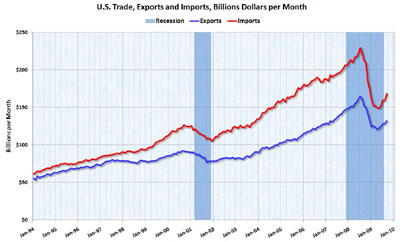
The yawning U.S. trade deficit, which was one of the factors that helped fuel the recent credit bubble, declined sharply in the aftermath of last year's economic meltdown. But it never came anywhere close to zero, let alone positive, and it was mostly an illusion anyway, the result of a temporary collapse in demand for durable goods. Paul Krugman:
But with the financial crisis abating, this process is going into reverse. Last week’s U.S. trade report showed a sharp increase in the trade deficit between August and September. And there will be many more reports along those lines.
So picture this: month after month of headlines juxtaposing soaring U.S. trade deficits and Chinese trade surpluses with the suffering of unemployed American workers. If I were the Chinese government, I’d be really worried about that prospect.
Unfortunately, the Chinese don’t seem to get it: rather than face up to the need to change their currency policy, they’ve taken to lecturing the United States, telling us to raise interest rates and curb fiscal deficits — that is, to make our unemployment problem even worse.
And I’m not sure the Obama administration gets it, either. The administration’s statements on Chinese currency policy seem pro forma, lacking any sense of urgency.
I don't know if Obama gets it, but the Chinese sure don't seem to:
Liu Mingkang, chairman of the China Banking Regulatory Commission, said that a weak U.S. dollar and low U.S. interest rates had led to "massive speculation" that was inflating asset bubbles around the world. It has created "unavoidable risks for the recovery of the global economy, especially emerging economies," Mr. Liu said. The situation is "seriously impacting global asset prices and encouraging speculation in stock and property markets."
....Early Monday, a spokesman for China's Ministry of Commerce added further criticism of the Obama administration, targeting recent measures by Washington against Chinese exports. "We've always known the U.S. and the West as free market economies. But now we're seeing a protectionist side," the spokesman, Yao Jian, told a monthly press briefing. Mr. Yao also rejected criticism of China's currency policy, saying the yuan's exchange rate has little to do with trade imbalances with the U.S. and that China should keep the exchange rate stable.
At some point our trade deficit has to turn around. The Chinese obviously don't want to be the ones to take the hit for this by strengthening their currency and damaging their export-based economy, but they really don't have much choice about it. The global economy is going to be rebalanced one way or another, and it can either happen gradually or it can happen suddenly. The latter would be no fun for anyone, China included. Better to take Door #1 instead.














Just curious, how much of
Just curious, how much of the $787B stimulus did China capture because we were afraid of being seen as protectionist?
leakage
A lot of the first stimulus, the tax refunds under Bush in 2008, probably went to China because it was money spent by consumers, who tend to buy cheap things made there.
But much of Obama's stimulus was directed toward aid to state and local govts and construction. School teachers, cops, etc. all local spending. Construction tends to be spent in the domestic economy for obvious reasons, but I'm sure there is some overseas leakage on items like steel.
That's yet another reason why govt spending as stimulus is now a better play than tax cuts to consumers.
Does investment in a business count as trade?
I was just curious, because it matters both how that is accounted for (alleged future return income streams, just for example) and if it is not, it changes how various methods of budget-balancing affect trade imbalance. Which is to say, the main problem with a high-end tax increase is that it cuts money available for investment -- but investment where, and is that part of the trade-balance accounting?
You would expect to see an
You would expect to see an inverse relationship between trade and capital flows. That's why Japanese investors were so active in the U.S. during the 1980s and 1990s. As the yen got stronger, U.S. assets appeared cheaper.
But China's currency is fixed, so that dynamic doesn't work as well, distorting capital flows. Still, China has been a very active overseas investor lately. Tax policy probably has little impact.
A fair deal
Ok, how about a rebalancing deal everyone can get on board with:
China will float its currency.
In exchange, the U.S. will agree to absorb as many unemployed, underemployed, and marginally attached Chinese workers as are willing to make the trip.
Unimpeded cross-border currency flows. Unimpeded cross-border labor flows.
Everybody wins. I'm sure Paul would approve.
WTO?
What I don't get is how China can be a member of the WTO and engage in what amounts to huge import duties on the other members. Why not just estimate where we think the yuan should be, and slap import duties on all goods shipped from China to make up the difference? ...Of course, I know why we can't, but it's not an irrational knee-jerk reaction.
The dollar/yuan or dyuan has
The dollar/yuan or dyuan has been essentially fixed for the last 20 years. Just consider them your populous poor malnourished companions to the east with the not completely terrible education system who will work for 8 times less. And they have a wealthy local government who collects a lot of the manufacturing money and loans it back to you and makes threats. And I'm not sure the folks in the government like black people like your president.
Anyway, China/US is just like the European Union except there's this sort of racist loanshark and head-in-the-sand drug addict thing going on too.
when
People have been saying our trade deficit has to come into balance since Reagan. "Just sayin'."
China will not coddle crony pseudo capitalists
It is up to America to turn its trade deficit around, not China's. When the US was accruing a positive trade imbalance after WW II, it cared nothing for its trading partners' deficits, and certainly would not change the value of its currency in order to protect their economies. The US used its economic power to increase its economic power after WW II, not help out its trading partners so they could compete better. If China needs to do anything as a hedge against the US trade deficits, it is to diversify its trading partners, not coddle crony pseudo capitalists.
marshall plan
Give me a break, tpx. I'm no rah-rah US #1, but there really was something called the Marshall plan, AND the US did really forgive a hefty amount of European debt after WW2.
The fact of the matter is that the floating exchange rate is one means of a country turning a deficit around. The US IS doing its part, but China is playing by a different set of rules. Those rules actually do interfere with the US's ability to decrease the trade deficit.
Just the facts.
U.S. has NOT done its part
Agree, that U.S. policy in the post-war period was very concerned that Europe and Japan recovered rapidly, In part, of course, to thwart Communism.
But don't agree that the U.S. had done its part to keep trade with China in balance. Since Reagan, U.S. policy has been designed, if not intentionally, to pump up trade deficits thanks to low savings and huge fiscal deficits. We've corrected the savings part, hopefully we will eventually correct the deficit part.
But China, of course, needs to partially float its currency.
The Marshall Plan was to
The Marshall Plan was to ensure the rebuilding of Europe was done with US capital and US corporations.
China is only able to play the way it does because it has so many dollars. These trillions of dollars were earned in the markets through hard work, giving the Chinese control over them, which they are using, or should be using, for their best interests, not mine, yours or any other Americans'. If what the Chinese do interferes with the US ability to reduce its trade deficit, then it is time Americans learned about market economics. Americans like to tell other nations how to fix their economies, especially by reducing social services to pay off deficits. When faced with similar needs, America wants its trading partners to bear the costs. China knows American living standards have to fall in order for it to pay off its debts, so they should wring as much wealth out of their relationship as possible until Americans learn the awful truth.
The Tao of international trade
It's not productive to think Americans must accept a reduced standard of living. If we aimed to do that we would be buying less from China (and others) and that would work in the short run to improve numbers, but to hurt many people here and in China. It might even cause such economic harm to China that the people would become unemployed and riot in the streets. These effects are not good for us or them.
We would do better if we thought of ways for our countries to trade for everyone's benefit and so that the dynamic which evolves will continue without major disruptions for many decades.
If America can begin producing more energy (and other things) then we'll have more buying power and we can buy more from China. That will put more dollars in the hands of some Chinese, but presumably also the ruling government. I'm not certain how their wealth is distributed, but it's safe to say there will be the Rich and everybody else, just as there is here. In that case the Rich (gov't or private) will need to buy or invest and our corporations which need investment dollars COULD be a good place for them to place that capital. If they pay their employees more then their standard of living can rise as they buy more (both domestic and international). If they do a combination of both, investing and improving living standards) then we might have the best of both, and political stability.
Finding solutions to improve things is possible and a lot more useful than whining and predicting disaster all the time.
China should buy all of America's food crop to cut our deficit
It is not productive to consume more than you produce, yet the American political economy has been based on this policy for quite some time. Only now that the deficits have become dangerously insurmountable do Americans seek partners to alleviate them. Finding a solution to America's over-consumption that requires someone else to bear the costs will be very difficult, if not magical, to find. America's wealthy certainly are not going to willingly transfer a bit of their assets to ensure other Americans lifestyles do not change for the worse when the deficit bubble bursts, and it makes no sense any other nation would sacrifice the well being of its people in order to save the well being of Americans. America's deficits are America's problem caused by Americans.
The renminbi will rise
I'm sure the Chinese leadership is fully aware that their currency will have to rise soon. The Bank of China said a couple of weeks ago for the first time that it will account for global capital flows when setting policy.
The problem, of course, is that China holds such huge dollar reserves, which would declline in value. They are probably afraid of doing anything that will ignite a run on the dollar. So, as usual, they are being very cautious.
Currency valuations not the problem
Currency valuations actually have little or nothing to do with global trade imbalances. If the yuan appreciates in any significant way, it's easy to predict that China will simply cut prices in order to maintain their share of the U.S. market.
All of the focus is on China. Yet, when our trade deficits are expressed in per capita terms (to factor out the sheer size of the country involved), our deficit with China barely makes the top twenty. Our per capita deficits in manufactured goods with other nations like Japan, Germany, Korea, Italy and others is much worse. No one is claiming that their currencies are under-valued.
The real driving force behind global trade imbalances is disparities in population density and per capita consumption. As people are forced to crowd together and conserve space, it becomes ever more impractical to own many products. Falling per capita consumption, in the face of rising productivity (per capita output, which always rises), inevitably yields rising unemployment and poverty.
This theory has huge ramifications for U.S. policy toward population management (especially immigration policy) and trade. The implications for population policy may be obvious, but why trade? It's because these effects of an excessive population density - rising unemployment and poverty - are actually imported when we attempt to engage in free trade in manufactured goods with a nation that is much more densely populated. Our economies combine. The work of manufacturing is spread evenly across the combined labor force. But, while the more densely populated nation gets free access to a healthy market, all we get in return is access to a market emaciated by over-crowding and low per capita consumption. The result is an automatic, irreversible trade deficit and loss of jobs, tantamount to economic suicide.
If you‘re interested in learning more about this important new economic theory, then I invite you to visit either of my web sites at OpenWindowPublishingCo.com or PeteMurphy.wordpress.com where you can read the preface, join in the blog discussion and, of course, buy the book if you like. (It's also available at Amazon.com.)
Pete Murphy
Author, "Five Short Blasts"