Ferris Jabr writes in Scientific American this month about the difference between reading a paper book and reading an e-book. The overall gist is that comprehension seems to be a bit lower on e-books, though only by a little. Here’s one piece from the article:
“The implicit feel of where you are in a physical book turns out to be more important than we realized,” says Abigail Sellen of Microsoft Research Cambridge in England and co-author of The Myth of the Paperless Office. “Only when you get an e-book do you start to miss it. I don’t think e-book manufacturers have thought enough about how you might visualize where you are in a book.
….Supporting this research, surveys indicate that screens and e-readers interfere with two other important aspects of navigating texts: serendipity and a sense of control. People report that they enjoy flipping to a previous section of a paper book when a sentence surfaces a memory of something they read earlier, for example, or quickly scanning ahead on a whim. People also like to have as much control over a text as possible—to highlight with chemical ink, easily write notes to themselves in the margins as well as deform the paper however they choose.
Yep. I love reading e-books using the Kindle app on my tablet even though I didn’t like it on the Kindle device I bought a few years ago. Why? The larger screen and faster 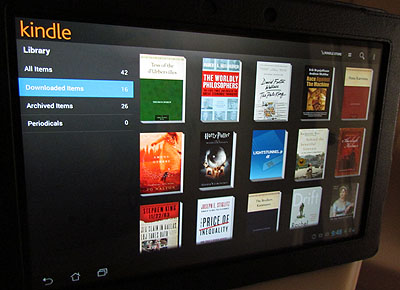 response time made all the difference. It doesn’t sound like much, but it was like night and day for me.
Likewise, on the tactile front, it makes a big difference to me that my tablet is inside a leather (or leather-like, anyway) cover. Obviously, the basic purpose of the cover is to protect the tablet in case I drop it or something, but it also makes it far more pleasant to read. Without the cover, it feels slick, metallic, and cold. I don’t like it. With the cover, it feels slightly tacky, organic, and warm—traits that I associate with books.
However, I do like to know how far along I am in a book, and I like being able to flip back and forth easily. Both are less automatic on e-books than with paper books. Last night, for example, I was 60 percent done with a book I was reading and figured I had plenty left to go. Then, suddenly, it ended. Partly that’s because my Kindle app inexplicably failed basic arithmetic (if I’d looked at the page count I would have seen that I was 320 pages into a 360-page book), but mostly because the book had a long index and lots of endnotes. Those are things I would have known immediately with a paper book, but which take a conscious effort to find out with an e-book.
But that’s a small thing. By far, the biggest drawback to e-books is the inability to casually flip back and forth and find things. The search function makes that easier in some respects—though I’m mightily perplexed that the last update to the Android Kindle app slowed down searching by about 10x—and bookmarks can take the place of dog-eared pages. Still, it’s not as quick or easy to simply flip back a couple dozen (or a couple hundred) pages while holding your current place. Perhaps this is different for younger readers who grew up using reading apps and keep bookmarks and notes as instinctively as I underline passages or turn down the corners of pages.
But anyway, yes: the next frontier for e-books is some nifty and intuitive way to make them as easy to navigate as paper books. Is anyone working on this?