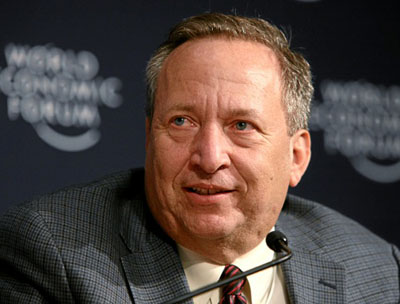
 I mentioned a couple of weeks ago that my main objection to Larry Summers as chairman of the Fed was his record on financial regulation. Today, Cass Sunstein uses his Bloomberg column to tell me I have nothing to worry about:
I worked with Summers in the Obama administration, and I can report that in internal discussions, he was one of the most uncompromising advocates for financial regulation. Of course, he supports the free-market system and wants to avoid unnecessary regulatory burdens. But time and again, he insisted that the events of 2008 required everyone, including him, to re-evaluate their views about regulating the financial industry. He contended that banks can’t police themselves any more than polluters can be trusted to protect the environment or pharmaceutical companies can be trusted to ensure that drugs are safe.
Building on these analogies, Summers vigorously argued on behalf of a consumer financial protection agency, and he supported strong safeguards designed to reduce the risk of another economic meltdown. Intensely focused on the problem of “too big to fail,” he was one of the earliest and most forceful advocates of promoting financial stability by requiring banks to have enough capital to withstand an economic downturn.
All of this might be true. Perhaps Summers really has changed his tune after living through the 2008 financial crisis. I’m not a White House insider, so there’s no way for me to know.
But I will say this: over the past decade I’ve become far, far more skeptical of reports based on private knowledge. It seems like there are always plenty of people around to tell us what the great and the good are “really” thinking based on conversations at Davos or Jackson Hole or the West Wing of the White House. Sometimes they’re right. But more often, if you want to know what someone really thinks, the best guide by far is their past actions and statements. There’s seldom any good reason to make things more complicated than that.
Now, it so happens that Janet Yellen, the other main candidate for the position, doesn’t have much of a track record on financial regulation. So it’s not as if this is a black-and-white competition. Nonetheless, I’d be very cautious about thinking that someone with long experience and well-considered views is likely to become a born-again regulator. With the immediate crisis out of the way, Summers’ regulatory temperament is probably about the same as it’s always been.
That said, and despite the remarkable amount of heat this appointment has generated, I can’t say that I have super strong feelings about the whole thing. I think Yellen has more relevant experience and a better track record of being right on the big questions, while Summers has well-known social problems and a dubious track record on financial regulation. That makes Yellen a better choice. But honestly, they aren’t very far apart on the big issues, and it’s unlikely that either one is head and shoulders above the other. If Obama nominates Summers, it would be just another case of him choosing someone I thought was second best. A minor disappointment, but that’s about it.