No, Bernie Sanders’ Domestic Policy Plan Doesn’t Really Cost $18 Trillion

Get your news from a source that’s not owned and controlled by oligarchs. Sign up for the free Mother Jones Daily.


The Wall Street Journal says Bernie Sanders’ domestic policy plan would cost $18 trillion over ten years. Is this true?
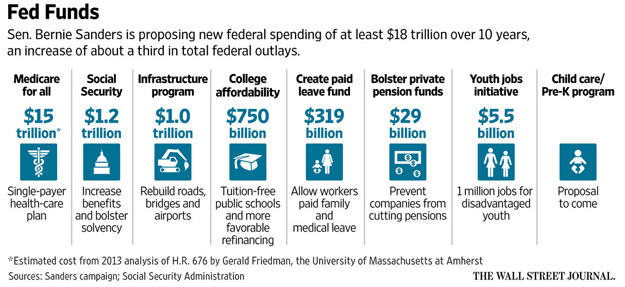
It depends on how you look at it. First, there’s a set of proposals that the Journal estimates would cost about $3.4 trillion. That’s not pocket change, but it’s about as much as Jeb Bush’s tax cut. The big difference is that Jeb’s tax cuts mostly benefit the rich, while Bernie’s proposals mostly benefit the poor and the middle class. You can decide for yourself which you prefer.

Then there’s the $15 trillion price tag for universal health care. Is this a fair estimate? It’s probably in the ballpark. Private health insurance accounted for about $1 trillion in spending last year, and assuming reasonable growth that will probably come to around $15 trillion over the course of a decade.

But here’s the thing: this is money we already spend. Right now, employers and workers pay insurance companies $1 trillion for health care. Under Bernie’s plan, we’d instead pay that money to the federal government. Generally speaking, this would be invisible to most of us. Behind the scenes, our dollars would flow to a different place, and that’s about it.

So the Sanders plan wouldn’t actually take money out of our pockets. It’s a wash. It needs to be evaluated instead on all the usual metrics. Would the government do a better job of holding down costs? Would government control distort market signals? Would innovation suffer? Would most of us have more choice in health care providers? Would more people be covered? Etc.

Bottom line: You should think of the Sanders plan as costing about $3.4 trillion. You may or may not like the idea of universal health care, but it wouldn’t have much impact on how much money you actually take home each week.
BEFORE YOU CLICK AWAY!

December is make or break for us. A full one-third of our annual fundraising comes in this month alone. A strong December means our newsroom is on the beat and reporting at full strength. A weak one means budget cuts and hard choices ahead.

The December 31 deadline is closing in fast. To reach our $400,000 goal, we need readers who’ve never given before to join the ranks of MoJo donors. And we need our steadfast supporters to give again today—any amount.

Managing an independent, nonprofit newsroom is staggeringly hard. There’s no cushion in our budget—no backup revenue, no corporate safety net. We can’t afford to fall short, and we can’t rely on corporations or deep-pocketed interests to fund the fierce, investigative journalism Mother Jones exists to do.

That’s why we need you right now. Please chip in to help close the gap.

BEFORE YOU CLICK AWAY!

December is make or break for us. A full one-third of our annual fundraising comes in this month alone. A strong December means our newsroom is on the beat and reporting at full strength. A weak one means budget cuts and hard choices ahead.

The December 31 deadline is closing in fast. To reach our $400,000 goal, we need readers who’ve never given before to join the ranks of MoJo donors. And we need our steadfast supporters to give again today—any amount.

Managing an independent, nonprofit newsroom is staggeringly hard. There’s no cushion in our budget—no backup revenue, no corporate safety net. We can’t afford to fall short, and we can’t rely on corporations or deep-pocketed interests to fund the fierce, investigative journalism Mother Jones exists to do.

That’s why we need you right now. Please chip in to help close the gap.

We Recommend

Latest

Sign up for our free newsletter

Subscribe to the Mother Jones Daily to have our top stories delivered directly to your inbox.

Get our award-winning magazine

Save big on a full year of investigations, ideas, and insights.

Subscribe

Support our journalism

Help Mother Jones' reporters dig deep with a tax-deductible donation.

Donate