Here’s an Easy Way to Compare Obamacare and AHCA

Get your news from a source that’s not owned and controlled by oligarchs. Sign up for the free Mother Jones Daily.


Who would get hurt by the Republican health care plan? The short answer is: pretty much everybody. But Andrew Sprung suggests a more precise way of looking at it, which he calls Total Subsidized Share of Costs, or TSS.

It’s a pretty simple concept. If, say, the government pays half your health care premium, and your policy covers half your medical expenses, then your TSS is the product of those two things: one quarter. The other three-quarters you have to pay yourself. If (more realistically), Obamacare pays 85 percent of your premium, and the policy covers 80 percent of your costs (i.e., it has an “actuarial value” of 80 percent), then your TSS is 68 percent and you pay the other 32 percent. Since CBO calculated actuarial values for the Republican bill, we can calculate TSS for both Obamacare and AHCA.

My purpose on earth is to put other people’s numbers into colorful charts, so let’s do that. But first, I happen to think that a better measure to look at is not how much is subsidized, but how much the covered person has to pay. So instead of TSS, let’s look at the inverse: Total Personal Share of Costs, or TPS.1 Here’s my TPS report for various income levels:
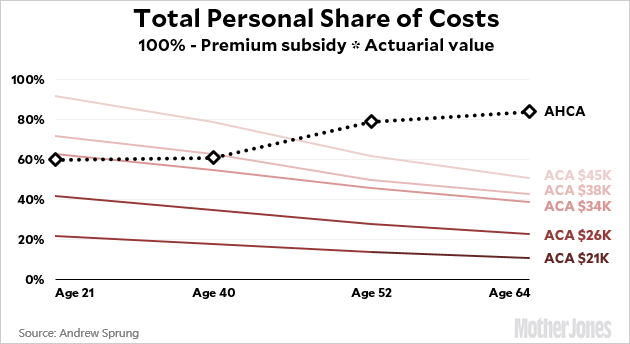
If your income is $34,000 or less, Obamacare is a better deal for everyone. At higher income levels, Obamacare is still better for older people but AHCA is better for young people.

Of course, someone earning $40,000 or more is likely to have a job that provides health insurance, and therefore doesn’t need either Obamacare or AHCA anyway. For nearly all the people who actually need individual health insurance in the first place, the Republican plan is a disaster. Poor people will all pay at least 60 percent of their health care costs, and older people will pay more than 80 percent.

1Astute readers will recognize another reason that I like the acronym TPS.
DECEMBER IS MAKE OR BREAK

A full one-third of our annual fundraising comes in this month alone. That’s risky, because a strong December means our newsroom is on the beat and reporting at full strength—but a weak one means budget cuts and hard choices ahead.

The December 31 deadline is closing in fast. To reach our $400,000 goal, we need readers who’ve never given before to join the ranks of MoJo donors. And we need our steadfast supporters to give again—any amount today.

Managing an independent, nonprofit newsroom is staggeringly hard. There’s no cushion in our budget—no backup revenue, no corporate safety net. We can’t afford to fall short, and we can’t rely on corporations or deep-pocketed interests to fund the fierce, investigative journalism Mother Jones exists to do.

That’s why we need you right now. Please chip in to help close the gap.

DECEMBER IS MAKE OR BREAK

A full one-third of our annual fundraising comes in this month alone. That’s risky, because a strong December means our newsroom is on the beat and reporting at full strength—but a weak one means budget cuts and hard choices ahead.

The December 31 deadline is closing in fast. To reach our $400,000 goal, we need readers who’ve never given before to join the ranks of MoJo donors. And we need our steadfast supporters to give again—any amount today.

Managing an independent, nonprofit newsroom is staggeringly hard. There’s no cushion in our budget—no backup revenue, no corporate safety net. We can’t afford to fall short, and we can’t rely on corporations or deep-pocketed interests to fund the fierce, investigative journalism Mother Jones exists to do.

That’s why we need you right now. Please chip in to help close the gap.

We Recommend

Latest

Sign up for our free newsletter

Subscribe to the Mother Jones Daily to have our top stories delivered directly to your inbox.

Get our award-winning magazine

Save big on a full year of investigations, ideas, and insights.

Subscribe

Support our journalism

Help Mother Jones' reporters dig deep with a tax-deductible donation.

Donate