Kevin Drum

I Need Some Help With Yelp

| Mon May. 6, 2013 11:52 AM PDT

Andrew Sullivan points me today to an essay by Tom Vanderbilt about the rise of online reviewing. Here he is describing his problems with Yelp reviews of restaurants:

As I navigate a Yelp entry to simply determine whether a place is worth my money, I find myself battered between polar extremes of experience: One meal was “to die for,” another “pretty lame.” Drifting into narrow currents of individual proclivity (writing about a curry joint where I had recently lunched, one reviewer noted that “the place had really good energy, very Spiritual [sic], which is very important to me”), I eventually capsize in a sea of confusion. I either quit the place altogether or, by the time I arrive, am weighed down by a certain exhaustion of expectation, as if I had already consumed the experience and was now simply going through the motions.

....What further complicates this picture of the masses liberating the objects of criticism from the tyranny of critics is that so many reviewers seem to turn toward petty despotism. Reading Yelp reviews, particularly of the one-star variety, one quickly senses the particular ax being ground—the hostess who shot the “wrong” look at the “girls’ night” group; a greeting that is too effusive, or insufficiently so; the waiter deemed “too uneasy with being a waiter”; or any number of episodes (each example has been taken from Yelp) that have little to do with food.

I've pretty much given up reading Yelp reviews. Part of the problem, as Vanderbilt notes, is that they're so polarized it's hard to make sense of them. Too often, it barely seems possible that the reviewers are even describing the same place.

But it's not just polarization. My sense is that people are much more likely to spend time writing a Yelp review when they're pissed off. And when they're pissed off they bring their full rhetorical skills to bear. So, as I browse through the reviews of even a pretty good place, I'm nearly always bombarded with enough horrible comments that I start to back off. Do I really want to go there? Seems pretty chancy.

Basically, Yelp makes me less likely to eat out, not more, because every place ends up sounding like a possible plunge into the heart of darkness. Is that because I'm more risk-averse than average? Or do others find the same thing? Let me know in comments. What's your advice for using Yelp most effectively?

Advertise on MotherJones.com

Advertising Didn't Have Much Effect on the 2012 Election

| Mon May. 6, 2013 10:06 AM PDT

Over at the Monkey Cage, Michael Franz has an interesting postmortem on the effect of TV advertising during the 2012 presidential election. He uses a clever design that takes advantage of the fact that ads in battleground states sometimes bleed over the border into non-battleground states, producing a random set of non-battleground voters who are exposed to large numbers of ads.

Franz's bottom line is simple: advertising didn't have much effect in 2012. The maximum effect—that is, the effect of swapping the market with the biggest Democratic ad advantage to the one with the biggest Republican ad advantage—is about 1 percentage point of the vote share. The effect is bigger if you look solely at ads in the final two months, but not a lot bigger. And this is the biggest possible effect. In more likely scenarios, where one side or the other out-advertised the other by a fairly normal amount, the effect is a few tenths of a percentage point.

This doesn't mean ads don't matter. What it means is that (a) they largely cancel each other out, and (b) there's probably a saturation point above which they have diminishing returns. It's also likely that ads have less impact in an election featuring a well-known incumbent (ads were apparently more effective in 2008 than in either 2004 or 2012). Nonetheless, this fits with other data suggesting that 2012 was a very fundamentals-driven election. Obama's superior organization might have made a difference at the margins, but only a small difference. This cake was pretty much fully baked before the Republican Party even agreed on a nominee.

POSTSCRIPT: As clever as this study design is, I do wonder if it's possible that battleground-state voters respond differently to ads than non-battleground-state voters. Perhaps there's an interaction between ads and all the other stuff going on in battleground states that makes them more effective than in other places?

Budget Follies Are Coming Soon to a Congress Near You

| Mon May. 6, 2013 9:07 AM PDT

One of the big pieces of political theater that political junkies are looking forward to this summer is the reconciliation of the House and Senate budgets. Ginger Gibson of Politico describes the basic differences, which are pretty well known to everyone:

The differences between the House GOP and the Senate Democratic plans are clear, with the House GOP plan balancing the budget after 10 years but extracting deep cuts in spending and ultimately converting Medicare to a voucher program. The Senate Democratic plan doesn’t balance the budget at all but does contemplate nearly $1 trillion in tax hikes along with equal parts spending cuts.

Republicans, after wailing for years about Democratic unwillingness to pass a budget via regular order (as opposed to makeshift continuing resolutions), suddenly find themselves unenthusiastic about naming a conference committee because it would give minority Democrats in the House an opportunity to force embarrassing votes on a variety of politically sensitive topics. For their part, Democrats, who have been OK with makeshift continuing resolutions for the past few years, have finally decided that the time is right for a High Noon showdown and think a conference committee would be peachy.

I don't actually have anything to say about this. Conference committees have been something of a dead letter for a while, and it's not as if I have any deep and principled love for them. Mainly, I think it's interesting that, as near as I can tell, Democrats feel more confident about their position these days than Republicans do. After about $3 trillion in spending cuts over the past two years, they seem confident that the public is firmly on their side when they demand that any further cuts should be matched with revenue increases from the wealthy.

We'll see about that. Basically, though, this is just a placeholder post to make sure everyone knows where we are at the moment. The budget wars haven't started to seriously heat up yet, but they probably will fairly soon.

Wanted: Adult Supervision for the Gun Nuts

| Mon May. 6, 2013 8:04 AM PDT

Guns have never been a hot button for me. On a pragmatic level, I don't think they have a big effect on crime. On a constitutional level, I've long accepted that the Second Amendment does indeed confer a personal right to bear arms. (A limited right, sure, but that's true of every right in the Constitution.) And on a political level, it's obvious that America has a long and deep cultural attachment to guns that simply isn't going away.

But last week the NRA proudly announced a new president: James Porter, a man who, among other things, refers to Barack Obama as a  "fake President"; apparently thinks the Civil War was a great example of an armed citizenry resisting Northern tyranny; and advocates training all civilians in the use of standard military firearms so "they're ready to fight tyranny" yet again. Fellow Southerner Ed Kilgore is distinctly unamused:

Am I perhaps being unfair to these people in suggesting that they are behaving like America-haters and are flirting with treason? I don't think so. Porter and those like him could dispel this sort of suspicion instantly, any time they wanted, by just saying: "Let's be clear: the kind of 'tyranny' we are arming ourselves to forestall is something entirely different from anything Americans have experienced since we won our independence—a regime engaged in the active suppression of any sort of dissent, and the closure of any peaceful means for the redress of grievances. We're not talking about the current administration, or either major political party, as presently representing a threat of tyranny."

I'm not holding my breath for any statements like that to emerge from the NRA, or indeed, from the contemporary conservative movement. It's ironic that people who almost certainly think of themselves as patriots—perhaps as super-patriots—are deliberately courting the impression that loyalty to their country is strictly contingent on the maintenance of laws and policies they favor, to be achieved if not by ballots then by bullets. Republican politicians should be repudiating such people instead of celebrating them, accepting their money and support, and even adopting their seditious rhetoric.

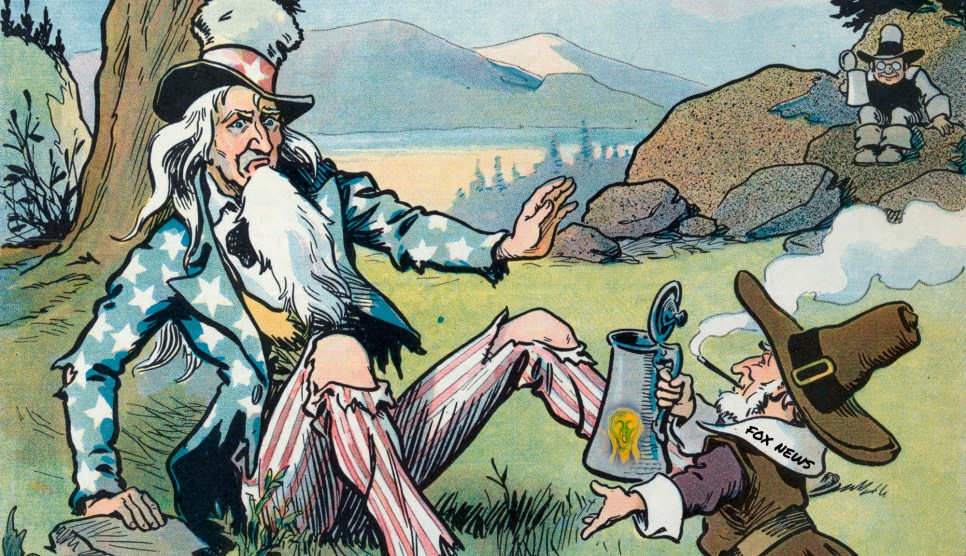
Normally, I'd brush off Porter's comments as nothing more than a guy blowing off steam in front of a friendly audience. And to a large extent, I do. Still, Ed is right. If an imam in Brooklyn toured the country saying stuff like this, no one would just laugh it off. Ditto for a Black Panther or the head of the American communist party. Fox News would go ballistic.

This kind of stuff has gone well beyond the stage of being a joke or merely a way to rally the troops, and it's long past time for some of the alleged adults in the conservative movement to rein it in. Enough's enough. Guns have never been a hot button for me in the past, but the NRA is sure working hard to make them into one.

What We Know—And What We Don't—About the Oregon Medicaid Study

| Sun May. 5, 2013 9:42 PM PDT

I've been spending a bit of time this weekend trying to understand better what the real issues are with the Oregon Medicaid study that was released on Thursday and shortly afterward exploded across the blogosphere. Unfortunately, I've come to the conclusion that it's next to impossible to explain it in a way that would be understandable to most people. My readers, however, are not "most people," so I figure I'll take a crack at it anyway. The damage may have already been done from the many misinterpretations of the Oregon study that have been published over the past few days, but who knows? Maybe this will help anyway.

First, to refresh your memory: In 2008, Oregon expanded Medicaid coverage but didn't have enough money to cover everyone. So they ran a lottery. If you lost, you got nothing. If you won, you were offered the chance to sign up for Medicaid. This provided a unique opportunity to study the effect of Medicaid coverage, because Oregon provided two groups of people who were essentially identical except for the fact that one group (the control group) didn't have access to Medicaid, while the other group (the treatment group) did.

There are several things to say about the Oregon study, but I think the most important one is this: not that the study didn't find statistically significant improvements in various measures of health, but that the study couldn't have found statistically significant improvements. It was impossible from the beginning.

Here's why. The first thing the researchers should have done, before the study was even conducted, was estimate what a clinically significant result would be. For example, based on past experience, they might have decided that if access to Medicaid produced a 20 percent reduction in the share of the population with elevated levels of glycated hemoglobin (a common marker for diabetes), that would be a pretty successful intervention.

Then the researchers would move on to step two: suppose they found the clinically significant reduction they were hoping for? Is their study designed in such a way that a clinically significant result would also be statistically significant? Obviously it should be.

Let's do the math. In the Oregon study, 5.1 percent of the people in the control group had elevated GH levels. Now let's take a look at the treatment group. It started out with about 6,000 people who were offered Medicaid. Of that, 1,500 actually signed up. If you figure that 5.1 percent of them started out with elevated GH levels, that's about 80 people. A 20 percent reduction would be 16 people.

So here's the question: if the researchers ended up finding the result they hoped for (i.e., a reduction of 16 people with elevated GH levels), is there any chance that this result would be statistically significant? I can't say for sure without access to more data, but the answer is almost certainly no. It's just too small a number. Ditto for the other markers they looked at. In other words, even if they got the results they were hoping for, they were almost foreordained not to be statistically significant. And if they're not statistically significant, that means the headline result is "no effect."

The problem is that, for all practical purposes, the game was rigged ahead of time to produce this result. That's not the fault of the researchers. They were working with the Oregon Medicaid lottery, and they couldn't change the size of the sample group. What they had was 1,500 people, of whom about 5.1 percent started with elevated GH levels. There was no way to change that.

Given that, they probably shouldn't even have reported results. They should have simply reported that their test design was too underpowered to demonstrate statistically significant results under any plausible conditions. But they didn't do that. Instead, they reported their point estimates with some really big confidence intervals and left it at that, opening up a Pandora's Box of bad interpretations in the press.

Knowing all this, what's a fair thing to say about the results of this study?

  • One fair thing would be to simply say that it's inconclusive, full stop. It tells us nothing about the effect of Medicaid access on diabetes, cholesterol levels, or blood pressure maintenance. I'm fine with that interpretation.
  • Another fair thing would be to say that the results were positive, but the study was simply too small to tell us if the results are real.
  • Or there's a third fair thing you could say: From a Bayesian perspective, the Oregon results should slightly increase our belief that access to Medicaid produces positive results for diabetes, cholesterol levels, and blood pressure maintenance. It shouldn't increase our belief much, but if you toss the positive point estimates into the stew of everything we already know, they add slightly to our prior belief that Medicaid is effective.
  • But you can't say that the results are disappointing, at least not without a lot of caveats. At a minimum, the bare fact that the results aren't statistically significant certainly can't be described as a disappointment. That was baked into the cake from the beginning. This study was never likely to find significant results in the first place.

So that's that. You can't honestly say that the study shows that Medicaid "seemed to have little or no impact on common medical conditions like hypertension and diabetes." That just isn't what it showed.

POSTSCRIPT: That said, there are a few other things worth saying about this study too. For example, the researchers apparently didn't have estimates of clinical significance in mind before they conducted the study. That's odd, and it would be nice if they confirmed whether or not this is true. Also: the subjects of the study were an unusually healthy group, with pretty low levels of the chronic problems that were being measured. That makes substantial improvements even less likely than usual. And finally: on the metrics that had bigger sample sizes and could provide more reliable results (depression, financial security, self-reported health, etc.), the results of the study were uniformly positive and statistically significant.

Who's Using Chemical Weapons in Syria?

| Sun May. 5, 2013 7:55 PM PDT

I haven't seen this picked up anywhere else, but Reuters is reporting that a UN official says they have no evidence that the Syrian regime has used chemical weapons in its ongoing civil war:

U.N. human rights investigators have gathered testimony from casualties of Syria's civil war and medical staff indicating that rebel forces have used the nerve agent sarin, one of the lead investigators said on Sunday.

The United Nations independent commission of inquiry on Syria has not yet seen evidence of government forces having used chemical weapons, which are banned under international law, said commission member Carla Del Ponte.

I have no idea if this is reliable or not. However, for more on just how shaky the evidence is about the use of chemical weapons in Syria, you might try this Guardian piece from a few days ago. Overall, it suggests that the Obama administration might indeed be wise to collect more definitive evidence about this before they do anything rash.

Advertise on MotherJones.com

Don't Call It "The Five" in San Francisco!

| Sat May. 4, 2013 3:13 PM PDT

Maria Bustillos writes in Aeon that when she drives from Los Angeles to San Francisco, she always takes I-5, the most direct route:

This is the way I always go. Not only because it’s fastest, but because, despite the conventional wisdom, I find it the most beautiful of all. California natives always call it just ‘The Five’: not Highway Five or Interstate Five or I-5.

Hoo boy. As soon as I read that I knew she was going to get some angry responses. Sure enough, here's the very first comment:

"The" in front of a highway number is NOT a CA native expression! It is rather, a SoCal thing based largely on CHP and LAFD radio chatter. It has become widespread all over the west into Arizona, Nevada and even Oregon, but is roundly discouraged in The Bay Area and in Norcal.

I'm not sure about Oregon, but this is definitely a Southern California thing that has spread throughout the southwest. It goes north to about San Luis Obispo or Monterey, but stops there. It's also, oddly enough, common in the Buffalo/Toronto area, but apparently nowhere else in the United States.

However, I don't think there's any evidence that this habit is based on CHP or LAFD chatter. Unfortunately, it's not clear what it is based on, since none of the explanations I've ever heard have really been convincing. The full story is here: Part 1, Part 2, Part 3.

Friday Cat Blogging - 3 May 2013

| Fri May. 3, 2013 11:52 AM PDT

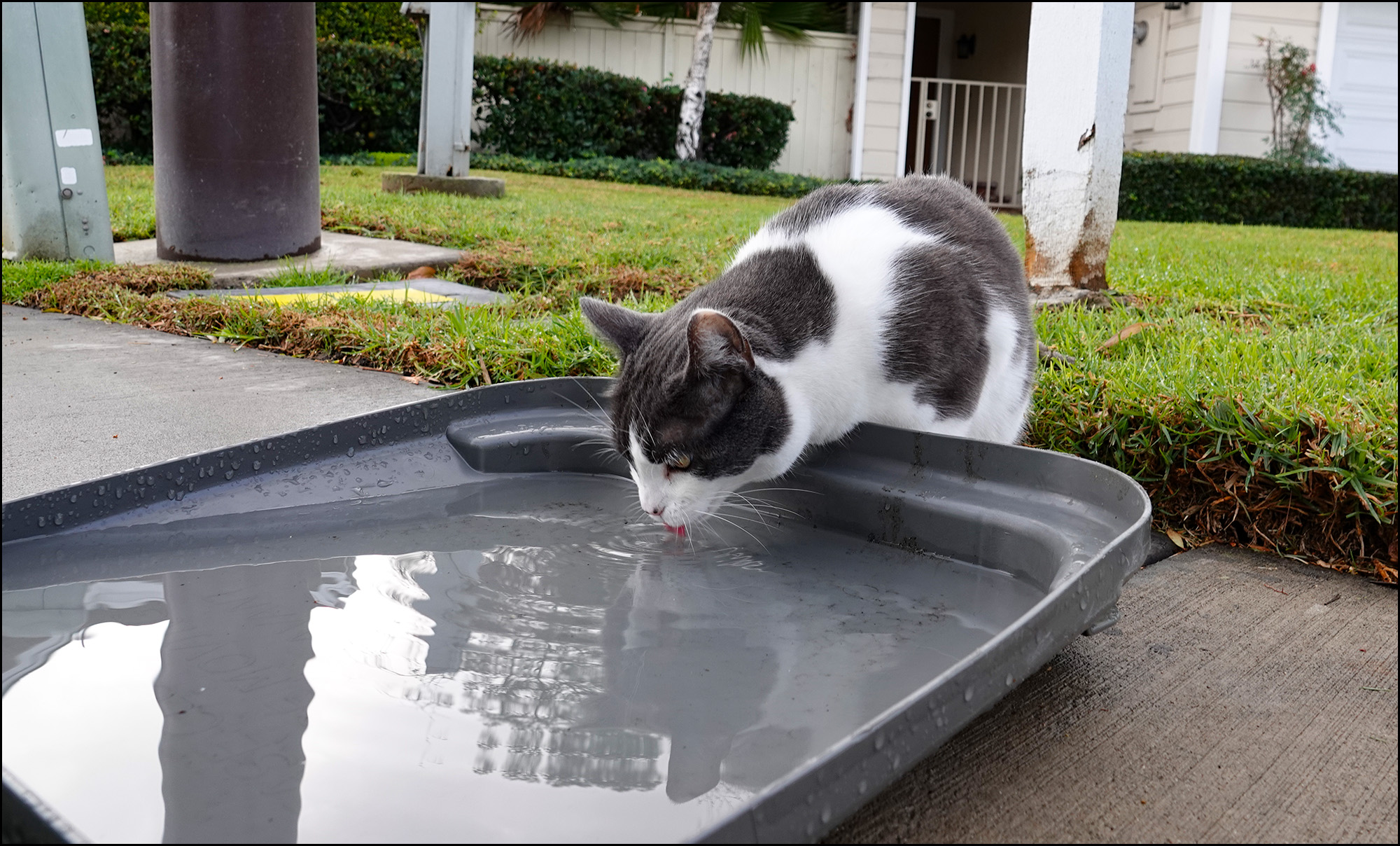
April showers are behind us, and now it's time for May flowers. Today, temps in Southern California are headed up into the 90s, so Domino headed into the backyard to bask in the warmth. In this photo, she's trying to disguise herself as a pool of water, hoping that some local birds will think she's a bird bath and fly right into her waiting jaws. It didn't happen this morning, but you never know. Maybe next time.

Are Republicans Playing Jedi Mind Tricks on Immigration Reform?

| Fri May. 3, 2013 11:48 AM PDT

Greg Sargent explores the immigration debate on the right, and explains why Marco Rubio and others are making the arguments they're making:

They are subtly making the case to their base that a defeat for immigration reform is actually a hidden victory for Obama....The idea is that if we don’t pass the Gang of Eight plan, Obama wins. This case is being made on several levels. On the one hand, this notion of leaving the issue “entirely in the hands of Obama” is a partly a suggestion that the President just may use his executive powers to solve the undocumented immigrant problem himself if we don’t pass the Senate plan — just as he did with the DREAMers.

....There’s a key nuance here. As I understand the thinking, GOP base voters are turned off by the political argument that we must reform immigration because if we don’t, Obama will be able to screw Republicans over politically with Latinos....That’s why the argument can’t be openly stated as: If we embrace reform, Obama loses. It has to be carefully calibrated in the manner Rubio has adopted: Not doing anything opens the door for a far greater victory for Obama later. He will be able to do for the undocumented what he did for the DREAMers — while not securing the border — a twofer for Obama.

Obama is playing his part in this dance, too. He and the White House frequently take care to say — not in these exact words, but this is the message — that while he supports the Senate compromise, it’s far from the liberal dream legislation he’d like.

Interesting. Basically, Sargent is suggesting that Republican base voters respond more strongly to the suggestion of a crafty Obama victory if they do nothing than they do to the possibility of an Obama loss if they do something. Partly that's because they've been trained to think of Obama as a cunning grifter constantly putting one over on them, and partly because they're not really convinced that passing immigration reform will help Republicans.

I'm not sure if I buy this or not. But I might!

A Different Kind of War Requires a Different Kind of POW Camp Too

| Fri May. 3, 2013 10:46 AM PDT

ThinkProgress passes along the following exchange on CNN between Jeffrey Toobin and former Bush administration press secretary Ari Fleischer. The subject is whether and why we need the Guantanamo prison:

TOOBIN: This country fought Adolf Hitler. And I don’t really believe that Osama bin Laden and his group are worse or more dangerous than Adolf Hitler. And we managed to defeat Adolf Hitler by following the rule of law.

FLEISCHER: They followed the law of war. They wore uniforms and they fought us on battlefields. These people are fundamentally, totally by design different. And they need to be treated in a different extrajudicial system.

Ed Kilgore has a bit to say about just how law-abiding the Nazis actually were (ahem), but I want to give Fleischer his due and assume that he intended to say something a bit more insightful than he actually did in the heat of real-time debate. Putting aside the war ethics of the Third Reich, Fleischer is right about a few things:

  • We are mostly fighting against non-state actors.
  • There are no geographical boundaries to this war.
  • There is no way to eventually declare victory, and no way for anyone to formally surrender.

The problem is that this undermines Fleischer's point, I think, rather than supporting it. Guantanamo is fundamentally a prisoner-of-war camp, but it's unlike any POW camp in history because we haven't put in place any boundaries on it. It's simply a life sentence for many of the prisoners, even if the evidence is thin or nonexistent that they ever fought against us in the first place.

So yes: we're fighting a different kind of war. That means we need to rethink how we handle POWs too. So far, we haven't really faced up to that.