Kevin Drum

Immigration Reform Gets a Sudden Blast of Reality

| Wed Jun. 5, 2013 7:52 AM PDT

One of the key questions that's been swirling around the immigration debate from the beginning is whether Marco Rubio is being an honest broker. Does he really and truly want immigration reform? Or does he want to play the role of reasonable conservative for as long as he can, and then, more in sadness than in anger, turn against his own bill at the end because it's not tough enough? Byron York reports that it's looking like the latter:

Speaking with radio host Hugh Hewitt Tuesday, Rubio said the Senate should “strengthen the border security parts of this bill so that they’re stronger, so that they don’t give overwhelming discretion to the Department of Homeland Security.” He said he was working with other senators on amendments to do just that.

Then Hewitt asked: “If those amendments don’t pass, will you yourself support the bill that emerged from Judiciary, Senator Rubio?”

Rubio answered, “Well, I think if those amendments don’t pass, then I think we’ve got a bill that isn’t going to become law, and I think we’re wasting our time. So the answer is no.”

"Those amendments" are poison pills that would require 100 percent operational control of the border before any new green cards are issued, a standard that's pretty obviously impossible to meet. The only reason to insist on them is to give Rubio a plausible exit strategy from his own bill.

Or so it seems. Maybe Rubio has something else in mind. But it's sure starting to look like Rubio has figured out that his support for immigration reform is doing him more harm than good with the tea party folks he needs if he ever wants to become president. What's more, he's probably less confident than he used to be about the chances of getting the House to go along anyway, which makes it pointless for him to keep taking damage over the issue.

We'll see. Rubio's support, as always, is critical to immigration reform. If he bolts, it's dead. But if he insists on his poison pill amendments, it's dead too. I'd say the odds on passage just dropped dramatically.

Advertise on MotherJones.com

Maybe Republicans Won't Block All of Obama's DC Court Nominees After All

| Tue Jun. 4, 2013 8:50 PM PDT

Will Republicans flatly obstruct all three of President Obama's nominees to the DC Circuit Court? It sure seems that way to me, but Jonathan Bernstein disagrees:

Here's my guess — not a prediction, but just a guess based on past patterns. We'll continue to hear the insipid rhetoric about "court packing" and how the DC Circuit doesn't need any judges anyway, but that will be mostly just background music for the rubes. One of the picks will get through fairly easily. One will be killed by filibuster. And the third will be a close call, but probably get through, perhaps with a few Republicans voting yes on cloture but against confirmation. Those opposing picks will mainly focus on claims that the nominees are out of the mainstream ideologically, or will allege lack of proper judicial temperament, or some other such reason — very few Republicans will claim that they are blockading the DC Circuit Court.

Maybe! Jonathan thinks Republicans will be leery of total obstruction because "it would almost certainly push Democrats over the edge into going nuclear." That's a good point—better, I think, than his argument that Republicans haven't blocked every single appellate court nominee in the past. I don't think that's very meaningful. This fight is different, and the stakes are higher, so I don't think past performance is a good indicator of how Republicans are going to play things.

But fear of pushing Democrats over the edge into killing the filibuster is probably quite real, and there might well be half a dozen Republican senators who (a) take that seriously and (b) are nervous about the total blockade strategy in the first place. These half dozen will also need to be senators who (a) aren't up for reelection next year and (b) can afford to cross the conservative media, which is almost certain to turn this into a litmus test of standing up against Obama's attempt to impose his thuggish one-party rule over the entire country. But there might well be six such senators. I'd say Jonathan makes a good case.

That IRS Conference in Anaheim Isn't Really the Scandal Everyone Thinks It Is

| Tue Jun. 4, 2013 5:17 PM PDT

The hot news today is the scandalous revelation that the IRS spent $4.1 million on an employee conference in Anaheim a few years back. Here's a typical description:

Some 2,600 Internal Revenue Service managers gathered in Anaheim, Calif., in August 2010 were treated to $50,000 worth of comic videos and $135,000 worth of guest speakers, one of whom collected $17,000 to paint portraits of famous personages on stage, an audit found....Some $64,000 was spent on giveaway swag for all attendees, including thousands of logo-emblazoned “brief bags” and spiral journals, 800 lanyards, 75 travel mugs and 75 picture frame/clocks, and various other customized knickknacks such as pens, can coolers and Post-It notes.

Can we talk? Yes, the Inspector General found that the event planners didn't always follow proper procedures, and I'm painfully aware that stuff like this often sounds dumb when you read about it after the fact. What's more, a few of the items in the IG report sound genuinely dodgy. But honestly, there's less here than meets the eye. The IG found that the IRS "did not use available internal personnel to assist in searching for the most cost-effective location as required," and I assume that's true. But you know what? There are surprisingly few places where you can hold a conference for 2,600 people. Just ask anyone who's ever done one of these things. And in the end, the total cost ended up at about $1,600 per person for a three-day conference. That's....not bad, actually. Again, just ask anyone who's ever done one of these things.

And for what it's worth, can I add that every single private company in the country has held more of these kinds of conferences than you can count? Yes, there's a Dilbertish case to be made that they're stupid and a waste of time. I was always fairly cynical about them, myself. But trust me: the rock-jawed titans of the private sector do all this stuff and more every single year. You might think it's dumb, but they all seem to think it's worthwhile. Is it any surprise that IRS management figured it was worthwhile too?

The Obama administration cracked down on this stuff long ago, and there's very little of it still being done. That's probably good optics, but it's less clear that it's good management. After all, it's not as if getting everyone together once a year for some face time is an obviously stupid thing to do. Either way, though, let's keep this in perspective. I know that's hard because this stuff is such an easy target, and I know that defending it is a lose-lose proposition. But just talk to some of your friends who work for large corporations. They'll tell you. Not only is this kind of conference nothing out of the ordinary, but by private sector standards it sounds positively restrained. As scandals go, this is pretty weak tea.

Please Don't Feed the Patent Trolls

| Tue Jun. 4, 2013 12:06 PM PDT

The Wall Street Journal reports that President Obama plans to take aim at patent trolls:

To help deter questionable lawsuits, the Obama administration plans to, among other things, direct the Patent and Trademark Office to start a rule-making process aimed at requiring patent holders to disclose the owner of a patent, according to senior Obama administration officials. Businesses sometimes are sued by shell companies and don't always know who actually owns the patent they are being accused of infringing, and whether the firm holds other relevant patents.

In addition, the president plans to ask Congress to pass legislation that would allow sanctions on litigants who file lawsuits deemed abusive by courts, officials said.

I suppose these might be good ideas, but I'm a little hard pressed to see how they're going to make much of a difference. I'm with Tim Lee, who points out that a series of court rulings in the 80s and 90s made it possible for everyone, not just the trolls, to be granted patents that never would have withstood scrutiny under earlier rules:

Today, we're suffering a collective hangover for that patenting binge: hundreds of thousands of patents that probably shouldn't have been granted. The problem is made worse by rules that give patent holders too much bargaining power against accused infringers.

Trolls have taken advantage of these rules, but so has everyone else with a patent portfolio....The most innovative start-ups are increasingly being forced to make payments to their more established competitors, whether or not the latter continue innovating. That actually discourages innovation, the opposite of the effect the patent system is supposed to have.

....Anti-troll legislation targets one set of firms that are taking advantage of a broken patent system. But it might be more productive to focus on reforms to fix the patent system itself.

The biggest problem here is that it's not as easy as it sounds to distinguish a patent troll from any other patent owner. But even if it were, why should we? In all sorts of areas, people are allowed to buy rights to revenue streams that they themselves aren't responsible for producing. Why should patents be any different?

They shouldn't be. If a patent is legitimate, then its owner should be able to exploit it. That should be true whether the owner is the original inventor, a corporation who employs the inventor, or a firm that buys the rights to the patent. What's more, there's no reason that an inventor with a legitimate patent shouldn't be able to sell it off if she thinks someone else is better able to exploit it. Once you allow that, however, there's nothing to stop someone from accumulating lots of legitimate patents and exploiting them.

But is a firm with lots of legitimate patents a patent troll? Nope. Whether we acknowledge it or not, the stuff that strikes as trollish is almost always related to firms with lots of patents that seem kind of bogus. If we want to reform our patent system, that's where we need to start. Limit patents much more stringently than we do and, perhaps, place common sense licensing rules on them. If we do that, we'll no longer care who owns the revenue stream.

For more, check out Zachary Roth's 2005 piece in the Washington Monthly, "The Monopoly Factory: Want to fix the economy? Start by fixing the Patent Office." It's a pretty good overview of the problem.

The Fox Tail is Wagging the GOP Dog

| Tue Jun. 4, 2013 10:28 AM PDT

What's the Republican Party to do? A recent report, commissioned by the College National Republican Committee, tells us what we already knew, namely that the GOP is widely reviled by young voters:

In the focus group research conducted in January 2013, the young “winnable” Obama voters were asked to say what words came to mind when they heard “Republican Party.” The responses were brutal: closed-minded, racist, rigid, old-fashioned....[The same] respondents in the Columbus group of young men who voted for Obama were asked to name who they viewed as leaders of the Democratic Party. They named prominent former or currently elected officials: Pelosi, the Clintons, Obama, Kennedy, Gore. When those same respondents were asked to name Republican leaders, they focused heavily on media personalities and commentators: Bill O’Reilly, Rush Limbaugh, Glenn Beck.

So what's the answer? It's obvious to us liberals: ease up on the gay bashing, ease up on the gender wars, ease up on the dog-whistle racial appeals, and ease up on the NRA über alles approach to gun regulation.

The problem is that while this may seem obvious to us, moving further and further to the right hasn't been the disaster for Republicans that we often make it out to be. Sure, they've lost two presidential elections in a row, but parties lose two presidential elections in a row all the time. On the brighter side, they won a landslide victory in 2010 and took control of the House. They control enough statehouses to gerrymander their way to continued control for a good long time. And for a party supposedly on the ropes, they sure seem to have Democrats scared that they might win back control of the Senate in 2014.

So why change? Especially since easing up on culture war issues, while it might appeal to younger voters, would almost certainly lose them votes among their older, more tea partyish base. It's genuinely hard to see how this turns into a net win for Republicans in the short term, and it's hard to see why they'd be motivated to risk it given the fact that they probably don't feel like they're actually in any existential danger right now.

Still, in the long term this is surely a serious problem. So how to solve it? By chance, a friend just wrote me an email that provides the answer. Here it is:

I'm a little confused. The Garance Franke-Ruta story on the "157 visits!" seems to have been completely missed by the Fox News world. I expected they'd breeze by it and not admit they got it wrong (O'Reilly's segment looks comical in retrospect, even going so far as to tell Douglas Shulman to shove the Easter eggs from the Easter Egg Roll up his ass) but they went right back to it last night. And Bob Woodward even joined in. They have to account for those 157 visits immediately!

What the ...?

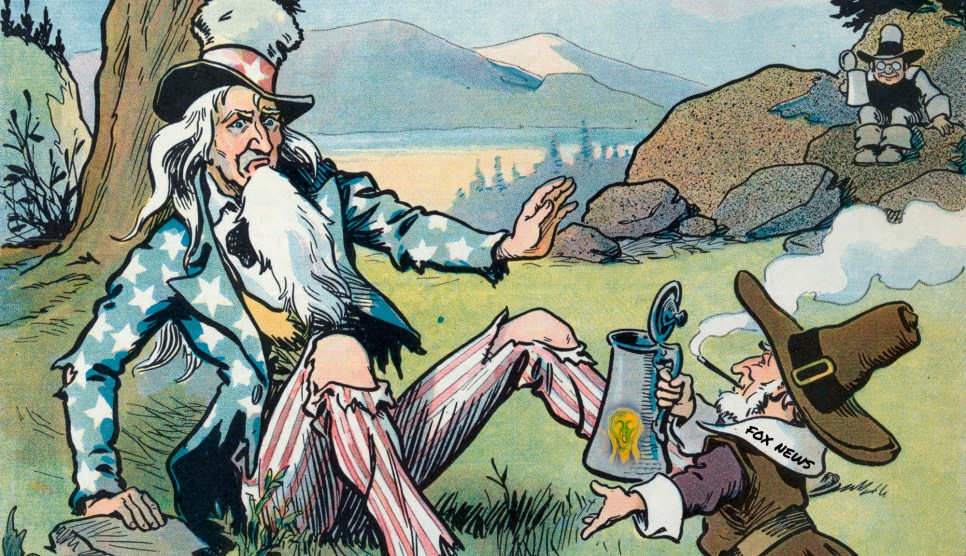
Bob Somerby was watching Fox last night and reports the same thing. And there you have it. It's conservative media that controls the GOP's fate. The Republican Party could almost certainly solve its problem if Fox News and the rest of the gang were on board. They could lighten up on the culture war stuff, thus increasing their appeal among young voters, while keeping the oldsters on board too. Right now, though, they can't do it because the Rush/Drudge/Fox axis will go ballistic, turning the tea partiers into frothing maniacs over every perceived deviation from traditional morality. If they agreed among themselves to stop doing this, the frothing would subside and the party would have a whole lot more short-term maneuvering room to address their long-term problem.

But my friend's email explains why that won't happen. Fox and the others aren't really in business to help Republicans. They're in business to keep the tea party crowd whipped up and ready to invest in the gold coins offered by their advertisers. Outrage is how they do this, and neither facts nor the long-term health of the GOP are allowed to get in the way. Pounding away mendaciously on Shulman's 157 visits might be the kind of overreach that hurts Republicans in the long run, but who cares? The rubes don't read the Washington Post and don't know that the story is bogus, so Fox will keep at it because it's good for business. The tail is now wagging the dog, and the Republican Party is being held hostage to the bottom line of the conservative media.

This is the Republican Party's core problem. Sure, it's always hard for a party to change directions, even moderately, but it's almost impossible when you have organs like Fox News generating froth-at-the-mouth outrage over every deviation from orthodoxy. It makes the short-term risk of change too great to bear. Until the GOP fixes that, they're going to have a hard time fixing anything else.

Blacks and Whites Use Pot At About the Same Rate, But Blacks Get Arrested for Pot Possession a Lot More

| Tue Jun. 4, 2013 9:14 AM PDT

From a report by the ACLU:

In Morgan and Pike Counties, AL, Blacks make up just over 12% and 37% of the population, respectively, but account for 100% of the marijuana possession arrests.

Just a coincidence, I'm sure. But across the country, it turns out, African Americans are arrested for pot possession at far higher rates than whites even though usage rates are about the same. Keith Humphreys points out that this is partly because marijuana laws have been loosened primarily in whiter areas of the country. At a guess, some of this might also be due to the use of possession charges as a plea bargain from more serious charges. Nonetheless, this accounts for only a fraction of the difference. The rest is most likely racially motivated, as the chart on the right makes clear. Black arrest rates are higher than white arrest rates—usually a lot higher—in every single one of the 25 biggest counties in the country.

More here from the ACLU study. The full report is here.

Advertise on MotherJones.com

Using Cash Rewards to Make Partisans Less Partisan

| Tue Jun. 4, 2013 8:37 AM PDT

Ask a Democrat how Obama has done on unemployment, and you'll get a positive answer. Ask a Republican and you'll get a negative answer. Ask them both about George Bush instead and the results will be reversed. Is this because political partisans really and truly see the truth differently? A team of researchers decided to conduct a couple of tests to find out:

In both experiments, all subjects were asked factual questions, but some were given financial incentives to answer correctly. In both experiments, we find that the incentives reduce partisan divergence substantially—on average, by about 55% and 60% across all of the questions for which partisan gaps appear when subjects are not incentivized.

....In our second experiment, we therefore implement a treatment in which subjects were offered incentives both for correct responses and for admitting that they did not know the correct response. We find that partisan gaps are even smaller in this condition—about 80% smaller than for unincentivized responses. This finding suggests that partisan divergence is driven by both expressive behavior and by respondents’ knowledge that they do not actually know the correct answers. These results have important implications for our understanding of public opinion. Most importantly, they call into question the claim that partisan divergence in beliefs about factual questions is ground for concern about voters’ abilities to hold incumbents accountable for their performance. Partisans may disagree in surveys, but we should not take these differences at face value.

In other words, don't take polls like this too seriously. Even partisans mostly know the truth, but when they're asked questions with actual numeric answers they take the opportunity to trash politicians they don't like instead of answering correctly. After all, that's more fun, and there's no payoff for an accurate answer.

This might be true. But I think there's an alternate possibility: partisans are likely to answer a bit more accurately when they're forced to actually think about their answers. The cash reward is just a way of demonstrating that the pollster is serious about wanting accurate answers. But does this mean that partisans really do know the truth, and are therefore better than we think at holding incumbents accountable? I wouldn't make that leap. Campaigns, after all, are precisely the opposite of this test condition: an environment in which partisans are actively encouraged not to think about their answers. And that means they probably don't. During the heat of a campaign, their true beliefs are probably a lot closer to the inaccurate answers they gave when there was no incentive to think hard.

In any case, I wonder who cares? Partisans are the very people least likely to hold anyone accountable in the first place. By definition, they're the ones who just vote by party. A more interesting experiment would test for accurate responses among nonpartisans, the only group that might be likely to abandon cheerleading during a campaign and try to seek out the truth—though I think it's unlikely even in that case.

This is an interesting study (though I'd note that the questions they ask are really hard), but I'm not sure I'd take it too seriously just yet. I doubt that it tells us anything about actual voting behavior.

A Wee Question About Republicans and the DC Circuit Court

| Mon Jun. 3, 2013 10:10 PM PDT

Here's the latest from the New York Times:

President Obama will nominate a slate of three candidates on Tuesday to fill the remaining vacancies on the United States Court of Appeals for the District of Columbia Circuit, a White House official said Monday.

The three candidates are people I've never heard of, but by this time tomorrow the internet will be bursting with people who are instant experts on all three. So no worries on that score. Instead I have a question for the hive mind.

We already know that Republicans are going to oppose all three of Obama's nominees, but not because they're mere obstructionists who are hellbent on preserving a conservative majority on the DC Circuit. Of course not. They're going to oppose them because, based on its caseload, the DC Court is too big and should be pared back by three seats.

Now, the DC Circuit Court was expanded to 12 members back in 1984, so it's been at that number for a long time. Then it got reduced to 11 seats in 2007 by a unanimous vote in the Senate. So here's my question: Following the 2007 vote, are any Republicans on record complaining about the DC Court being too big prior to 2010 or so? It doesn't seem likely, since in 2005 they confirmed Thomas Griffith as the (then) 11th member, and in 2006, after a couple of vacancies had opened up, they confirmed Brett Kavanaugh as the (then) 10th member. So it sure seems as if Republicans thought the court needed more than eight members back when it was George Bush making the nominations.

But who knows? Maybe their arms were twisted and the record shows that most of them, in their heart of hearts, wanted to shrink the DC Circuit even before Obama became president. Can anyone provide any evidence of that?

Are Lousy Jobs Responsible for Economic Recovery?

| Mon Jun. 3, 2013 5:25 PM PDT

Brad Plumer calls this "the most depressing jobs chart in a long time":

Basically, what these charts show is that in countries where the labor market has improved since 2007, average job quality has declined. "The nations that have made the most inroads in reducing their unemployment, such as Germany or Israel, have often done so by adding lots of lower-quality jobs, including part-time gigs and jobs with lower benefits."

I have some doubts about this. The right-hand chart, which is for developing economies, I'd just toss out completely. The correlation is tiny, and a quick eyeball suggests an enormous variance. This is basically just random data.

The chart on the left, which is for advanced economies, looks better, but the position of Spain gave me pause. According to this data, job quality in Spain has gone up enormously since 2007. Up? What definition of job quality are they using? Here it is:

In advanced economies (a) the change in the percentage of temporary employees, (b) the change in social benefits expenditure as share of total public expenditure and (c) the growth in the average hourly wages between 2007 and 2011 were used.

Hmmm. Hourly wages in Spain may have been flat since 2007, but I don't think they've actually gone up. So that means Spain's job quality index has skyrocketed because (a) lots of temp employees have been let go, which means there's now a higher percentage of permanent employees, and (b) social benefits have gone up because the unemployment rate is in the stratosphere.

I dunno. Does that smell like "increased job quality" to you? Me neither. Don't get me wrong: It makes perfect sense that a reduction in job quality might help keep unemployment in check. I'm just not sure this chart demonstrates it. Spain is such an outlier that I'll bet it drives a fair amount of this correlation, and I'm not sure I trust a job quality index that gives Spain such a high score.

I might be missing something here. I'm sure someone will let me know if I am. For now, though, I'm a little skeptical of this.

WGA Officially Declares "Star Trek" Better Written Than "TNG"

| Mon Jun. 3, 2013 2:06 PM PDT

The Writers Guild of America has announced the 101 best written TV shows of all time, and I would like to draw your attention to a small excerpt from the list:

33. Star Trek

79. Star Trek: The Next Generation

This officially gives the lie to Matt Yglesias' absurd contention a couple of weeks ago that TNG was the better-written series. Think about it this way. TNG's most famous line is "Make it so," an expression of pure mush. Star Trek's most famous line is "Beam me up, Scotty," a phrase that no one on the show ever actually said. How many shows are so well written that they become famous for a line that was never even used? Not many.

And don't forget Star Trek's other great lines! "Fascinating." "I'm a doctor, not a bricklayer." "A hundred quatloos on the newcomers." "Live long and prosper." Top that, TNG.