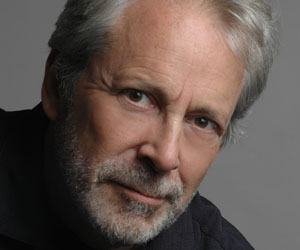
MoJo Interview: Geoffrey Nunberg

The renowned linguist on "torture," "socialism," and why George W. Bush wasn't as inarticulate as you thought.

Fri June 5, 2009 2:50 AM PST

Mere semantics? Hardly. Linguist Geoffrey Nunberg knows words are more powerful than we give them credit for. A professor of linguistics at the University of California-Berkeley, Nunberg has been a regular contributor to the National Public Radio program Fresh Air since 1988, and he is the author of several books—most recently, The Years of Talking Dangerously, a collection of his commentary from the Bush years. We chatted with Nunberg about the panoply of terms for our financial woes, Obama's task of de-nerding the Democratic discourse, and why Twitter might be the best thing that has ever happened to the English language.


story continues below story continued from above

Mother Jones: Credit crisis, credit crunch, depression, recession, slowdown, downturn—why do you think we have so many terms for our current financial situation?

Geoffrey Nunberg: To a large extent, the uncertainty about what to call it has a lot to do with the uncertainty about what it is—and how optimistic or pessimistic you are and what you have done with that 401(k). The word "recession" was originally introduced as a euphemism for "depression." And very quickly those words acquired the connotations they were designed to escape. I'm kind of nostalgic for the days when we just called them "hard times." The new language gives an aura of precision that really isn't justified. In fact, whatever economists tell you, words like "recession" and "depression" are really no more accurate and precise than "bad hair day."

MJ: Have the words become politically polarized? Are some terms are more common among financial pundits on the right or left?

GN: I think both sides have an interest in avoiding the darker language. The Republicans because they started it, and the Democrats because they have to fix it. The thing about words like "depression" is that people fear they are self-actuating. If you call it a depression, whether you're the administration or someone on the financial side, you'll lower confidence.

MJ: Any thoughts on the torture semantics debate?

GN: You find people using these terms like "enhanced interrogation techniques." In one speech Bush used the word "professionals" 26 times—the idea being not only that these people knew what they were doing but also that they weren't taking any pleasure in it. The idea that these pudding-faced American kids who were working in McDonald's a year earlier could be capable of that is very disturbing to a lot of people.

MJ: It seems like the media have really made a decision not to use the word "torture."

GN: With a few exceptions—The New Yorker is one—the American media have almost categorically refused to use what Rumsfeld referred to as "the torture word." From the minute that story broke, though, the European press had no trouble using that word or its equivalent in French and German and Italian. Even Rupert Murdoch's Times. Even though the Fox network wouldn't go near the word. So it was a singularly American refusal to address this as torture. It had partly to do with the ease with which the American media are cowed by pressures from the right. And afraid of being accused of bias.

MJ: How about the right's current fondness for the word "socialism"?

GN: That term was part of the Republican lexicon for years and years. Any time the Democrats proposed any legislation on child labor, social security, the Republicans immediately cried socialism—to the point where in 1952 Harry Truman said that when you hear someone saying "down with socialism," they really mean "down with progress." Within 20 or 30 years, the word "socialism" had pretty much vanished from the lexicon of the right. Bush and Cheney never talked about socialism. So it's a very recent reinvention, and one that came late in the campaign. They went after Obama: "He's a celebrity," "He's elitist," "He's out of touch," and "Oh. By the way, he's a socialist." It may have had to do with the realization that the traditional cultural politics weren't working in this campaign, and the need in some way to turn the discussion to the economic issues in a way that would be favorable to the Republicans. It may also have to do with a kind of psychological state the Republicans are in right now. When a party suffers this kind of defeat, there's a part of it that folds in on itself to lick its wounds and becomes even more strident in its language.

MJ: Do you think the way Obama talks has changed since his campaign days?

GN: He's certainly more careful now than he was, as any president has to be. And he tends to be less rhetorically extravagant than he was during the campaign. He's really going to have to come up with really evocative language. We've had the winter of the nerds, the winter of the wonks. In the last six months people have been so concerned about the economy that terms like "legacy assets" have dominated the discussion. If Obama wants to put over his very ambitious plans of health care, he is going to have to come up with language that is more evocative. It's going to have to be language that not just he can wield, but that the ordinary Democrat that lacks his charisma can deploy, too.

MJ: Did George W. Bush dumb down American political discourse?

GN: I think George Bush was very good at being George Bush. He controlled certain linguistic gestures that worked to his advantage. He used "see" as if he were clueing in people on something they didn't already know. "See, we want freedom." Or "See, the American people want jobs." That was very effective for him. He didn't speak in the complicated, convoluted syntax of John Kerry. That wouldn't have worked for him. But under the right circumstances, he was capable of communicating. I think he got very bad press for linguistic stumbles and malaprops and so on. That shouldn't have counted against him one way or the other as a politician. I don't make a case for being inarticulate. But I also don't know that you should hold it against someone. We tend to look for a level of Churchillian eloquence in our leaders that may or may not make them good leaders. I wouldn't examine the grammar of a CEO before deciding whether to invest in the company's stock.

MJ: If George W. Bush didn't dumb us down, then will Twitter?

GN: It's just silly to imagine that this form of communication could have any effect on language. The English sentence has done very well for itself over the last thousand years or so, and it's not about to autodestruct because kids have suddenly started to text message each other rather than passing notes under their desk. In fact, what we're taught in school—the gospel according to Strunk and White—is to be concise. What imposes more constraints of conciseness than Twitter? So in that sense, Twitter could be the greatest thing that's happened to English since print.

Kiera Butler is an associate editor at Mother Jones.

Get Mother Jones by Email - Free. Like what you're reading? Get the best of MoJo three times a week.
Comments
no profile pic for comment author

Twitter

I thnk u r rng abt Twttr.

no profile pic for comment author

The chimp was just trying to

The chimp was just trying to read what his professional writers gave him, he did not make any of this up extemporaneously, he's a teleprompter moron.

no profile pic for comment author

Who are you calling 'chimp?'

Who are you calling 'chimp,' chump?

no profile pic for comment author

Bush talk pretty one day

"I think he got very bad press for linguistic stumbles and malaprops and so on. That shouldn't have counted against him one way or the other as a politician."

Maybe not as a politician, but when you're president of the U.S. linguistic stumbles can have pretty serious repercussions. Call me crazy, but I don't think it's too much to ask that our president have firm command of the English language. W clearly did not. The idea that he "controlled certain linguistic gestures" is laughable. He was just speaking the only way he knew how.

no profile pic for comment author

W. surely did not have a

W. surely did not have a grasp on language that many (myself included) would have expected in the President. However, I think Nunberg has a point that Bush was using language specifically, within the limits of his ability of course, and no doubt coached by his handlers as well...but still. You can't deny that his very linguistic bumbling didn't endear as many people as it repelled. There are large swaths of population in the US that are alienated by the kind of skillful oration you and I would find confidence in; they find condescending. I do believe Bush was using the image that comes with a lack of book learnin' much to his advantage.

seakat

Twitter a Good Thing?

At best the jury is still out on that one.

As part of my job for a rather large Pacific Northwest University, I write short, instructional memos and emails all the time. If part of my instructions are towards the end of the memo, they often are ignored.

I believe limiting people - especially young people - to 140 characters and spaces is only encouraging them NOT to read.

k.b.

no profile pic for comment author

Articulation is important

". I don't make a case for being inarticulate. But I also don't know that you should hold it against someone. We tend to look for a level of Churchillian eloquence in our leaders that may or may not make them good leaders. I wouldn't examine the grammar of a CEO before deciding whether to invest in the company's stock."

I would. It is important not to dumb down language too much. Vocabulary exists for a reason and that reason is to convey a clear and articulate message. If a CEO does not have enough command of the English language to be able to convey a coherent action plan and mission for his/her company, I would prefer not to invest with that company as it would not seem to have a clear idea of where it is going and therefore would appear to have an uncertain future. The same should be said for the person who holds the office of President of the USA. I want to know that my president has enough of a command of the English language to both comprehend information that is being conveyed to him by advisers, as well as to give articulate and clear orders as to how to respond to a situation. This seems to me to be simple common sense with direct implications for national security. Shame on you for implying that it is OK for the President to dumb down the English language simply because he is a politician.

~Kitty - Just another over educated snob.

no profile pic for comment author

Does eloquence equal intelligence?

It's difficult to consider a man - W - who doesn't display more than a rudimentary grasp of the English language as being intelligent.
But, is there a link or are there spectacularly bright people out there who can't string a sentence together?

no profile pic for comment author

Tell and show

To hold Churchill's oratory as the alternative to W's is a bit of a contrasting reach, as it is to specify the "grammar" of a CEO as opposed to the content of what he is saying. I don't think that the question is one of being articulate so much as making some kind of sense.

no profile pic for comment author

Kiera! You missed a golden

Kiera! You missed a golden opportunity to ask him about Strunk & White's Elements of Style, which has recently come under fire from Nunberg's cobloggers at Language Log.

no profile pic for comment author

Tuidder become Tdr

I'd be more inclined to agree that Twitter is benign if the Twitter generation was more literate to begin with. Does Butler ever *read* blogs and online posts? Talk about the dumbing (or dumming) of America.

no profile pic for comment author

Bush not intelligent

IMO, W is not intelligent, nor well read, nor a creative thinker. He is though a very clever man in the sly sense of the word. Some may call that intelligence. He knew how to manipulate people, and without the backing of his family or money, I don't believe he would have risen above 'average' or even 'below average'. I call intelligent someone who is able to think and reason regardless of education and someone who is always learning about life and others. Even some computer programs 'learn' by input they receive. I believe W left office with the same mindset he came in with.

James M. Martin

Newspeak

The GOPS get their talking points from Frank Luntz, a devotee or Orwellian Newspeak. It is Luntz who turns "torture" into "enchanced interrogation techniques" and like euphemisms. There was a wonderful line in Oliver Stone's W where one of the characters advises against showing the body bags as they return from Iraq because there's nothing like death to turn people off of war. Luntz and the GOP Newspeak team know how to keep Big Brother popular (for a while at least) simply by calling a spade a trowel.

no profile pic for comment author

Twitter's character

Twitter's character allotment would be good disciipline, and could encourage one to come up just the perfect word. Maybe. The English language is so beautiful in its nuances.

no profile pic for comment author

Another spin doctor....

...overdue to have a copy of Webster's lofted in his general direction...I think the real test of the concept/definition of 'torture' is to have people that don't seem to understand the concept, despite apparently elevated levels of education, to actually be personally subjected to some of the treatment we've seen and heard about, first-hand, and see if they can go ahead and nail that concept down for us in 144 characters or less as a result of their newfound direct experience in this area. I don't know how good that would look on the old resume, but I'll bet they could get some think-tank or publication to pay em for writing about it...but, it's been done.
After all, all you REALLY need to do in order to get someone to confess all their worldly sins and all they know is to make em listen to a loop tape of Alberto Gonzales repeating "I can't recall" in that Senate hearing...I think a lot of people tend to agree that some crooked, and if not illegal/crooked, then highly, highly questionable stuff went on under the Bush administration, and one of the reasons that Obama gained office by a landslide was so that someone could bear the 'new broom', and fog all that business out from top to bottom, there. Good riddance to Darth Cheney et. al....and, to sum up, succinctly: "Ya can't polish a toid".

Klaatu marachas necktie

no profile pic for comment author

Submitted by KittyCML

It's difficult to consider a man - W - who doesn't display more than a rudimentary grasp of the English language as being intelligent.
But, is there a link or are there spectacularly bright people out there who can't string a sentence together?

Post a comment
Alternately, you may login to or register an account
The content of this field is kept private and will not be shown publicly.
  • Web page addresses and e-mail addresses turn into links automatically.
  • Allowed HTML tags: <a> <ul> <ol> <li> <blockquote> <img>
  • Lines and paragraphs break automatically.

More information about formatting options


Jail.org - Inmate Search
Criminal records, instant public records & people search & current court records. www.jail.org

U.S. Public Records Search
Search County & State Court Records, Criminal records, Vital and Adoption Records www.PublicRecordsInfo.com

Records.com - People Search
Public Records and Background Checks. Instantly Search Criminal Records, Addresses and Court Records www.Records.com

Court Records & County Records
Find Instant Public Records, Criminal Records as Well as County Property Records Search. www.PublicRecordsIndex.com

Mother Jones Podcast
Get in on the conversation! We talk about culture, politics, the environment, the economy and more. Listen now!

TalkBackTees.com
A treasure trove of liberal wit, wisdom and quotations, from ancient to modern, on colorful, cotton tees.

Support Independent Artists
Amazing art, crafts, apparel, paper-goods and more. A carefully curated selection of sundries since 1999.

FREE CONNECTIONS FOR GREEN SINGLES
Meet progressive singles in the environmental, vegetarian & animal rights community who share your values
