Even Wall Street Thinks Income Inequality Could “Capsize” the Economy


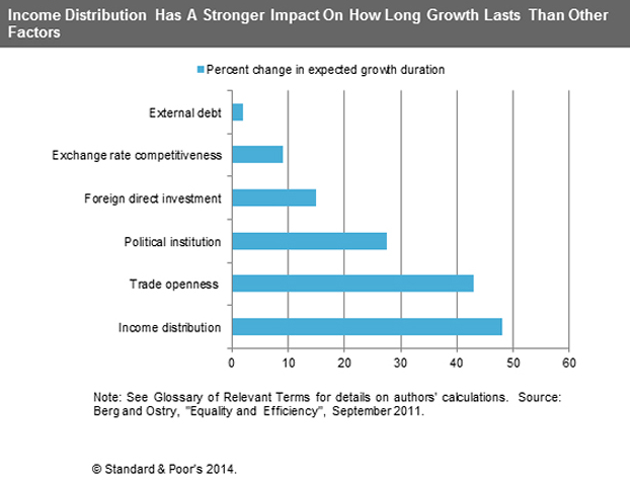
There’s a lot of evidence that record-high income inequality has gutted the United States’ post-recession recovery. But on Tuesday, the argument was made by an unexpected source: Standard & Poor’s (S&P), a Wall Street firm providing ratings and analysis on stocks and bonds, issued a report pointing out economic disparity’s role in “dampening US economic growth.”

Over the next decade, S&P forecasts that the economy will expand at just a 2.5 percent annual rate, a downgrade from the 2.8 percent growth it predicted just five years ago. One explanation: “At extreme levels, income inequality can harm sustained economic growth over long periods. The US is approaching that threshold.”
income distribution

The gap between the richest and poorest Americans has been skyrocketing for decades, with no end in sight. How exactly does this widening wealth gap affect the economy? “Higher levels of income inequality increase political pressures, discouraging trade, investment, and hiring,” the report explains. It leads extremely wealthy households to save more and consume less, while lower-income households must borrow to sustain consumption. “When these imbalances can no longer be sustained, we see a boom/bust cycle such as the one that culminated in the Great Recession.”

S&P warns against drastic changes to the tax code, arguing that “heavy taxation solely to equalize wages may reduce incentives to work or hire more workers…Policymakers should take care, however, to avoid policies and practices that are either too heavy handed or foster an unchecked widening of the wealth gap. Extreme approaches on either side would stunt GDP growth.”

Instead, S&P suggests focusing on education to increase national productivity. According to the report, one additional year of education in the American workforce could increase GDP by $525 billion—about a 2.4 percent boost—over the next five years.

As S&P ominously concludes the report, “A lifeboat carrying a few, surrounded by many treading water, risks capsizing.”

DECEMBER IS MAKE OR BREAK

A full one-third of our annual fundraising comes in this month alone. That’s risky, because a strong December means our newsroom is on the beat and reporting at full strength—but a weak one means budget cuts and hard choices ahead.

The December 31 deadline is closing in fast. To reach our $400,000 goal, we need readers who’ve never given before to join the ranks of MoJo donors. And we need our steadfast supporters to give again—any amount today.

Managing an independent, nonprofit newsroom is staggeringly hard. There’s no cushion in our budget—no backup revenue, no corporate safety net. We can’t afford to fall short, and we can’t rely on corporations or deep-pocketed interests to fund the fierce, investigative journalism Mother Jones exists to do.

That’s why we need you right now. Please chip in to help close the gap.

DECEMBER IS MAKE OR BREAK

A full one-third of our annual fundraising comes in this month alone. That’s risky, because a strong December means our newsroom is on the beat and reporting at full strength—but a weak one means budget cuts and hard choices ahead.

The December 31 deadline is closing in fast. To reach our $400,000 goal, we need readers who’ve never given before to join the ranks of MoJo donors. And we need our steadfast supporters to give again—any amount today.

Managing an independent, nonprofit newsroom is staggeringly hard. There’s no cushion in our budget—no backup revenue, no corporate safety net. We can’t afford to fall short, and we can’t rely on corporations or deep-pocketed interests to fund the fierce, investigative journalism Mother Jones exists to do.

That’s why we need you right now. Please chip in to help close the gap.

We Recommend

Latest

Sign up for our free newsletter

Subscribe to the Mother Jones Daily to have our top stories delivered directly to your inbox.

Get our award-winning magazine

Save big on a full year of investigations, ideas, and insights.

Subscribe

Support our journalism

Help Mother Jones' reporters dig deep with a tax-deductible donation.

Donate