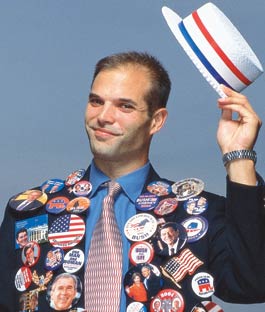
With his mild manners, neat V-neck sweater and dark hair cropped short, Matt Taibbi looks like he’s on a furlough from West Point, which is to say he doesn’t look the way you’d expect a guy to look who’s been hailed as the new Hunter S. Thompson. This, after all, is someone who describes himself as a “dissolute, drug-abusing anarchist who reads the battle diaries of Vietnamese generals on rainy days.”
But read his pieces in the New York Press — where, for example, he recently penned a column gleefully anticipating the pope’s imminent death, which may or may not have gotten his boss fired — or Rolling Stone, or the campaign dispatches collected in his new book, Spanking the Donkey, and you start to get the point. Assigned to cover the 2004 Democratic primary, he quickly found … that there was nothing to cover — just an endless chain of pseudo-events, photo-ops, and vapid pronouncements. So he fell back on his own resources. Oh, and drugs. And so, to take one example, we find Taibbi dropping acid and donning a Viking helmet to interview the Kerry campaign’s communications director.
But there’s a serious core to his schtick, sort of, and that core centers on the insight that modern politics is an empty show removed from the concerns of ordinary Americans and that mainstream journalists either don’t understand this or, existing in a sick symbiosis with the political class, simply choose not to point it out.
Mother Jones recently sat down with Taibbi to learn more about his adventures on the campaign trail and get his impressions on the state of journalism today.
Mother Jones: The idea of reporting on political campaign coverage began with Timothy Crouse’s Boys on the Bus and Hunter S. Thompson’s Fear and Loathing on the Campaign Trail. You’ve now written your own book on the subject. How has that story changed?
Matt Taibbi: I was assigned exactly the same story from exactly the same people [Rolling Stone]. But the difference is that story doesn’t exist anymore. All the other reporters now are so paranoid about being quoted or showing up in an unfavorable light. Everyone assumes they’re going to be on the record somewhere. So there’s no bizarre behavior that goes on. Also I think that there’s definitely a different breed of reporter than what used to exist.
MJ: How so?
MT: My father is a reporter [for NBC], and my whole life I grew up around reporters. When I was a kid, at the time that Boys on the Bus was being written, reporters were rowdy, cynical, wisecracking, foulmouthed, a little bit iconoclastic, and independent thinking. These weren’t necessarily good qualities – but reporters certainly didn’t view themselves as being team players or worrying about the company. It was always “us against the editors.”
Nowadays, when you go around with a big crew of reporters who are following a story like the campaign, they’re all total careerists. Even if they’re straight out of school all they want to do is do a really good job and suck up to the staffers.
MJ: What was the makeup of the bus?
MT: For the most part it’s a lot of Ivy League people. It’s not a real fun-loving crowd. I think the schedule is not what it used to be like in ‘72. I don’t think they did four cities in a day back in ‘72 and there wasn’t a 24-hour news cycle. There were no cable guys who had to file eight times a day and the wire services didn’t have the technology. Now every place you go, as soon as the candidate says anything slightly different than what he said a couple hours ago, they have to go and update everything. The cable people have to go and do a live hit. By the end of the night they’re completely exhausted – just barely enough time to go to sleep to wake up and do it all over again. It’s like a cult. They have no social lives, they’re exhausted they have no time to do anything except file.
MJ: How did you go about writing the book?
MT: I spent time with the Dean and Kerry campaigns, and spent a few weeks on my own in New Hampshire during primary season. The book was originally supposed to be a full-blown campaign trail diary. For a variety of reasons — one of them being I ran out of money — it didn’t work out that way. Also, as I cover in the book, I kind of had a nervous breakdown while I was covering Kerry. I was so freaked out and depressed by the whole thing that I couldn’t do journalism for a while. The project nearly died there.
MJ: What was it about the Kerry campaign that caused such distress?
MT: I had been on the plane for about three weeks of the month I was assigned with him and just couldn’t think of a way to cover it. I couldn’t find an angle that would be interesting, because the whole campaign is so sanitized. They make it impossible for anything new or original to come out of the entire experience. The campaign is cut off from the public, everyone is just repeating their PR lines all of the time. So what I ended up doing, whenever we landed and we went to a campaign event, is I would run a mile away from the event, interview those people and then come back. One of the things about the campaign is that it never goes to a bad neighborhood. Candidates don’t want to be associated with poor people, people who have jobs or are ugly; they want to be associated with a certain middle class demographic, so as a result they leave those others out completely. The whole thing was really depressing. Also, in the book, I got so nuts that I ended up acting out. I dressed up in a Viking costume. I just couldn’t think of anything to do, so I thought, “Why not this?”
MJ: How’d that go over?
MT: It didn’t really work either. I found out at the end of the trip that one of Kerry’s chief of communications guys was the former deputy head of the ONDC (Office of National Drug Policy). This guy actually invented the fried egg commercial. So I had the idea that I would do a lot of acid and interview the guy in a Viking costume and write about it – asking him a lot of leading questions about drugs. So I did a long interview, while on acid, wearing these ridiculous wrap-around sunglasses, saying things like: ‘It’s really terrible about these kids smoking marijuana.’ Rolling Stone cut out the drug part – they didn’t want that in the article. So it came out like I had done it for no apparent reason.
MJ: How did you get started in journalism?
MT: I went to Bard College, but finished school in Leningrad. When I finished I stayed there and started freelancing in St. Petersburg and Uzbekistan. I worked for an English-language paper in Moscow for a while, a typical ex-pat paper. They had a lot of wire service and then straight reporting. I never really wanted to be a journalist and I became really frustrated with it, so I quit and played professional basketball in Mongolia for a while. But then I got sick and had to come back to the states. When I got better I decided I wasn’t going to go back to straight journalism anymore, so I started up this humor paper [the eXile] in Moscow. I was the editor for about 6 years.
MJ: Why so frustrated with journalism?
MT: It started when I was working in that paper in Moscow. I really loved Russia and I thought it was a great place. Unspoiled and different from America in such a great way, it’s so different. Everything in America is so uniform. In Russia everywhere you go is completely insane. In Russia, if you wake up in the morning to go do something you’re supposed to do for your job and end up 100 miles away stone drunk with a bunch of strangers it’s totally OK. In America we’re so efficient. When the Americans came into Russia en masse in the mid 90’s they all had this crusading missionary attitude – like we have to change this place and turn it more into America. We have to take all these dingy old buildings and replace them with our gleaming corporate storefronts. We have to replace all these interesting idiosyncratic people and replace them with middle class managers who all want to buy IKEA furniture and go on vacations in Ibiza. They had a real missionary zeal about it.
And the reporters were worse than everybody. A lot of them didn’t speak Russian too, and that infuriated me. They would hang out with each other. They would go only to Western-style bars, live in their compounds and write all these stories. That the plot of the story was always the same: If this politician spoke English and was pro-American than he was the good guy and whoever the Russian guy was the bad guy. And they were really ruthless about it. I got really upset about it and that’s why I couldn’t write for that paper anymore.
MJ: So how do you feel about being a journalist now?
MT: I’ve got a bit of a case of the existential despair lately. I was having a lot more fun in Russia. In fact, I think I’m only going to be here another year and then I’m going to go back overseas somewhere. I might still do a little bit of reporting, but we’ll see.
I think that if you’re a thinking person you should always be trying to learn something new. Whereas the stage I’m in, most of what I do is I have opinions and I tell people what I think, which is easy but not particularly enlightening. Most publications have a preconceived notion of what they want when they send you on a story. So you go there and find the evidence that you need; it’s not like a voyage of intellectual discovery, it’s really just a fact-finding mission. I’d like to learn something new.
MJ: You recently were the subject of some pretty intense national criticism for your Press column about the Pope. You write columns each week which tend to be inflammatory, so how was this different?
MT:: It was on the cover, which was a significant difference. I found that out only just before it was going to be published. When I wrote it I had no idea that it was going to turn into such big a deal, and frankly it wouldn’t have, had not Matt Drudge put it on his website. If there’s one lesson I got out of the whole thing, it’s that Matt Drudge has incredible power. He puts this thing on his site, and within 3 hours he has two senators, the mayor of New York and a congressman all joining in, jumping on the pig pile. It’s like any time this guy sends something up the flagpole, everyone salutes, and that’s kind of scary. I don’t think anybody else has that kind of ability.
MJ: What do you think that says about journalism, when people like Drudge have so much influence and politicians like Congressman Anthony Wiener told people to get copies of the paper and throw them in the trash?
Taibbi: The thing that I most was upset with was my company’s response to Anthony Weiner. It’s illegal to go around collecting free newspapers and throw them in the trash; even though the paper is free you’re only entitled to one. What Wiener was proposing was interference with commerce, there’s actually a statute in the Rico Law that makes that illegal. We knew it, and you could tell that that was the case because Weiner amended his suggestion about an hour later, clearly because a lawyer talked to him. And I think that it would have really behooved the newspaper to stand up to him and to have threatened a lawsuit or litigate to get people to calm down about that kind of thing. There’s sort of a problem in journalism that there’s a general lack of backbone when it comes to standing behind stories or an unpopular person or anything like that. It’s pretty common for the publishers to cave in, which is what happened in our case.
MJ.com: How do you feel about your boss’s [Editor-in-Chief Jeff Koyen] decision to leave the newspaper?
MT: To be perfectly honest, I think my boss leaving was a somewhat separate issue. I think there were some other issues involved between he and the publishers. But it was definitely uncomfortable for me.
MJ:You’ve been hailed as “the next” Hunter S. Thompson. What do you make of that?
MT: That makes me really unconformable, obviously. Actually that’s come up a little bit with this book. There are parts in the New Hampshire sections where I’m actually in a lot of the same places that Thompson was when he was covering the campaign. I get a lot of grief about being the Hunter S. Thompson wannabe, and that’s what I was trying to avoid in this book. We’re not really the same kind of writer I don’t think.
MJ: When you’re writing are you thinking consciously about “being different” from Thompson?
MT: I thought about his book a lot while I was writing it, because it was a case of someone successfully covering the campaign. He did it and had an interesting take on the whole thing. But the thing is that presidential politics has really changed since then. The emotional center of Thompson’s book was that he was rooting for McGovern. There was this kind of idealistic sense throughout the whole book that was essentially rooting for a political outcome. It was kind of a suspense story to see if his guy could win. That was obviously completely opposite in this campaign. There was no character I could root for. Also, in Thompson’s time world was really black and white. Nixon was the bad guy, and it was the reactionaries vs. the idealists. That landscape is gone now, and what’s wrong with American politics has a lot to more to do with the media and the sort of amorphous, invisible qualities in the presidential election today. It was really difficult for me to find the bad guy in that picture. There wasn’t a clear cut ‘us vs. them’ kind of thing.
MJ: Having covered the campaign, were you surprised at the outcome of the election?
MT: No, I actually won a lot of money. In his book, Thompson obviously was betting money, and kept losing bets, and I bet everyone that I came into contact with that Bush would win. I never had any doubts about that. Although I have to say I was surprised that Kerry won the nomination. He’s definitely not a sunny personality. But he’s not an idiot either, and I’d still much rather have him in office than Bush.